In the shadowy corners of Greek mythology, where abstract concepts take on divine form and the darker aspects of human nature are given personality, dwells Dolos. Who is Dolos, the Greek spirit of trickery? He is the daimon, or personified spirit, of cunning deception, craftiness, treachery, and guile . Unlike the grand Olympian gods who rule from Mount Olympus, Dolos is a lesser deity, a powerful force of nature that represents the very act of deceit itself. His name, simply the Greek word for “trick” or “deceit,” speaks to his essence . He is the embodiment of the clever, often dangerous, intelligence that can be used to mislead, manipulate, and undermine. As an apprentice to the Titan Prometheus and a companion of the Pseudologoi (Lies), Dolos operates at the intersection of creation and falsehood. This article explores the complete mythology of Dolos, from his debated origins and his most famous myth to his role in ancient society and his enduring legacy as the archetypal trickster figure.
The Origins and Genealogy of Dolos
A Matter of Divine Parentage
The origins of Dolos are as elusive and shifting as the deceptions he personifies. Ancient sources offer two distinct, and conflicting, traditions regarding his parentage. This lack of a definitive genealogy reflects his nature as a spirit of ambiguity and suggests that his role as a principle of trickery was more important to the ancient Greeks than a clear-cut place in the divine family tree. The very nature of Dolos as a being of deception makes it fitting that even his origins remain uncertain and subject to multiple interpretations.
According to the Roman author Hyginus in his Fabulae, Dolos was the son of Aether (the bright, upper sky) and Gaia (the Earth) . This lineage places him among the primordial forces of creation, a being born from the very fabric of the cosmos. Aether represents the pure, upper air that the gods breathe, while Gaia is the primordial earth mother, the source of all life. If this tradition is accepted, his siblings would include a host of other personified spirits, such as Dolor (Pain), Ira (Anger), Luctus (Lamentation), and Mendacium (Lies), aligning him with the darker, more troubling aspects of existence . This genealogy suggests that trickery is an inherent part of the natural order, as fundamental as pain, anger, and grief.
In contrast, the Roman statesman and scholar Cicero, in his work De Natura Deorum, provides a different genealogy. He lists Dolos as the child of Erebus (Darkness) and Nyx (Night) . This is a far more common and fitting origin for spirits of deception and treachery. The children of Nyx are among the most feared and powerful forces in the cosmos, including Moros (Doom), Thanatos (Death), Hypnos (Sleep), Nemesis (Retribution), and Eris (Strife) . In this context, Dolos is part of a grim family that represents the inescapable and often negative aspects of human existence. His female counterpart, Apate (Deceit), is also frequently listed among the children of Nyx, making them siblings as well as partners in deception . This genealogy places trickery in the realm of darkness and night, associating it with the hidden, the unseen, and the dangerous.
The Significance of Conflicting Traditions
The existence of these two conflicting genealogies for Dolos is itself a rich source of mythological meaning. It suggests that the Greeks themselves were uncertain about the exact nature and origin of trickery. Was it a fundamental part of creation, as natural as the sky and the earth? Or was it a darker force, born from the shadows and the night? Both interpretations carry weight.
The lineage from Aether and Gaia suggests that trickery is not an aberration but an inherent part of the cosmos. It implies that the universe itself contains the potential for deception, that it is woven into the very fabric of existence. This is a profoundly pessimistic view, suggesting that falsehood is as fundamental as truth. On the other hand, the lineage from Erebus and Nyx suggests that trickery is a force of darkness, something that emerges from the hidden places of the world and the human soul. This interpretation aligns with the many myths where deception is used as a weapon against the forces of order and light.
The very fact that Dolos has multiple, contradictory parentages also reflects his nature as a god of ambiguity. In the world of the spirits and daimones, where abstract concepts were given form, a clear genealogy was less important than the nature of the concept itself. Dolos was the embodiment of deceit, and it is fitting that even his origin story is shrouded in doubt and contradiction. This uncertainty serves as a warning: if even the gods cannot agree on the origins of trickery, how can mortals hope to fully understand or guard against it?
The Myth of Dolos and Prometheus
The Apprentice and the Imperfect Copy
Dolos is not a central figure in the grand, sweeping narratives of Greek mythology, like the Trojan War or the adventures of Heracles. Instead, his most famous appearance is in a single, potent fable that encapsulates his entire nature and function. The story, recorded by the Roman poet Phaedrus, is known as “Prometheus and Guile” and is included in the collections of Aesop’s Fables . This single fable has been the primary source for understanding Dolos throughout the centuries, demonstrating the power of a well-crafted moral tale.
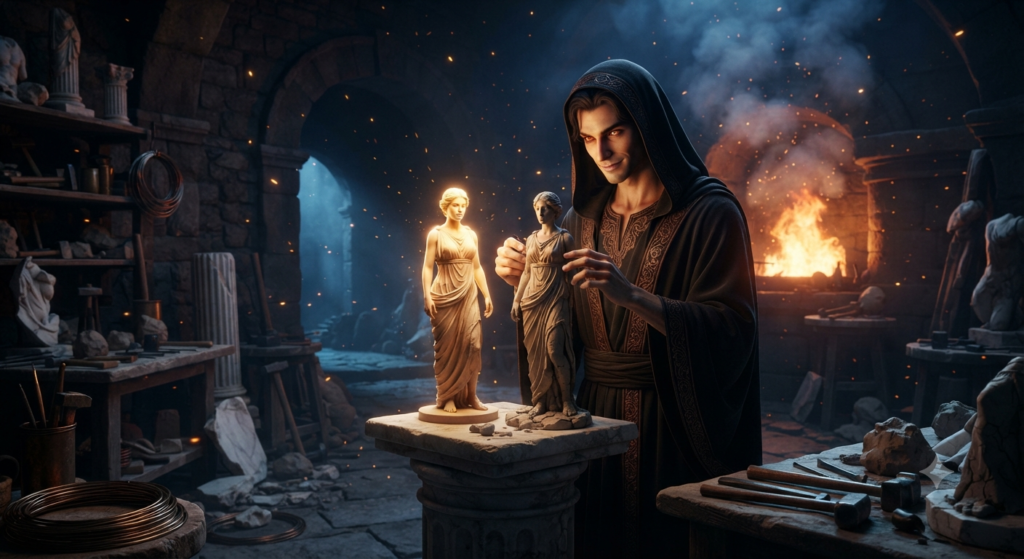
The myth begins with the Titan Prometheus, the divine craftsman who, in some traditions, created humanity from clay. In this fable, Prometheus is a sculptor, and he decides to create a statue of Aletheia, the personification of Truth, to serve as a guide and moral compass for humankind . He puts immense skill and care into his work, fashioning a perfect representation of truth. Prometheus, known for his intelligence and his love for humanity, wanted to give people a tangible representation of the virtue of honesty. The statue was meant to be a constant reminder of the value of truth and the importance of living an honest life.
However, before he can finish, Zeus summons him away, leaving his workshop in the care of his apprentice, Dolos. The timing of this summoning is crucial; it suggests that Zeus may have been testing Dolos, or perhaps that the gods intended for falsehood to come into existence alongside truth. Left alone, Dolos is “fired by ambition” . Seizing the opportunity, he decides to create a copy of Prometheus’s statue, a perfect imitation designed to deceive. This ambition is a key aspect of Dolos’s character; he is not content with being a mere apprentice but seeks to match or even surpass his master’s skill, even if it means creating something dangerous.
He works with “sly fingers,” crafting a figure identical in size and appearance to Aletheia . The task is almost complete when he runs out of clay. The only remaining part to be finished is the feet. This is where the fable’s moral takes shape. As Dolos quakes in fear at the thought of his master’s return, Prometheus arrives. The Titan is amazed by the similarity of the two statues and, seemingly amused or perhaps wanting to claim credit, places both in the kiln. The myth does not specify whether Prometheus is angry or amused; his reaction is left ambiguous, perhaps suggesting that even the wisest of the Titans could be fooled by a clever imitation.
The Birth of Falsehood
After the statues are fired and life is breathed into them, the difference between truth and falsehood becomes immediately apparent. Aletheia can walk with grace and confidence, her feet firmly planted on the ground. The imitation, however, is unable to move; it stands stuck in its tracks, a perfect replica but incapable of forward motion. This unfinished twin, this product of subterfuge, is named either Pseudologos or Mendacius, both words meaning “falsehood” or “lies” . The name Pseudologos is particularly revealing, combining the Greek words for “false” (pseudos) and “speech” (logos), meaning “false speech” or “falsehood.”
The symbolism of this myth is profound and direct. The feet, or lack thereof, represent a fundamental truth about deception: it is without a foundation. A falsehood may appear convincing, even perfect in its imitation of the truth, but it cannot stand on its own. It cannot “walk” forward; it is static, trapped by its own deceit. The fable concludes with the enduring wisdom that, while a lie may have a successful beginning, in time, truth will always prevail . This is a deeply optimistic moral, suggesting that despite the prevalence and cleverness of deception, truth ultimately has the power to endure and to triumph. This aligns with the broader Greek belief that the cosmos is ultimately ordered by justice and that falsehood, however powerful, is ultimately self-defeating.
Deeper Interpretations of the Fable
Beyond the simple moral about truth and lies, the myth of Dolos and Prometheus can be interpreted on multiple levels. It is a story about the nature of creation and the relationship between the creator and the created. Prometheus, the master craftsman, creates something perfect and true. Dolos, the apprentice, creates a copy that is flawed. This can be seen as a commentary on the nature of art and imitation. A perfect copy is still just a copy; it lacks the essential quality of the original. It may look the same, but it cannot function in the same way.
The myth also explores the theme of ambition and the dangers of overreaching. Dolos is driven by a desire to prove himself, to create something that will rival his master’s work. However, his ambition leads him to create something that is fundamentally flawed and ultimately harmful. This is a recurring theme in Greek mythology, from the story of Icarus to the tragedy of Oedipus: those who overreach, who try to exceed their proper place or defy the gods, are punished.
Furthermore, the myth can be read as a commentary on the nature of humanity. Humans, according to this fable, are given both Truth and Falsehood. Aletheia represents the ideal, the virtue that humans should strive for. The nameless, footless statue represents the reality of human nature, which is often prone to deception and self-deception. The myth suggests that while truth is the ideal, falsehood is a constant presence in human life, a temptation that must be resisted. It is a powerful reminder that the potential for deception exists within every person and that only through conscious effort and moral choice can truth prevail.
Dolos’s Role and Relationships
A Spirit Among Spirits
As a daimon, Dolos was not a god who was worshipped or venerated with temples and sacrifices. Instead, he was a personified spirit, a force that was “meant to be felt and experienced” . The daimones represented the various conditions and afflictions of humanity, and Dolos was the embodiment of the potential for trickery that exists within every person . He was a cautionary figure, a reminder of the downfalls of dishonesty. Unlike the Olympian gods, who had distinct personalities and complex mythologies, the daimones were more like forces of nature—impersonal, pervasive, and often dangerous.
In the world of the Greek spirits, Dolos worked in tandem with a cohort of similar beings. His most consistent companion was his female counterpart and sister, Apate, the goddess of deceit . Together, they represent the dual aspect of deception: Dolos as the clever, cunning trick and Apate as the broader concept of fraud. Apate is sometimes considered the female equivalent of Dolos, embodying the same concept but from a different perspective. In some traditions, they are married, representing the union of cunning and deception. He was also a close companion of the Pseudologoi, the spirits of lies . This network of spirits created a powerful force for falsehood in the mortal realm. The presence of these spirits in the world was a constant reminder that deception was not just a human failing but a cosmic force, a part of the divine order that had to be reckoned with.
Dolos, Metis, and the Double-Edged Sword of Cunning
The ancient Greeks had a complex relationship with the concept of trickery. While Dolos and Apate represented its negative, destructive aspects, other deities were associated with a more positive or neutral form of cunning. The most prominent of these is Metis, the goddess of wisdom and crafty counsel, who was also the first wife of Zeus. The distinction between metis (cunning intelligence) and dolos (trickery) is important. Metis represents the cleverness that is used for good, a form of intelligence that allows one to navigate complex situations or overcome obstacles through wit. Dolos, however, is this same intelligence when it is corrupted, when it is used for personal gain or to mislead and harm others . This distinction is subtle but crucial; it is the intent behind the act that separates the wise counsel of Metis from the destructive deception of Dolos.
This dual nature is reflected in ancient literature. The works of Homer, Aeschylus, and Euripides are filled with instances of dolos, where characters achieve victory through guile rather than strength. The most famous example is Odysseus, the “man of many wiles,” who uses cunning and deception to survive and ultimately win the Trojan War. In this context, dolos is not necessarily a negative quality; it is a survival tactic, a tool of the hero. Odysseus’s dolos is seen as a virtue, a sign of his intelligence and resourcefulness. As Aeschylus writes, it was necessary to defeat the Titans through dolos—guile—rather than through force . This suggests that dolos, as embodied by the spirit, is an amoral force; it is the intent of the user and the context of the act that determine whether it is good or evil. This is perhaps the most important lesson from the myth of Dolos: trickery itself is not inherently evil. It is a tool, and like any tool, its moral value is determined by how it is used.
The Legacy of Dolos
The Trickster Archetype
Dolos is the archetypal trickster figure in Greek mythology, representing a universal character type that appears in cultures around the world. The trickster is a complex and often contradictory figure: they can be foolish and wise, destructive and creative, malevolent and benevolent. They use cunning and deception to achieve their goals, often breaking the rules and challenging the established order. Dolos, as the personification of trickery, embodies the essence of the trickster archetype. He is the voice of cunning, the manipulator, the one who uses words and actions to deceive and mislead.
The trickster figure serves several important functions in mythology. They often act as a catalyst for change, disrupting the status quo and forcing other characters to adapt and grow. They can also serve as a cautionary figure, a warning about the dangers of deception and the consequences of failing to see through appearances. The trickster is a reminder that the world is not always what it seems and that wisdom requires not just intelligence but also skepticism and caution. In the figure of Dolos, we see all these aspects of the trickster: the cleverness, the ambition, the willingness to deceive, and the ability to create something new (even if it is flawed). He is a reminder that trickery is a fundamental part of human nature and the cosmos, a force that cannot be ignored or eliminated.
Dolos in Language and Literature
The name of Dolos has left a lasting mark on language and literature. The English words “dole” and “doleful,” though not directly derived from his name, share a thematic connection to the sorrow and misery that deception can cause. More directly, his name is the root of the Greek word dolos, which appears frequently in ancient Greek literature. The use of this word in works like the Iliad and the Odyssey shows how central the concept of trickery was to the Greek worldview. In the Odyssey, for example, the hero Odysseus is described as the master of dolos, a man whose cunning is his greatest weapon.
In modern literature and pop culture, the concept of the trickster is alive and well. Characters like Loki from Norse mythology, the Joker from DC Comics, and countless others are direct descendants of the tradition that Dolos represents. They are the ones who challenge the heroes, question authority, and remind us that the world is not always as straightforward as it seems. The spirit of Dolos lives on in these characters, a testament to the enduring power of the trickster archetype. He is a symbol of the part of human nature that is drawn to deception, manipulation, and the game of appearances.
Frequently Asked Questions About Who is Dolos, the Greek spirit of trickery?
What is Dolos the god of?
Dolos is the Greek spirit (daimon) of trickery, cunning deception, craftiness, treachery, and guile . He personifies the very act of deceit, representing the clever but dangerous manipulation of truth.
What does the name Dolos mean?
The name Dolos (Δόλος) is the ancient Greek word for “trick,” “deceit,” or “guile” . It is a direct description of his nature and function.
Who are the parents of Dolos?
Ancient sources are divided on his parentage. According to Hyginus, he is the son of Aether (Sky) and Gaia (Earth) . However, Cicero states that he is the son of Erebus (Darkness) and Nyx (Night) .
What is the relationship between Dolos and Prometheus?
Dolos is famously the apprentice of the Titan Prometheus . The Titan, a master craftsman, leaves his workshop in Dolos’s care, which leads to the fable where Dolos creates a flawed copy of Prometheus’s statue of Truth.
What is the myth of Dolos and Prometheus?
In the fable, Prometheus creates a statue of Aletheia (Truth). While he is away, his apprentice Dolos creates a perfect copy but runs out of clay before finishing the feet. When both statues are brought to life, Truth can walk, but the imitation (Falsehood) is stuck in place, symbolizing that lies are without a foundation .
Who are the companions of Dolos?
Dolos works closely with his female counterpart, Apate, the goddess of deceit . He is also a companion of the Pseudologoi, the spirits of lies.
What is the Roman equivalent of Dolos?
The Roman equivalent of Dolos is Mendacius, whose name also means “falsehood” or “lies” .
How was Dolos worshipped in ancient Greece?
Dolos was not a god who was widely worshipped or had a formal cult . As a daimon, he was a personified spirit, a force of nature that was experienced and understood through his presence in the world rather than venerated in temples.
What is the difference between Dolos and Metis?
The distinction between metis (cunning intelligence) and dolos (trickery) is important. Metis represents the cleverness that is used for good, a form of intelligence that allows one to navigate complex situations or overcome obstacles through wit. Dolos, however, is this same intelligence when it is corrupted, when it is used for personal gain or to mislead and harm others .
Is Dolos considered a god or a spirit?
Dolos is typically classified as a daimon, a personified spirit, rather than a full Olympian god . Daimones represented abstract concepts and conditions of human experience, and they were felt and experienced in the world rather than worshipped in temples with formal cults.
Conclusion
Who is Dolos, the Greek spirit of trickery? He is a shadowy but essential figure in the Greek mythological cosmos, the personification of one of humanity’s most potent and problematic capabilities. As a daimon, he is not a god of grand narratives but a force of nature, an embodiment of the human condition that was “felt and experienced” . His very existence as a spirit of deception acknowledges that trickery is not merely a human failing but a cosmic principle, a fundamental part of the universe that must be acknowledged and understood. His most famous story, the fable of the flawed copy of Truth, serves as a timeless cautionary tale, revealing the inherent weakness of deception: a lie may be convincing, but it is ultimately without a foundation and cannot endure.
However, to see Dolos only as a figure of pure malice would be a mistake. He is part of a broader Greek understanding of cunning, where dolos is a double-edged sword—a tool that can be used for survival, for noble victory, or for treacherous ends. The legacy of Dolos is not one of reverence but of recognition. He endures as a powerful symbol of the potential for deception that lies within all of us, a reminder that the line between cleverness and deceit is often perilously thin. His story, preserved in a single fable, continues to resonate because it speaks to a universal truth about human nature: we are all capable of deceit, and the choice between truth and falsehood is one that we must make every day. Dolos serves as a cautionary figure, a reminder that the path of deception is a trap, and that while a lie may have a successful beginning, in the end, truth will always prevail.

Orin Vale has spent the better part of two decades tracing the threads that connect the world’s oldest stories — from the halls of Asgard to the banks of the Nile, from Olympus to the jungles of the Maya. What began as a childhood fascination with flood myths and trickster gods grew into years of independent study across comparative mythology and ancient religion, always chasing the same question: what did these stories mean to the people who first told them? Orin writes for readers who want more than trivia — the ones looking for the beliefs, fears, and truths that myths were built to carry.