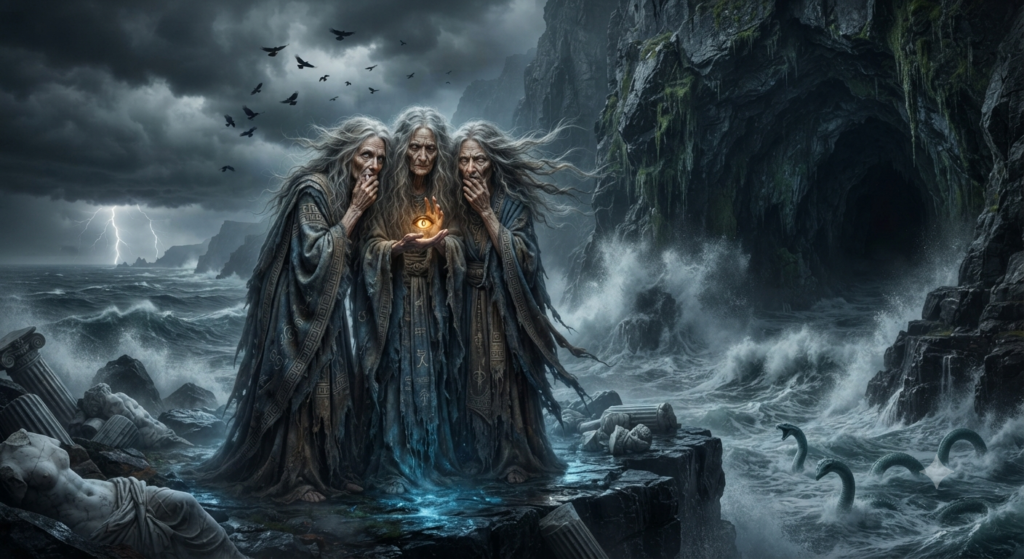
The Graiai, often translated as the “Grey Ones” or “Old Women,” represent one of the most fascinating and enigmatic trios in Greek mythology. Who are the Graiai in Greek mythology? They are three ancient sea-hags, daughters of the primordial sea deities Phorcys and Ceto, who shared a single eye and a single tooth among themselves. These sisters of the Gorgons were grey-haired from birth and played a crucial role in the heroic quest of Perseus, who stole their shared eye to force them to reveal the location of the Gorgon Medusa. Their story, preserved in sources ranging from Hesiod’s Theogony to the works of Aeschylus, offers a unique window into the ancient Greek understanding of old age, prophecy, and the liminal spaces between life and death.
The Graiai embody the concept of collective existence, their shared physical attributes symbolizing a profound interdependence that sets them apart from other mythological figures. Their encounter with Perseus demonstrates how even the most formidable obstacles could be overcome through cunning and determination. This comprehensive guide explores their origins, mythology, family connections, symbolism, and enduring cultural legacy, providing a definitive account of these mysterious figures who guarded the secrets of the Gorgons at the edge of the known world.
Origins and Divine Lineage
Parentage and Family Connections
The Graiai were the daughters of Phorcys and Ceto, two ancient sea deities who personified the dangers and hidden treasures of the ocean . Phorcys represented the hidden dangers of the sea, while Ceto embodied the monsters and creatures that lurked beneath the waves. This lineage placed the Graiai within a prominent family of primordial beings known as the Phorcydes, a group that included some of the most fearsome creatures in Greek mythology .
Their most famous siblings were the Gorgons—Sthenno, Euryale, and Medusa—whose terrifying visages could turn mortals to stone . This family connection establishes the Graiai as guardians of a sort, positioned between the mortal world and the monstrous realm of their sisters. Some traditions also linked them to the Hesperides, the nymphs of the evening, further extending their sphere of influence to the western edges of the world .
The Name and Its Meaning
The name “Graiai” derives from the ancient Greek word “graia,” meaning “old woman,” which itself traces back to the Proto-Indo-European root ǵerh₂-/ǵreh₂-, meaning “to grow old” . This etymology directly reflects their most distinctive characteristic: they were born with grey hair, never experiencing youth or the gradual aging that mortals endure . The English translations of their name—”Grey Ones,” “Old Women,” or “Grey Witches”—capture different aspects of their nature, emphasizing both their age and their supernatural qualities .
Their alternative name, the Phorcydes, simply means “daughters of Phorcys,” connecting them to their father and the broader family of sea deities . This patronymic emphasizes their origins in the primordial world of the sea, before the Olympian gods established their rule.
Mythological Role and the Quest of Perseus
Guardians of Secret Knowledge
The Graiai served as guardians of hidden knowledge, specifically the location of their Gorgon sisters. In the myth of Perseus, the hero was tasked with retrieving the head of Medusa, a seemingly impossible mission that required him to find the Gorgons’ secret dwelling place. Only the Graiai knew this location, and they guarded the information jealously .
When Perseus sought them out, he found them in a cave beneath the Atlas Mountains, according to some sources . The hero observed that the three sisters shared a single eye and a single tooth, passing them back and forth as needed. In a moment of cunning, Perseus waited until one sister was passing the eye to another and snatched it, along with the tooth, plunging the sisters into blindness and helplessness .
The Ransom of Sight
With their shared eye in his possession, Perseus held the Graiai hostage. They could not see without the eye, and they could not eat without the tooth. Desperate to regain their sight, they agreed to reveal the location of the Gorgons and, in some versions of the myth, also directed Perseus to the nymphs who could provide him with the winged sandals, the helm of invisibility, and the kibisis (a special bag) he needed to complete his quest .
The encounter demonstrates a classic pattern in Greek heroic myth: the hero’s triumph over seemingly invincible opponents through cleverness rather than brute strength. Perseus did not defeat the Graiai in combat; he outwitted them, exploiting the fundamental weakness of their collective existence .
The Fate of the Graiai
After obtaining the information he needed, Perseus returned the eye and tooth to the sisters. Some versions of the myth suggest that he threw the eye into a lake, leaving them permanently blind, but the more common tradition holds that he returned their possessions, allowing them to resume their eternal vigil . Unlike many figures in Greek mythology who meet violent ends, the Graiai were immortal goddesses who continued their existence, forever guarding whatever secrets remained at the edge of the world.
Appearance and Physical Description
The Form of Ancient Hags
The Graiai were typically depicted as old women, their grey hair serving as the defining physical characteristic. Hesiod, in his Theogony, describes them as “fair-cheeked,” suggesting that despite their age, they retained a certain beauty or nobility of appearance . This detail may reflect the paradox of their existence: they were ancient beyond measure, yet they were immortal and ageless in the sense that they did not experience physical decline beyond their grey hair.
Their age was so profound that a human childhood for them was inconceivable; they simply existed as ancient beings from the moment of their birth . This quality aligns them with other primordial figures who existed before the establishment of the Olympian order.
Swan-Shaped Monsters
A fascinating alternative description of the Graiai appears in Aeschylus’s lost play Phorcydes, where they are depicted as having the bodies of swans with the heads and arms of old women . The scholiast on Aeschylus confirms that they were considered “swan-shaped” (κυκνόμορφοι), a representation that has puzzled scholars and inspired diverse interpretations .
This avian form may be connected to their marine origins, as swans were associated with water and were sometimes thought to inhabit the same liminal spaces between land and sea where the Graiai dwelt. Some scholars have suggested that the swan imagery reflects the white foam of the sea, linking the Graiai to their maritime parentage and the white-capped waves that crashed against the rocks . The swan form may also connect them to prophecy and the mysterious realm of knowledge they guarded.
The Three Sisters and Their Names
Variations in the Tradition
The number of the Graiai varies across different sources. Hesiod, the earliest surviving authority, mentions only two: Pemphredo and Enyo . However, Apollodorus and Aeschylus both speak of three, adding Deino as the third sister . Hyginus, a Roman author, lists Pemphredo, Enyo, and Persis, while noting that “for this last others say Dino” . This variation suggests that the tradition was not fixed, and different communities may have emphasized different aspects of their story.
The Meaning of Their Names
Each of the names carries significant meaning that reflects the nature of the Graiai and their role in mythology:
Pemphredo (Πεμφρηδώ), meaning “alarm” or “she who guides the way,” was named for her role in the story of Perseus. Her name suggests both the fear she inspired and the guidance she was forced to provide . She is described as “well-clad” in Hesiod’s account, perhaps indicating a certain dignity or status among the sisters .
Enyo (Ἐνυώ), meaning “horror” or “the waster of cities,” was the sister who personified the dreadful aspects of war and destruction. Her name connects her to the broader mythological figure of Enyo, a separate goddess of war, suggesting that the Graiai shared aspects of multiple divine personalities . Hesiod describes her as “saffron-robed,” a detail that may indicate her association with the dawn or with the ritual clothing of priestesses .
Deino (Δεινώ), meaning “dread” or “the dreadful anticipation of horror,” represents the fear that precedes terrible events. Apollodorus lists her as the third sister, emphasizing the terrible nature of the Graiai’s existence . Her name complements Enyo’s, creating a spectrum of terror that ranges from anticipation to manifestation.
Persis (Περσίς), mentioned by Hyginus as an alternative to Deino, means “the destroyer,” further emphasizing the dangerous nature of these ancient beings .
Symbols and Meaning
The Shared Eye
The single eye shared by the Graiai represents the most compelling symbol associated with these figures. On one level, it reflects the ancient Greek understanding of collective vision and shared knowledge. The eye, as the organ of sight, represented perception and understanding. By sharing a single eye, the Graiai existed in a state of perpetual interdependence, unable to function independently of one another .
This symbol has been interpreted in various ways by scholars. Some have suggested that the single eye may allude to the “evil eye” or the power of vision to bring harm, connecting the Graiai to the broader realm of supernatural beings who could influence mortals through their gaze . Others have seen in the shared eye a representation of the collective wisdom of old age, which can only be accessed through community and shared experience.
The Shared Tooth
The single tooth, shared in the same manner as the eye, represents the collective consumption and the shared existence of the sisters. Without the tooth, they could not eat, tying their physical survival directly to their cooperation. The tooth may also symbolize the power of speech or the ability to bite through obstacles, both of which the Graiai exercised in their interactions with Perseus .
In the myth, the theft of both eye and tooth renders the sisters completely helpless—they cannot see, and they cannot eat. This double deprivation demonstrates the completeness of Perseus’s victory and the total dependence of the Graiai on their shared resources.
Marine Symbolism
The Graiai, as daughters of Phorcys and Ceto, participated in the broader marine symbolism of Greek mythology. They were often associated with the white foam of the sea, a phenomenon that occurs at the boundary between water and air, between the known world of the shore and the unknown depths of the ocean . This association positions them as liminal figures, existing at the threshold between different realms.
Some scholars have interpreted the Gorgons and Graiai as personifications of sea terrors, with the Gorgons representing the destructive power of the open sea and the Graiai representing the white-crested waves that dash against the rocks of the coast . This interpretation emphasizes their role as guardians of the boundary between the mortal world and the realm of monsters.
Ancient Sources and Literary References
Hesiod’s Theogony
The earliest surviving reference to the Graiai appears in Hesiod’s Theogony, composed in the 7th or 8th century BCE. Hesiod writes:
“And again, Ceto bore to Phorcys the fair-cheeked Graiae, sisters grey from their birth: and both deathless gods and men who walk on earth call them Graiae, Pemphredo well-clad, and saffron-robed Enyo, and the Gorgons who dwell beyond glorious Ocean…”
This passage establishes the Graiai as primordial beings, born with grey hair and dwelling at the edges of the known world. Hesiod’s mention of only two Graiai (Pemphredo and Enyo) reflects the earlier tradition, before the third sister was added .
Aeschylus’s Phorcydes
Aeschylus, the great Athenian tragedian of the 5th century BCE, wrote a play entitled Phorcydes as part of a trilogy on the life of Perseus. While the play is now lost, fragments and descriptions survive, providing evidence that the Graiai formed a chorus in the drama. According to these sources, Aeschylus described the Graiai as swan-shaped monsters with the heads and arms of old women, a depiction that may have been used to create a memorable and unsettling spectacle on the stage .
The scholiast on Aeschylus provides crucial details about the Graiai’s shared eye and tooth, confirming that this distinctive characteristic was well-established by the 5th century BCE .
Apollodorus’s Library
Apollodorus’s Library, a compendium of Greek mythology from the 1st or 2nd century CE, provides a comprehensive account of the Graiai story. He lists three sisters (Deino, Enyo, and Pemphredo) and describes how Perseus stole their eye and tooth to compel them to reveal the Gorgons’ location . This version became the standard account for later writers and established the three-sister tradition that persists in modern retellings.
Hyginus’s Fabulae
The Roman author Hyginus, writing in the 1st century BCE, included the Graiai in his Fabulae, a collection of mythological stories. He mentions Pemphredo and Enyo and adds Persis as the third sister, though he notes that others called her Dino (Deino) . Hyginus’s work helped transmit the Greek tradition to Roman audiences and preserved aspects of the myth that might otherwise have been lost.
Artistic Representations
Ancient Greek Art
The Graiai appear in ancient Greek vase painting, though not as frequently as some other mythological figures. The scene of Perseus stealing the eye from the sisters was a popular subject, especially on Attic vases from the 5th century BCE. In these depictions, the Graiai are shown as old women, sometimes with the distinctive grey hair that marked their age, and the eye is often depicted as a prominent object passed between them .
The swan-form described by Aeschylus is less commonly depicted, suggesting that this version of their appearance may have been more popular in literature than in visual art. When the swan imagery does appear, it serves to emphasize the otherworldly and liminal nature of these figures.
Burne-Jones’s Perseus Series
The Pre-Raphaelite painter Edward Burne-Jones created a celebrated series of paintings depicting the story of Perseus, including a canvas titled “Perseus and the Graiae” . Created around 1877-1880, this painting shows the hero approaching the three sisters in a barren landscape that Burne-Jones described as “greyland – a gleaming rosy light only.” The composition captures the tension and drama of the encounter, with the sisters shown as elderly figures in a stylized setting.
Burne-Jones’s depiction includes a Latin inscription provided by the classicist Richard Jebb, which translates as: “Pallas Athene with her urging spurred Perseus to action and equipped him with arms. The blind sisters of the Gorgons revealed to him the remote home of the nymphs” . This inscription demonstrates the continued cultural significance of the Graiai in the 19th century and their enduring place in the Western artistic tradition.
Cultural Influence and Modern Relevance
The Symbol of Collective Existence
The Graiai’s shared eye and tooth have made them a powerful symbol of collective existence and interdependence. Their story reminds us that strength can be found in community, but also that such collective arrangements can be fragile when external forces exploit their shared resources. The myth has been interpreted as a cautionary tale about the dangers of dependency and the vulnerability that comes with sharing essential resources.
Influence on Later Literature
The Graiai have influenced numerous later works of literature, from medieval bestiaries to modern fantasy novels. Their image of sharing a single eye has been adapted in various contexts, often as a metaphor for limited perspective or collective vision. The sisters’ role as guardians of secret knowledge places them within the broader tradition of prophetic and oracular figures who control access to hidden wisdom.
Modern Adaptations
The Graiai continue to appear in modern popular culture, most notably in the Percy Jackson series by Rick Riordan, where they are depicted as the “Gray Sisters” who operate a taxi service in New York City . In this modern adaptation, the sisters retain their shared eye and tooth, and the protagonist, Percy Jackson, repeats Perseus’s trick of stealing the eye to force them to reveal information. This retelling demonstrates the enduring appeal of the myth and its ability to be adapted to new settings while preserving its essential elements.
The Riordan version also connects the Graiai to the Fates, another trio of mythological sisters who controlled mortal destiny. While the Graiai and the Fates are distinct figures in ancient mythology, their shared triadic structure and their connection to knowledge and fate make them natural companions in modern retellings .
Feminist Readings
Modern feminist scholarship has interpreted the Graiai as symbols of female power and agency, albeit in a distorted and monstrous form. As women who exist outside the normal structures of society, the Graiai represent the dangers and powers of female community, particularly in the context of old age. Their shared eye and tooth have been read as metaphors for the wisdom and sustenance that women provide to one another in patriarchal societies.
Legacy and Historical Significance
The Role of the Graiai in Greek Religious Thought
The Graiai occupied a unique position in Greek religious thought. As immortal beings who dwelled at the edge of the world, they represented the boundaries of human knowledge and the limits of mortal understanding. Their role as guardians of the Gorgons’ location placed them at the threshold of the monstrous, between the known world of Greek civilization and the terrifying wilderness beyond.
Their association with old age and grey hair connected them to the wisdom that comes with experience, but their monstrous aspects suggested that such wisdom could be dangerous and alien. The Graiai embodied the ambivalence of ancient Greek attitudes toward aging, particularly female aging, which could be seen as both a source of wisdom and a threat to social order.
The Perseus Connection
The Graiai’s most significant contribution to Greek mythology is their role in the Perseus story. Without the information they provided, Perseus could not have found Medusa or completed his quest. The Graiai thus function as the gatekeepers of heroic achievement, the figures who control access to the knowledge necessary for success. This role positions them within a broader pattern of Greek myths in which heroes must pass through trials of wisdom and cunning before they can achieve their goals.
Frequently Asked Questions About Who are the Graiai in Greek mythology?
Who are the Graiai in Greek mythology and what do they represent?
The Graiai are three ancient sea-hags, daughters of Phorcys and Ceto, who shared a single eye and tooth among them. They represent old age, collective existence, and the guardianship of hidden knowledge. Their name means “Grey Ones” or “Old Women,” reflecting their birth with grey hair .
What are the names of the three Graiai?
The three Graiai are named Deino (meaning “dread”), Enyo (meaning “horror” or “warlike”), and Pemphredo (meaning “alarm” or “she who guides the way”). Some sources list Persis as an alternative to Deino, and Hesiod’s earlier tradition mentions only two sisters .
Why did the Graiai share one eye and one tooth?
The shared eye and tooth symbolize the collective nature of their existence and their interdependence. They took turns using these essential organs, and their dependence on each other made them vulnerable to Perseus’s trick. The theft of the eye and tooth rendered them blind and unable to eat .
How did Perseus defeat the Graiai?
Perseus waited until the Graiai were passing their single eye from one sister to another and snatched it, along with the tooth. He then held these items hostage, refusing to return them until the sisters revealed the location of the Gorgons. This demonstrated his cleverness rather than brute strength .
Were the Graiai related to the Gorgons?
Yes, the Graiai were sisters to the Gorgons (Sthenno, Euryale, and Medusa). Both groups were daughters of Phorcys and Ceto, making them part of the same monstrous family known as the Phorcydes .
What did the Graiai look like?
The Graiai were typically depicted as old women with grey hair from birth. However, Aeschylus described them as swan-shaped monsters with the heads and arms of old women and the bodies of swans. This unusual depiction connects them to both the sea and the realm of prophecy .
What is the significance of the Graiai in Greek mythology?
The Graiai serve as guardians of secret knowledge, controlling access to information about the Gorgons and the location of Medusa. They represent the boundaries of mortal knowledge and the dangers of seeking hidden wisdom. Their story also explores themes of collective existence and interdependence .
Where can the Graiai be found in modern culture?
The Graiai appear in modern literature such as Rick Riordan’s Percy Jackson series, where they are depicted as the “Gray Sisters” who operate a taxi service. They also feature in art, including Edward Burne-Jones’s painting “Perseus and the Graiae,” and continue to appear in adaptations of the Perseus myth .
Conclusion
The Graiai stand as one of the most distinctive and memorable trios in Greek mythology. Their shared eye and tooth, their grey hair from birth, and their role in the quest of Perseus have secured their place in the mythological imagination for millennia. Who are the Graiai in Greek mythology? They are the embodiment of collective existence, the guardians of hidden knowledge, and the threshold figures who control access to the monstrous world of the Gorgons.
Their story reflects fundamental themes in Greek thought: the power of cleverness over brute force, the dangers of dependency, and the ambivalent nature of wisdom acquired through age. As sisters of the Gorgons and daughters of the primordial sea, they represent the boundaries of the known world, the limits of human understanding, and the challenges that heroes must overcome.
The enduring fascination with the Graiai speaks to the power of their symbolism and the depth of their mythological significance. They remind us that knowledge is often guarded and that accessing it requires courage and cunning. They also remind us that even the most ancient and formidable beings can be overcome through cleverness and determination. In a world that often values individual achievement, the Graiai stand as a testament to the power of collective existence—and the vulnerability that such interdependence can create.

Orin Vale has spent the better part of two decades tracing the threads that connect the world’s oldest stories — from the halls of Asgard to the banks of the Nile, from Olympus to the jungles of the Maya. What began as a childhood fascination with flood myths and trickster gods grew into years of independent study across comparative mythology and ancient religion, always chasing the same question: what did these stories mean to the people who first told them? Orin writes for readers who want more than trivia — the ones looking for the beliefs, fears, and truths that myths were built to carry.