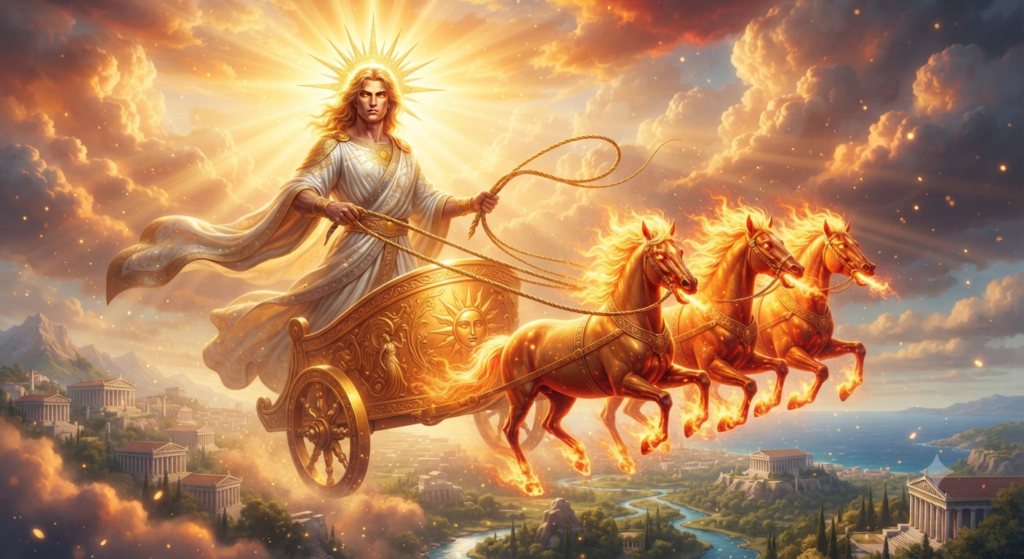
Helios, the radiant Titan god of the sun, stands as one of the most vital and visually spectacular figures in the ancient Greek pantheon. Who is Helios in Greek mythology? He is the personification of the sun itself, a powerful deity who daily drove his golden chariot across the sky, bringing light and warmth to the world. As the all-seeing god who witnessed everything beneath his blazing rays, Helios played a crucial role in numerous myths, from revealing the secrets of the gods to punishing mortals who dared to harm his sacred flocks. His influence was not merely celestial; he was a guardian of oaths, a bestower of sight, and a central figure in the religious life of the island of Rhodes, where the famous Colossus stood as a testament to his might. This guide provides a definitive account of Helios, exploring his origins, powers, family, myths, worship, and enduring legacy.
Origins and Divine Lineage
The Titan Son of Hyperion and Theia
Helios was born into the generation of gods known as the Titans, the powerful and primordial deities who ruled the cosmos before the Olympians . He was the son of Hyperion, the god of heavenly light and wisdom, and Theia, the goddess of sight and the shining blue of the sky . This parentage made him a brother to two other celestial deities: Selene, the goddess of the moon, and Eos, the goddess of the dawn . Together, they formed a divine family that governed the cycle of day and night, with Eos announcing the coming of her brother each morning.
In some traditions, his mother is given as Euryphaessa, a name that also means “wide-shining,” further emphasizing the family’s association with light . Homer often refers to Helios by the patronymic “Hyperion,” a common practice in epic poetry that highlights his heritage .
The Rise of the Olympians
As a Titan, Helios belonged to the older order of gods who were eventually overthrown by Zeus and his Olympian siblings. However, unlike many of his kin who were imprisoned in Tartarus, Helios managed to retain his prominent position. He wisely did not fight against the Olympians and instead continued his essential duty of driving the sun across the sky. In later tradition, he was sometimes described as having a palace in the east, but he always remained a distinct and important figure, eventually coming to be viewed as an ally of Zeus . His continued free rein was a practical necessity for the new regime, for the sun was too essential to be left without a master.
The Sun God’s Daily Journey
The Chariot and the Golden Cup
The most defining attribute of Helios was his daily journey across the heavens. He was imagined as a handsome, beardless man, crowned with a radiant aureole of sunbeams, who drove a magnificent chariot pulled by four powerful, fire-breathing steeds . These horses, often described as winged and white, were given fiery names in later works: Pyrois, Aeos, Aethon, and Phlegon, which translate to “the Fiery One,” “He of the Dawn,” “the Blazing,” and “the Burning” .
Each morning, he would emerge from the east, rising from the river Oceanus, the great world-encircling stream. He would drive his chariot across the vault of heaven, reaching his highest point at noon, and then descend in the west, arriving at the land of the Hesperides as evening fell . To return to his rising place in the east, Helios did not travel back across the sky. Instead, he would board a giant, golden cup or bowl, a marvel crafted by the smith-god Hephaestus. In this boat, he would sail around the northern streams of Oceanus, passing through the underworld, to arrive back in the east before dawn . This nightly voyage was a testament to his unique and indispensable role.
The All-Seeing One
Because of his position high in the sky, Helios was known as “Panoptes,” the “all-seeing” one . He was believed to witness every event that took place on earth, making him a powerful witness to oaths and secrets. This divine omniscience made him a key figure in several myths. He was the one who revealed to Hephaestus the affair between his wife, Aphrodite, and the god of war, Ares . He also told Demeter that her daughter, Persephone, had been abducted by Hades with the permission of Zeus . This ability to see all made him an invaluable source of truth, as well as a figure to be respected and feared.
Major Myths and Adventures
The Fall of Phaethon
The most famous myth involving Helios is the tragic story of his mortal son, Phaethon. The youth, born to Helios and Clymene, was mocked by his peers for claiming to be the son of a god . To prove his divine parentage, Phaethon traveled to his father’s palace in the east and begged for a sign. Helios swore by the river Styx to grant his son any wish. Phaethon’s request was to drive his father’s sun-chariot for a single day .
Helios was horrified, knowing that even the gods themselves could not control the blazing chariot and its fiery horses. He begged the boy to reconsider, warning of the dangerous path and the powerful steeds, but Phaethon would not be dissuaded. Bound by his oath, Helios reluctantly allowed his son to take the reins . As predicted, Phaethon was unable to control the horses. The chariot veered wildly off course, plunging too close to the earth, scorching the land, drying up rivers, and turning the people of Africa black . To prevent the entire world from being consumed by fire, Zeus was forced to intervene, striking the chariot with a thunderbolt and killing Phaethon, who fell to his death into the river Eridanus . The grief of Helios was immense, and his daughters, the Heliades, wept so much for their brother that they were transformed into poplar trees, and their tears became golden amber .
The Cattle of the Sun
In Homer’s Odyssey, Helios plays a crucial role as a figure whose wrath is not to be trifled with. He owned a magnificent herd of seven flocks of sheep and seven herds of cattle on the island of Thrinacia. These were immortal creatures, sacred to the god, and they were tended by his two nymph daughters, Phaethusa and Lampetia . When Odysseus and his men landed on the island, the prophet Tiresias warned them not to harm the cattle of Helios, if they wished to return home .
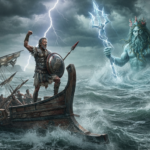
Driven by starvation during a long storm, Odysseus’s men disobeyed and slaughtered several of the sacred cattle while he was asleep. They feasted, but the omens were bad: the hides crawled and the meat bellowed on the spits . Lampetia immediately informed her father of the sacrilege. In a fury, Helios went to Zeus and demanded revenge, threatening to take the sun down to the Underworld and shine it upon the dead if he was not avenged . Zeus responded by sending a thunderstorm that destroyed the ship as soon as it put to sea, killing all of Odysseus’s men and leaving only the hero himself clinging to the wreckage . This story reinforces Helios’s power and the absolute sanctity of his sacred property.
The Golden Cup and Heracles
In a more positive myth, Helios demonstrates a capacity for generosity. During his quest for the cattle of Geryon, Heracles (Hercules) was traveling through the Libyan desert and was becoming unbearably hot. In frustration, he drew his bow and threatened to shoot an arrow at the sun god . Instead of retaliating, Helios, who admired the hero’s boldness, gave Heracles a gift: a golden cup in which he could sail across the sea . This cup was the very same vessel Helios used for his own nightly journey on the Oceanus. Heracles used it to sail to Erytheia to steal the cattle, showcasing a rare moment of cooperation between the Titan and an Olympian hero .
Family and Relationships
His Consorts and Offspring
Helios had a numerous and powerful progeny, born from his relationships with both goddesses and mortal women . With the Oceanid nymph Perseis, he fathered a formidable and magical family: the sorceress Circe, the witch-queen Pasiphaë, and the king Aeëtes of Colchis, who possessed the Golden Fleece . This magical lineage established Helios as an ancestor of some of the most complex and powerful figures in Greek myth.
His most famous mortal son was Phaethon, whose mother was Clymene. He was also the father of the Heliadae and Heliades with the nymph Rhode, the eponymous nymph of the island of Rhodes, cementing his role as the ancestral god of that island . Other children include Augeas, a king of Elis, whose stables were one of Heracles’s labors, and various other kings and heroes. This extensive family tree highlights his deep integration into the fabric of Greek mythology and the royal genealogies of the ancient world.
Worship and Religious Importance
The Cult of Helios
While Helios was a universal presence, his formal worship was not as widespread in mainland Greece as that of some other Olympians . He was honored in several sanctuaries across the Peloponnese, including Corinth, Troezen, and Elis, where white horses were sometimes sacrificed in his honor . However, the principal center of his worship was undoubtedly the island of Rhodes .
In Rhodes, Helios was the supreme god, the patron deity to whom the island belonged. The Rhodian tradition claimed that when the island rose from the sea, Helios claimed it as his own and fathered the Heliadae, the first rulers of the island . The Rhodians celebrated him with grand festivals, including the Halieia, a major athletic and musical competition held every five years in his honor . The island was also famous for its annual ritual of sacrificing a chariot and four horses by throwing them into the sea as an offering to Helios .
The Colossus of Rhodes
The pinnacle of Helios’s worship in Rhodes was the famous Colossus of Rhodes, one of the Seven Wonders of the Ancient World. This massive bronze statue of the god was erected between 304 and 280 BCE to commemorate the successful defense of the city against a siege . Towering over the harbor at a height of approximately 33 meters (over 100 feet), it was a breathtaking representation of the sun god . The statue stood for only a few decades before it was toppled by an earthquake in 228 or 226 BCE. Even in its ruined state, it remained a tourist attraction for centuries. The Colossus stands as a monumental testament to the importance of Helios in the ancient world and the gratitude of the Rhodians to their patron deity .
Helios and Apollo: The Sun God’s Identity Shift
Original Distinction
In the earliest Greek literature, Helios and Apollo were two entirely distinct gods. Helios was the sun itself, a powerful but often remote Titan who performed a mechanical daily duty. Apollo, on the other hand, was an Olympian god of music, prophecy, healing, and plague, with no connection to the sun .
The Syncretism of the Classical and Hellenistic Periods
Starting in the 5th century BCE, a gradual process of identification began. Greek philosophers began to equate the two deities, seeing the sun as a symbol of Apollo’s radiant purity and prophetic power. Apollo’s epithet “Phoebus,” meaning “shining,” helped facilitate this connection. By the Hellenistic period, the two were often treated as one and the same, or at least as two aspects of a single divine entity . The idea was popularized in literature, and eventually even some cults reflected the syncretism.
Despite this identification, it is important to note that it was never complete. The Greeks never depicted Apollo as actually driving the sun-chariot . That role, the core function of Helios, remained uniquely his. The Romans, however, fully embraced the equation, and the sun god, known as Sol, became an important part of their state religion, culminating in the imperial cult of Sol Invictus. This syncretism often leads to confusion, but it is vital to remember that in their original and distinct forms, Helios was the sun, and Apollo was not .
Symbols and Artistic Representations
Attributes and Iconography
Helios’s artistic representations are rich with solar symbolism. He is consistently depicted as a handsome, beardless, and youthful man. His most characteristic attribute is the radiant crown or aureole of sunbeams, which encircles his head like a halo of pure light . He is clothed in fine robes, often purple, and is frequently shown holding a whip in his right hand to control his fiery horses . His main symbols are the sun itself, the golden chariot, and the four powerful steeds that draw it across the sky .
Depictions in Art
Helios appears in various forms of ancient art. He is often featured on the edges of scenes on Greek pottery, riding his chariot to indicate the dawn or dusk, providing a temporal and geographical context to the myth being depicted . In some vase paintings, he takes center stage, such as in a celebrated red-figure krater where he is shown ascending into the sky while stars, depicted as young children, descend into the ocean . One of the most famous sculptural representations was on the east pediment of the Parthenon, where he was depicted rising from the sea in his chariot at the dawn of a new day. Later, elaborate magical objects, such as the “Magic Sphere of Helios,” were produced, featuring the god as a cosmic ruler, surrounded by astral symbols, reflecting his role in late antiquity as a powerful figure of magic and fate .
Frequently Asked Questions About Who is Helios in Greek mythology?
Who is Helios in Greek mythology?
Helios is the ancient Greek Titan god and personification of the sun. He is best known for driving a golden chariot pulled by four fiery horses across the sky from east to west each day, bringing light to the world .
Is Helios the same as Apollo?
No, originally Helios and Apollo were entirely distinct deities. Apollo was the god of music, prophecy, and healing, with no solar attributes. They became identified and syncretized in the 5th century BCE and later, but Helios remained the specific personification of the sun’s chariot .
What is the most famous myth about Helios?
The most famous myth is the story of his son, Phaethon. Phaethon begged to drive his father’s sun-chariot but lost control, scorching the earth. Zeus killed him with a thunderbolt to save the world from being consumed by fire .
What are Helios’s main symbols?
His primary symbols are the sun itself, his radiant crown or aureole of sunbeams, and his golden chariot drawn by four fiery steeds. He is also associated with the rooster, the white horse, and the heliotrope flower .
What was the Colossus of Rhodes?
The Colossus of Rhodes was a giant bronze statue of Helios that stood over the harbor of Rhodes. It was one of the Seven Wonders of the Ancient World, built to celebrate the Rhodians’ victory in a siege, and was a testament to the god’s importance on the island .
Why was Helios called “Panoptes”?
“Panoptes” means “all-seeing.” Because he drove the sun across the sky, Helios could see everything that happened on earth. He was a key witness in myths, revealing the affair of Aphrodite and Ares and the abduction of Persephone .
What happened to Helios’s sacred cattle?
Helios had immortal cattle and sheep on the island of Thrinacia. When Odysseus’s men killed and ate some of the cattle, Helios demanded vengeance from Zeus, who destroyed their ship, killing all of them .
What is Helios’s relationship with Heracles?
Helios gave the hero Heracles a gift: a massive golden cup. Heracles used this magical boat to sail the seas in his quest for the cattle of Geryon, demonstrating an act of generosity from the sun god .
Conclusion
In the pantheon of Greek mythology, Helios occupies a place of fundamental importance that transcends the usual political intrigue of the gods. As the sun itself, he was the source of life, light, and time itself. Who is Helios in Greek mythology? He is the eternal charioteer of the sky, the all-seeing witness to every deed, and a deity whose power was both essential and absolute. His myths, though not as numerous as those of the Olympians, are deeply impactful, showcasing his capacity for paternal love, his fearsome wrath, and his role in the cosmic order. From the tragic tale of Phaethon to the monumental Colossus of Rhodes, Helios’s legacy is one of radiant power and enduring significance.
His gradual identification with Apollo highlights a fascinating period of religious evolution, but it never fully eclipsed his distinct identity as the original sun god. For the ancient Greeks, he was not just a symbol but a daily reality, his chariot a constant reminder of the divine order that governed their world. His legacy lives on, not only in the names of flowers and the stories we tell, but as a powerful reminder of humanity’s age-old reverence for the life-giving star at the center of our solar system.

Orin Vale has spent the better part of two decades tracing the threads that connect the world’s oldest stories — from the halls of Asgard to the banks of the Nile, from Olympus to the jungles of the Maya. What began as a childhood fascination with flood myths and trickster gods grew into years of independent study across comparative mythology and ancient religion, always chasing the same question: what did these stories mean to the people who first told them? Orin writes for readers who want more than trivia — the ones looking for the beliefs, fears, and truths that myths were built to carry.