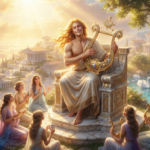
In the vast and intricate tapestry of Greek mythology, alongside the well-known Olympian gods and heroic figures, exists a rich world of personified spirits known as daimones. Among these is a figure of profound warmth and essential cosmic importance. Who is Philotes, the Greek goddess/spirit of friendship? She is the primordial personification (a daimona) of friendship, affection, and the very bonds of love and social connection that unite mortals and gods. Born from the darkness of the primordial night, she represents the positive, unifying forces of the universe, standing in eternal opposition to the spirits of strife and discord. Her influence extends from the most intimate relationships between lovers to the grand, cosmic forces that shape creation itself.
Philotes, whose very name translates to “friendship” or “affection,” represents a concept that was foundational to ancient Greek society and philosophy. Unlike the more familiar gods of desire like Aphrodite or Eros, Philotes embodies a broader, more foundational force of attraction and unity. Her presence in ancient texts, from the epic poetry of Hesiod to the philosophical fragments of Empedocles, reveals a powerful and enduring figure whose role in the cosmos was both vital and deeply revered. This definitive guide explores the origins, mythology, and enduring legacy of Philotes, shedding light on the goddess of friendship and her vital role in the ancient world.
Origins and Divine Lineage
A Child of the Night
Philotes belongs to a generation of gods and spirits far older than the Olympians. Her parentage places her among the primordial deities who represent the fundamental forces of existence. In Hesiod’s Theogony, the foundational text of Greek mythology, Philotes is born from the goddess Nyx (Night), who produced her without a father . This parthenogenetic birth, shared with her many siblings, establishes Philotes as an elemental and powerful being. She was not created in a moment of divine dalliance but emerged from the very fabric of the cosmos as an essential force.
The lineage of Nyx is one of immense power. As a primordial goddess, Nyx was so powerful and fearsome that even Zeus held her in awe. Her children, born from her alone, represent the unavoidable and often harsh realities of existence: Moros (Doom), the Keres (Violent Death), Thanatos (Death), and the Oneiroi (Dreams) . However, this lineage also includes figures like Philotes who represent positive aspects of existence, a duality that is central to understanding the Greek worldview.
A Later Addition to the Genealogy
While Hesiod’s account presents Philotes as a daughter of Nyx alone, later Roman authors offer a slightly different version of her lineage. The Roman mythographer Hyginus, in his Fabulae, and the statesman Cicero, in his work De Natura Deorum, both list Philotes (equated with the Roman personifications of Amicitia or Gratia) as the child of Erebus (Darkness) and Nyx . This addition of a father, the personification of darkness, was a common pattern in Roman mythography, as they often sought to pair deities in a more organized and familial structure. Nonetheless, her core identity remains unchanged: she is a fundamental force born from the primordial elements of the cosmos.
A Family of Duality
Perhaps the most telling aspect of Philotes’s origins is the company she keeps. Her siblings include figures that represent both the light and shadow of the human condition. She is the sister of Apate (Deceit), Geras (Old Age), and Nemesis (Retribution) . This close relationship with such negative forces illustrates a profound truth: the ancient Greeks understood that friendship and affection exist in a world also defined by conflict, deception, and hardship. Philotes is not a naive or simple goddess of sunshine; she represents a force that must constantly contend with, and triumph over, its opposite numbers.
This is most evident in her relationship with Eris (Strife). In Hesiod’s poetry, Philotes is repeatedly paired with Eris as her antithesis. While Eris sows discord and war, Philotes brings unity and harmony . This cosmic opposition would become the core of her mythological and philosophical role.
The Mythological Role of Philotes
Personification of Social and Sexual Bonds
In its simplest sense, Philotes is the spirit of friendship, affection, and companionship. Her name, philotes, is the ancient Greek word for “friendship” . However, her role extends far beyond the modern understanding of a casual friendship. In the ancient world, philia encompassed a broad spectrum of relationships, including the bonds between family members, the loyalty between comrades-in-arms, the affection between lovers, and the ties that held a community together. Philotes was the divine embodiment of all these positive, unifying relationships.
The ancient sources hint at the breadth of her domain. For the Greek poet Hesiod, the word philotes could also denote “sexual intercourse” . This is not a contradiction but rather a reflection of the ancient Greek view that the physical and emotional bonds of love were all part of a single, powerful spectrum of human experience. Philotes, therefore, was not just about a pleasant association; she was the foundational force behind all forms of love, connection, and societal glue.
The Cosmic Principle of Creation
The pre-Socratic philosopher Empedocles elevated Philotes from a personified deity to a fundamental cosmic principle. He identified Philotes as one of the two primary forces that govern the universe, the other being Neikea (Strife) . According to Empedocles, the world is in a constant state of flux, driven by the eternal interplay of these two forces.
In this philosophical framework, Philotes is the force of attraction, love, and unity. She works to bring disparate elements together, to create harmony, and to combine the four fundamental elements of the universe (earth, air, fire, and water) into complex forms . She is the “driving force behind creation,” the principle that builds structures, forms life, and creates the world as we know it . Neikea, on the other hand, is the force of separation, repulsion, and conflict. The cosmic cycle of creation and destruction was, in Empedocles’s view, the result of Philotes and Neikea alternately gaining dominance.
A Goddess of Purity and Principle
Empedocles also described a moral dimension to Philotes. As the embodiment of unity and life, she was fundamentally opposed to destruction. In his philosophical fragments, he states that Philotes is “hurt and offended by life-destroying offerings” and demands the abstention from animal sacrifices . This is a remarkable departure from typical ancient Greek religious practice, which often involved animal sacrifice. By linking the goddess of friendship with a call for non-violence, Empedocles presents her as a patron of a higher spiritual and ethical path. He even identifies her with Kypris (Aphrodite), further solidifying her role as a force of love and creation .
Family and Relationships
Her Parents
In the most authoritative sources, Philotes is a daughter of Nyx, the primordial goddess of the night. Hesiod writes of her birth from Nyx alone, making her one of the most ancient and powerful figures in the Greek pantheon . In the Roman tradition, her father is given as Erebus (Darkness), but her connection to Nyx remains the primary and most significant aspect of her identity.
Her Brothers and Sisters
Philotes has a vast and often fearsome family. Her most prominent siblings, listed in Hesiod’s Theogony, include:
- Moros (Doom): The personification of impending doom.
- Thanatos (Death): The god of peaceful death.
- Hypnos (Sleep): The god of sleep.
- Oneiroi (Dreams): The spirits of dreams.
- Eris (Strife): The goddess of discord, and Philotes’s main adversary.
- Nemesis (Retribution): The goddess of divine retribution.
- Apate (Deceit): The spirit of deception.
- Geras (Old Age): The spirit of old age.
This wide array of siblings, representing both benign and malevolent forces, places Philotes at the center of the human condition. She embodies the forces of unity and love that help mortals cope with the grim realities of death, old age, and strife.
Children
Unlike many of the more prominent Greek deities, there are no surviving records of Philotes taking a consort or bearing children . Her role is not that of a mother goddess, but rather a fundamental principle of connection. She exists as a force of unity rather than as a figure who builds a family of her own.
Symbols and Representations
Absence of a Distinct Form
In a fascinating departure from the norm, Philotes has no single, definitive physical description or artistic depiction in surviving ancient art . Unlike the frequently depicted Aphrodite or Athena, Philotes’s form is not a matter of record. This may be because of her nature as a daimona—a personified spirit—rather than a fully fleshed-out anthropomorphic deity. Her power lies in her abstract essence, not in a physical form.
Speculations on Her Appearance
Despite the lack of concrete evidence, some modern scholars and enthusiasts have speculated on what Philotes might have looked like. Based on the iconography of her siblings, such as the winged figure of Death (Thanatos) or the spirits of Dreams (Oneiroi), it is suggested that Philotes would likely have been depicted as a winged, youthful, and attractive female spirit . This would be in line with a generic depiction of positive, ethereal daimones. However, it is important to state clearly that these are educated guesses, not based on direct ancient evidence.
Her Roman Equivalents
Perhaps the most concrete evidence of Philotes’s importance is her clear identification with Roman deities. She was equated with both Gratia (Grace, Favor) and Amicitia (Friendship) . This identification by Roman intellectuals and mythographers demonstrates that the core concepts she embodied were not just Greek but were recognized and venerated across the ancient Mediterranean. Her name and her role were fundamentally understood, even if the specific iconography was less developed.
Ancient Sources and Literary References
Hesiod’s Theogony (c. 8th – 7th Century BCE)
This is the most important and earliest surviving source for the goddess Philotes. In his genealogical poem, Hesiod writes:
“Also deadly Nyx bare Nemesis to afflict mortal men, and after her, Apate (Deceit) and Philotes (Friendship) and hateful Geras (Old Age) and hard-hearted Eris (Strife).”
This simple line places her in the context of the most ancient forces of the cosmos and establishes her as a direct counterpart to the forces of discord.
Empedocles (c. 5th Century BCE)
The pre-Socratic philosopher Empedocles, in his surviving fragments, is the most significant source for Philotes’s role as a cosmic principle. He depicts her as the divine force of love and attraction, the architect of the universe and a primary force of creation . He associates her with Kypris (Aphrodite) and describes her as being opposed to the shedding of blood and animal sacrifice, presenting a unique ethical dimension to her character .
Roman Sources: Hyginus and Cicero
The Roman writers Hyginus and Cicero provide crucial evidence for the continuity of her worship and concept. In their works, she is known as Amicitia (Friendship) and Gratia (Favor). Hyginus lists her as the daughter of Nox (Night) and Erebus, and Cicero similarly discusses her as one of the children of these primordial forces . These texts confirm that the idea of Philotes transcended Greek culture and was integrated into the Roman worldview.
Legacy and Modern Relevance
A Reflection of Greek Social Ideals
Philotes is a direct reflection of the immense value ancient Greek society placed on friendship and social bonds. The concept of philia, which she personifies, was one of the most important philosophical concepts in the ancient world. It was the basis for political alliances, military brotherhoods, and personal relationships. Her presence in mythology underscores that friendship was not just a casual arrangement but a sacred, divinely-ordained force essential for a well-functioning society.
The Forgotten Goddess
Despite her importance in ancient thought, Philotes remains one of the lesser-known figures of Greek mythology. She was never featured in epic tales, adventure myths, or plays. Her role was that of a background principle, a fundamental force of creation rather than a dramatic character. This may be why she lacks the fame of figures like Zeus or Athena, but it does not diminish her importance in the ancient view of the cosmos.
Modern Interpretations
Today, Philotes can be seen as a powerful symbol of the importance of human connection. In an era where social isolation and division are major concerns, her role as the goddess of unity and the antithesis of strife is more relevant than ever. She represents the foundational human need for friendship, affection, and community, reminding us of the sacredness of the bonds that tie us together. Her association with Empedocles’s philosophy also casts her as a symbol of creation, peace, and the rejection of violence, ideas that resonate strongly in the modern world.
Frequently Asked Questions About Who is Philotes, the Greek goddess/spirit of friendship?
Who is Philotes in Greek mythology?
Philotes is the primordial goddess or spirit (daimona) who personifies friendship, affection, and social bonds. She is one of the children of Nyx, the goddess of the night, and represents the positive, unifying force in the cosmos .
What is the meaning of the name Philotes?
The name Philotes is the ancient Greek word for “friendship” or “affection.” The term encompassed a broad spectrum of relationships, from the bonds between lovers and family members to the ties between comrades and fellow citizens .
Who were the parents of Philotes?
In the oldest sources, such as Hesiod’s Theogony, Philotes is the daughter of Nyx (Night) alone, with no father. However, later Roman authors like Hyginus and Cicero also name Erebus (Darkness) as her father .
What is the role of Philotes in Empedocles’s philosophy?
The philosopher Empedocles elevated Philotes to a fundamental cosmic principle of love, attraction, and creation. He taught that she is the force that brings the elements of the universe together, working in opposition to Strife (Neikea), which pulls them apart .
Is Philotes the same as Aphrodite?
No. While both represent aspects of love, they are distinct figures. Philotes represents friendship and the broader bonds of affection, while Aphrodite is the goddess of erotic love, beauty, and desire. However, the philosopher Empedocles did sometimes identify her with Kypris (Aphrodite) .
What are Philotes’s symbols?
Unlike many Greek gods and goddesses, Philotes has no surviving distinct artistic depiction or set of symbols. Her form was never a matter of record, though some speculate she would have appeared as a winged youth.
What is the Roman name for Philotes?
The Romans equated Philotes with two different goddesses: Amicitia, the personification of friendship, and Gratia, the personification of favor and grace .
What is Philotes’s relationship to Eris (Strife)?
Philotes and Eris are conceived as direct opposites, often appearing together in ancient lists. While Philotes represents friendship, unity, and affection, Eris is the goddess of discord, conflict, and strife .
Conclusion
In the grand narrative of Greek mythology, Philotes holds a quiet but indispensable place. She was not a goddess of grand adventures or divine scandals, but rather the embodiment of the fundamental human need for connection and affection. Who is Philotes, the Greek goddess/spirit of friendship? She is the cosmic force of unity, the divine advocate for peace, and the spirit of the bonds that hold society together. From her ancient lineage as a child of Nyx to her role as a cornerstone of Empedoclean philosophy, she represents the essential principle that creation and harmony triumph over chaos and destruction.
Her legacy is a powerful reminder of a world where friendship was not a mundane aspect of life but a sacred and divine force. In an age that often feels increasingly fractured and isolated, the spirit of Philotes remains as relevant as ever. She invites us to recognize the profound importance of love, loyalty, and connection, and to see them not as simple human emotions but as the fundamental, life-giving forces that make civilization possible. Though she may not have temples or statues, her spirit endures in every act of kindness, every bond of friendship, and every gesture of affection that unites one soul to another.

Orin Vale has spent the better part of two decades tracing the threads that connect the world’s oldest stories — from the halls of Asgard to the banks of the Nile, from Olympus to the jungles of the Maya. What began as a childhood fascination with flood myths and trickster gods grew into years of independent study across comparative mythology and ancient religion, always chasing the same question: what did these stories mean to the people who first told them? Orin writes for readers who want more than trivia — the ones looking for the beliefs, fears, and truths that myths were built to carry.