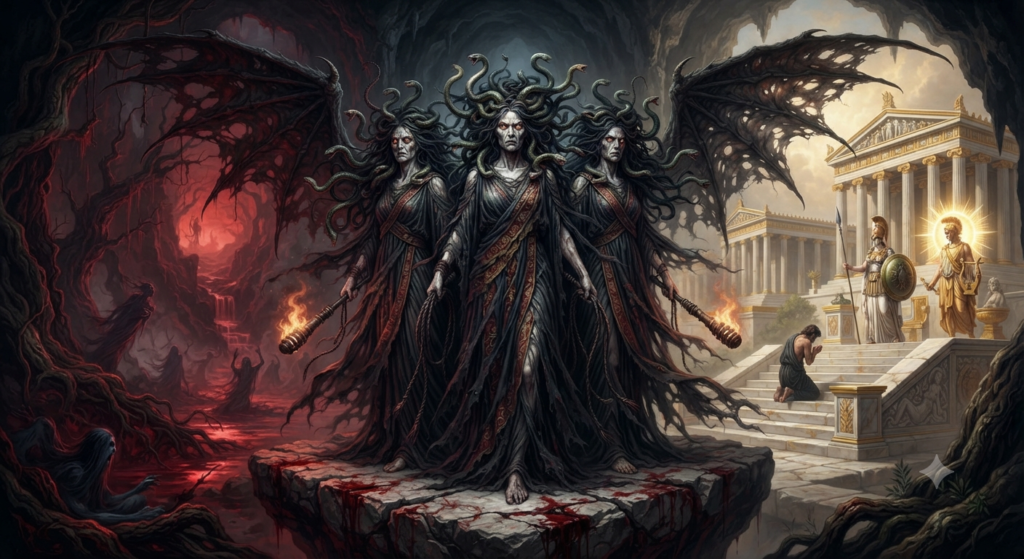
In the final play of Aeschylus’s monumental Oresteia trilogy, the Erinyes—ancient goddesses of vengeance—undergo one of the most remarkable transformations in all of Greek literature. Who are the Erinyes (Furies) in Aeschylus’s Eumenides? They are the terrifying chthonic deities who pursue Orestes for the murder of his mother, Clytemnestra, and who ultimately become the Eumenides, the “Kindly Ones,” after being persuaded by Athena to accept a new role as protectors of justice in Athens. This transformation from monstrous avengers to benevolent guardians represents the central theme of the play: the evolution from a primitive system of blood vengeance to a civilized legal order. The Erinyes embody the ancient, pre-Olympian forces of retribution, and their reconciliation with the younger gods marks a pivotal moment in Greek mythology and the development of Western concepts of justice.
Origins and Nature of the Erinyes
Primordial Lineage and Identity
The Erinyes, whose name is often translated as “the Angry Ones” or “the Avengers,” belong to a generation of gods far older than the Olympians. They are chthonic deities—gods of the underworld—who operate in the realm of darkness and the earth, in contrast to the ouranioi, the gods of heaven who dwell on Mount Olympus. Aeschylus exploits this polarity between the older and newer generations of gods throughout the Oresteia, creating a dramatic conflict between two competing systems of divine justice.
In Greek tradition, the Erinyes were born from the drops of blood that fell upon the earth when the primordial sky god Uranus was castrated by his son Cronus. This violent origin connects them fundamentally to crimes of bloodshed and familial betrayal. They are the ministers of divine justice who demand vengeance for murder, particularly for the killing of blood relatives. Their primary concern is with crimes that most offend the gods: patricide, matricide, betrayal of parents and family, murder, manslaughter, the breaking of oaths, and crimes against the gods themselves.
Appearance and Characterization
Aeschylus presents the Erinyes as figures of almost unimaginable horror. They are described as “grey, ancient children” and “eternal virgins” who disgust even the gods. Apollo, in one of his more contemptuous speeches, calls them “these grey, ancient children never touched by god, man, or beast” and says they are “born for destruction only”. The Chorus, composed of the Erinyes themselves, appears “visibly in all the horror of their terrifying aspect”.
Their appearance on stage would have been a powerful visual spectacle for the Athenian audience. Aeschylus, whose dramatic genius was particularly strong in “dealing with visions of Fear,” deliberately emphasized the horror of their office and appearance at the beginning of the play. The more terrifying the enraged goddesses appeared, the more striking their ultimate appeasement would be. They are described as having snakes for hair, eyes that drip with poison, and wings that allow them to pursue their prey relentlessly. The theatrical masks worn by the actors portraying the Erinyes became so iconic that they were later used by practical jokers to frighten unsuspecting victims.
The Erinyes in the Narrative of the Eumenides
The Pursuit of Orestes
The play opens at the temple of Apollo in Delphi, where Orestes has sought refuge after murdering his mother, Clytemnestra, to avenge his father, Agamemnon. The Erinyes have pursued him relentlessly, and their presence is so terrifying that the Pythia, Apollo’s priestess, flees in horror. Apollo, who commanded the matricide and considers the Erinyes contemptible, has temporarily lulled them to sleep.
The ghost of Clytemnestra appears and rebukes the sleeping Furies, showing them the wounds Orestes inflicted and reminding them of the offerings she made to them during her lifetime. She commands them to wake and pursue Orestes once more. The Erinyes awake in a rage, only to find their prey has escaped with Apollo’s help. Their leader expresses their anguish:
“They disgust me. These grey, ancient children never touched by god, man, or beast—the eternal virgins. Born for destruction only, the dark pit, they range the bowels of Earth, the world of death, loathed by men and the gods who hold Olympus.”
The Clash Between Old and New Gods
When Apollo emerges from his temple to confront the Erinyes, the conflict between the old and new orders becomes explicit. Apollo mocks and curses them, calling them monsters and threatening them with his arrows. The Erinyes retaliate, accusing Apollo of being responsible for the matricide and demanding why he dares to interfere with their sacred duty. Apollo argues that they should also pursue a wife who kills her husband, but the Erinyes respond that such a murder does not “destroy one’s flesh and blood”.
This exchange reveals the fundamental difference in their worldviews. The Erinyes believe that the worst crimes are committed against one’s own blood relations—that the bond between mother and child is inviolable. Apollo, representing the newer Olympian order, cannot accept that a wife who murders her husband should escape punishment. The conflict between them is not merely personal but cosmic, representing the tension between the ancient law of blood vengeance and the emerging concept of state-administered justice.
The Trial and Transformation
The trial scene in Athens is the climax of the play. Athena establishes the first court of law, the Areopagus, with ten Athenian citizens serving as jurors. The Erinyes serve as the prosecution, arguing that Orestes must be punished for matricide. Apollo acts as the defense attorney, arguing that Orestes acted under divine command and that a father’s life holds greater value than a mother’s.
The philosophical and moral complexity of the case is evident in the jury’s deadlock: the votes are equally divided. Athena casts the deciding vote in favor of Orestes, arguing that as a goddess born only from a father (Zeus), she cannot value a woman’s death more than a man’s. This decision, while resolving the immediate crisis, also reflects the deeply ingrained misogyny of ancient Greek society and has troubled modern audiences.
The Transformation from Erinyes to Eumenides
The Anger of the Furies
The acquittal of Orestes enrages the Erinyes beyond measure. They curse the “younger gods” for violating the “ancient laws” of vengeance and robbing them of their power. They threaten to make Athens barren, to poison the soil, and to destroy the city entirely. Their wrath is understandable: they have been defeated, humiliated, and stripped of their ancient authority.
The threat to Athens would have resonated deeply with the play’s original audience. The Erinyes, as ancient and powerful beings, were not to be trifled with. Their anger could indeed bring destruction upon the city. Aeschylus portrays them as figures who genuinely believe they are fighting for justice, for the maintenance of a cosmic order that has existed since the beginning of time.
The Diplomacy of Athena
Athena, however, possesses a wisdom that the Erinyes lack. Rather than dismissing or defeating them by force, she offers them a new role and a new identity. She reminds them that the vote was tied, not lost outright, and that the outcome came from Zeus himself. More importantly, she promises them a place of honor in Athens as patron goddesses of the city, where people will revere and adore them.
The Erinyes are initially too wrathful to hear her words, continuing to curse the younger gods and threaten destruction. Athena, with remarkable patience, explains that they can use their power for good, caring for people rather than destroying them. The goddess of wisdom appeals to their sense of honor, their desire for respect, and their need for a meaningful role in the new cosmic order.
The Eumenides: “The Kindly Ones”
After some convincing, the Erinyes accept Athena’s offer. They agree to give up their bloodthirsty role and become defenders of justice and of Athens itself. From that point on, they are referred to as the Eumenides—”the Kindly Ones”. This name, which gives the play its title, represents not simply a euphemistic attempt to placate fearsome goddesses but a genuine transformation in their nature and function.
The reconciliation is both religious and political. The Erinyes receive a home within Athena’s city, where they will receive special honors. They become beneficent powers who can bestow prosperity and peace upon Athens, as long as their wrath is not awakened by sin. In return, Athens gains the protection of these powerful ancient deities, whose good will is a tremendous advantage.
The Role and Symbolism of the Erinyes in the Play
Avatars of Blood Vengeance
The Erinyes represent the primitive, pre-legal system of blood vengeance. Their justice is absolute, impartial, and merciless. They punish regardless of circumstances, motives, or mitigating factors. Orestes’s action, even if commanded by a god, does not excuse his guilt in their eyes. The Erinyes are the “power that attends the curse,” the force that ensures the wrongdoer suffers for their crime.
Throughout Greek literature, the Erinyes are associated with specific crimes: perjury, murder, unfilial conduct, impiety. Their punishment is unyielding; they are “fateful, and fierce to punish” the wicked. They are often linked with Dike (Justice) as agents of cosmic moral order. As the Orphic Hymn to the Erinyes states, they “justly rule with Dike’s impartial eye”.
Symbolism of Age and Tradition
The Erinyes are consistently portrayed as figures of age and tradition. They are “grey, ancient children” who have existed since the dawn of time. They are “the daughters of Night,” the primordial darkness that preceded the Olympian order. Their age gives them authority, and they repeatedly remind the younger gods of their ancient rights and traditions.
Apollo’s contempt for them as “grey, ancient children” is telling. He sees them as relics of a savage past, obstacles to the progress of civilization. The Erinyes themselves are painfully aware of the threat the Olympians pose to their existence. When Orestes is acquitted, they lament that “the younger gods” have violated “the ancient laws” and robbed them of their power.
The “Problem of the Eumenides”
Scholars have long debated the meaning of Aeschylus’s solution to the conflict between the Erinyes and the Olympians. Some, like Sidgwick, see the play as a conflict between “the powers of light” and “the powers of darkness,” with the gods of light (Apollo and Athena) triumphing over the forces of darkness (the Erinyes and the ghost of Clytemnestra). Others, like Verrall, see the conflict as between two competing rights: absolute justice versus the relative justice of a civic community.
The “problem” lies in reconciling the apparent contradiction: the Erinyes are terrifying goddesses who pursue the guilty, but they are also transformed into benevolent Eumenides who bless the city. This transformation is not simple appeasement but a genuine integration of the old and new orders. The Erinyes are not defeated; they are persuaded. They are not destroyed; they are transformed. This resolution reflects Aeschylus’s vision of a world in which justice can be both absolute and merciful, both ancient and modern.
Ancient Sources and Literary Context
Hesiod and Early Tradition
The earliest surviving reference to the Erinyes appears in Hesiod’s Theogony, where they are described as the daughters of Earth (Gaia) born from the blood of Uranus. In Hesiod, they attend the birth of Horkos (Oath) as punishers of perjury. The gap between these early conceptions and the complex figures of Aeschylus’s play is immense. In Homer, the Erinyes are “the power that attends the curse,” invoked by the injured party—a parent, elder, or beggar—to punish wrongdoers. By the middle of the fifth century BCE, the Erinyes had received shrines and cults both in Athens and the suburb of Colonus. They were known as the Semnai (the “Holy Ones”) and the Eumenides (the “Kindly Ones”).
Aeschylus and the Oresteia
The Eumenides is the third play of the Oresteia, the only surviving Greek tragic trilogy. The first play, Agamemnon, depicts the murder of Agamemnon by his wife, Clytemnestra. The second play, The Libation Bearers, shows the revenge of Orestes, who kills Clytemnestra and her lover. The third play, The Eumenides, deals with the consequences: the pursuit of Orestes by the Erinyes and his eventual acquittal through the establishment of the Areopagus.
The Erinyes are the “ministers of divine justice” whose prominence is brought about by the vendetta theme that runs throughout the trilogy. At the end of The Libation Bearers, they appear to Orestes, demanding vengeance for the murder of his mother. In The Eumenides, they form the chorus and appear on stage “visibly in all the horror of their terrifying aspect”.
The Erinyes in Other Literature
The Erinyes appear elsewhere in Greek literature, often in a similar capacity as avengers of crime. Sophocles, in Oedipus at Colonus, refers to them as the “terrible goddesses who see all,” and describes how the people pass their shrine “without speech or glance or utterance,” fearing to utter their name. The Orphic Hymns describe them as “eternal rulers, terrible and strong, to whom revenge and tortures dire belong”. Later Roman authors equated them with the Furies (Furiae), goddesses who “investigate men’s crimes and sift out ancient wrongs”.
Artistic Representations
Visual Depictions
The Erinyes appear in ancient Greek vase painting and sculpture, although they are less commonly depicted than many other mythological figures. When they do appear, they are often shown in pursuit of Orestes, a scene that was popular in Greek art. They are depicted as winged figures, often with snakes in their hair, and they carry torches or whips to pursue their victims. The theatrical masks worn by actors in Aeschylus’s play were so distinctive that they became the standard way of representing the Erinyes in art.
The scenes on the stage in Aeschylus’s Eumenides were also visually innovative. The chorus of Erinyes, dressed in terrifying costumes and wearing monstrous masks, would have had a powerful effect on the audience. Recent scholarship has explored how Aeschylus used sound and music to enhance the horror of the Erinyes, connecting their chthonic cries to the tradition of the pythikos nomos, an instrumental solo for the aulos that conveyed the suffering of the serpent at Delphi.
The Enduring Image
The Erinyes have remained powerful figures in Western art and culture. They appear in Dante’s Inferno, where they guard the gates of the City of Dis. They feature prominently in Renaissance and Neoclassical paintings, often portrayed as winged women with snakes for hair, pursuing their victims through the underworld. The image of the Furies as merciless avengers has become a staple of Western art and literature.
Legacy and Modern Relevance
The Development of Western Justice
The transformation of the Erinyes in Aeschylus’s play represents one of the most important moments in Western intellectual history. The establishment of the Areopagus, the first court of law, marks the transition from a society governed by blood vengeance to one governed by law and reason. The trial of Orestes is a symbol of the birth of justice, the idea that disputes can be resolved through rational deliberation rather than violence.
This theme has enormous modern relevance. The play explores how societies can reconcile the demands of tradition with the need for progress. The Erinyes, as representatives of the old order, are not simply eliminated; they are integrated into the new system. Their wisdom and power are acknowledged and honored, but they are transformed and redirected toward positive ends. This integration of old and new reflects a mature understanding of how societies evolve.
The Furies and the Modern World
The Erinyes continue to resonate in the modern world. They have become a symbol of the moral force that insists that crimes must be punished, that wrongs must be righted. They are the avengers who will not be silenced, the voices that demand accountability. At the same time, their transformation into the Eumenides, the Kindly Ones, suggests that even the most vengeful passions can be transformed into forces for good.
The play also addresses issues of gender and justice that remain relevant today. The trial of Orestes features arguments about the relative value of men and women, about whether a mother’s life is as valuable as a father’s. Apollo’s argument that a father is more important because he provides the “spark of life” represents the misogyny of ancient Greek society, and Athena’s agreement with him reflects the patriarchy of Athens. These uncomfortable aspects of the play force modern audiences to confront the fact that our own justice systems are not immune to bias.
Frequently Asked Questions About Who are the Erinyes (Furies) in Aeschylus’s Eumenides?
Who are the Erinyes in Aeschylus’s Eumenides?
The Erinyes, also known as the Furies, are ancient chthonic goddesses of vengeance who pursue Orestes for the murder of his mother, Clytemnestra. They are the central figures of the play’s chorus and represent the primitive system of blood vengeance that existed before the establishment of legal justice.
Why are the Erinyes called the Eumenides?
The Erinyes become the Eumenides—”the Kindly Ones”—at the end of the play after being persuaded by Athena to accept a new role as protectors of Athens. This transformation reflects their change from terrifying avengers to benevolent guardians of the city.
What is the conflict between the Erinyes and Apollo in the play?
The conflict is a clash between two systems of justice. The Erinyes believe that matricide is the worst possible crime and that Orestes must be punished regardless of his motives. Apollo, who commanded the murder, argues that Orestes was acting justly and that the Erinyes should also pursue a wife who kills her husband.
How do the Erinyes threaten Athens?
After Orestes is acquitted, the enraged Erinyes threaten to make Athens barren, to poison its soil, and to destroy the city entirely. They believe the younger gods have robbed them of their power and violated the ancient laws of vengeance.
What role does Athena play in the Eumenides?
Athena establishes the first court of law, the Areopagus, to try Orestes. When the jury is split, she casts the deciding vote in favor of Orestes. She then persuades the Erinyes to accept a new role as patron goddesses of Athens, transforming them into the Eumenides.
What is the “problem of the Eumenides”?
Scholars have long debated the meaning of Aeschylus’s solution to the conflict between the Erinyes and the Olympians. The “problem” is reconciling the apparent contradiction: the Erinyes are terrifying avengers, but they are transformed into benevolent goddesses who bless the city.
What do the Erinyes represent in Greek mythology?
The Erinyes represent the power of blood vengeance and the absolute justice that demands punishment for murder, especially murder of family members. They are older than the Olympian gods and embody the ancient, pre-legal concept of retribution.
How were the Erinyes depicted on stage in Aeschylus’s time?
Aeschylus presented the Erinyes in terrifying costumes and masks, emphasizing their horror at the beginning of the play. They were described as “grey, ancient children” and “eternal virgins” who disgusted even the gods. The theatrical masks became iconic and were later used to frighten people.
Conclusion
The Erinyes, the Furies of Aeschylus’s Eumenides, represent one of the most profound and complex figures in Greek mythology. They are the ancient goddesses of vengeance, born from the blood of Uranus and charged with punishing crimes of bloodshed and betrayal. In Aeschylus’s hands, they become more than mere monsters; they are the embodiment of a primitive but essential form of justice, the power that insists that wrongs must be righted and that the guilty must suffer. Their pursuit of Orestes, the matricide, is not a matter of arbitrary cruelty but a sacred duty.
The transformation of the Erinyes into the Eumenides, the Kindly Ones, is the culmination of Aeschylus’s vision of the evolution of justice. The old order is not rejected but integrated, not destroyed but transformed. The Erinyes receive a place of honor in Athens, and their power, once used for destruction, is now used for blessing. This reconciliation represents a mature understanding of how societies evolve: the past is honored, its wisdom acknowledged, but its power is redirected toward new and better ends.
The Erinyes in the Eumenides also reflect the concerns of their time. The play addresses the tension between private vengeance and public justice, between the law of the family and the law of the city, between the old gods and the new. These tensions remain with us today. The Erinyes, as avengers and as guardians, as forces of terror and as forces of blessing, continue to challenge us to think about what justice means, who should administer it, and how we can transform the darkest passions into forces for good. Who are the Erinyes in Aeschylus’s Eumenides? They are ourselves, our rage and our mercy, our desire for revenge and our hope for peace, the ancient darkness within us and the possibility of transformation.

Orin Vale has spent the better part of two decades tracing the threads that connect the world’s oldest stories — from the halls of Asgard to the banks of the Nile, from Olympus to the jungles of the Maya. What began as a childhood fascination with flood myths and trickster gods grew into years of independent study across comparative mythology and ancient religion, always chasing the same question: what did these stories mean to the people who first told them? Orin writes for readers who want more than trivia — the ones looking for the beliefs, fears, and truths that myths were built to carry.