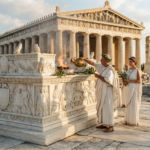
In the rich tapestry of Greek mythology, among the nine divine sisters who inspired artists, poets, and scholars, Clio holds a position of singular importance as the patroness of recorded memory. Who is Clio (Kleio), the Muse of history? She is one of the nine Muses, the goddess who presides over the writing and preservation of history, and whose name itself means “to make famous” or “to celebrate.” As the daughter of Zeus and Mnemosyne (the personification of Memory), she embodies the essential connection between remembrance and the recording of human deeds, ensuring that great accomplishments are not lost to time. Clio is typically depicted with an open scroll or a set of books, and her association with the trumpet symbolizes the proclamation of heroic achievements. This definitive guide explores her origins, mythology, attributes, and the profound legacy she has left on the study of history and the arts.
Origins and Divine Lineage
A Daughter of Zeus and Mnemosyne
Clio is one of the nine Muses, the goddesses of music, song, dance, and the arts of the mind . In the Classical era, when the Muses were assigned specific literary and artistic spheres, Clio was named the Muse of history . Like all her sisters, she was a goddess, the daughter of Zeus, the king of the gods, and Mnemosyne, the Titaness who personified memory . This parentage is profoundly significant, as it places Clio at the intersection of divine authority (Zeus) and the essential human faculty of remembrance (Mnemosyne). Her role, therefore, was to ensure that the great deeds of mortals were celebrated and passed down to future generations.
In some accounts, she is also the mother of Hyacinthus (or Hyacinth), a beautiful young man who was loved by the god Apollo. According to the myth, after Clio reprimanded Aphrodite for her passionate love for Adonis, the goddess of love punished her by making her fall in love with Pierus, a king of Macedonia . From that union, Hyacinthus was born, a youth of great beauty who was later killed by Apollo, leading to the creation of the hyacinth flower from his blood . Other traditions credit her as the mother of Hymenaeus (the god of marriage) and Rhesus . These myths, while varied, highlight that even a goddess dedicated to the serious task of recording history was subject to the dramatic passions and tragic narratives that define Greek mythology.
The Meaning of Her Name
The name Clio (from the Greek Kleio) is derived from the Greek root kleos, which means “fame,” “glory,” or “renown” . It also connects to the verb kleiein, which means “to recount,” “to make famous,” or “to celebrate” . This etymology defines the very purpose of Clio: she is the one who glorifies the past, who makes the achievements of heroes and mortals known throughout the world . The concept of kleos was central to ancient Greek culture; it was the immortal fame that a hero could achieve through great deeds, preserved in epic poetry and song. As the Muse of history, Clio became the overseer of this process, transforming fleeting mortal actions into eternal memory .
Her name is directly linked to the word for “fame,” underlining her function as the proclaimer and glorifier of history, great deeds, and accomplishments . She is the one who hears the stories and ensures that they are told to future generations.
The Mythological Role of Clio
The Muse of History
In Greek mythology, Clio is specifically assigned as the patron of history . This role evolved over time; the Muses were originally goddesses of music and dance, but as Greek culture became more sophisticated, their domains were refined to cover specific arts and sciences. By the Classical era, Clio was firmly established as the Muse who presides over the writing and recording of history . This is the role for which she is most remembered and celebrated.
She is not simply the recorder of events but the inspiration behind the historian’s craft. The historian’s work, the act of inquiring and writing about the past, was considered a form of divine inspiration, guided by the Muse. Her role was to give the historian the ability to see the truth of events and to express it in a way that would be remembered .
The Historian’s Muse
The connection between Clio and the practice of history is most famously demonstrated by Herodotus, the 5th-century BCE Greek historian often called the “Father of History.” His monumental work, The Histories, an investigation into the origins of the Greco-Persian Wars, was later divided into nine books, each named after one of the nine Muses . The first book, which begins the entire narrative, is named “Clio” . This attribution signifies that Herodotus’s work was seen as being under the inspiration of the Muse, and that the entire enterprise of history-writing began with her blessing.
Symbols and Attributes
The Scroll and the Book
In art, Clio is consistently portrayed with attributes that represent her role as the recorder of history. She is most often depicted holding an open scroll or seated beside a chest of books . The scroll and book symbolize the written record, the primary tools of the historian, and the repository of all human knowledge and memory . These symbols connect her directly to the physical act of writing and preserving the past.
She is sometimes shown with a stylus (a writing instrument), further emphasizing her role in the creation and preservation of historical texts . The presence of these tools reinforces her function as the guardian of the written word and the custodian of historical memory.
The Trumpet and the Laurel Wreath
Other common symbols include the heroic trumpet and the clepsydra (water clock) . The trumpet is a symbol of proclamation and renown. Clio sounds her trumpet to broadcast the fame of heroes and the importance of events, ensuring that they are known throughout the world and remembered in future ages . The trumpet represents her role in “making famous” the deeds of the past.
The laurel wreath is another important attribute, signifying honor and victory . As a symbol of triumph, it connects to the celebration of great deeds that is central to her function as the glorifier of history. Cesare Ripa’s Iconologia, an important source book for Baroque artists, stated that Clio should be depicted with a crown of laurels, a trumpet, and an open book, a combination that perfectly summarizes her attributes .
Representation in Art
Artists have depicted Clio in various ways, each emphasizing different aspects of her role. Artemisia Gentileschi’s celebrated painting “Clio: The Muse of History” (c. 1632) provides a powerful example. In this work, Clio is depicted as a statuesque young woman, crowned with laurels and dressed in a greenish-blue mantle. She stands with her right hand resting a trumpet on an open book, with her left hand placed on her hip, gazing into the distance . This composition captures both her power as a proclaimer of history (the trumpet) and her connection to the written record (the book).
Another depiction, described in a guide to antique gems, shows Clio holding a scroll in her left hand, her right hand raised in a gesture of profound reflection, with her finger nearly touching her lips in a gesture reminiscent of the god of silence, Harpocrates . This image emphasizes the thoughtful, analytical nature of the historian, suggesting that Clio is not just a recorder but a figure of deep contemplation.
Worship and Religious Importance
A Goddess on Olympus and Helicon
Clio, like her sister Muses, was a goddess who was worshipped and invoked by those seeking inspiration. The Muses were considered to dwell on Mount Olympus, the home of the gods, where they entertained the other gods with their arts . However, their more earthly home was on Mount Helicon in Boeotia, or Mount Parnassus, another sacred site associated with Apollo and the arts . They were also associated with Pieria in Thessaly, near Mount Olympus . These locations were places of pilgrimage for artists, poets, and scholars who sought the Muses’ favor.
There are no specific cults dedicated exclusively to Clio, as she was worshipped as part of the collective group of the nine Muses. They were invoked at the beginning of epic poems, historical works, and other literary productions, a tradition that has continued into the modern era. The Muses were seen as the source of knowledge, and their aid was essential for any creative or intellectual endeavor .
Invoking the Muse
The practice of invoking the Muse was a standard convention in ancient literature. By calling upon Clio or one of her sisters, a poet or historian was acknowledging that their work was not purely their own creation but was inspired by a divine power. This tradition is most famously seen in Homer’s Iliad, which opens with a plea to the Muse, but it continued for centuries. It was a way for the author to claim divine authority for their work and to ensure its success.
This tradition is also linked to the concept of kleos, or immortal fame. By invoking the Muse of history, the historian is asking her to help them create a work that will be remembered and celebrated for generations, effectively ensuring that the subjects of the history will achieve kleos.
Ancient Sources and Literary References
Hesiod and the Birth of the Muses
The earliest surviving reference to Clio and her sisters is found in Hesiod’s Theogony (c. 700 BCE). In this work, he describes his encounter with the Muses on Mount Helicon, where they taught him “beautiful song” . Hesiod’s account is one of the foundational texts on the Muses, establishing their genealogy and their role as the source of inspiration for poets. In his Theogony, Hesiod lists the nine Muses by name and emphasizes their power to speak both truth and fiction, a duality that is central to their nature and the nature of art itself .
Herodotus and “The Histories”
The most significant literary association for Clio is her connection to Herodotus’s The Histories. The nine books of this seminal work are named after the nine Muses, and the first book is titled “Clio” . This is a profound honor, effectively making Clio the official patron of the entire historical enterprise. Herodotus was the first historian to systematically collect material and arrange it into a narrative, and his work was seen as a divinely inspired project under the protection of the Muse of history.
Legacy and Modern Influence
Clio in the Modern World
Clio’s legacy extends far beyond ancient Greece. Her name and image have been adopted by numerous institutions, awards, and organizations that are dedicated to the study and celebration of history. The “Clio Awards,” for instance, are a prestigious annual competition recognizing excellence in advertising . This may seem like a divergence from her historical role, but advertising is, in its own way, about creating a powerful narrative and making a brand famous, thus linking it to Clio’s function as a “proclaimer” .
“Clio” as a Symbol of the Historical Discipline
In the academic world, “Clio” has become a metonym for the discipline of history itself. The Cambridge University History Society is informally referred to as “Clio,” and similar organizations at other universities use her name . This usage reflects the enduring power of her myth: the study of history is seen as a calling inspired by the Muse.
Her name is also used in other areas of scholarship. The term “cliometrics” refers to the application of economic theory and statistical methods to historical analysis, and “cliodynamics” is a field that uses mathematical models to study historical and social change . These terms, derived from Clio’s name, show that her influence has even extended into modern, data-driven approaches to understanding the past.
The Proclaimer and the Scholar
The figure of Clio embodies both the celebratory and the critical aspects of history. As her name suggests, she is a “proclaimer, glorifier and celebrator of history, great deeds and accomplishments” . Yet, modern historians also approach their subjects with a critical eye, aware that history involves both the celebration of truth and the rigorous analysis of sources. As one scholar notes, Clio reminds historians to “be responsible scholars” and to “share what they learn” . She represents the ideal of the historian as one who is both inspired and meticulous, both a storyteller and a truth-seeker.
The concept of kleos—the immortal fame that Clio helps to bestow—is a powerful legacy of the ancient Greek worldview. In a world where fame is fleeting, Clio offers the promise of enduring memory. She reminds us that what we do, what we create, and what we record can echo through the ages, inspiring and informing generations to come.
Frequently Asked Questions About Who is Clio (Kleio), the Muse of history?
Who is Clio in Greek mythology?
Clio is the Muse of history in Greek mythology. She is one of the nine daughters of Zeus and Mnemosyne. Her name means “to make famous,” and she is responsible for glorifying and recording the great deeds of the past .
What does the name Clio mean?
The name Clio comes from the Greek root kleos, meaning “fame” or “glory,” and the verb kleiein, which means “to recount,” “to make famous,” or “to celebrate.” She is the “Proclaimer” who ensures that great deeds are remembered .
What are Clio’s symbols?
Clio’s most common symbols are an open scroll or a set of books, representing the written record of history. She is also frequently depicted with a trumpet, symbolizing the proclamation of fame, and a laurel wreath, signifying honor .
Who were the parents of Clio?
Clio’s parents were Zeus, the king of the gods, and Mnemosyne, the Titaness of memory . This lineage connects her to both divine authority and the essential faculty of remembrance, which are fundamental to her role.
Did Clio have any children?
According to some traditions, Clio was the mother of Hyacinthus, a youth of great beauty loved by Apollo. In other accounts, she was the mother of Hymenaeus, the god of marriage, and Rhesus. These myths often involve her being punished by Aphrodite .
How is Clio connected to Herodotus?
The historian Herodotus’s work, The Histories, was divided into nine books, each named after a Muse. The first book is titled “Clio.” This connection signifies the divine inspiration behind the historical enterprise and firmly establishes Clio as the patron of history .
What is the modern legacy of Clio?
Clio’s legacy lives on in many ways. She is the namesake of the Clio Awards for advertising excellence, and academic organizations like the Cambridge University History Society are informally called “Clio.” Her name is also used in fields like cliometrics and cliodynamics .
Why is Clio important to historians?
For historians, Clio embodies the ideal of the discipline. She represents the responsibility to record the truth, to critically analyze the past, and to share knowledge. She reminds historians to be both inspired and rigorous in their work .
Conclusion
Clio, the Muse of history, is far more than a figure from ancient myth. Who is Clio (Kleio), the Muse of history? She is the embodiment of the human quest to remember, to understand, and to celebrate the past. As the daughter of Memory and the proclaimer of fame, she represents the vital link between the events of yesterday and the stories we tell today. From the scrolls of ancient Greece to the modern research libraries of the world, her spirit has guided historians, writers, and artists in their work. Her attributes—the scroll, the trumpet, the laurel wreath—are not just artistic symbols but powerful reminders of the purpose of history: to record, to proclaim, and to honor the deeds of those who came before.
Her legacy extends into the modern world, where her name adorns awards for excellence and is used as a shorthand for the discipline itself. The fact that the “Father of History,” Herodotus, named his first book after her is a testament to her foundational importance. In the end, Clio’s most significant contribution is her reminder that we are all participants in history—shaped by the past and responsible for shaping the memory of our own time for the future.

Orin Vale has spent the better part of two decades tracing the threads that connect the world’s oldest stories — from the halls of Asgard to the banks of the Nile, from Olympus to the jungles of the Maya. What began as a childhood fascination with flood myths and trickster gods grew into years of independent study across comparative mythology and ancient religion, always chasing the same question: what did these stories mean to the people who first told them? Orin writes for readers who want more than trivia — the ones looking for the beliefs, fears, and truths that myths were built to carry.