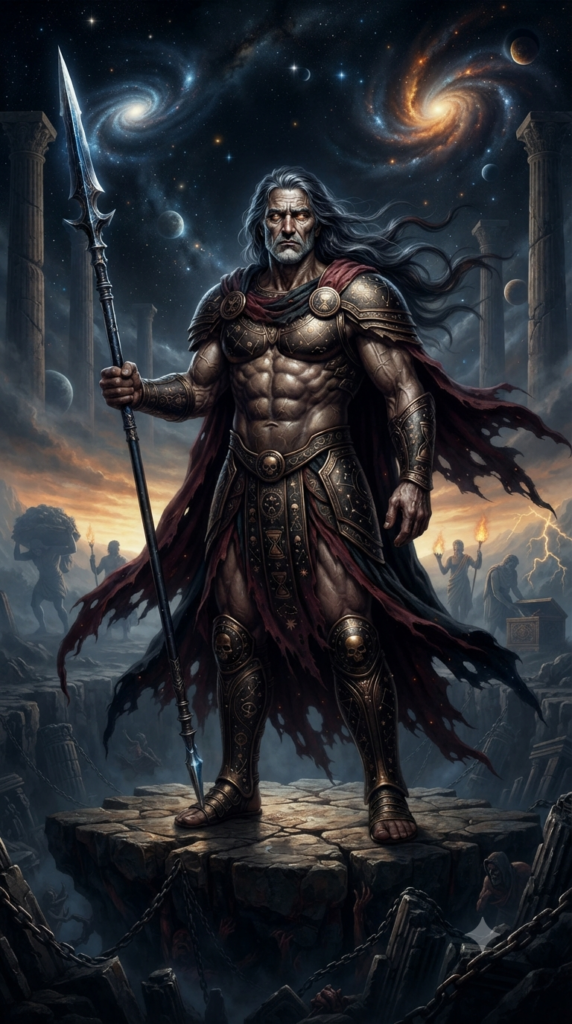
Among the elder Titans who once ruled the cosmos before the Olympian gods, Iapetus stands as one of the most significant yet enigmatic figures in the Greek pantheon. Who is Iapetus (Iapetos) in Greek mythology? He is the Titan god of mortality and the mortal life-span, a son of Uranus (Sky) and Gaia (Earth), and the father of some of the most famous figures in Greek myth—including Atlas, Prometheus, Epimetheus, and Menoetius . Imprisoned in the abyss of Tartarus after the Titanomachy, he represents the old order of the cosmos, the embodiment of human finitude, and the ancestor of all mankind.
Though Iapetus does not appear in the epic adventures of heroes or the dramatic conflicts of the Olympian gods, his influence permeates Greek mythology through his famous children. His name, often interpreted as “the Piercer,” evokes themes of mortality, craftsmanship, and the violent transitions of power that shaped the Greek understanding of the universe. This definitive guide explores every aspect of his mythology, from his primordial origins and cosmic role to his family connections, symbols, and enduring legacy in the ancient world.
Origins and Divine Lineage
A Son of Sky and Earth
Iapetus was born to the primordial deities Uranus (Sky) and Gaia (Earth), making him one of the twelve original Titans who preceded the Olympian gods . His siblings included Cronus, Oceanus, Hyperion, Coeus, Crius, Rhea, Tethys, Theia, Phoebe, Themis, and Mnemosyne. This lineage placed him among the most ancient and powerful beings in the Greek cosmos, second only to the primordial forces themselves .
The Titans were the elder generation of gods, responsible for the original ordering of the cosmos and the establishment of fixed heavenly cycles . Unlike their monstrous siblings—the Cyclopes and the Hecatoncheires—the Titans were revered as the architects of the golden age of myth, a time when Cronus ruled the world in an era of peace and abundance. Iapetus stood alongside his brother Cronus during this age, supporting his reign as a loyal and powerful ally .
The Meaning of His Name
The etymology of Iapetus’s name has been the subject of scholarly debate. The most widely accepted interpretation derives his name from the Greek word iaptō, meaning “to wound,” “to pierce,” or “to hurl” . This etymology suggests his role as a god of violence and death—the “Piercer” who represents the inevitable end of mortal life. Some scholars have connected this meaning to the idea that Iapetus may have been a god of craftsmanship, as the spear (a tool of piercing) was a product of human ingenuity. However, the evidence for this interpretation is sparse, and he is most consistently designated as the god of mortality .
His name is also linked to his role in the Titanomachy, where he was one of the generals who fought against the Olympians. The etymology of “hurling” may refer to Zeus throwing Iapetus and his brothers into Tartarus, a fitting punishment for their rebellion .
The Role of Iapetus in Greek Mythology
God of Mortality
Iapetus is consistently identified as the Titan god of mortality and the mortal life-span . This domain connects him directly to the human condition, and he was regarded by the Greeks as the ancestor of the human race . His sons, especially Prometheus, were credited with the creation of mankind and the bestowal of fire and civilization. Through them, Iapetus’s influence extended directly to mortals, making him a figure of immense importance in the mythological understanding of humanity’s place in the cosmos .
Some scholars have interpreted Iapetus’s role as that of a god who “presided over the mortal life-span who assigned mortal creatures their finite lot” . Like his brother Titans, he was a god of time, one of the sons of Uranus, the great dome of heaven that measured all of time . His wife, Clymene, whose masculine form “Klymenos” was a euphemistic title of Hades, also reflects this chthonic connection .
The Four Pillars of the Cosmos
Iapetus and three of his brothers—Hyperion, Coeus, and Crius—played a crucial role in the cosmic order as the four pillars at the four corners of the world . This role originated from their involvement in the castration of Uranus, when they held the Sky-God fast at the four corners of the earth while Cronus wielded the sickle . After this event, the four brothers were personified as the pillars that held the sky apart from the earth, with each taking a cardinal direction:
- Iapetus represented the pillar of the west
- Hyperion represented the pillar of the east
- Coeus represented the pillar of the north
- Crius represented the pillar of the south
When the Titans were later cast into the pit of Tartarus—a void beneath the foundations of the cosmos, where earth, sea, and sky all have their roots—their cosmological role shifted from being supports of heaven to bearers of the entire cosmos . This connection to the west is significant, as it was a role later held by his son Atlas, who was condemned to bear the heavens on his shoulders as a punishment for his role in the Titanomachy .
The Overthrow of Uranus
The story of the Titans begins with the conflict between Cronus and his father Uranus. Uranus, who had imprisoned the Cyclopes and the Hecatoncheires in Tartarus, was enraged by their ugliness. Gaia, their mother, in turn became enraged at Uranus’s cruelty and sought revenge. She created an adamantine sickle and gave it to her youngest son, Cronus, who agreed to overthrow his father .
When Uranus descended to earth to lie with Gaia, four of his sons—Hyperion, Crius, Coeus, and Iapetus—seized hold of the Sky-God and held him fast at the four corners of the world while Cronus castrated him with the sickle . Humiliated and defeated, Uranus fled, leaving Cronus as the ruler of the Titan gods. Iapetus’s role in this act of rebellion was essential, as he helped to immobilize the Sky-God, making his castration possible .
The Titanomachy and Imprisonment
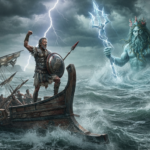
The Titanomachy was the great war between the Titans, led by Cronus, and the Olympians, led by Zeus. The conflict was sparked when Cronus, paranoid that his children would overthrow him as he had overthrown his own father, began to swallow them at birth. Rhea, his wife, managed to save the youngest child, Zeus, who grew up to defeat his father and rescue his siblings from Cronus’s belly .
Iapetus fought alongside his brother Cronus against the younger gods. Some sources suggest that he was one of the generals of the Titan army and was defeated in one-on-one combat with Zeus himself . After the war was lost, Iapetus was cast into Tartarus, the deepest part of the Underworld, along with Cronus and the other Titans who had rebelled .
Iapetus is specifically mentioned by Homer in the Iliad as being in Tartarus with Cronus . In Book VIII, Homer writes that Iapetus and Cronus dwell in Tartarus “where neither breeze nor light of the sun reaches them” . This imprisonment serves as a powerful symbol of the triumph of the new Olympian order over the older generation of gods, and it marks the end of the Golden Age and the beginning of the age of Zeus.
Family and Relationships
Spouses and Consorts
Iapetus’s wife is usually described as a daughter of Oceanus and Tethys. The most common tradition, found in Hesiod’s Theogony and in Hyginus, names her as Clymene . However, Pseudo-Apollodorus gives her name as Asia . Other sources mention Tethys, Asopis, or Libya as potential spouses . The variation in her name is typical of Greek mythology, where local traditions often diverge.
The names of his wife are significant. Clymene, meaning “Fame,” was an abstract concept associated with renown in death, achieved through glorious actions in life . Her connection to the underworld is also evident in her masculine form, Klymenos, which was a euphemistic title of Hades . Asia, on the other hand, connects him to the eastern regions of the world, consistent with his role as the western pillar.
His Famous Offspring
Iapetus’s most significant legacy is his children, who play central roles in some of the most important myths of Greek mythology :
Atlas is the most famous of Iapetus’s sons, condemned by Zeus to hold up the heavens on his shoulders for eternity . He was the leader of the Titan troops during the Titanomachy, and his punishment reflects his daring and strength. He represents the quality of excessive daring, a trait he inherited from his father .
Prometheus is the cunning god who defied Zeus by stealing fire from the gods and giving it to humanity . His name means “Forethought,” and his intelligence and craftiness represent the intellectual side of humanity. As a punishment, Zeus chained him to a rock where an eagle would eat his liver every day, only to have it regenerate each night .
Epimetheus is the brother of Prometheus, whose name means “Afterthought” . He was the guileless fool who accepted the gift of Pandora from Zeus, unleashing all the evils of the world upon humanity. His stupidity and carelessness represent the worst aspects of human nature .
Menoetius is the son who embodies arrogance, insolence, and overweening pride . Zeus struck him down with a thunderbolt during the Titanomachy and cast him into Tartarus. He represents the quality of rash violence and the dangers of excessive pride.
In addition to these famous sons, Iapetus is also called the father of Buphagus (in Pausanias) and Anchiale (in Stephanus of Byzantium) in other sources . His descendants were often designated by the patronymic forms Iapelidae, Iapetionidae, or Iapetionides, emphasizing their connection to their divine ancestor .
The Sons of Iapetus as Ancestors of Mankind
Hesiod and other Greek scholars regarded the sons of Iapetus as the ancestors of mankind and, as such, some of humanity’s worst qualities were said to have been inherited from these four gods . Each son was described with a particular moral fault that led to his downfall:
- Prometheus represents crafty scheming and the misuse of intelligence for purposes of deception
- Epimetheus embodies foolish stupidity and refuses instruction, leaving him vulnerable to the ills of Pandora’s box
- Atlas represents excessive daring, leading him to overstep his bounds and earn the punishment of bearing the heavens
- Menoetius embodies rash violence and arrogance, leading to his destruction by Zeus
This tradition reflects the Greek understanding of human nature as a mixture of divine and flawed elements, with the sons of Iapetus serving as cautionary tales about the dangers of the very qualities that make humanity capable of both greatness and folly.
The Connection to Japheth
One of the most intriguing aspects of Iapetus’s legacy is his association with the biblical figure Japheth, one of the sons of Noah . The practice of identifying various historical nations and ethnic groups as descendants of Japheth, together with the similarity of their names, led to a fusion of their identities from the early modern period to the present .
The connection is based on several factors:
- Name similarity: Iapetus and Japheth share a linguistic resemblance, suggesting a possible connection between the Greek Titan and the Hebrew patriarch.
- Progenitor role: Both figures are regarded as ancestors of humanity. Iapetus is the father of Prometheus, who created mankind, and Japheth is considered the ancestor of the peoples of Europe .
- Geographical connections: The tradition, reported by Josephus in his Antiquities of the Jews, made Japheth the ancestor of the “Japhetites,” a term often applied to Indo-European peoples. This aligns with Iapetus’s role as the western pillar, connecting him to the west and north .
The association was particularly popular among 17th-century theologians and early modern biblical scholars, who sought to reconcile Greek mythology with biblical history. Robert Graves, the 20th-century mythographer, also noted the connection, and more recently, John Pairman Brown has explored the parallels between the two figures .
Ancient Sources and Literary References
Hesiod’s Theogony
Hesiod’s Theogony, composed in the 8th or 7th century BCE, is the earliest surviving source to mention Iapetus . In this foundational work of Greek mythology, Hesiod lists Iapetus among the twelve Titans and names Clymene as his wife and Atlas, Menoetius, Prometheus, and Epimetheus as his sons . The Theogony also describes the rebellion against Uranus and the subsequent Titanomachy, placing Iapetus among the defeated Titans who were cast into Tartarus .
Homer’s Iliad
Homer, in the Iliad, is the only ancient author to explicitly mention Iapetus by name as a resident of Tartarus alongside Cronus . This reference confirms his status as one of the key Titans who suffered for their rebellion against Zeus. The Iliad describes the depths of Tartarus as a place where “neither breeze nor light of the sun reaches them,” emphasizing the eternal darkness and isolation of Iapetus’s punishment .
Aeschylus and Prometheus Bound
Aeschylus’s play Prometheus Bound deals with the punishment of Prometheus, one of Iapetus’s sons. In this play, Prometheus is described as the son of the goddess Themis, with no father named . However, his brother Atlas is also mentioned, establishing the family connection. The play itself is a powerful exploration of the themes of rebellion, punishment, and divine justice that characterized the Titans’ struggle with the Olympians .
Apollodorus’s Library
Pseudo-Apollodorus, in his Library (1st-2nd century CE), provides a comprehensive account of Iapetus’s genealogy . He names Asia as Iapetus’s wife and lists his four sons . This source confirms the standard tradition while offering the variant name of Asia, showing the fluidity of the myth.
Horace and the Roman Tradition
The Roman poet Horace, in his Odes, refers to Prometheus as the “bold offspring of Iapetus” (audax Iapeti genus), using the Roman name for the Titan . Horace specifically mentions Prometheus’s theft of fire, connecting Iapetus’s lineage to one of the most important events in human history .
The Dictionary of Greek and Roman Biography
The Dictionary of Greek and Roman Biography and Mythology (1870) provides a comprehensive account of Iapetus, synthesizing the ancient sources . It notes the alternative traditions regarding his wife (Asia, Clymene, Tethys, Asopis, or Libya) and mentions that Hyginus, in one account, confuses the Titans with the Giants, making Iapetus a son of Tartarus rather than Uranus . The dictionary also emphasizes that being the father of Prometheus, Iapetus “was regarded by the Greeks as the ancestor of the human race” .
The 1911 Encyclopaedia Britannica
The 1911 Encyclopaedia Britannica entry on Iapetus confirms his role as the father of the personifications of certain human qualities and his imprisonment in Tartarus . It also notes the connection to Japheth, which has fascinated scholars for centuries.
Symbols and Interpretations
The God of Mortality
Iapetus’s role as the god of mortality is his defining characteristic. This domain connects him to the fundamental human condition—the finite nature of life and the inevitability of death. His name, “the Piercer,” evokes the image of a wound or a spear, symbolizing the violence and pain of death . Through his sons Prometheus and Epimetheus, who created mortal creatures out of clay, Iapetus was the origin of humanity’s limited lifespan, a gift that sets mortals apart from the gods .
The Piercer
His epithet “the Piercer” has multiple interpretations . It could represent his role as an aggressor in the Titanomachy, a fierce warrior who fought against the Olympians. It might also connect him to the spear, a tool of craftsmanship and violence, reflecting the duality of human nature that he and his sons represent . Some scholars have suggested that the name relates to his role as the god of violent death, while others see it as a reference to his participation in the castration of Uranus.
The Pillar of the West
Iapetus’s role as the pillar of the west connects him to the geographical and cosmological order of the world. This is a significant role, as it places him at one of the four corners of the earth, holding the sky apart from the earth . His son Atlas later inherited this role, but in its original form, Iapetus himself was the pillar—the personification of the western boundary of the cosmos.
The Ancestor of Humanity
Iapetus’s most enduring legacy is his role as the ancestor of the human race. Through his sons, especially Prometheus and Epimetheus, he is the origin of human qualities and human flaws. The Greek view of humanity as a flawed but capable race reflects the qualities inherited from Iapetus’s sons. This makes him a foundational figure in Greek mythology, directly responsible for the creation of the beings who would worship the Olympian gods.
Legacy and Influence
The Legacy of His Sons
The most visible legacy of Iapetus is through his famous sons. Atlas, the bearer of the heavens, has become a symbol of endurance and strength. Prometheus, the defiant giver of fire, has become an icon of rebellion, intelligence, and the progress of civilization. Epimetheus, the recipient of Pandora’s box, serves as a cautionary tale about the dangers of accepting gifts without thinking. Menoetius represents the arrogance that invites destruction .
These figures have shaped Western culture through their depictions in art, literature, and philosophy. They have influenced the work of Aeschylus, Horace, and countless other writers, and they continue to be reinterpreted in modern contexts.
The Connection to Japheth
The connection between Iapetus and Japheth is a fascinating example of how Greek mythology and biblical history were reconciled by early scholars. This connection demonstrates the enduring influence of Iapetus in Western thought, as he became a figure used to explain the origins of European peoples.
Modern References
Iapetus is rarely named in modern popular culture, but he has been immortalized in another way: the moon of Saturn, Iapetus, was named after him . This astronomical tribute, like the naming of other Saturnian moons after Titans, reflects the enduring legacy of these ancient gods. The name serves as a reminder of the Titans’ cosmic importance, connecting them to the vast reaches of space and the mysteries of the universe.
Frequently Asked Questions About Who is Iapetus (Iapetos) in Greek mythology?
Who is Iapetus in Greek mythology?
Iapetus is the Titan god of mortality and the mortal life-span, one of the twelve elder Titans and the son of Uranus and Gaia. He is the father of Atlas, Prometheus, Epimetheus, and Menoetius, and he was imprisoned in Tartarus after the Titanomachy for rebelling against Zeus .
What does the name Iapetus mean?
Iapetus’s name is derived from the Greek word iaptō, meaning “to wound,” “to pierce,” or “to hurl.” This gives him the epithet “the Piercer” and connects him to themes of violent death, warfare, and the mortal condition .
Who were the parents of Iapetus?
Iapetus was the son of Uranus (the Sky) and Gaia (the Earth), making him a second-generation deity. He was born to the primordial deities who existed at the dawn of the universe .
What was Iapetus’s role in Greek mythology?
Iapetus played a crucial role in two of the most important events in Greek myth: the castration of Uranus, where he helped hold the Sky-God fast, and the Titanomachy, where he fought against the Olympians and was ultimately imprisoned in Tartarus . He is also the god of mortality and the ancestor of humanity .
Who were the children of Iapetus?
Iapetus’s most famous children are Atlas, Prometheus, Epimetheus, and Menoetius. He also fathered Buphagus and Anchiale in other sources. His children personify human qualities and are central to many myths, from the creation of mankind to the theft of fire .
Why was Iapetus imprisoned in Tartarus?
Iapetus was imprisoned in Tartarus for his role in the Titanomachy, the war against the Olympians. He fought alongside Cronus against Zeus and was defeated. Iapetus is specifically mentioned by Homer as being imprisoned with Cronus in Tartarus .
Is Iapetus connected to the biblical Japheth?
Yes, Iapetus has been linked to Japheth, the son of Noah, based on the similarity of their names and their roles as progenitors of humanity. This connection was explored by 17th-century theologians and later by scholars such as Robert Graves and John Pairman Brown .
What does Iapetus represent as a god?
Iapetus represents mortality, the human condition, and the old order of the cosmos. As the ancestor of humanity, he embodies the finite nature of mortal life, the qualities that define humanity, and the consequences of rebellion against the gods .
Conclusion
The story of Iapetus is one of the foundational myths of Greek mythology, a tale of power, rebellion, and the origins of humanity. Who is Iapetus (Iapetos) in Greek mythology? He is the Titan god of mortality, the son of Sky and Earth, the father of some of the most famous figures in Greek myth, and the ancestor of all mankind. Imprisoned in Tartarus for his rebellion against the new Olympian order, he represents the old world, a time of chaos and struggle before the establishment of the divine hierarchy.
His legacy, however, lives on through his children. Atlas, Prometheus, Epimetheus, and Menoetius—each embodying a different aspect of human nature—have shaped Western culture in profound ways. The story of Iapetus reminds us of the tension between the old and the new, the rebellious and the obedient, the mortal and the divine. It is a testament to the enduring power of Greek mythology to explore the themes of power, punishment, and the human condition.
Iapetus’s association with Japheth, the biblical progenitor of Europe, further illustrates his enduring influence, as he became a figure used to reconcile classical and biblical traditions. His name on a moon of Saturn is a fitting tribute to the Titan who once held up the sky, a reminder of the cosmic scale of the gods and the power of myth to transcend time and culture.

Orin Vale has spent the better part of two decades tracing the threads that connect the world’s oldest stories — from the halls of Asgard to the banks of the Nile, from Olympus to the jungles of the Maya. What began as a childhood fascination with flood myths and trickster gods grew into years of independent study across comparative mythology and ancient religion, always chasing the same question: what did these stories mean to the people who first told them? Orin writes for readers who want more than trivia — the ones looking for the beliefs, fears, and truths that myths were built to carry.