The Pleiades, often known as the “Seven Sisters,” represent one of the most beloved and enduring figures in Greek mythology—a sisterhood of seven celestial nymphs whose story bridges the mortal and divine realms. Who are the Pleiades in Greek mythology? They are the seven daughters of the Titan Atlas and the sea-nymph Pleione, companions of the goddess Artemis, whose tragic fate and divine affairs led to their transformation into the famous star cluster that bears their name. These sister-nymphs—Maia, Electra, Taygete, Alcyone, Celaeno, Sterope, and Merope—each became the ancestress of royal and heroic bloodlines, their myth serving as a powerful explanation for the celestial phenomenon that has guided sailors and farmers for millennia.
This comprehensive guide explores every facet of the Pleiades, from their primordial origins and familial connections to their romantic entanglements with the gods and their ultimate catasterism—the transformation into stars. The story of the Pleiades is one of sisterhood, tragedy, and cosmic significance, deeply woven into the fabric of ancient Greek religion, agriculture, and navigation.
Origins and Divine Lineage
The Daughters of Atlas and Pleione
The Pleiades were born to the Titan Atlas, the mighty deity condemned by Zeus to hold up the heavens on his shoulders for eternity, and Pleione, an Oceanid nymph who protected sailors . According to most traditions, they were born on Mount Cyllene in Arcadia, a mountain that would later become associated with their eldest sister, Maia . In some accounts, their mother was given as Aethra, another Oceanid, rather than Pleione, though the Pleione tradition is the most widely accepted .
Their lineage placed them among the most ancient and powerful families of the Greek cosmos. As the daughters of a Titan, they were sisters to several other notable mythological figures, including Calypso, the nymph who detained Odysseus on her island; Hyas, their brother who died in a hunting accident; and the Hyades, their sisters who wept so bitterly for Hyas that they were transformed into stars . Together with the Hyades, the Pleiades were called the Atlantides, Dodonides, or Nysiades, and they served as nursemaids and teachers to the infant god Dionysus .
The Meaning of Their Name
The etymology of the name “Pleiades” is a subject of scholarly debate . The most obvious derivation traces the name to their mother, Pleione, making them the “daughters of Pleione” . However, most classicists believe that the name of the star cluster came first, and Pleione was invented to explain it—a common pattern in Greek mythology where the personification follows the celestial phenomenon .
An alternative and equally compelling derivation connects the Pleiades to the Greek word plein, meaning “to sail” . This etymology emphasizes the cluster’s crucial importance in Mediterranean navigation, as the season for sailing began with the heliacal rising of the Pleiades in the spring . The name may also derive from pleos, meaning “full” or “many,” a reference to the numerous stars in the cluster . The Roman name for the Pleiades, Vergiliae, is likely connected to ver, the Latin word for “spring,” again emphasizing their seasonal significance .
The Seven Sisters and Their Names
Maia
Maia, the eldest and most beautiful of the seven sisters, was renowned for her solitary nature and extraordinary beauty . She preferred to live alone in the caves of Mount Cyllene, avoiding the company of gods and mortals alike. Despite her reclusive nature, Zeus fell deeply in love with her, and their union produced Hermes, the messenger god and patron of travelers, merchants, and thieves . Maia’s name means “mother” or “nurse” in Latin, and she was later identified by the Romans with their spring goddess, which is why the month of May bears her name .
Electra
Electra, whose name means “amber” or “brightness,” was seduced by Zeus and bore him two sons: Dardanus and Iasion . Dardanus became the founder of the ancient city of Troy, making Electra the ancestral mother of the Trojan royal house . Some traditions identify Electra as the “lost Pleiad,” claiming that she vanished from the sky in grief after the fall of Troy . Others maintain that Merope is the lost sister, a point of variation that reflects the fluidity of Greek myth .
Taygete
Taygete was another of Zeus’s conquests, though her story involves a more elaborate pursuit. According to myth, when Zeus attempted to seduce her, Taygete fled into the arms of Artemis, who transformed her into a doe to escape the god’s clutches . Despite Artemis’s protection, Zeus eventually succeeded in his pursuit, and Taygete gave birth to Lacedaemon, the founder of Sparta . The mountain range in the Peloponnese, the Taygetus, bears her name, a permanent geographical testament to her significance in Spartan mythology.
Alcyone
Alcyone, the second sister and the leader of the Pleiades, was favored by Poseidon, the god of the sea, who fathered several children with her, including Hyrieus, Hyperenor, and Aethusa . Her name is associated with the “halcyon days”—a period of calm and prosperity in the Mediterranean when the seas were peaceful and safe for sailors . According to some sources, Alcyone was the brightest of the Pleiades stars, outshining even her eldest sister, Maia .
Celaeno
Celaeno, whose name translates to “melon” or “swarthy,” was also loved by Poseidon, who fathered Lycus and Nycteus with her . She bore additional children to Prometheus, the Titan who stole fire for humanity, including Lycus and Chimaereus . Some sources claim that Celaeno shines less brightly than her sisters because she was struck by lightning .
Sterope (or Asterope)
Sterope, sometimes called Asterope—meaning “star” or “star-face”—was the sister favored by Ares, the god of war . Their union produced Oenomaus, the king of Pisa who famously challenged suitors of his daughter Hippodamia to a chariot race, a myth deeply connected to the founding of the Olympic Games . Her star is one of the fainter members of the cluster, reflecting her status as one of the weaker sisters .
Merope
Merope, the youngest and most reluctant of the sisters, presents the most poignant story . Unlike her sisters, who had affairs with gods, Merope married a mortal, Sisyphus, the infamous king of Corinth who was condemned to roll a boulder up a hill for eternity . Their children included Glaucus, Ornytion, Thersander, and Almus . According to one tradition, Merope became the “lost Pleiad” because she hid her face in shame at having married a mortal, making her star the faintest in the cluster and often invisible to the naked eye . Another tradition, however, attributes the lost star to Electra, who grieved for Troy .
The Mythology of Catasterism
The Pursuit of Orion
The most famous myth involving the Pleiades concerns their transformation into stars, a process known in Greek mythology as catasterism. According to the most widespread version, the sisters, along with their mother Pleione, were walking through Boeotia when they encountered the giant hunter Orion . Orion, described in some sources as the son of Poseidon, was immediately inflamed with passion for the sisters and began to pursue them .
For five to seven years, Orion relentlessly pursued the Pleiades through the woods, his amorous advances making their lives a torment . The sisters prayed to the gods for rescue, and their prayers were heard . According to one tradition, Zeus transformed the Pleiades first into doves (peleiades) to allow them to escape Orion’s grasp, and then into stars, where they would be forever safe from his unwanted attentions . As a further act of cosmic justice, Zeus also transformed Orion into a constellation, and in the night sky, the hunter is still depicted as pursuing the seven sisters eternally, an endless chase that has inspired countless stories across cultures .
Alternative Traditions of Catasterism
While the pursuit by Orion is the most famous version of the Pleiades’ catasterism, it is not the only one. According to some accounts, the seven sisters were so overcome with grief at the fate of their father, Atlas, who was forced to hold up the sky, or at the death of their sisters, the Hyades, that they took their own lives . Zeus, moved by their tragic fate, immortalized them by placing them in the sky, where they would shine forever . This version emphasizes the themes of filial devotion and the pain of loss that run through so many Greek myths.
A more obscure account preserved in a scholiast on Theocritus presents an entirely different tradition, naming the Pleiades as daughters of an Amazonian queen and crediting them with inventing ritual dances and nighttime festivals . This variant is an intriguing reminder that Greek mythology was not monolithic but varied across regions and time periods.
Role in Agriculture and Navigation
The Pleiades in the Ancient Calendar
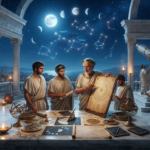
The Pleiades were far more than mythological figures; they were a practical and indispensable part of the ancient Greek calendar. Their heliacal rising—the first appearance of the stars in the dawn sky after their annual period of invisibility—marked the beginning of the sailing season in the Mediterranean . Their setting, when they disappeared from the evening sky, signaled the end of safe navigation and the onset of winter storms.
The poet Hesiod, writing in the 8th century BCE, gave the Pleiades a prominent place in his Works and Days, a didactic poem on agriculture and the farmer’s year . He instructed farmers to begin harvesting when the Pleiades rose at dawn, which in Greek times fell in May, and to begin plowing when they set at dawn in November :
“And if longing seizes you for sailing the stormy seas, / when the Pleiades flee mighty Orion / and plunge into the misty deep / and all the gusty winds are raging, / then do not keep your ship on the wine-dark sea / but, as I bid you, remember to work the land.”
This agricultural and navigational significance made the Pleiades a central feature of Greek life, their rising and setting marking the rhythm of the year in a way that directly affected the daily existence of farmers and sailors. In this sense, the Pleiades were not distant celestial abstractions but immediate and practical guides to survival.
The Significance of the “Lost Pleiad”
One of the most intriguing aspects of the Pleiades myth is the persistent tradition that one of the seven sisters was “lost” or invisible. The ancient Greek poet Aratus of Soli, writing in the 3rd century BCE, gave the names of all seven sisters but then reported that “only six are visible to the eyes” . This observation is not merely poetic license; it reflects a genuine astronomical phenomenon. Today, most people with good eyesight see only six stars in the Pleiades cluster, and even in antiquity, this was apparently the case.
The mythological explanations for the “lost Pleiad” vary. According to the most common tradition, Merope is the invisible sister, because she was ashamed of marrying a mortal, Sisyphus, rather than a god . In this version, her star is the faintest in the cluster, often too dim to be seen with the naked eye. An alternative tradition identifies Electra as the lost sister, claiming that she faded from view in grief after the fall of Troy, her city founded by her son Dardanus .
Fascinatingly, similar “lost Pleiad” stories are found in cultures across the globe, from Native American tribes to Aboriginal Australian communities, suggesting that the phenomenon of the seemingly missing star has captured human imagination universally .
The Pleiades as Divine Ancestresses
The Royal Bloodlines of Greece
The Pleiades were more than just celestial beauties; they were the ancestral mothers of some of the most important royal houses in Greece. Through their affairs with gods and mortals, each sister gave birth to figures who would establish dynasties and shape Greek history:
- Maia, with Zeus, gave birth to Hermes, establishing her as the ancestor of the Arcadian royal house and the patron of all travelers and merchants .
- Electra, with Zeus, gave birth to Dardanus, the founder of Troy, making her the ancestress of the Trojan royal line .
- Taygete, with Zeus, gave birth to Lacedaemon, the founder of Sparta, establishing her as the ancestral mother of the Spartan royal house .
- Alcyone, with Poseidon, gave birth to Hyrieus, whose descendants included the legendary hunter Orion .
- Celaeno, with Poseidon, gave birth to Lycus and Nycteus, figures associated with Thebes and its royal house .
- Sterope, with Ares, gave birth to Oenomaus, the king of Pisa and an important figure in the mythology of the Olympic Games .
- Merope, with Sisyphus, gave birth to Glaucus, Ornytion, and others, connecting the Pleiades to the Corinthian royal house .
This extensive genealogy demonstrates the foundational importance of the Pleiades in Greek mythology. They were not simply stars or nymphs but the connective tissue between the divine order and the human world, their bloodlines uniting gods and mortals in a narrative of shared descent.
Ancient Sources and Literary References
Hesiod and the Agricultural Tradition
As noted above, Hesiod is the earliest surviving source to mention the Pleiades in a significant way. In his Works and Days, he provides the practical, agricultural context for the stars, indicating their importance in the daily life of the Greeks . He also appears to allude to the story of Orion pursuing the Pleiades, stating that they “flee mighty Orion” and “plunge into the misty deep” .
Homer and the Doves of Zeus
Homer, in the Odyssey, makes a possible allusion to the Pleiades when he mentions the doves that brought ambrosia to Zeus . The Greek word for doves, peleiades, is phonetically similar to “Pleiades,” and the tradition that the sisters were transformed into doves before becoming stars seems to connect to this Homeric reference . Homer’s mention of the “Planctae” or wandering rocks, through which one dove was always lost, may also reflect the tradition of the lost Pleiad .
Apollodorus and the Comprehensive Myth
Apollodorus, the 1st or 2nd century CE mythographer, provides the most comprehensive account of the Pleiades myth in his Library. He names all seven sisters, gives their parentage, and recounts their transformation into stars, providing the canonical version of the myth that would be passed down through the ages .
Hyginus and the Constellation Tradition
Hyginus, the 1st century BCE Roman author, provides significant details about the astronomical and mythological aspects of the Pleiades in his Astronomica and Fabulae. He offers the account of Orion’s pursuit and the sisters’ transformation into doves, emphasizing the connection between the myth and the observed movement of the stars across the sky .
Ovid and the Poetic Tradition
Ovid, in his Fasti, a poetic calendar of Roman festivals, includes the Pleiades and provides the myth of Merope’s shame, which explains why her star is the faintest . His work demonstrates the enduring appeal of the Pleiades myth in Roman literature and its integration into the broader cultural imagination.
Artistic Representations and Cultural Influence
The Pleiades in Ancient Art
The Pleiades appear in ancient Greek art, though their representation is less common than that of the major Olympian gods. The pursuit of Orion, depicted on vases and reliefs, was a popular motif, emphasizing the dramatic moment of escape and transformation. In many of these depictions, the sisters are shown as a unified group, their sisterhood emphasized, while Orion is shown as an aggressive, pursuing force.
The Pleiades in Renaissance and Neoclassical Art
The Pleiades experienced a revival in Renaissance and Neoclassical art, where they were frequently depicted as beautiful, celestial maidens. The “Lost Pleiad” was a particularly popular subject, symbolizing grief, shame, or loss. One famous example is The Lost Pleiad (1874/75) by Randolph Rogers, a marble sculpture showing Merope rising from a cloud in search of her lost siblings . Another is William-Adolphe Bouguereau’s L’etoile perdue (The Lost Star, 1884), which depicts Merope from behind with the other Pleiades as faint images in the background .
The Pleiades in Literature and Poetry
The Pleiades have inspired countless writers and poets. The Greek poet Sappho mentions them in one of her most famous fragments:
“The moon has gone / The Pleiades gone / In dead of night / Time passes on / I lie alone”
Lord Tennyson, in his poem Locksley Hall, offers a more vivid description:
“Many a night I saw the Pleiads, rising through the mellow shade, / Glitter like a swarm of fire-flies tangled in a silver braid.”
The Pleiades also appear in the Book of Job, a testament to their cross-cultural and interreligious significance:
“Can you bind the beautiful Pleiades? Can you loose the cords of Orion?”
The Pleiades in Modern Popular Culture
The Pleiades have become a staple of modern fantasy and popular culture. In Rick Riordan’s Percy Jackson series, they appear as the “Seven Sisters,” and in numerous other works, they serve as a symbol of sisterhood, transformation, and cosmic order. Their story continues to resonate because it combines the human drama of family, love, and loss with the awe-inspiring mystery of the stars.
The Worldwide Myth of the Seven Sisters
A Story Reaching Across Cultures
Remarkably, the story of the Seven Sisters is not confined to Greek culture. Similar myths are found in cultures across the globe, from Aboriginal Australia to Native America, from Africa to Asia . In Australian Aboriginal traditions, the Pleiades are often a group of young girls being chased by a hunter or group of men, a story that is strikingly similar to the Greek myth . In many of these Aboriginal stories, one of the sisters has died, is hiding, is too young, or has been abducted, explaining why only six stars are visible .
The “Out of Africa” Hypothesis
The remarkable similarity of these stories has led to a fascinating hypothesis: that the myth of the Seven Sisters may be the oldest story in the world, dating back to the great human migration out of Africa around 100,000 years ago . Recent astronomical research has shown that the stars of the Pleiades cluster are moving . If we rewind the movement of these stars by 100,000 years, one star, Pleione, would have been further from its companion Atlas, making it much easier to see with the naked eye . It is possible that our ancestors in Africa would have truly seen seven stars in the cluster, and the story of seven sisters was carried by every human group as they migrated across the globe .
This hypothesis suggests that the Greek myth of the Pleiades is not just a local story but part of a shared human heritage, one of the oldest surviving stories in the world.
Frequently Asked Questions About Who are the Pleiades in Greek mythology?
Who are the Pleiades in Greek mythology?
The Pleiades are the seven daughters of the Titan Atlas and the Oceanid Pleione. They are nymphs who were transformed into stars and are associated with the famous star cluster of the same name. Their names are Maia, Electra, Taygete, Alcyone, Celaeno, Sterope, and Merope .
What is the story of the Pleiades and Orion?
The hunter Orion pursued the Pleiades relentlessly. To protect them, Zeus transformed the sisters first into doves and then into stars. Orion was also turned into a constellation, and he continues to pursue them eternally across the night sky .
Why do we only see six stars in the Pleiades cluster?
One of the seven sisters is traditionally considered “lost.” The most common explanation is that Merope, who married a mortal, hid her face in shame, and her star became the faintest in the cluster. Some traditions claim Electra is the lost sister, who faded from grief after Troy fell .
Who were the parents of the Pleiades?
The Pleiades were the daughters of Atlas, the Titan who held up the heavens, and Pleione, an Oceanid nymph who protected sailors. In some accounts, their mother was Aethra, another Oceanid .
What is the significance of the Pleiades in Greek agriculture?
The Pleiades served as a crucial agricultural calendar. Their heliacal rising in the spring marked the start of the sailing season and the time for harvest, while their setting in the autumn signaled the time for plowing and the end of safe navigation .
Why are the Pleiades called the “Seven Sisters” in many cultures?
The name derives from the Greek myth of the seven sisters who were transformed into stars. The names of the sisters were assigned to individual stars in the cluster, a practice that was formalized in the 17th century .
What is the connection between the Pleiades and Dionysus?
The Pleiades, along with their sisters the Hyades, were the nursemaids and teachers of the infant Dionysus. They were called the Atlantides, Dodonides, or Nysiades in this role .
Why is the Pleiades story found in cultures around the world?
Recent research suggests that the story of the “Seven Sisters” may be incredibly ancient, possibly dating back to the human migration out of Africa about 100,000 years ago. The stars of the Pleiades cluster have moved over time, and 100,000 years ago, seven stars would have been visible .
Conclusion
The Pleiades, the Seven Sisters of Greek mythology, are a testament to the enduring power of myth to explain the world around us. Who are the Pleiades in Greek mythology? They are the daughters of Atlas and Pleione, a sisterhood of nymphs whose story of celestial transformation has guided sailors and farmers, inspired artists and poets, and connected humanity across cultures and millennia. Their affairs with gods—Zeus, Poseidon, and Ares—made them the ancestors of royal houses and heroes, weaving them into the very fabric of Greek history. Their transformation into stars, driven by the relentless pursuit of Orion, is a cosmic drama that continues to be reenacted every night in the sky above.
Beyond the boundaries of Greece, the story of the Seven Sisters resonates with surprising similarity in Aboriginal Australia and other Indigenous cultures, suggesting that this myth might be one of humanity’s oldest surviving stories, a shared inheritance from our deep past. The Pleiades are more than stars; they are a reminder of the power of storytelling, the beauty of the night sky, and the bonds of sisterhood that unite us all. From the agricultural wisdom of Hesiod to the poetry of Sappho and Tennyson, the Seven Sisters continue to shine as a beacon of myth, history, and the enduring power of the human imagination.

Orin Vale has spent the better part of two decades tracing the threads that connect the world’s oldest stories — from the halls of Asgard to the banks of the Nile, from Olympus to the jungles of the Maya. What began as a childhood fascination with flood myths and trickster gods grew into years of independent study across comparative mythology and ancient religion, always chasing the same question: what did these stories mean to the people who first told them? Orin writes for readers who want more than trivia — the ones looking for the beliefs, fears, and truths that myths were built to carry.