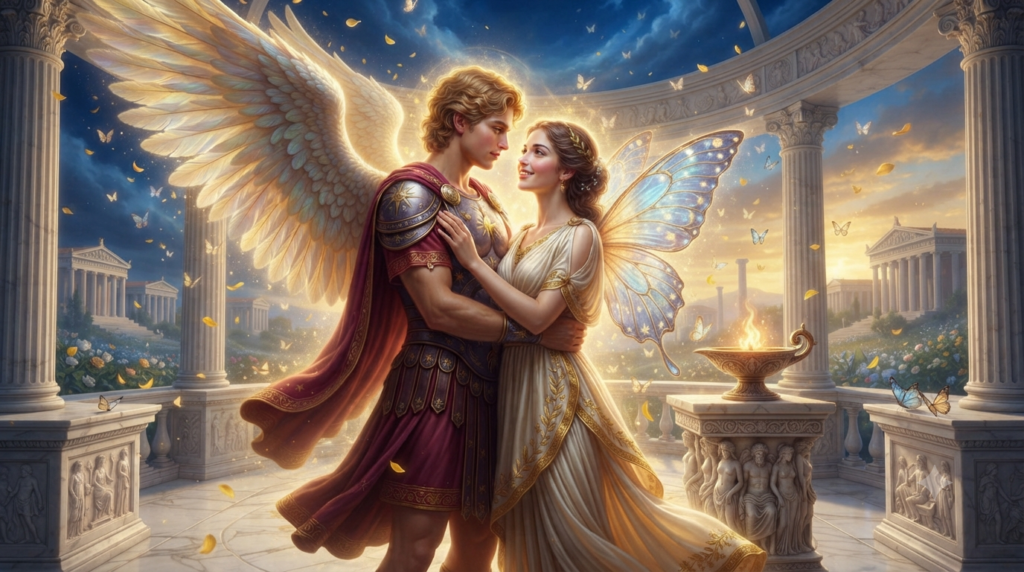
The answer to the question of who is Psyche’s partner (Eros/Cupid) in Greek mythology? is the god of love himself, known to the Greeks as Eros and to the Romans as Cupid. Theirs is not merely a romantic tale; it is the foundational myth of the soul’s journey toward true love, a story that has captivated audiences for millennia. Psyche, a mortal princess of breathtaking beauty, and Eros, the divine agent of desire, represent the ultimate union of the human soul with the power of love. Their relationship, forged through trials, deception, and immense suffering, ultimately culminates in a sacred marriage that elevates Psyche to immortality. The partnership is a complex allegory exploring the nature of trust, the pain of separation, and the transformative power of love that endures despite seemingly insurmountable obstacles.
The myth, preserved in its most complete form by the Roman writer Lucius Apuleius in his 2nd-century novel The Golden Ass, is a cornerstone of Western literature and art. It stands as a testament to the enduring human fascination with the soul’s search for its other half, with the trials that test the strength of love, and with the ultimate reward of divine union. To understand this myth is to understand a core archetype of romantic love that has influenced countless stories, poems, and artworks from antiquity to the present day .
Origins and Historical Background of the Myth
While the most famous and complete narrative of Eros and Psyche comes from a Roman source, the myth’s roots stretch back to classical Greece. The earliest known depictions of the pair appear in Greek art from the 4th century BC, suggesting that the core elements of their story were part of the mythological consciousness long before Apuleius penned his version . The names themselves are deeply significant. Psyche (Ψυχή) is the ancient Greek word for “soul” or “breath of life,” often personified as a butterfly, a symbol of the soul’s immortality and its capacity for transformation . Eros (Ἔρως), in Greek, is the personification of love, desire, and sexual attraction.
The relationship between Eros and Psyche, as we know it, is a unique blend of myth, folktale, and allegory. By the time of Apuleius in the 2nd century AD, the story had absorbed various influences. It contains elements common to the “monster’s bride” or “Cupid and Psyche” folktale type, but it is also deeply infused with Neoplatonic philosophy . In this philosophical framework, the soul (Psyche) is on a journey to achieve union with divine love (Eros). This elevated the story from a simple romance to a profound allegory for the soul’s ascent from the material world to a state of spiritual perfection. The myth’s survival and proliferation are almost entirely due to Apuleius’s work. After the fall of the Roman Empire, the story survived in manuscripts and was rediscovered during the Renaissance, profoundly influencing the art and literature of the period.
The Mythological Role: A Union of Soul and Love
The central relationship in the myth is not just a love story; it is a powerful statement about the nature of existence. Psyche’s role is to represent the human soul, with all its virtues, flaws, and potential for growth. Eros’s role is to represent the divine, irresistible force of love that can both torment and elevate. Their union is the ultimate goal, symbolizing the perfect state of being where the human soul finds its completion in divine love .
The myth serves several key functions. First, it provides an etiology, or origin story, for the concept of the soul and its connection to love. It argues that the soul’s ultimate destiny is to be united with a love that is both passionate and transcendent. Second, the trials Psyche undergoes serve as a moral and spiritual allegory. They demonstrate that the path to true love is paved with hardship, requiring courage, perseverance, and devotion. The story’s popularity as a wedding narrative in later art also highlights its role as a celebration of marriage, depicting it as a sacred, divinely sanctioned union .
Family and Relationships
The relationships in this myth are complex and pivotal to the plot. They define the motivations of the characters and drive the conflict forward.
Eros (Cupid) and His Mother, Aphrodite (Venus)
Aphrodite, the goddess of love and beauty, is Eros’s mother. Their relationship is strained and fraught with tension. Aphrodite views Psyche’s beauty as a threat and demands her son use his powers to punish her . When Eros disobeys and falls in love with Psyche, he is not just acting against his mother’s orders but challenging her authority and worldview. Aphrodite’s wrath is as much about her wounded pride as it is about divine retribution. Despite her anger, the myth suggests a complex mother-son dynamic. Aphrodite’s subsequent punishment of Psyche can be interpreted as a fierce, possessive form of love—a test to prove whether Psyche is worthy of her son .
Psyche and Her Sisters
Psyche has two older sisters who are consumed by jealousy. They are mortal and petty, representing the negative aspects of human nature that can corrupt and destroy. They exploit Psyche’s innocent curiosity, tricking her into betraying her husband’s trust. Their treachery leads directly to Psyche’s downfall and subsequent trials. Ultimately, their greed proves fatal, as they are killed when they attempt to claim the same divine destiny as their sister, falling to their deaths from the mountain .
The Offspring of Eros and Psyche
The final act of the myth is the birth of a daughter, named Hedone in Greek (Voluptas in Latin), the goddess of pleasure or delight . This child is the living embodiment of the union between the human soul (Psyche) and divine love (Eros). The concept of “pleasure” resulting from this perfect union is not a shallow hedonism but rather the profound and lasting joy that comes from finding true love and spiritual fulfillment.
Symbols and Meaning
The myth of Eros and Psyche is rich in symbolism, with each major element carrying profound meaning.
- The Butterfly: Psyche’s most enduring symbol is the butterfly, which she is often depicted with. It represents the soul, its immortality, and its capacity for transformation . Just as a caterpillar undergoes a metamorphosis to become a butterfly, Psyche transforms from a mortal princess into a divine goddess through her trials and love.
- The Lamp: Psyche’s lamp is a symbol of knowledge, curiosity, and betrayal. It is the instrument through which she breaks her husband’s trust, shedding light on the forbidden mystery of his identity. The lamp’s revelation, however, is a necessary step. It leads to suffering, but also to a more mature, knowledgeable love based on seeing the other truly and fully .
- The Oil and the Arrow: The hot oil that burns Eros and the arrow that scratches Psyche are potent symbols of the pain inherent in love. The oil represents the wound inflicted by suspicion and broken trust, while Eros’s arrow (which he scratches himself with, or which wounds Psyche) represents the sudden, feverish, and often painful onset of love that can also cause injury .
- The Impossible Tasks: The tasks that Aphrodite sets for Psyche—sorting grain, gathering golden fleece, collecting water from the Styx—are a series of impossible labors symbolizing the immense struggle and effort required for the soul to purify itself and achieve its goal. They represent the hardships, sacrifices, and trials one must endure in the pursuit of true love and self-transcendence .
- The Box of Beauty: Psyche’s final task is to bring a box of Persephone’s beauty from the underworld. When she succumbs to curiosity and opens it, she finds not beauty but a “Stygian sleep,” which kills her . This symbolizes the folly of trying to grasp divine perfection by mortal means. It represents a death of the old self and is the final trial before resurrection and transformation. It is only when she is “dead” to her mortal nature that Eros can find her and elevate her to immortality.
Powers and Characteristics
Eros (Cupid) is a god of immense power. He is the embodiment of desire, capable of inspiring love and attraction in all beings—mortals, gods, and even monsters. The myth asserts that he is so powerful that even his mother, Aphrodite, must use him to execute her will . Eros’s primary characteristic is his role as an agent of love, but he is also an independent being with his own emotions and desires. He is portrayed as rebellious against his mother, choosing his own path of love over obedience. He is initially deceptive, hiding his identity from Psyche, but ultimately proves to be a devoted and forgiving partner. His power is such that he can plead with the king of the gods, Zeus, to make Psyche immortal, demonstrating his elevated status even among the Olympians .
Psyche begins as a mortal princess possessing extraordinary beauty, a characteristic that causes her initial misfortune. However, her true strength lies not in her physical appearance but in her character. She is portrayed as intensely curious, a trait that leads to her downfall but also sets her journey in motion. More importantly, she is resilient, brave, and deeply devoted. When her husband forsakes her, she does not give up. She travels across the world, endures the wrath of a goddess, and completes impossible tasks . Her primary power as a mortal is her perseverance. Upon becoming a goddess of the soul, her characteristic is her dominion over the human spirit, representing the journey and final destination of every soul.
Worship and Religious Importance
While Psyche was never a major figure in public cult worship like the Olympian gods, she held significant religious and philosophical importance. Her apotheosis—the transformation from mortal to goddess—is a key element of the myth that would have resonated deeply in the ancient world, particularly within mystery religions.
The story of the soul’s journey, its trials, death, and rebirth, echoes the initiatory rituals of mystery cults such as those of Eleusis and Dionysus. These cults promised initiates a blessed afterlife, a concept that Psyche’s story beautifully illustrates. She represents the possibility of divine transformation for the human soul, offering a mythologized version of the hope for salvation .
Furthermore, by the time of Apuleius, who was himself a Platonist and possibly an initiate into mystery religions, the myth served as a vehicle for philosophical and theological ideas. The wedding of Eros and Psyche was an allegory for the soul’s ascent to the divine, a central theme in the Neoplatonic tradition that would become incredibly influential in later Western philosophy and Christian theology.
Ancient Sources
The primary and most complete source for the myth of Eros and Psyche is the novel Metamorphoses, commonly known as The Golden Ass, written by the Roman author Lucius Apuleius in the 2nd century AD. The story is presented as a tale-within-a-tale, told by an old woman to a kidnapped bride, and it occupies a significant portion of the book’s central books (IV-VI) .
Before Apuleius, the story existed in oral tradition and was depicted in Greek art. However, there is no surviving written Greek version that predates the Roman novel. Evidence of the myth’s earlier existence includes:
- Greek Art: Vase paintings and relief sculptures from the 4th century BC depict the figures of Eros and Psyche together, sometimes in a tender embrace, indicating that the love story was a known motif in Greek culture .
- Iconography: The image of Psyche with butterfly wings appears in classical art, confirming her association with the soul before Apuleius’s text.
Artistic Representations
The story of Eros and Psyche has been a favorite subject for artists for over two millennia. Their love and trials have been depicted in a vast array of media, including sculpture, painting, mosaic, and literature.
In ancient art, the pair is often shown in a tender, intimate manner, foreshadowing their ultimate union. With the rediscovery of Apuleius’s text in the Renaissance, the myth became a central theme in European art.
- Sculpture: One of the most famous depictions is Antonio Canova’s Neoclassical masterpiece, “Psyche Revived by Cupid’s Kiss” (1787-1793). The sculpture captures the climactic moment when Eros revives the seemingly lifeless Psyche with a kiss, his face full of love and her body arching towards him in a graceful, dynamic pose. It is an iconic representation of love’s power to conquer death.
- Painting: Numerous artists have painted scenes from the myth. Raphael and his workshop famously decorated the Villa Farnesina in Rome with frescoes depicting the story. Artists like François Gérard, Jacques-Louis David, and William-Adolphe Bouguereau all created celebrated paintings of Psyche’s encounter with Eros, often focusing on the moment of revelation with the lamp. The myth’s visual potential, from the beauty of its characters to the drama of its plot, has ensured its enduring popularity.
Cultural Influence and Historical Legacy
The myth of Eros and Psyche has transcended its ancient origins to become one of the most influential love stories in Western culture. Its themes have been adapted, reinterpreted, and retold countless times.
- Literature and Poetry: Beyond Apuleius, the myth has inspired poets and authors from Boccaccio in the 14th century to C.S. Lewis in the 20th. Lewis’s novel Till We Have Faces (1956) is a powerful reimagining of the story from the perspective of Psyche’s sister, exploring themes of jealousy, faith, and the nature of the gods .
- Philosophy and Psychology: The allegorical interpretation of the myth made it a cornerstone of Neoplatonic thought, which in turn influenced Christian theology. In modern psychology, the names of Eros and Psyche have been adopted by psychoanalysts. The term “psyche” is used for the human mind or soul, and “Eros” is used to describe the life instinct or creative drive, a concept famously developed by Sigmund Freud.
- Opera and Music: The story has been adapted into numerous operas, ballets, and musical works.
- Modern Media: The tale continues to be a source of inspiration for films, novels, and television shows, often serving as the blueprint for “Beauty and the Beast” style narratives, where a protagonist must learn to see beyond appearances to find true love.
Frequently Asked Questions About Who is Psyche’s partner (Eros/Cupid) in Greek mythology?
Who exactly is Psyche’s partner in the Greek myth?
Psyche’s partner is Eros, the Greek god of love, desire, and attraction. In Roman mythology, he is known as Cupid or Amor. He is the son of Aphrodite (Venus) and Ares (Mars) .
Is Psyche’s partner a god or a monster?
Initially, Psyche is told by an oracle that her husband will be a fearful monster. However, her unseen husband is actually Eros, a beautiful and powerful god. His identity is hidden from her, which is the source of the myth’s central conflict .
Why did Eros hide his identity from Psyche?
Eros hid his identity because he was acting against his mother Aphrodite’s orders, who had commanded him to make Psyche fall in love with a monster. He also wanted Psyche to love him for who he was, not just for the fear or awe of a god. He placed the condition that she must never look upon his face to preserve their trust and prevent his mother from discovering his disobedience .
What were the tasks Aphrodite gave Psyche to prove herself to Eros?
The tasks Aphrodite assigned Psyche were seemingly impossible trials. They included sorting a huge pile of mixed grains by nightfall, shearing golden fleece from violent and deadly rams, filling a flask from the water of the River Styx that flowed down a treacherous cliff, and, finally, traveling to the Underworld to retrieve a box of Persephone’s beauty .
How did Psyche complete the impossible tasks given by Aphrodite?
Psyche did not complete the tasks through her own strength alone. She received help from various sources. An army of ants sorted the grains for her, a green reed advised her on how to safely collect the golden fleece, and an eagle filled her flask with water from the Styx. For the final task of retrieving Persephone’s beauty, she was guided by a tower on how to navigate the Underworld .
Did Eros and Psyche have any children?
Yes, after Psyche was made a goddess and they were married, they had a daughter. Her Greek name is Hedone, which translates to “Pleasure” or “Delight.” In Roman mythology, she is known as Voluptas .
What is the main lesson or theme of the Eros and Psyche myth?
The core theme of the myth is the idea that true love requires trust and patience. It is also a powerful allegory for the human soul’s journey toward divine love and perfection. The story teaches that the path to love is often filled with trials and suffering, but through resilience, devotion, and perseverance, the soul can achieve a transcendent and blissful union .
Where can I find the original story of Eros and Psyche?
The most complete and famous version of the story is found in the Roman novel Metamorphoses, also known as The Golden Ass, written by Lucius Apuleius in the 2nd century AD. It is a classic of Latin literature and has been translated into many languages .
Conclusion
The myth of Eros and Psyche is far more than a simple love story. It is a profound and enduring allegory about the nature of the human soul and its quest for love. Psyche’s partner, Eros, is not just the agent of love but the divine goal itself. The journey from a mortal princess to a goddess, from the pain of separation to the joy of reunion, encapsulates the human struggle for connection, trust, and self-fulfillment.
The myth’s historical importance is immense; it has survived from antiquity to the present day, shaping our understanding of romance, spirituality, and psychology. Culturally, it has provided the blueprint for countless stories where love must triumph over adversity and appearances must be overcome to reveal a deeper truth. Today, the story of Psyche’s trials and Eros’s devotion reminds us that the pursuit of love is a demanding and often painful path, yet it is the only one that leads to the soul’s ultimate transformation. Their partnership is the symbolic foundation upon which we have built our ideal of romantic love and spiritual bliss.

Orin Vale has spent the better part of two decades tracing the threads that connect the world’s oldest stories — from the halls of Asgard to the banks of the Nile, from Olympus to the jungles of the Maya. What began as a childhood fascination with flood myths and trickster gods grew into years of independent study across comparative mythology and ancient religion, always chasing the same question: what did these stories mean to the people who first told them? Orin writes for readers who want more than trivia — the ones looking for the beliefs, fears, and truths that myths were built to carry.