The question of who are the Pygmies in Greek mythology? leads us to one of the most fascinating and enduring tribes of the ancient Greek imagination. The Pygmies (Greek: Πυγμαῖοι Pygmaioi) were a legendary race of diminutive humans whose name derives from the Greek word pygmē, meaning “fist” or the length of the forearm from the elbow to the knuckles, a measurement of about 18 inches . They were not mere fantasy but a people believed to inhabit the most distant and exotic regions of the known world, locked in an eternal and epic struggle against their mortal enemies, the cranes. This seemingly humorous conflict, first immortalized by Homer in the Iliad, captivated the Greek and Roman imagination for over a millennium, becoming a powerful symbol of courage against overwhelming odds and a testament to the ancient world’s fascination with the unknown edges of the earth. The myth of the Pygmies offers a unique window into ancient Greek perspectives on geography, ethnography, and the nature of heroism.
Origins and Historical Background
The origins of the Pygmy myth are deeply rooted in the earliest layers of Greek literature and were influenced by a combination of poetic invention and garbled reports from distant lands. The name itself, Pygmaioi, first appears in the works of Homer, who is considered the primary source for the legend . However, the myth likely predates Homer, drawing from an ancient oral tradition that placed fantastical peoples at the world’s edge . From their very first mention, the Pygmies were defined by their diminutive stature, their location at the farthest reaches of the world, and their ceaseless war with cranes.
The myth’s historical context is crucial to understanding its significance. The ancient Greeks were explorers and colonists, but their knowledge of the world beyond the Mediterranean was often fragmentary and blended with myth. The Pygmies were a way to make sense of the unknown. Their homeland was placed in various exotic locales, often shifting with the expanding geographical knowledge of the Greeks. Initially, in Homer, they dwelled near the river Oceanus, the great, earth-encircling river believed to lie at the southern edge of the world . As Greek geographical awareness grew, they were relocated to the sources of the Nile in Africa, or even as far as India, reflecting the merging of mythology with ethnography . The story took on a life of its own, influenced by accounts from travelers and traders who brought back stories of strange peoples, which were then integrated into the existing mythological framework. The myth’s longevity is largely due to its inclusion in foundational works by poets, historians, and philosophers who treated it not purely as a fable, but as a genuine, albeit exotic, natural phenomenon .
The Mythological Role of the Pygmies
The primary mythological role of the Pygmies is to inhabit the periphery of the known world and to personify the epic struggle between civilization and the forces of nature. They are not central figures in grand mythological sagas like the Trojan War, but they serve as a colorful and important element in the tapestry of Greek myth.
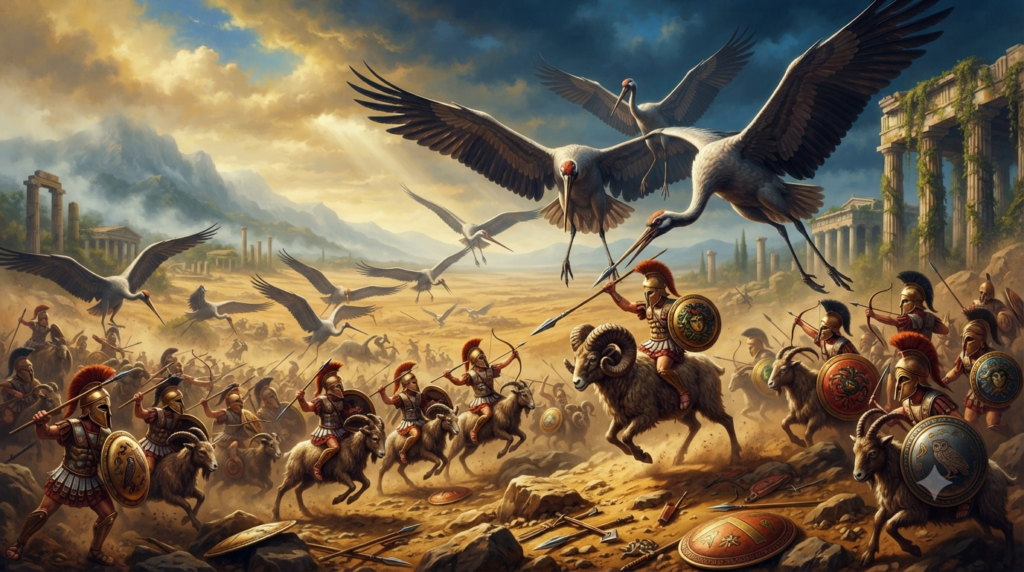
Their most famous role is as the perennial antagonists of the cranes. This “geranomachy” (crane-war) is first described in the Iliad, where Homer uses the clamor and chaos of the battling Pygmies and cranes as a simile for the Trojan army . This single, powerful image gave birth to an entire mythological subgenre. The war symbolizes the eternal conflict between a brave but small people and a formidable natural force. It was seen as a comical, yet heroic, struggle, representing the underdog’s fight for survival. The Pygmies, in their tiny bodies, embodied a fierce and indomitable spirit . The myth served as a cultural touchstone, offering a metaphor for the small but valiant individual facing a colossal challenge, a theme that would be retold and adapted for centuries.
Family and Relationships
The Pygmies, though a tribe, were given genealogical connections that integrated them into the broader world of Greek mythology.
Ancestry and Origins
According to some sources, the Pygmies were earth-born, akin to the race of Giants. This lineage is suggested by their connection to the giant Antaeus, whose death at the hands of Heracles they sought to avenge in one tale . This made them children of Gaia (Earth), which explained their connection to the land and their underground dwellings. The poet Hesiod, in a fragmentary work, traces their lineage to Epaphus, the son of Zeus and Io, making them descendants of the same divine bloodline as the Ethiopians and Libyans . This genealogical link placed them within a recognizable framework of legendary peoples, lending their existence a degree of credibility.
Notable Individuals and Enemies
The most famous individual associated with the Pygmies is their Queen Gerana. In a story recounted by the Roman poet Ovid, Gerana was a Pygmy queen of exceptional beauty who boasted that she was more beautiful than the goddess Hera . This act of hubris was swiftly punished: the enraged Hera transformed Gerana into a crane, forever making her an enemy of her own people. This etiology (an origin story) explained the eternal enmity between the Pygmies and the cranes, turning a natural migration pattern and a supposed battle into a personal and divine vendetta. Her metamorphosis was a cautionary tale about the dangers of pride, especially when challenging the gods.
Symbols and Meaning
The Pygmies and their world are rich in symbolism, with their physical characteristics, their war, and their way of life carrying profound meaning.
- Diminutive Stature: The Pygmies’ small size is their defining characteristic and a potent symbol. It represents the vulnerability and powerlessness of humanity in the face of the vastness of nature and the cosmic order. However, it is simultaneously a symbol of defiant courage and cunning. Their boldness in fighting the cranes and even attacking the sleeping Heracles shows that size is no measure of spirit . The Greeks used the proverbial phrase “fitting Pygmies’ spoils onto a colossus” to describe those who toil in vain, referencing the absurdity of comparing small things to huge ones .
- The Geranomachy (Crane War): The battle with the cranes is the most potent symbol of the Pygmy myth. It represents the eternal struggle against superior forces, whether they be natural disasters, invading armies, or the challenges of fate. It is also a metaphor for the agricultural cycle, where farmers must constantly defend their crops from ravaging birds . The Pygmies’ annual expedition to destroy the cranes’ eggs and chicks can be seen as a mythologized version of a farmer’s battle against pests .
- Underground Dwellings: The Pygmies were often said to live in caves or underground houses, literally and figuratively placing them on the margins of the civilized world . This association with the earth, particularly if they were considered “earth-born,” linked them to chthonic (underworld) powers. Their subterranean homes symbolized their connection to the primitive and the elemental, contrasting with the above-ground, sunlit cities of the Greeks. Their houses, sometimes described as being made of mud, feathers, and eggshells, reinforced this connection to the natural world .
Powers and Characteristics
The Pygmies, though small, possessed a distinctive set of characteristics and, in a sense, their own “powers.”
- Diminutive Size: Their height was their most famous characteristic. Various authors gave different measurements. Homer simply calls them “Pygmaian,” but later writers were more specific. Pliny the Elder described the “Three-Span” Pygmies (Trispithami), who were no more than three spans (27 inches) tall . Ctesias, a Greek physician and historian, placed them in India and described them as being about two cubits (approximately three feet) tall .
- Fierce Warriors: Despite their tiny stature, the Pygmies were renowned as a fierce and warlike race. They were expert archers and slingers, and they rode into battle on the backs of rams and goats . Their annual war against the cranes required military organization and bravery. They were even bold enough to attack the hero Heracles while he slept, though this audacity ultimately proved futile .
- Agricultural Society: The Pygmies were not just warriors; they were also an agricultural people. They were described as sowing and reaping grain, using axes to harvest stalks they believed to be “trees” . This detail adds a layer of civilization to their character, moving them beyond the realm of simple monstrous beings.
- Short Lifespan and Unusual Customs: In later medieval and legendary accounts, the Pygmies acquired even more fantastical traits. The 14th-century Travels of Sir John Mandeville claimed they lived only six or seven years, and married at six months old . They were also portrayed as master craftsmen who could work gold, silver, and silk with remarkable skill .
Worship and Religious Importance
The Pygmies did not have a formal cult of worship in the Greek world, but their myth held significant religious and philosophical importance. Their story was deeply intertwined with the concept of hubris (overweening pride) and divine retribution, as seen in the tale of Queen Gerana. Her transformation into a crane served as a powerful moral lesson: no mortal, no matter how beautiful or honored, could challenge the supremacy of the gods .
Furthermore, the Pygmies’ presence in the works of Homer and Hesiod gave them a canonical status that ensured their inclusion in discussions about the nature of the world. Philosophers and historians debated their existence as part of a larger intellectual project to map the known world and its inhabitants. For Aristotle, the Pygmies were not a fable but a real race living near the sources of the Nile . For Strabo, they were a fabulous invention . This debate reflects the ancient Greek struggle to distinguish between myth and reality, a core function of their developing scientific and philosophical traditions.
Ancient Sources
The primary ancient sources for the Pygmies span literature, history, and philosophy, demonstrating the widespread cultural currency of the myth.
- Homer’s Iliad (c. 8th century BC): The foundational text. Homer’s simile in Book III is the earliest and most famous reference, establishing the war with the cranes as the Pygmies’ defining trait .
- Hesiod’s Catalogue of Women (c. 7th-6th century BC): A fragmentary work that traces the genealogy of the Pygmies, connecting them to the lineage of Epaphus .
- Herodotus’s Histories (c. 5th century BC): The “Father of History” treats the Pygmies as a real people, relaying a story about Nasamonian explorers who encountered them in Africa, providing the myth with ethnographic weight .
- Aristotle’s History of Animals (c. 4th century BC): The philosopher definitively states that the Pygmies are real, placing them near the sources of the Nile and describing their caves and lifestyle .
- Pliny the Elder’s Natural History (1st century AD): The Roman encyclopedist compiles a detailed description of the Pygmies, including their height (three spans), their war with the cranes, and their houses made of mud and feathers .
- Ovid’s Metamorphoses (1st century AD): The poet recounts the transformation of Queen Gerana into a crane, providing an etiology for the eternal conflict .
- Philostratus’s Imagines (3rd century AD): Provides a vivid description of the Pygmies attacking the sleeping Heracles, full of comic and heroic detail .
- Apollonius of Tyana: The biography by Philostratus also mentions the Pygmies, describing them as living underground .
Artistic Representations
The Pygmies were a popular subject in ancient Greek and Roman art, with the “geranomachy” (crane-battle) being a particularly favored scene .
- Vase Painting: The earliest and most extensive depictions come from Greek vase painting. One of the most famous examples is the François Vase, an Athenian black-figure volute krater dating to c. 570 BC, which features a detailed scene of Pygmies armed with clubs, hooked sticks, and slings, riding on goats as they battle cranes . On later Archaic and Classical vases, they were often portrayed as pudgy and grotesquely proportioned dwarves, which may have been intended for comic effect .
- Mosaics and Wall Paintings: In the Hellenistic and Roman periods, the Pygmies appeared in a wider variety of media. They were featured in Nilotic scenes (scenes of Egyptian life) on Roman mosaics and wall paintings, often engaged in humorous confrontations with crocodiles and hippopotamuses, which shows how the myth was adapted to different contexts .
- Sculpture and Gems: Pygmies also appeared on Hellenistic rhyta (drinking horns) and were featured in isolated groups on engraved gems .
Cultural Influence
The myth of the Pygmies has had a surprisingly long and varied cultural influence, extending far beyond the ancient world.
- Geography and Exploration: The myth directly influenced the naming and perception of real peoples. When 19th-century European explorers encountered the short-statured indigenous peoples of Central Africa, they called them “Pygmies,” consciously applying the ancient Greek name to them . This act of naming had profound and often problematic consequences, imposing a mythological framework onto real human populations.
- Literature: The Pygmies became a staple of classical and medieval bestiaries and encyclopedias. They were included in St. Augustine’s The City of God as one of the monstrous races of men, and in The Travels of Sir John Mandeville, where they were given even more fantastical traits . Perhaps most famously, Jonathan Swift used the myth as a direct template for the Lilliputians in Gulliver’s Travels . In the 20th century, C.S. Lewis included “Dufflepuds,” a race of monopodial dwarfs inspired by Pliny’s account, in his Chronicles of Narnia.
- Philosophy and Intellectual History: The debate over the existence of the Pygmies served as a case study for early modern scholars. Sir Thomas Browne, in his Pseudodoxia Epidemica (1646), systematically argued that the Pygmy myth was a poetic fiction, while other learned authors believed in their literal existence . This debate is a key part of the history of science, illustrating the slow shift from credulous acceptance of ancient authority to empirical skepticism.
Legacy
The legacy of the Pygmy myth is multifaceted and continues to resonate today. Its most immediate legacy is the modern ethnonym “Pygmy,” which is still used to describe the Aka, Mbuti, and other Central African peoples . This is a powerful and controversial legacy, as it demonstrates how ancient literary tropes can shape and sometimes distort modern scientific and cultural discourse.
The myth’s narrative core—the courage of the small and weak against the large and powerful—has become an archetypal story. It is a forerunner of the “underdog” narrative that pervades modern culture, from sports to politics to epic fantasy. Furthermore, the constant literary, artistic, and scholarly engagement with the story from antiquity to the present day is a testament to its enduring appeal. It is a story that has been continually retold and reinterpreted, showing the remarkable power of a single Homeric simile to create a world and a people that have captivated the human imagination for nearly three millennia.
Frequently Asked Questions About Who are the Pygmies in Greek mythology?
Where did the Pygmies live according to Greek mythology?
The Pygmies were believed to inhabit the most remote and exotic regions of the world. In Homer’s Iliad, they lived on the southern shores of the river Oceanus, the great river that encircled the earth . As Greek geographical knowledge expanded, they were relocated to the sources of the Nile in Africa, or to the far-off lands of India . In essence, they were always placed at the edge of the known world, emphasizing their otherness and exotic nature.
Why were the Pygmies always at war with cranes?
The battle was an eternal struggle, often interpreted as a fight for survival. According to one myth, the war began as a punishment from the goddess Hera. The Pygmy Queen Gerana boasted of her beauty, and in revenge, Hera transformed her into a crane, making her and all cranes the eternal enemies of the Pygmies . Other explanations frame it as a practical war: the Pygmies fought the cranes to destroy their eggs and young, thereby protecting their own crops from the migratory birds .
What did the Pygmies look like?
They were described as diminutive humans of very small stature. Various ancient authors gave different measurements, from the length of a forearm (about 18 inches) to three spans (27 inches) or two cubits (about 3 feet) . In art, they were often depicted as pudgy, comical dwarves with larger heads and sometimes with exaggerated features, though in some depictions they appear as fully armed, normal-looking warriors .
Did the ancient Greeks believe the Pygmies were real?
Yes and no. The belief in the Pygmies was a subject of debate. Some, like the philosopher Aristotle, accepted them as a genuine race of people living in Africa . Others, like the geographer Strabo, dismissed the entire story as a fabulous invention of Homer’s . This debate reflects the broader ancient intellectual struggle to reconcile poetic tradition with emerging scientific knowledge. Their presence in both historical and philosophical texts indicates they were taken seriously by many.
What is the story of the Pygmies and Heracles?
In a humorous tale recounted by Philostratus, the Pygmies attempted to attack the hero Heracles while he was sleeping in Libya after killing the giant Antaeus . Claiming to be Antaeus’s brothers, the entire Pygmy army swarmed the hero. They brought siege engines against his head as if it were a fortress and attacked his limbs. But the giant was unharmed; he awoke, laughed at them, and scooped up all the warriors in his lion skin to carry them away .
What did the Pygmies use for transportation in their war?
For their epic battles against the cranes, the Pygmies were said to ride into combat on the backs of rams and male goats . This detail added to the comical and fantastic nature of the myth, portraying a miniature cavalry mounting a war against the birds from the sky.
What does the word “Pygmy” mean?
The word comes from the ancient Greek pygmaios, which is derived from pygmē, meaning “fist” or the length of the forearm from the elbow to the knuckles . In Greek, this measurement was used to describe the diminutive stature of the legendary people. The name itself is a defining characteristic, emphasizing their small size in relation to the Greek norm.
How did the Pygmies influence the naming of real people?
When European explorers in the 19th century encountered the short-statured indigenous peoples of Central Africa, they drew a direct connection to the ancient Greek myth and named them “Pygmies” . This act of naming has had a lasting impact, as the term is still used today to refer to various ethnic groups such as the Mbuti and Aka, despite being a label imposed from outside.
Conclusion
The Pygmies of Greek mythology are far more than a simple footnote in ancient lore. They represent a fascinating intersection of poetry, proto-science, and cultural imagination. From their first appearance in Homer’s Iliad as a simile for a clamoring army, they evolved into a fully-realized race inhabiting the world’s edge, eternally locked in a heroic and comical war with cranes. Their myth provided answers to questions about the unknown, gave a face to the exotic “other,” and served as a powerful moral lesson about pride and the importance of courage, no matter how small the vessel. Their legacy is immense, from influencing the naming of real indigenous groups to providing the template for iconic literary works like Gulliver’s Travels. The Pygmies remind us that even the most fantastical myths can have a profound and lasting impact on how we understand ourselves and the wider world. They endure as a testament to the power of storytelling, a cautionary tale about the dangers of hubris, and a timeless symbol of the indomitable spirit of the underdog.

Orin Vale has spent the better part of two decades tracing the threads that connect the world’s oldest stories — from the halls of Asgard to the banks of the Nile, from Olympus to the jungles of the Maya. What began as a childhood fascination with flood myths and trickster gods grew into years of independent study across comparative mythology and ancient religion, always chasing the same question: what did these stories mean to the people who first told them? Orin writes for readers who want more than trivia — the ones looking for the beliefs, fears, and truths that myths were built to carry.