The question of who are the Makroboi in Greek mythology? leads us to one of the most fascinating and enigmatic peoples of the ancient Greek imagination. The Makroboi (Μακροβίοι, meaning “long-lived”), also known as the Macrobians, were a legendary race of Ethiopians who inhabited the farthest reaches of the known world . Their name, derived from the Greek words makros (“long”) and bios (“life”), tells us everything we need to know about their most defining characteristic: they were a people blessed with extraordinary longevity, with an average lifespan of 120 years . Unlike the mythical creatures or monsters of Greek lore, the Makroboi occupied a fascinating space between historical ethnography and mythological fantasy, representing the ancient Greek fascination with the exotic peoples who dwelled at the edges of the earth. This article will serve as a definitive guide to the Makroboi, exploring their origins, their depiction in ancient sources, their legendary encounter with the Persian Empire, and their enduring legacy in the history of geographical and ethnographic thought.
Origins and Historical Background of the Makroboi
The origins of the Makroboi myth are firmly rooted in the earliest Greek explorations of the known world. The concept of the Makroboi emerged during a period when Greek geographical knowledge was expanding, and they were placed at the extremity of the known world, in this case in the extreme south, contrasting with the Hyperboreans in the extreme north . Their home was associated with Aethiopia, a vast and somewhat undefined landmass that the Greeks believed lay south of Egypt. For the Greeks, “Aethiopia” was a mythical as well as a geographical term, referring to the lands at the edge of the world inhabited by people blessed by the gods .
The primary source for the Makroboi is the 5th-century BCE Greek historian Herodotus, who is often called the “Father of History” . In his monumental work, the Histories, Herodotus provides the most detailed account of this legendary people. According to Herodotus, the Makroboi dwelt geographically along the sea south of Libya on the Atlantic, though it is important to note that later authors placed them elsewhere, such as India, demonstrating the fluid nature of ancient geographical knowledge .
Herodotus’s account likely drew upon a combination of Egyptian sources, travelers’ tales, and Greek ethnographic speculation . The Egyptians had long traded with and conducted military campaigns into Nubia and Ethiopia, and they would have possessed some knowledge of the peoples living beyond their southern borders. However, the Egyptians had little incentive to share precise information with the Persians, and Herodotus’s account of the Makroboi may have been a mixture of genuine ethnographic detail, hearsay, and deliberate obfuscation by his Egyptian informants . Nevertheless, the existence of the Makroboi myth demonstrates the deep Greek fascination with the world beyond the Mediterranean and their belief that remote lands were home to extraordinary peoples with unusual customs and gifts.
The Mythological Role of the Makroboi
The primary mythological role of the Makroboi was to embody the concept of a blessed and ideal existence at the edge of the world. Their extraordinary longevity was a sign of divine favor and a mark of their status as a people living in a state of natural perfection. In contrast to the short, often brutal lives of ordinary mortals, the Makroboi enjoyed a life span of 120 years or more, which the Greeks interpreted as a direct consequence of their pure diet and their closeness to the gods .
The Makroboi’s role in the broader mythological imagination was to represent the “other,” a people who lived according to different principles and laws. They were not merely a curiosity but a challenge to the assumptions of the Greek and Persian world. Their king’s famous response to the Persian emperor Cambyses—a challenge to string an unstrung bow—was a potent symbol of the futility of imperial ambition and the power of a people who lived in harmony with their own values . The Makroboi were a mirror held up to the Greek and Persian worlds, exposing the limitations of their own cultures and the arrogance of their empires.
Family and Relationships
The Makroboi, as a legendary people, were not integrated into the genealogical family trees of the gods and heroes in the same way as the figures of Greek myth. However, they were closely associated with the concept of Aethiopia and the Ethiopians, who were themselves sometimes mythologized as a people beloved by the gods. In Greek mythology, the Ethiopians were often depicted as a pious and blessed race, and the Makroboi can be seen as a sub-group of this broader Ethiopian category .
The relationship between the Makroboi and the gods is implied through their extraordinary lifespan. Their longevity was a divine gift, a sign that they lived in a state of favor with the divine powers. This association with the gods places them in a different category from the monstrous races of Greek myth, such as the Cyclopes or the Giants. The Makroboi were not monsters but exemplary humans, living proof that the gods could bestow extraordinary blessings upon those who lived in accordance with the natural order.
Symbols and Meaning
The symbols associated with the Makroboi are deeply tied to their physical characteristics, their customs, and their values.
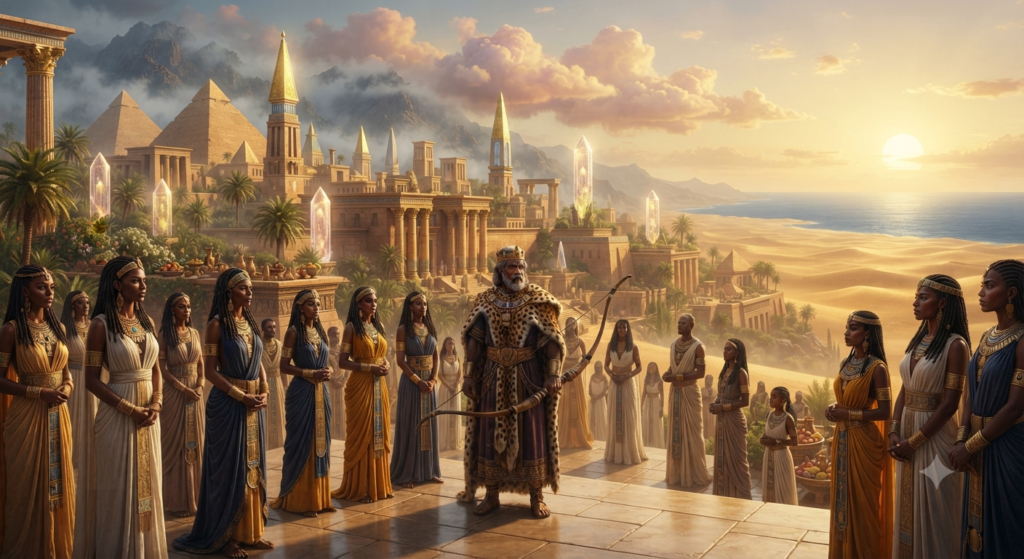
- The Unstrung Bow: The bow that the Makroboian king sent to Cambyses was a powerful symbol of the limits of imperial power. It represented the strength and self-sufficiency of the Makroboi, and the inability of the Persians to conquer them. The bow also symbolized the Makroboi’s martial prowess and their contempt for the Persian king who could not bend it .
- The Crystal Sepulchres: The Makroboians practiced an elaborate form of embalming, preserving their dead in hollow crystal pillars that were kept in their homes. This practice was a symbol of their reverence for the dead and their belief in the preservation of the body. The crystal pillars also symbolized the purity and incorruptibility of the Makroboi, who were able to keep their dead among them without decay .
- Golden Chains: According to Herodotus, the Makroboi had so much gold that they shackled their prisoners in golden chains. This was a symbol of the immense wealth of the region and the Makroboi’s indifference to a metal that others prized so highly. It represented a kind of inverted world, where the most precious metal in the Persian Empire was used for the most menial of purposes .
- The Table of the Sun: The Makroboi had a sacred meadow where boiled meat was laid out for all who chose to eat. This was a symbol of their communal generosity and their trust in the bounty of the earth. The “Table of the Sun” represented a state of natural abundance that did not require the labor of agriculture or the accumulation of private property .
Powers and Characteristics
The defining “power” of the Makroboi was their extraordinary longevity. Herodotus reports that they lived to be 120 years old on average, and sometimes older . This remarkable lifespan was attributed to their diet, which consisted primarily of boiled flesh and milk, and their rejection of the bread that was the staple food of the Greeks and Persians .
The Makroboi were also characterized by their physical stature and beauty. They were said to be the “tallest and handsomest of all men” . Their height was so notable that they elected their king on the basis of stature, choosing the tallest man among them to rule . This combination of longevity and physical perfection placed the Makroboi in a category beyond the normal human condition.
They were also a people of remarkable wealth and resourcefulness. They possessed vast quantities of gold, which they used for the most common purposes. They practiced a sophisticated form of embalming, and they lived in a city with laws and institutions . Their civilization, as described by Herodotus, represented a form of ideal society that contrasted sharply with the empires of Greece and Persia.
Worship and Religious Importance
The Makroboi were not worshipped themselves, but their existence and their customs had religious significance in the context of ancient Greek thought. Their longevity was a sign of divine favor, and their customs were often interpreted as a form of piety. The “Table of the Sun,” for instance, was a sacred ritual that reflected a belief in the bounty of the gods and the importance of communal sharing .
The Makroboi also practiced a form of reverence for the dead that involved the preservation of the body. This practice was seen as a mark of respect for the deceased and a belief in the continuity of the soul. The dead were kept in the homes of their relatives for a year and given offerings, suggesting a form of ancestor worship . In this sense, the Makroboi were a people of deep religious conviction, and their practices reflected a worldview that was different from, but no less valid than, that of the Greeks.
Ancient Sources
The primary ancient source for the Makroboi is Herodotus’s Histories. Book 3, chapters 17-25, contains the most detailed account of the Makroboi, their encounter with Cambyses, and their customs . Herodotus’s account is the foundation upon which all later references to the Makroboi are built. It is a text that has been studied and debated for centuries, and its influence on the history of geography and ethnography is immense.
Later authors also mentioned the Makroboi, though often with variations. The Roman author Pliny the Elder, drawing on the authority of the Greek physician Ctesias, placed the Makroboi in India, rather than Africa . This demonstrates the fluid nature of ancient geography and the tendency of writers to adapt earlier sources to their own frameworks. The Greek geographer Strabo and the Roman historian Diodorus Siculus also referenced the Makroboi, though their accounts are less detailed than Herodotus’s.
A pseudo-Lucianic work entitled Macrobii (The Long-Lived) also survives from antiquity, though it is not a mythological account but a catalog of long-lived individuals and peoples, including the Makroboi .
Artistic Representations
The Makroboi are not a common subject in surviving ancient Greek or Roman art. Unlike the gods and heroes of mythology, they were a legendary people rather than a series of individual figures, making them more difficult to depict in narrative art. However, their association with Aethiopia, which was a common subject in Roman art, particularly in Nilotic scenes, suggests that they may have been depicted in some contexts.
The “Nilotic” scenes that appear in Roman mosaics and wall paintings often depict the exotic peoples and wildlife of Africa. These scenes may have included figures representing the Makroboi, though they would have been difficult to distinguish from other Ethiopian figures. The lack of specific artistic representations, however, only underscores the Makroboi’s status as a mythologized people whose identity was defined more by their conceptual characteristics than by any particular iconography.
Cultural Influence
The influence of the Makroboi extends far beyond the pages of Herodotus. Their story has been a source of fascination for writers, historians, and travelers for centuries.
- Geography and Ethnography: The Makroboi served as a model for the “other” in ancient thought. They represented the exotic, the blessed, and the powerful peoples who lived at the edge of the known world. Their story was a testament to the limits of imperial power and the importance of respecting the customs and values of other peoples.
- Travel Literature: The story of the Makroboi appears in the works of later travelers and explorers, such as James Bruce, who attempted to identify them with the Shangalla people of Nubia . This effort to map the Makroboi onto real historical populations reflects the enduring power of the myth and the desire of later generations to find the truth behind Herodotus’s account.
- Philosophy: The Makroboi were a subject of philosophical reflection on the nature of human life and the ideal society. Their longevity and their rejection of bread were seen as evidence of the superiority of a simple, natural way of life. Their king’s response to Cambyses was a powerful critique of Persian hubris and a lesson in the limits of imperial ambition.
Legacy
The legacy of the Makroboi is complex and multifaceted. They represent the enduring power of Herodotus’s Histories and the influence of his account of the ancient world. They also demonstrate the ancient Greek fascination with the exotic peoples of Africa and the importance of Ethiopia in the Greek imagination.
The Makroboi have been the subject of scholarly debate for centuries. Scholars have attempted to identify them with various historical populations, including the Abyssinians, the Shangalla, and the Makaberab tribe of the Atbarah region in Sudan . The debate over their true identity reflects the difficulty of interpreting Herodotus’s account and the challenge of distinguishing myth from reality in ancient history.
Ultimately, the Makroboi are a testament to the power of myth to shape our understanding of the world. They represent a vision of a perfect people living in harmony with nature, blessed by the gods, and defiant in the face of imperial aggression. Their story is a reminder that the ancient world was not just a world of gods and heroes but also a world of peoples who lived beyond the boundaries of the known world, embodying the dreams and desires of the cultures that imagined them.
Frequently Asked Questions About Who are the Makroboi in Greek mythology?
Who exactly were the Makroboi in Greek mythology and history?
The Makroboi (also known as the Macrobians) were a legendary people mentioned by the historian Herodotus. They were a tribe of Ethiopians who lived in a kingdom at the edge of the known world, believed to be in Africa near the Atlantic coast. Their name means “long-lived,” as they were said to live to an average age of 120 years .
Where did the Makroboi live according to ancient sources?
Herodotus placed the Makroboi along the “southern sea” in Libya (Africa), at the farthest reach of the inhabited world. Later authors, such as Pliny the Elder, placed them in India instead, showing the fluidity of ancient geographical knowledge .
What is the story of the Makroboi and the Persian Emperor Cambyses?
According to Herodotus, Cambyses II of Persia sent spies to the Makroboi after conquering Egypt. The Makrobian king, who was elected based on his stature, sent back a challenge to the Persians: an unstrung bow. He told them that if the Persians could string it, they would have the right to invade his country; until then, they should be grateful that the Makroboi did not invade Persia .
What made the Makroboi “long-lived”?
The Makroboi were believed to live to 120 years or more due to their diet and lifestyle. They ate boiled meat and milk and rejected bread, which was the staple of the Persians and Greeks. The Makrobian king derided the Persians’ diet as “rubbish” .
What were the customs and practices of the Makroboi?
The Makroboi had an elaborate practice of embalming their dead and preserving them in hollow crystal pillars. They had so much gold that they used it to make chains for their prisoners. They also elected their king based on his height, selecting the tallest man to rule .
What is the “Table of the Sun” associated with the Makroboi?
The “Table of the Sun” was a sacred meadow in the Makrobian capital where boiled meat was laid out each night for anyone to eat during the day. It was a symbol of communal generosity and the bounty of the earth .
Did the Makroboi have any connection to the gods?
Their extraordinary longevity and their abundance of resources were interpreted as signs of divine favor. Their customs, including their reverence for the dead and their sacred “Table of the Sun,” suggested a people who lived in harmony with the divine order.
Are the Makroboi considered a real historical people or a myth?
The Makroboi are generally considered a legendary people. While they were based on real peoples that the Greeks and Egyptians may have encountered, their depiction in Herodotus is heavily mythologized. They serve as an ideal “other” to contrast with Greek and Persian civilizations .
Conclusion
The Makroboi of Greek mythology represent a fascinating intersection of history, myth, and geography. Their name, meaning “long-lived,” points to the defining characteristic that captured the Greek imagination: a people blessed with an extraordinary lifespan, physical perfection, and immense wealth. In the pages of Herodotus, they stand as a powerful symbol of the limits of imperial ambition, a reminder that there were peoples beyond the reach of the Persian Empire who lived according to different principles and values. The Makroboi were not merely a curiosity but a moral and philosophical challenge, an example of a society that had achieved a state of natural perfection. Their story is a testament to the power of ancient storytelling to shape our understanding of the world and to the enduring human fascination with the exotic and the unknown.

Orin Vale has spent the better part of two decades tracing the threads that connect the world’s oldest stories — from the halls of Asgard to the banks of the Nile, from Olympus to the jungles of the Maya. What began as a childhood fascination with flood myths and trickster gods grew into years of independent study across comparative mythology and ancient religion, always chasing the same question: what did these stories mean to the people who first told them? Orin writes for readers who want more than trivia — the ones looking for the beliefs, fears, and truths that myths were built to carry.