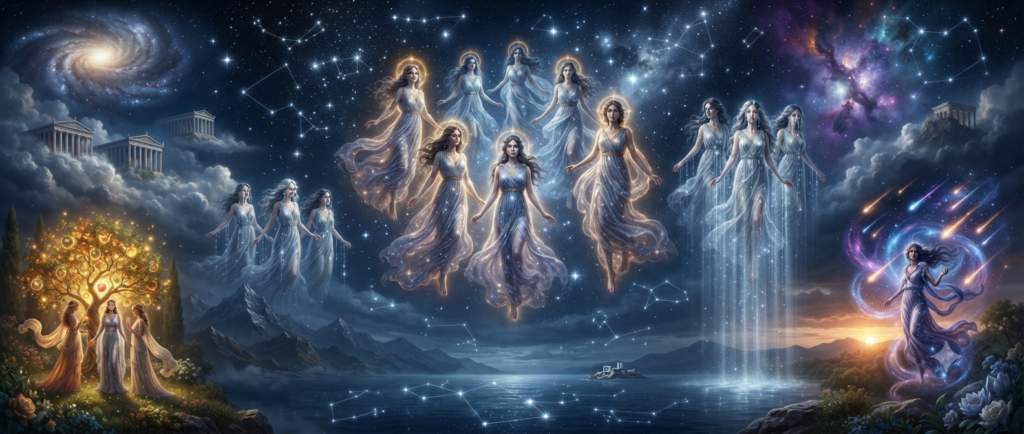
The question of who are the celestial nymphs of Greek mythology? opens a window into a shimmering realm where the boundaries between the divine, the natural, and the astronomical blur into a single, luminous tapestry. These were not the nymphs of rushing streams or shadowy forests, but rather the ethereal denizens of the sky, the stars, and the cosmic order. They were the personifications of clouds, stars, constellations, and the celestial phenomena that governed the ancient Greek understanding of time, navigation, and fate. From the rain-bringing Hyades to the starry Pleiades, from the goddess of falling stars to the nymphs of the sunset, these celestial beings occupied a unique and vital space in the mythological imagination. They were the daughters of Titans and gods, the companions of Olympians, and the brides of the sun itself. This article will serve as a definitive guide to the celestial nymphs, exploring their origins, their diverse forms, their roles in myth, and their enduring legacy in the stars above.
Origins and Historical Background of the Celestial Nymphs
The concept of celestial nymphs is deeply embedded in the ancient Greek cosmogony and their understanding of the night sky. Unlike the chthonic nymphs of the earth or the aquatic nymphs of the sea, these beings were associated with the heavens and its phenomena. Their origins are rooted in the genealogies of the earliest gods, connecting them directly to the Titans and the primordial forces of the universe.
The most significant source for these figures is the Theogony of Hesiod, who not only detailed the origins of the gods but also established the celestial families that would populate the night sky . The celestial nymphs were often the daughters of the Titan Atlas, who bore the weight of the heavens, linking them directly to the cosmic order . Others were the progeny of Oceanus and Tethys, the primordial parents of the rivers and seas, suggesting a connection between the water that nourished the earth and the moisture that formed the clouds . This blending of origins reflects the ancient Greek belief that all parts of the cosmos were interconnected.
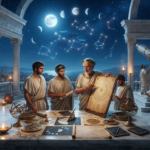
The historical importance of these nymphs lies in their integration into the practical and religious life of the Greeks. The rising and setting of their constellations were used as agricultural and navigational markers . The Hyades, for example, whose name means “the rainy ones,” signaled the onset of the stormy season in November, crucial for sailors and farmers alike . The Pleiades were used as a calendar for the agricultural year. In this way, the celestial nymphs were not just figures of myth, but were actively consulted in the rhythms of daily life.
The Mythological Role of the Celestial Nymphs
The primary mythological role of the celestial nymphs was to personify the heavens and its various elements. They were the living embodiments of stars, clouds, rain, and the atmospheric phenomena that shaped the world. They were not merely passive decorations in the sky; they were active agents whose actions had direct consequences on the earth.
Some, like the Hyades, were bringers of rain, their weeping for their dead brother Hyas manifesting as the life-giving storms that ended the dry season . Others, like the Pleiades, were starry companions to heroes and gods, their place in the sky serving as a reminder of their earthly adventures and divine parentage . The Hesperides, the nymphs of the evening and the golden light of sunset, were the guardians of the golden apples, a symbol of immortality and divine favor . Asteria, the Titan goddess of falling stars, used her celestial power to escape the advances of Zeus, transforming herself into the island of Delos .
Their role was to connect the divine realm of the gods with the mortal world. By watching their movements, mortals could understand the will of the gods and predict the cycles of nature. They were the celestial clock and calendar of the ancient world.
Family and Relationships
The celestial nymphs were integrated into the complex family tree of Greek mythology through their relationships with the Titans and Olympians.
The Pleiades and the Hyades
Two of the most famous groups of celestial nymphs were the Pleiades and the Hyades, both of whom were linked to the Titan Atlas and the Oceanid Pleione . The Pleiades were seven sisters: Maia, Electra, Taygete, Alcyone, Celaeno, Sterope, and Merope . They were famous for their love affairs with gods and mortals; Maia, for example, was the mother of Hermes by Zeus . The Hyades were also a group of nymphs, often numbering seven, who were placed in the stars as a reward for their sisterly devotion . Their brother was Hyas, who was killed in a hunt, and their weeping for him gave them their name [“the rainy ones”] . In some traditions, the Hyades were the nurses of the infant god Dionysus .
The Hesperides
The Hesperides were the nymphs of the west and the evening. Their parentage varies across sources; they are sometimes the daughters of Nyx (Night) and Erebus (Darkness), reflecting their connection to the evening sky, or of Atlas and Hesperis . Their role was to guard the golden apples in a garden at the edge of the world. Their names, such as Aegle (“dazzling light”), Erytheia (“the red one”), and Hesperia (“sunset glow”), evoke the colors of the setting sun .
The Nymphai Artemisiai
This was a group of sixty Oceanid nymphs who were the handmaidens of Artemis, the goddess of the hunt and the moon . Their names, such as Nephele (“cloud”) and Hyale (“crystal”), suggest their connection to the celestial and watery realms . They were the companions of the virgin goddess and represented the wild, untamed aspects of the night sky.
Asteria
Asteria was a Titaness, the daughter of Coeus and Phoebe, and the sister of Leto . Her name means “starry,” and she was the goddess of falling stars and perhaps nighttime divination. Her most famous myth is her escape from Zeus, transforming into a quail and then the island of Delos, where her sister Leto would later give birth to Apollo and Artemis . The island of Delos was sometimes called Ortygia, meaning “quail island” . She is also the mother of Hecate by the Titan Perses .
The Heliades and the Loved of Helios
The sun god Helios had numerous relationships with nymphs. His daughters by the Oceanid Clymene were the Heliades, who mourned their brother Phaethon’s death so much that they were transformed into poplar trees, weeping tears of amber . He also loved the Oceanid Clytia, who was transformed into the heliotrope flower after he abandoned her . These stories connect the celestial nymphs directly to the sun god and the cycles of day and night.
Symbols and Meaning
The symbols of the celestial nymphs are rooted in their physical manifestations and their roles in nature.
- The Constellation: The most prominent symbol for groups like the Pleiades and the Hyades is their constellation. They are literally the stars in the sky. Their placement and movement were interpreted as divine signs .
- Rain: The Hyades were the bringers of rain. Their symbol was the life-giving storm that ended the summer’s drought. Their weeping was a metaphor for the rain itself .
- The Golden Apple: The Hesperides were the guardians of the golden apples, a symbol of immortality, divine power, and the ultimate prize .
- The Quail: For Asteria, the quail was her symbol, representing her transformation and escape from Zeus. It is also a symbol of the island of Delos .
- The Cloud: The Nymphai Artemisiai, with names like “Cloud,” symbolized the ephemeral, shifting nature of the sky and the misty companions of the moon goddess .
Powers and Characteristics
The powers of the celestial nymphs were as varied as their domains.
- Astronomical Influence: The primary power of the Pleiades and Hyades was their influence as constellations. Their rising and setting signaled the changing of seasons and could be used for navigation and agriculture .
- Control Over Rain: The Hyades specifically had the power to bring rain. In some versions, they were literally the rain itself .
- Transformation: Like many nature spirits, the celestial nymphs possessed the power of transformation. Asteria could transform into a quail and an island . The Hesperides could transform into trees .
- Guardianship: The Hesperides were guardians of a sacred grove and the golden apples, a task of great importance given by the gods .
- Divine Companionship: The Nymphai Artemisiai were the constant companions of Artemis, reflecting their role in the goddess’s wild, celestial retinue .
Worship and Religious Importance
Like many nymphs, the celestial nymphs did not have formal cults or temples in the same way as the Olympian gods. However, they held immense religious importance through their connection to the heavens and the natural world. Their worship was often integrated into the observation and veneration of the celestial phenomena they represented.
Farmers and sailors would look to the rising and setting of the Pleiades and Hyades to guide their actions. This was a form of practical reverence for these deities. In some traditions, the Hyades were honored as the nurses of Dionysus, linking them to the mysteries of the god of wine and ecstasy . The Hesperides, as guardians of the golden apples, were figures of mythical and symbolic importance in the tales of Heracles. Their power and their place in the cosmos were acknowledged through myth and the careful observance of the stars.
Ancient Sources
The celestial nymphs are referenced in a wide range of ancient texts, from epic poetry to astronomical treatises.
- Hesiod’s Theogony: The foundational text for the genealogies of the Pleiades and other nymphs .
- Hesiod’s Astronomy: A now-fragmentary work that detailed the mythology of the constellations, including the Hyades .
- The Iliad and Odyssey of Homer: These epics reference the movements of the Pleiades and other celestial bodies.
- Ovid’s Metamorphoses and Fasti: The Roman poet retells the myths of the Pleiades, Hyades, and other nymphs, often with a Roman interpretation .
- Hyginus’s Fabulae and Astronomica: A Roman author whose works are a crucial source for the myths of the celestial nymphs, providing details on their parentage and the stories behind their constellations .
- Apollodorus’s Library: A later compilation of Greek myths that provides genealogical information on the Pleiades and others .
- Callimachus’s Hymn to Artemis: Describes the Nymphai Artemisiai as the companions of the goddess .
- Nonnus’s Dionysiaca: A late epic that mentions the Hyades as nurses of Dionysus .
Artistic Representations
The celestial nymphs are often depicted in ancient Greek and Roman art, frequently in scenes that illustrate their myths or as symbols of the heavens themselves.
- Vase Painting: The Pleiades and Hyades are sometimes depicted as groups of women on Greek vases, often alongside figures like Atlas or Zeus. Their attributes might include stars or celestial symbols.
- Mosaics: The Hesperides and their garden are a popular subject in Roman mosaics, often shown as beautiful women in a lush landscape, with the golden apple tree as a central focus. A 2nd-century AD mosaic from Constanța depicts Pontus, but similar artistic conventions were used for celestial figures .
- Sculpture and Reliefs: Asteria appears in the Gigantomachy frieze on the Pergamon Altar, showing her as a warrior goddess, reinforcing her Titan lineage and divine power . The Muses, some of whom had celestial associations like Urania, are also frequently depicted in sculpture and relief.
- Coins and Gems: The constellations, such as the Pleiades, were sometimes used as symbols on ancient coins, representing the divine nature of a city or a ruler.
Cultural Influence
The influence of the celestial nymphs extends far beyond the ancient world. Their names and stories have become deeply embedded in Western culture, language, and science.
- Astronomy: The constellations that were named for them, such as the Pleiades and Hyades, are still known by those names today. The Hesperides are associated with the evening star, the planet Venus.
- Literature and Poetry: The celestial nymphs have inspired countless poets and writers. Their myths have been retold in works from Ovid to C.S. Lewis. The “nymph” archetype, a beautiful, ethereal female spirit associated with nature, is a direct descendant of these figures.
- Art: Artists from the Renaissance to the present day have been inspired by the stories of the Pleiades, the Hyades, and the Hesperides, capturing their beauty and their connection to the cosmos.
- Language: The term “Pleiades” is used in the title of a famous modern novel. The word “hesperides” has been used in the names of ships and literary works, evoking the allure of the distant west.
Legacy
The legacy of the celestial nymphs is profound. They represent the ancient Greek attempt to imbue the cosmos with life, meaning, and personality. They transformed the cold, distant stars into beloved daughters of gods, grieving sisters, and guardians of divine secrets. Their stories are a testament to the human need to connect with the heavens and to find narrative in the patterns of the night sky. They stand as a beautiful and enduring reminder that the universe is not just a physical reality, but a living tapestry of myth and story.
Frequently Asked Questions About Who are the celestial nymphs of Greek mythology?
What are celestial nymphs in Greek mythology?
Celestial nymphs are a class of nature spirits associated with the sky, stars, clouds, and celestial phenomena. They are the personifications of constellations like the Pleiades and Hyades, as well as the rain, the evening light, and the stars themselves. They were believed to inhabit the heavens and influence the world through the cycles of nature.
Who are the most famous celestial nymphs?
The most famous celestial nymphs include the Pleiades (seven sisters placed in the stars), the Hyades (rain-bringing nymphs also in the stars), the Hesperides (nymphs of the evening and guardians of the golden apples), and Asteria (the Titan goddess of falling stars). The Nymphai Artemisiai, the cloud-nymph handmaidens of Artemis, are also notable.
What is the difference between a celestial nymph and a Muse?
While both are divine female figures, celestial nymphs are primarily associated with the natural world and celestial phenomena, such as the stars and the sky. The Muses, on the other hand, are the goddesses of the arts, literature, music, and science. However, one of the Muses, Urania, was specifically the Muse of Astronomy, linking her to the celestial realm .
Who were the parents of the Pleiades?
The Pleiades were the daughters of the Titan Atlas, who held up the heavens, and the Oceanid Pleione . Their names were Maia, Electra, Taygete, Alcyone, Celaeno, Sterope, and Merope .
Why are the Hyades associated with rain?
The Hyades are associated with rain because their name is derived from the Greek word hyein, which means “to rain.” Their constellation’s heliacal rising (rising just before the sun) in the autumn marked the beginning of the rainy season in Greece, and they were seen as weeping nymphs whose tears became the rain .
What did the Hesperides guard?
The Hesperides, the nymphs of the evening, were the guardians of a beautiful garden located in the far west, at the edge of the world. In this garden, they guarded the golden apples of immortality, which had been a gift from Gaia to Hera upon her marriage to Zeus .
Who is Asteria in Greek mythology?
Asteria is a Titan goddess of falling stars and, in some traditions, nocturnal divination . She is the daughter of the Titans Coeus and Phoebe and the sister of Leto. To escape the amorous advances of Zeus, she transformed herself into a quail and then into the island of Delos, which became the birthplace of Apollo and Artemis .
Did any of the celestial nymphs have important children?
Yes, several celestial nymphs were significant mothers. Maia, one of the Pleiades, was the mother of Hermes by Zeus . Asteria was the mother of Hecate by the Titan Perses . The Oceanid Clymene was the mother of Phaethon by Helios .
Conclusion
The celestial nymphs of Greek mythology are a dazzling and essential part of the ancient Greek cosmos. They are the bridge between the divine order of the heavens and the mortal world, embodying the stars, the clouds, and the rains that governed life on earth. From the starry Pleiades and the tearful Hyades to the golden-eyed Hesperides and the fleeing Asteria, each group and goddess tells a story that connects the movements of the heavens with human emotions, fears, and hopes. Their historical importance is immense, as their constellations were a practical tool for navigation and agriculture. Their cultural legacy is etched into our literature, our art, and even our astronomy. They remind us that the sky is not just a physical space, but a realm of endless stories, a testament to the power of myth to give meaning and magic to the universe we inhabit.

Orin Vale has spent the better part of two decades tracing the threads that connect the world’s oldest stories — from the halls of Asgard to the banks of the Nile, from Olympus to the jungles of the Maya. What began as a childhood fascination with flood myths and trickster gods grew into years of independent study across comparative mythology and ancient religion, always chasing the same question: what did these stories mean to the people who first told them? Orin writes for readers who want more than trivia — the ones looking for the beliefs, fears, and truths that myths were built to carry.