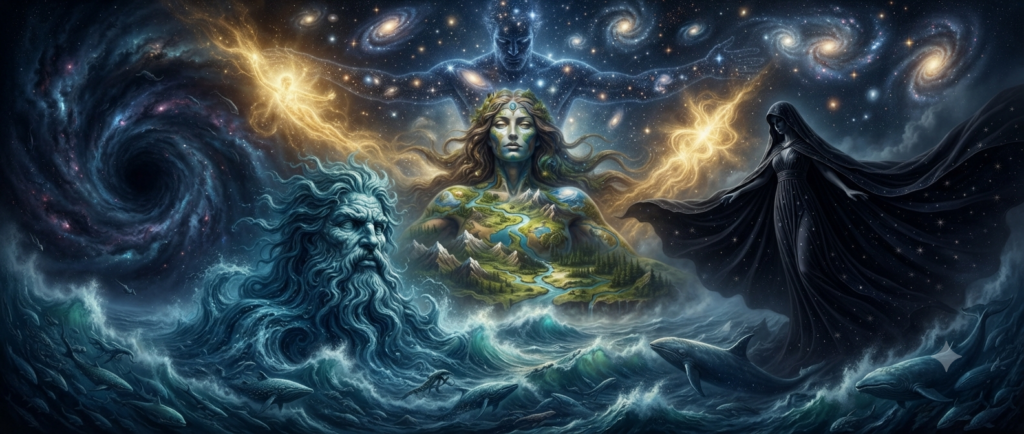
The question of who are the primordial gods of Greek mythology? leads us to the very beginning of existence in the ancient Greek worldview. These deities, known as the Protogenoi (from protos meaning “first” and genos meaning “born”), were the first beings to emerge at the dawn of creation . They were not gods in the anthropomorphic sense of the Olympians, but rather the elemental building blocks of the cosmos itself. Gaia was not merely the goddess of the earth; she was the earth. Ouranos was the literal sky, Pontus the sea, and Nyx the night . These primeval forces formed the very fabric of the universe, and from them, all subsequent generations of gods—the Titans and the Olympians—would descend. Understanding these foundational figures is essential to grasping the entirety of Greek mythology, as they represent the ancient Greeks’ profound attempt to explain the origin and order of the world around them.
Origins and Historical Background of the Protogenoi
The concept of primordial gods is deeply rooted in the ancient Greek cosmogony, the narrative of how the universe came into being. The most influential and comprehensive account of these origins comes from the poet Hesiod, who lived around the 8th century BCE . His epic poem, the Theogony (meaning “Birth of the Gods”), is the definitive source for the genealogies of the Greek deities and systematically outlines the emergence of the first divine beings .
Hesiod’s Theogony begins with a simple and powerful image: “In truth at first Khaos (Chaos) came to be, but next wide-bosomed Gaia (Earth)… and dim Tartaros (the Pit) in the depth of the wide-pathed Earth, and Eros (Love), fairest among the deathless gods” . From these initial figures, the cosmos was populated. Chaos, in this context, was not a god of disorder but rather the great void, the gap or chasm from which everything else emerged . It is crucial to recognize that the primordial gods were not created by another deity; they came into existence spontaneously, fully formed, as the first principles of the universe .
It is important to note that the list of primordial gods was not static. Different authors and traditions across the ancient Greek world offered their own variations. The Orphic tradition, for instance, had a distinct cosmogony that featured figures like Phanes, Hydros, and Chronos as the earliest beings, emerging from a cosmic egg . Despite these variations, the core idea remains consistent: the first gods were elemental, powerful, and impersonal forces that predated the more familiar and dramatic pantheon of later myths.
The Mythological Role of the Primordial Gods
The primary mythological role of the primordial gods is to serve as the foundation for all other existence. They represent the raw materials and fundamental forces that constitute the universe: the earth, the sky, the sea, darkness, light, time, and necessity. They are the origins from which the entire family tree of Greek gods and goddesses is descended .
These deities are not active participants in the myths that involve heroism, adventure, or romance. They are passive, elemental beings. Their role is not to act but to be. Gaia gives birth to the Titans and the sea gods; Tartarus becomes the prison of the Titans; Nyx brings forth the forces of death and sleep. In this way, the Protogenoi are the ultimate ancestors. Their presence establishes the cosmic order and sets the stage for the epic conflicts and divine dramas that would follow. Their story is the story of creation itself.
Family and Relationships
The relationships among the primordial gods are often incestuous and generative, serving to create the diverse and powerful beings that would populate the cosmos.
The Primordial Family Tree According to Hesiod
Hesiod’s Theogony provides the most familiar genealogy of the Protogenoi . It describes a series of generations and unions:
- Generation 1: The first beings to emerge are Chaos (the Void), Gaia (the Earth), Tartarus (the Underworld Pit), and Eros (Procreation) .
- Generation 2: From Chaos: Chaos gives birth to Erebus (Darkness) and Nyx (Night) . From the union of Nyx and Erebus, Aether (Light) and Hemera (Day) are born .
- Generation 2: From Gaia: Gaia, through parthenogenesis (without a father), gives birth to Ouranos (the Sky), the Ourea (the Mountains), and Pontus (the Sea) .
- Generation 3: From Gaia and Ouranos: The union of Gaia and her son Ouranos produces the Titans, the Cyclopes, and the Hecatonchires (Hundred-Handed Ones) .
- Generation 3: From Gaia and Pontus: The union of Gaia and her son Pontus produces the “Old Men of the Sea”: Nereus, Thaumas, Phorcys, Ceto, and Eurybia .
This genealogical structure demonstrates how the primordial gods are the ultimate ancestors of all other Greek deities.
Alternative Traditions
Other sources present different family structures. The Orphic tradition, for example, speaks of Hydros (Water) and Thesis (Creation) as the first beings, from which Chronos (Time) and Ananke (Necessity) emerged . Chronos and Ananke then created the cosmic egg from which Phanes was born, a hermaphroditic god of creation who began the process of ordering the universe . These alternative cosmogonies highlight the diversity of thought in the ancient world regarding the very beginning of existence.
Symbols and Meaning
The symbols of the primordial gods are not abstract representations; they are their very selves. Their “symbols” are the physical and conceptual realities of the universe.
- Gaia (Earth): Represented by the ground, mountains, and all of the natural world. She is the fertile mother, the firm foundation of all life.
- Ouranos (Sky): The starry dome that covers the earth. He represents the vastness of the heavens and the limitless reach of space.
- Pontus (Sea): The saltwater depths of the ocean, representing the untamed, powerful, and “fruitless” deep .
- Nyx (Night): The personification of the dark, a powerful force from which many fearful concepts were born, such as Thanatos (Death) and Hypnos (Sleep). She is often depicted as a woman veiled in black, bringing the dark mists across the sky .
- Chaos (Void): The original state of the universe, a gaping chasm or empty space, representing the potential for all existence .
- Tartarus (Abyss): The deepest, darkest part of the underworld, a pit of suffering and the ultimate prison for the Titans .
These symbols emphasize that the Protogenoi were not allegorical or mythical in a literary sense; they were the fundamental principles of nature, which the ancient Greeks honored and feared as the most primary of divine forces.
Powers and Characteristics
The “powers” of the primordial gods are not the directed abilities of gods like Zeus or Athena. Their power is inherent in their very nature.
- Personification of the Universe: Their primary power is to be the literal thing they represent. Their power is the power of the earth, the sky, the sea, and the darkness itself.
- Spontaneous Generation: The Protogenoi possess the power of self-creation, emerging spontaneously at the beginning of time . This sets them apart from all later gods who are born from other beings.
- Procreation: Many of the Protogenoi possess the power to generate new life, often through parthenogenesis (Gaia creating Ouranos) or through incestuous unions (Gaia and Ouranos creating the Titans) .
- Formlessness: Most primordial gods, unlike the Olympians, are largely formless or are depicted only partially in human form. Gaia might appear as a woman half-risen from the earth, but she is inseparable from it . They lack the distinct, often petty, human personalities of the later gods. Their characteristics are the impersonal, unyielding forces of nature.
Worship and Religious Importance
The primordial gods were not widely worshipped in formal cults or temples like the Olympian gods, such as Zeus or Athena . It is difficult to petition or placate a force like “Night” or “The Void” in the same way one might ask for a safe voyage from Poseidon. Their religious importance lies in their role as foundational beings in the Greek cosmogony.
They were revered in mythology and literature as the ultimate origins of all divine power. The creation narratives of Hesiod were not just stories; they were sacred texts that explained the world’s order and the legitimacy of the ruling deities. By acknowledging the Protogenoi, the ancient Greeks were recognizing the profound and ancient power of the universe itself, a power that preceded and transcended the gods of Mount Olympus. Oaths sworn in the name of Gaia were considered the most binding of all, demonstrating the deep respect for these fundamental powers .
Ancient Sources
Our knowledge of the primordial gods comes from a variety of ancient texts, each offering a slightly different perspective on the creation of the world.
- Hesiod’s Theogony (c. 8th century BCE): The most comprehensive and influential source, detailing the genealogy of the Protogenoi, Titans, and Olympians .
- Homer’s Iliad and Odyssey (c. 8th century BCE): While not as detailed as the Theogony, these epics reference the primordial gods. Interestingly, Homer identifies Oceanus and Tethys as the “father and mother of the gods,” a different, more ancient perspective on creation .
- The Orphic Hymns and Fragments (c. 6th century BCE – 2nd century CE): A collection of religious and mystical texts that present a unique cosmogony involving figures like Phanes, Hydros, Chronos, and Ananke .
- Aristophanes’ Birds (414 BCE): This comedic play provides a parody of the Orphic creation myth, with Nyx and Eros as the primary creators .
- Pseudo-Apollodorus’ Bibliotheca (c. 1st-2nd century CE): A comprehensive compilation of Greek myths that summarizes the events of the Theogony and other sources.
Artistic Representations
The primordial gods are rarely, if ever, depicted in classical Greek vase painting or sculpture in the same way as the Olympians. Because they are formless personifications, they are difficult to represent artistically. However, there are some notable exceptions:
- Gaia: One of the few Protogenoi to be anthropomorphized. In Athenian vase painting, she is depicted as a matronly woman, often shown half-risen from the earth, symbolizing her inseparability from her native element. A famous example shows her handing the infant Erichthonius to Athena .
- Nyx and Hemera: In later mosaic art, Night and Day are sometimes represented as cloaked figures or as women riding across the sky, bringing the dark or the light.
- Pontus: A 2nd-century AD Greco-Roman mosaic from Constanța, Romania, depicts Pontus as a giant, bearded head rising from the sea, with crab-claw horns and a watery beard—a rare and symbolic depiction .
- Tartarus: As a pit or an abyss, Tartarus is represented as a place rather than a person in art. However, later depictions might show him as a dark, shadowy figure in the underworld.
The lack of clear artistic representations of most Protogenoi reinforces their nature as elemental forces rather than anthropomorphic deities.
Cultural Influence
The cultural influence of the primordial gods is foundational. They represent the first step in the Greek intellectual project of understanding the cosmos. Their influence can be seen in several areas:
- Cosmogony and Philosophy: The idea that the world was formed from a primordial chaos or from basic elements like earth and water profoundly influenced pre-Socratic philosophers. For instance, Thales of Miletus proposed that water was the fundamental principle of all things, a concept resonating with the primordial role of Pontus and Oceanus .
- Literature and Poetry: The creation narratives of the Theogony provided the mythological framework for all subsequent Greek literature. Poets and dramatists constantly referenced the primordial gods to establish a sense of scale, authority, or cosmic horror.
- The Oath: In ancient Greece, oaths sworn by Gaia were considered the most unbreakable and sacred . This highlights the profound moral and religious weight associated with the earth as a fundamental and all-seeing force.
Legacy
The legacy of the primordial gods is perhaps more profound than that of many Olympians. They represent the ancient Greeks’ ultimate attempt to find meaning and order in the chaos of the universe. They established a worldview where everything—the land, the sky, the sea, and all the powers of nature—was a manifestation of the divine. This concept influenced not only later religious and philosophical thought in the Greek world but also, through cultural transmission, left a permanent mark on Western civilization. The very names of figures like Gaia, Nyx, and Chaos have entered the lexicon as terms to describe fundamental aspects of our world. They stand as a testament to the power of mythology to answer the most basic human question: where did everything come from?
Frequently Asked Questions About Who are the primordial gods of Greek mythology?
Who is the first primordial god in Greek mythology?
According to Hesiod’s Theogony, the first being to emerge was Chaos, which represented the void or a great chasm. However, some traditions, like the Orphic, place figures such as Chronos (Time) or Hydros (Water) as the first principles. The answer depends on the specific tradition being followed.
What is the difference between primordial gods, Titans, and Olympians?
The Primordial gods (Protogenoi) are the first beings who represent the elemental forces of the universe (Earth, Sky, Sea). The Titans are the children of the primordial gods (specifically Gaia and Ouranos) and represent a second generation of powerful deities. The Olympians are the third generation, the children of the Titans, who overthrew their parents to rule the cosmos from Mount Olympus.
Are the primordial gods still worshipped today?
No, the primordial gods did not have formal cults or temples in ancient Greece and are not worshipped in modern times. Their significance is primarily mythological and historical. They are the foundational figures of the Greek pantheon.
What is Chaos in Greek mythology?
Chaos is not a god of disorder but the personification of a void or a gap. In Hesiod’s cosmogony, Chaos was the first thing to exist, a formless state from which everything else emerged.
Were any of the primordial gods evil?
The primordial gods are not generally considered “evil” in a moral sense. They are elemental forces that are beyond human concepts of good and evil. For example, Tartarus is a place of punishment, but he is not a malevolent being; he is simply the pit itself.
Is Gaia considered a primordial god?
Yes, Gaia (or Gaea) is one of the most important primordial gods. She is the personification of the Earth and is considered the Mother of All Life. In Hesiod’s Theogony, she is the second being to emerge after Chaos.
Are there any famous myths involving the primordial gods directly?
The primordial gods are rarely the central figures in myths involving heroes or adventure. Their “myth” is the story of creation itself. However, their actions are the catalyst for all other myths. For instance, Gaia’s anger at Ouranos for hiding their children led to the castration of Ouranos by Cronus, which is the foundational event for the rise of the Titans and the subsequent reign of Zeus.
What is the role of Eros among the primordial gods?
Eros, in the primordial sense, is the god of procreation and the force that causes beings to reproduce and bring new life into the world. This elder Eros is distinct from the more well-known son of Aphrodite and represents a fundamental cosmic principle of generation .
Conclusion
The primordial gods of Greek mythology represent the ancient world’s most profound attempt to understand the origins of the universe. They are the Protogenoi, the first-born, elemental forces that constitute the very fabric of reality: the Earth, the Sky, the Sea, the Night, and the Void. Far from being simple fairy tales, these cosmogonies, most famously recorded by Hesiod, are complex theological and philosophical works that explain the world’s fundamental order. While they may lack the personal drama of the Olympian gods, their historical importance is immense, providing the foundation for all subsequent Greek myth, literature, and thought. Their cultural legacy is the establishment of a worldview where nature itself is divine, and their modern relevance lies in their enduring power as archetypes for the forces that govern our existence. The question of who are the primordial gods of Greek mythology? ultimately leads to an answer that is as vast and mysterious as the cosmos they represent.

Orin Vale has spent the better part of two decades tracing the threads that connect the world’s oldest stories — from the halls of Asgard to the banks of the Nile, from Olympus to the jungles of the Maya. What began as a childhood fascination with flood myths and trickster gods grew into years of independent study across comparative mythology and ancient religion, always chasing the same question: what did these stories mean to the people who first told them? Orin writes for readers who want more than trivia — the ones looking for the beliefs, fears, and truths that myths were built to carry.