The question of who are the Moirai (Fates) in Greek mythology? leads us to the very heart of the ancient Greek understanding of destiny, mortality, and the cosmic order. The Moirai, often known in English simply as the Fates, were the three goddesses who personified the inescapable destiny of every being, from the lowliest mortal to the mightiest god . They were not merely deities who influenced fate; they were the incarnations of fate itself, the forces that ensured the laws of the universe were upheld. Their name, derived from the ancient Greek word moira, meaning “share” or “allotted portion,” reveals their fundamental function: to assign to every person their portion in life . This article will serve as a definitive guide to the Moirai, exploring their origins, their distinct roles as Clotho, Lachesis, and Atropos, their symbols, their complex relationship with the gods, and their profound and lasting legacy.
Origins and Historical Background of the Moirai
The concept of fate in Greek religion evolved over time, moving from an impersonal force to a trio of powerful, personified goddesses. In the earliest works of Greek literature, such as the Homeric epics, fate is often spoken of in the singular as Moira or Aisa, an impersonal power that governed the span of human life . While Zeus is sometimes depicted as the dispenser of fate, the idea of an external, unyielding force was already present.
However, it was the poet Hesiod, in his 8th-century BCE work the Theogony, who gave the Moirai their definitive form . Hesiod completed their personification, establishing them as three distinct goddesses with individual names and functions: Clotho (the Spinner), Lachesis (the Allotter), and Atropos (the Inevitable) . This transformation marked a significant development in Greek theology, moving from an abstract principle to a more tangible, albeit still daunting, divine presence. The Moirai, as they would be known for centuries to come, were now fully formed.
The role of the Moirai was to ensure that every being, mortal and divine, lived out their destiny as it was assigned to them by the laws of the universe . For a mortal, this destiny spanned their entire life and was represented by a thread being spun from a spindle . Their importance in the Greek religious and philosophical worldview cannot be overstated; they were the ultimate arbiters of a person’s life, from birth to death.
The Mythological Role of the Moirai
The primary mythological role of the Moirai was to personify destiny and to ensure its fulfilment. They were the cosmic enforcers of the natural and moral order, making sure that every being received the fate that was their due. At the birth of a man, the Moirai would spin out the thread of his future life and follow his steps, directing the consequences of his actions .
As the personifications of the duration of human life, the Moirai were conceived as both goddesses of birth and goddesses of death . This duality is reflected in their companions: they are often paired with Eileithyia, the goddess of childbirth, and they also appear alongside the Keres, the spirits of violent death, and the infernal Erinyes . They were the beginning and the end, the alpha and omega of human existence.
Their role was not to actively participate in human affairs, but to oversee the thread of life. They assigned to every person their fate or share in the scheme of things . They were the divine weavers whose work was the fabric of existence itself. One of the most important and complex aspects of their role was their relationship with the gods.
The Three Moirai: Clotho, Lachesis, and Atropos
The Moirai were always three in number, and each sister had a distinct and vital function in the creation and termination of human life . Their Roman equivalents were the Parcae, with the individual names Nona, Decima, and Morta .
Clotho (The Spinner)
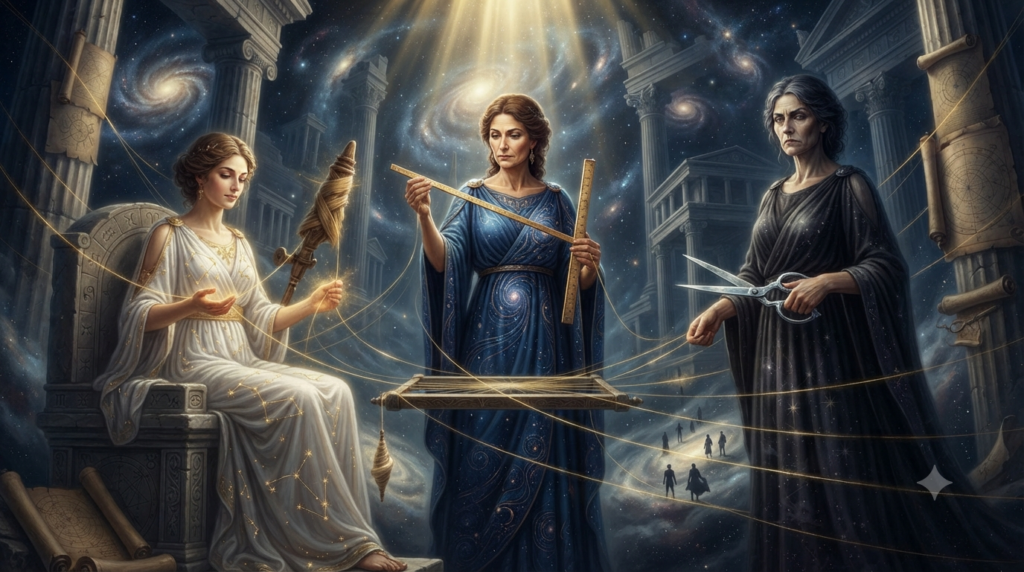
Clotho (Greek Κλωθώ, “the spinner”) was the youngest of the three sisters . Her name means “the Spinner,” and her role was to spin the thread of life from her distaff onto her spindle . This act of spinning represented the moment of conception and the beginning of a person’s life. Clotho was the origin, the one who initiated the journey of every soul into the world. Her Roman equivalent was Nona, a goddess originally invoked in the ninth month of pregnancy .
Lachesis (The Allotter)
Lachesis (Greek Λάχεσις, “the apportioner” or “drawer of lots”) was the second sister . Her name means “the Allotter,” and her role was to measure the thread of life that Clotho had spun . She determined the length of the thread, and by extension, the lifespan and the share of fortune and misfortune that each person would receive. Lachesis measured out the destiny, deciding the course of life’s events. Her Roman equivalent was Decima (“the Tenth”) .
Atropos (The Inevitable)
Atropos (Greek Ἄτροπος, “the inexorable” or “the inevitable,” literally “unturning”) was the eldest and most feared of the three sisters . Her name means “the Inexorable” or “Inflexible,” and her role was to cut the thread of life with her “abhorred shears” . When Atropos cut the thread, the person died. She chose the manner of each person’s death, making her the ultimate arbiter of a mortal’s end . Her power was final and irreversible. Her Roman equivalent was Morta (“the dead one”) .
Family and Relationships
The parentage of the Moirai varies across different traditions, reflecting the evolution of Greek mythology .
- Daughters of Nyx (Night): In the earliest tradition, as recorded by Hesiod in his Theogony, the Moirai are the daughters of the primordial goddess Nyx (Night) . They were born without a father, making them ancient and powerful forces from the very beginning of the cosmos. This lineage emphasizes their role as fundamental, impersonal forces of the universe.
- Daughters of Zeus and Themis: In a later tradition, the Moirai are presented as the daughters of Zeus, the king of the gods, and Themis, the Titan goddess of divine law and order . This lineage places them in a more structured and subordinate relationship to Zeus. In this version, they are often accompanied by their sisters, the Horae (Eunomia, Dike, and Eirene), who represent lawfulness, justice, and peace .
- Other Genealogies: Other sources provide even more varied parentage. They are sometimes considered the daughters of Ananke (Necessity) , or even of Chronos (Time) and Ananke . The Orphic tradition, a mystical branch of Greek religion, also placed them in a distinct genealogical framework.
This variation in parentage highlights the complex and sometimes contradictory nature of Greek mythology. It also illustrates the shifting theological perspectives on fate: was it a primeval, impersonal force (as with Nyx), or was it an aspect of the divine order administered by Zeus (as with Themis)?
Symbols and Meaning
The symbols of the Moirai are directly tied to their function as the weavers of fate .
- The Thread, Spindle, and Distaff: The most important symbols are the instruments of spinning: the thread, the spindle, and the distaff . The thread represents the life of an individual, from its beginning to its end. The spinning of the thread is the act of creation and the weaving of a person’s destiny.
- The Measuring Rod: Lachesis is depicted with a staff or measuring rod, which she uses to measure the thread of life . This symbolizes the apportioning of one’s lifespan and the events that will occur.
- The Shears (or Scissors): Atropos is most frequently represented with a cutting instrument, such as shears or scissors, with which she cuts the thread of life . This is the ultimate symbol of mortality and the inescapable nature of death.
- The Dove: In some representations, the Moirai are also associated with the dove, a symbol of peace and the soul .
Powers and Characteristics
The power of the Moirai was absolute and inescapable. They were the enforcers of destiny, and their decisions were final and irrevocable. A person’s fate, as spun, measured, and cut by the three sisters, could not be changed. This was the core of their power.
- Above the Gods? One of the most debated aspects of their power was their relationship with the gods, particularly Zeus. In some traditions, the Moirai were considered to be above even the gods, meaning that even Zeus, the king of the Olympians, was subject to their decrees . In other representations, however, Zeus is depicted as their leader, with the ability to command them .
- Appearance: The Moirai are described in ancient sources as severe, inflexible, and stern . Poets typically express them as ugly and unwavering, representing the gravity of their role . Other authors, however, depict them as beautiful maidens, perhaps to show respect for their serious responsibility . In art, they are often shown with the attributes of their roles, such as the spindle, the staff, and the shears .
Worship and Religious Importance
The Moirai were not widely worshipped in the same way as the Olympian gods, but they did have cults and their name was feared .
- Temples and Sanctuaries: They had temples and sanctuaries at various locations in Greece. At Sicyon, there was an altar dedicated to the Moirai . In the Peiraieus, a decree from the mid-4th century BCE outlines a sacrifice to the Moirai, requiring three cakes and a honeycomb for each . There was also a sanctuary of the Moirai at Olympia .
- Rituals and Sacrifices: The sacrifices made to them, such as the “νηφάλιος” (wineless) offerings, were a way of acknowledging their power, perhaps in the hope of appeasing them or avoiding their attention .
- Representing Inevitability: The Moirai represented the terrifying and inescapable nature of fate. Because of this fear, they were often referred to by epithets and avoided speaking their true names . They were the personification of the idea that destiny was inescapable, a concept that was both feared and respected in the ancient world.
Ancient Sources
The Moirai appear in many of the most important ancient texts.
- Homer’s Iliad and Odyssey (c. 8th century BCE): These epics refer to Fate (Moira) in the singular as an impersonal power .
- Hesiod’s Theogony (c. 8th century BCE): The definitive source for the three personified Fates, Clotho, Lachesis, and Atropos, and their genealogy as daughters of Nyx .
- The Homeric Hymns: These hymns occasionally mention the Moirai.
- Pindar’s Odes (5th century BCE): The poet often invokes and honors the Fates.
- Aeschylus’s Prometheus Bound (5th century BCE): The play features the Moirai as the enforcers of Zeus’s will.
- Plato’s Republic (c. 380 BCE): Plato describes the Moirai as the daughters of Ananke (Necessity), singing of the past, present, and future in the cosmic order .
- Apollodorus’s Bibliotheca (c. 1st-2nd century CE): Provides a summary of their genealogy and role .
- Hyginus’s Fabulae and Astronomica (c. 2nd century CE): A Roman mythographer who preserves important Latin versions of their myths .
Artistic Representations
The Moirai are a common subject in ancient Greek and Roman art, recognizable by their attributes.
- Vase Painting: In Archaic and Classical vase painting, the Moirai are often depicted as solemn women, sometimes holding their attributes.
- Sculpture: They appear in sculptural reliefs, often on temple friezes or funerary monuments.
- Mosaics: Roman mosaics, such as one from Philippi, depict the birth of the Fates, showing them as figures of great authority .
- Renaissance and Neoclassical Art: The Moirai have been a popular subject for later artists, such as Michelangelo and Canova, who often depicted them as the three goddesses of fate.
Cultural Influence and Historical Legacy
The influence of the Moirai has been profound, extending far beyond the ancient world.
- Literature and Poetry: The Fates have been a constant source of inspiration for writers. The motif of the three women weaving a person’s destiny appears in the work of Dante, Shakespeare (in Macbeth), and countless other authors.
- Language: The term “fate” itself is a direct descendant of the Latin word fatum (which was derived from the Roman equivalent of the Moirai, the Parcae). The Greek word “moira” is the root of terms like “moros” (fate) and the modern concept of “morality,” linking the idea of fate to a moral order.
- Psychology: The archetype of the three fate goddesses has been explored by psychologists, notably in the context of Jungian archetypes as representations of the past, present, and future.
Legacy
The legacy of the Moirai is the enduring human fascination with fate, destiny, and the question of free will. They are the quintessential symbols of the inescapable nature of time and mortality. Whether one views them as a terrifying, impersonal force or as a part of a divine order, their story is a powerful reminder of the limits of human power and the universal truth of death. They continue to appear in popular culture, from films like Hercules to books like the Percy Jackson series, ensuring that the ancient goddesses of fate remain a part of the modern imagination.
Frequently Asked Questions About Who are the Moirai (Fates) in Greek mythology?
What do the three Fates do?
Each of the three Fates has a specific role. Clotho spins the thread of life, Lachesis measures the thread to determine a person’s lifespan and fortune, and Atropos cuts the thread, bringing a person’s life to an end . Together, they control the destiny of every mortal and immortal being.
Are the Fates more powerful than Zeus?
This is a debated point in Greek mythology. In some sources, the Fates are considered to be above even the gods, meaning that Zeus himself is subject to their decrees . In other traditions, however, Zeus is seen as their leader, with the power to command them. The answer depends on the specific myth and the author’s interpretation.
Who are the parents of the Moirai?
The parentage of the Moirai varies. The earliest tradition, found in Hesiod, states that they are the daughters of Nyx (Night), born without a father . In a later tradition, they are the daughters of Zeus and Themis, the goddess of divine law .
What does the name “Moirai” mean?
The name “Moirai” comes from the ancient Greek word moira, meaning “share,” “part,” or “allotted portion” . Their name itself defines their function: to assign to every person their portion or share in life.
Why are the Fates often depicted with a thread?
The thread is a metaphor for a person’s life. The act of spinning, measuring, and cutting the thread represents the beginning, duration, and end of a human life . This powerful image helped the ancient Greeks visualize the abstract concept of fate.
What is the Roman equivalent of the Moirai?
The Roman equivalent of the Moirai is the Parcae . The individual Roman goddesses are Nona (equivalent to Clotho), Decima (equivalent to Lachesis), and Morta (equivalent to Atropos) .
Did the Moirai have any symbols?
Yes, their primary symbols are the spinning implements (thread, distaff, spindle), Lachesis’s measuring rod, and Atropos’s shears or scissors . These instruments visually represent their function as the weavers and cutters of the thread of life.
Conclusion
The Moirai, the three Fates of Greek mythology, stand as one of the most powerful and enduring symbols of the ancient world. They are the answer to the profound human questions of destiny, mortality, and the limits of power. As the personifications of fate, their role was to ensure that every being received their allotted portion, from birth to death. The distinct roles of Clotho, Lachesis, and Atropos—the spinner, the allotter, and the inevitable—created a powerful metaphor for the arc of human life. Their complex relationship with the gods, at times above them and at times subordinate, reflects the ancient Greek struggle to understand the nature of the universe and the forces that govern it. The Moirai remain a potent symbol of the inescapable, reminding us that death is the universal fate.

Orin Vale has spent the better part of two decades tracing the threads that connect the world’s oldest stories — from the halls of Asgard to the banks of the Nile, from Olympus to the jungles of the Maya. What began as a childhood fascination with flood myths and trickster gods grew into years of independent study across comparative mythology and ancient religion, always chasing the same question: what did these stories mean to the people who first told them? Orin writes for readers who want more than trivia — the ones looking for the beliefs, fears, and truths that myths were built to carry.