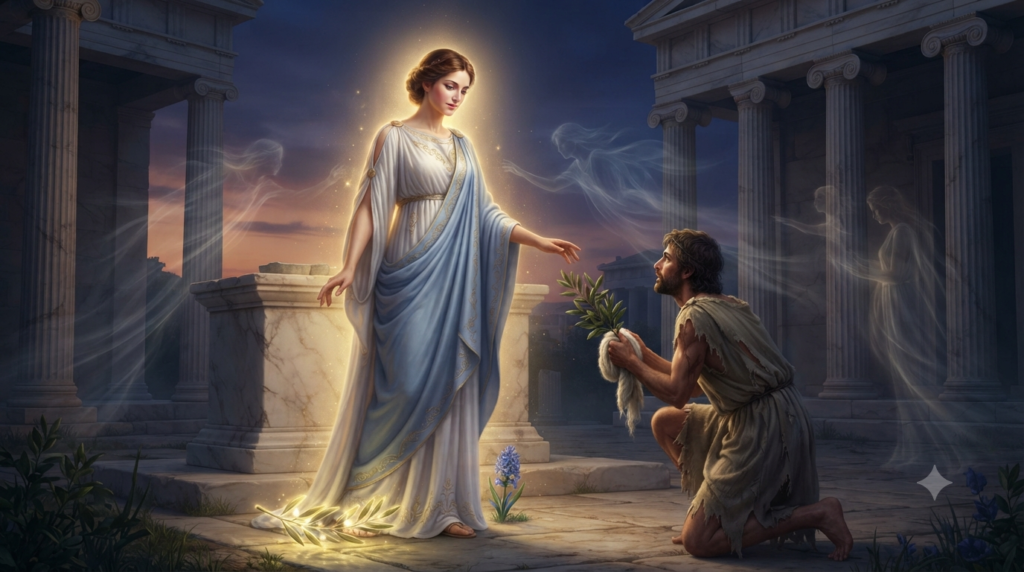
In the rich tapestry of Greek mythology, alongside the powerful Olympian gods and the fearsome monsters, exists a host of personified spirits who embody abstract concepts fundamental to human experience. Among these, one figure stands as a gentle but profound testament to the ancient Greek understanding of compassion. The answer to the question of who is Eleos, the Greek personification of mercy? leads us to a unique and deeply humane deity, a goddess whose worship was a distinct and defining characteristic of one of Greece’s most celebrated city-states. Eleos (Ἔλεος) was the divine personification of mercy, pity, and compassion, the gentle force that tempered justice with kindness . Unlike many of her divine counterparts, Eleos did not inspire epic tales of heroism or dramatic interventions in mortal affairs; her power was quieter, more profound, residing in the act of forgiveness and the protection of the vulnerable. This article will serve as a definitive guide to Eleos, exploring her origins, her unique cult, her mythological role, and her lasting legacy as the embodiment of human kindness.
Origins and Historical Background of Eleos
The origins of Eleos as a personified deity are somewhat distinct from the primordial gods who emerged at the dawn of creation. Like many of the Greek personified abstractions, Eleos belongs to a class of deities known as daimones (spirits), who represented abstract concepts . However, unlike more ancient figures such as Nyx (Night) or Erebus (Darkness), Eleos appears to have been a later development in Greek religious thought, emerging as a recognized divine figure during the Classical period.
The primary source for the genealogy of Eleos is the Roman author Hyginus, who states that she was the daughter of Erebus (Darkness) and Nyx (Night) . This lineage is significant, as it places her among the children of the primordial deities of the cosmos, a family that included other powerful and sometimes fearsome abstractions such as Thanatos (Death) and Hypnos (Sleep). This connection implies that mercy, like death and sleep, is a fundamental aspect of the human condition, a force woven into the fabric of existence. Her opposite number was Anaideia, the personification of cruelty and ruthlessness, highlighting the clear ethical dimension of her role .
Scholarly debate exists regarding the exact date of her cult’s introduction. Some historians suggest that while an altar dedicated to her existed in Athens from the late sixth century BCE, the “insubstantial god” herself may have been a later personification, perhaps developing from the concept of pity rather than being an original divine force . This underscores the idea that Eleos was not just a mythical figure but a cultural and philosophical concept that was gradually given a divine form.
The Mythological Role of Eleos
The primary mythological role of Eleos was to embody the principles of mercy and compassion. She was not a figure who participated in the great adventures of the gods; her role was more passive and profound. She represented the ideal of clemency, the power of forgiveness, and the importance of empathy in human affairs . In a world where the gods could be harsh and vengeful, Eleos stood as a reminder that humanity’s greatest strength often lay in its capacity for kindness.
Her most important function was as the patron of suppliants. The altar of Eleos in the Athenian agora was a place of sanctuary, where those who sought mercy or asylum could find it. Mythological figures such as Adrastus, the king who led the failed war of the Seven against Thebes, and the Heraclidae (the children of Heracles) sought refuge at her altar, imploring the assistance of the Athenians . This role cemented her status as a protector of the desperate and the wronged, a goddess who would listen to all supplicants, “day and night, no matter how horrendous their crimes” . Her cult was a practical expression of the Athenian ideal of compassion, a public and religious commitment to aiding those in need.
The Unique Worship of Eleos in Athens
One of the most remarkable aspects of Eleos is the distinct nature of her worship. Unlike the pan-Hellenic deities such as Zeus or Athena, Eleos was venerated almost exclusively in Athens . The ancient writer Pausanias, in his Description of Greece, famously noted that “the Athenians are the only ones among the Hellenes that worship this divine being, and among all the gods this is the most useful to human life in all its vicissitudes” . This exclusive worship was a point of pride for the Athenians, who viewed their devotion to mercy as a defining characteristic of their city’s moral character.
The center of this worship was an altar located in the Athenian agora (the marketplace and civic center) . Unlike the grand temples dedicated to other gods, the sanctuary of Eleos was reportedly a modest affair, “without statues or rituals, for the goddess dwelled only in the hearts of men” . This simplicity is telling; it suggests that mercy was not to be found in ornate buildings or elaborate ceremonies but in the actions and intentions of people. The altar itself was a powerful symbol of Athens’s identity as a place of refuge and civilization.
The rituals associated with Eleos were also unique. Honoring her involved the cutting of hair and the removal of garments at her altar, acts of humility and supplication . This further underscores the personal and introspective nature of her worship. The altar was a well-known asylum, a place where even the most desperate could find protection, a concept that fascinated and was commented upon by later writers .
Family and Relationships
As a daimon, Eleos is not integrated into the sprawling family trees of the Olympian gods, but her genealogy places her among the fundamental forces of the universe.
Parents
The most widely accepted genealogy, derived from the Roman mythographer Hyginus, states that Eleos was the daughter of Erebus (the personification of darkness) and Nyx (the personification of night) . This parentage makes her a sister to a host of other abstract deities, including:
- Thanatos (Death)
- Hypnos (Sleep)
- The Moirai (The Fates)
- Nemesis (Retribution)
This lineage suggests that mercy, like sleep, death, and fate, is an intrinsic part of the cosmic order, a fundamental aspect of existence that is not subject to the whims of the Olympian gods but is a law of the universe itself.
Opposite: Anaideia
Her mythological opposite was Anaideia, the personification of ruthlessness, cruelty, and shamelessness . This duality highlights the ethical dimension of her role: mercy and cruelty are opposing forces in the human soul, and Eleos represents the choice for compassion.
Symbols and Meaning
Eleos is not heavily associated with the complex iconography of the major Olympian gods. Her symbols are more conceptual, reflecting her role as a personification.
- The Altar: Her primary symbol was the altar itself, located in the Athenian agora. It represented the principle of asylum and the protection of the vulnerable. It was a physical manifestation of a city’s commitment to mercy .
- The Suppliant’s Branch: Those seeking mercy would often come bearing an olive branch wrapped in wool, a universal symbol of supplication. Eleos was the goddess who would receive these pleas.
- The Sanctuary of the Heart: As her temple was said to be in the hearts of men, her symbol is the internal act of compassion. She represents the choice to forgive and to pity.
- The Blue Hyacinth: In some later traditions, the blue hyacinth is associated with Eleos, symbolizing sorrow, humility, and the beauty of a merciful heart .
Powers and Characteristics
The “power” of Eleos is not a magical ability; it is a moral and social force. Her primary power is her ability to inspire mercy in the hearts of humans. She was the force that could stay the hand of the executioner, the voice that could plead for the life of a criminal, the emotion that could soften the hardest heart.
Her characteristics are those of a gentle, benevolent force:
- Compassion: Eleos is the embodiment of empathy and the ability to feel for others in their suffering .
- Forgiveness: She represents the power to grant clemency and to absolve transgressions .
- Pity: She is the personification of pity, the feeling of sorrow for the misfortunes of others .
- Impartiality: According to later tradition, she treated all supplicants equally, regardless of the severity of their crimes, making her a truly impartial dispenser of a second chance .
Religious and Philosophical Importance
The cult of Eleos was of great religious and philosophical importance in Athens. It represented a conscious and public commitment to humanitarian principles that set Athens apart from other Greek city-states . It was a form of civic religion that reflected the democratic and humanistic values of the city.
The altar of Eleos played a crucial role in the Athenian self-image. It was a symbol of their civilization and their willingness to offer asylum to those in need. This was a powerful political as well as religious statement. In a world often ruled by might, the Athenians chose to build a sanctuary for mercy.
The concept of Eleos also had a profound influence on Greek philosophy. Most notably, it was a central element in Aristotle’s theory of tragedy. In his Poetics, Aristotle argued that tragedy should evoke eleos (pity) and phobos (fear) in the audience, leading to a katharsis (purification) of these emotions . This makes Eleos not just a religious figure but a foundational concept for Western literature and aesthetics.
Ancient Sources
Eleos is mentioned in several key ancient sources, providing insight into her role and worship.
- Pausanias’ Description of Greece (2nd century CE): Provides the most detailed account of her altar and her unique worship in Athens. He praises her as “the most useful” of the gods .
- Pseudo-Apollodorus’ Bibliotheca: Mentions Eleos, noting that figures like Adrastus and the Heraclidae sought refuge at her altar .
- Hyginus’ Fabulae: A Roman source that provides a genealogy, listing her as the daughter of Erebus and Nyx .
- Timocles (fr. 33 PCG): A fragment of his comedy demonstrates that Eleos was personified in 4th-century BCE Greek literature .
- Aristotle’s Poetics: While not a mythological source, his use of eleos as a key element of tragedy demonstrates the philosophical importance of the concept .
- Statius’ Thebaid: A Roman epic that describes the altar of Eleos (using her Roman counterpart, Clementia) in Athens, showing that the concept was remembered in the Roman world .
Cultural Influence and Historical Legacy
The legacy of Eleos is profound, extending far beyond the ancient Athenian agora. Her influence can be seen in several key areas:
- Athenian Civic Identity: The worship of Eleos was a defining characteristic of Athens, shaping its reputation as a compassionate and civilized city-state .
- Literature and Philosophy: Aristotle’s use of eleos as a foundational element of tragedy has shaped Western literature for over two millennia . The concept of tragedy as an art form designed to evoke pity is a direct legacy of this personified concept.
- Modern Language: The Greek word eleos is the root of the modern English word “eleemosynary,” meaning charitable or relating to charitable giving. While a rare word, it is a direct linguistic descendant.
- Modern Culture: The name Eleos has been used in modern branding, such as the Australian skincare company Aesop’s “Eleos” hand balm, highlighting the enduring cultural resonance of the concept of care . The character of Eleos has also been adapted in modern storytelling, such as in tabletop role-playing games, where she is depicted as a goddess of forgiveness and new beginnings .
Frequently Asked Questions About Who is Eleos, the Greek personification of mercy?
What does the name Eleos mean?
The name Eleos comes from the ancient Greek word eleos (ἔλεος), which means “compassion,” “pity,” and “mercy” . The name is a direct reflection of her divine function. She is not a goddess who grants mercy; she is mercy.
Who are the parents of Eleos?
According to the Roman mythographer Hyginus, Eleos is the daughter of Erebus (the god of Darkness) and Nyx (the goddess of Night) . This makes her a primordial goddess, a force that has existed since the beginning of creation.
Why was Eleos only worshipped in Athens?
According to the ancient traveler Pausanias, the Athenians were unique among the Greeks in their worship of Eleos. This exclusive worship was a point of pride for them and reflected a public commitment to the ideals of compassion and asylum that they believed set their city apart from others .
What is Eleos’s role in Greek mythology?
Eleos is the personification of pity, mercy, and compassion. Her primary role was as a protector of suppliants who sought refuge from persecution or punishment. Her altar in Athens was a famous place of asylum, where figures like Adrastus and the Heraclidae sought aid .
Does Eleos have any symbols?
Her primary symbol is her altar in the Athenian agora, which represented the ideals of asylum and civic mercy . In some later traditions, she is associated with the blue hyacinth, a flower that symbolizes sorrow and humility.
Is Eleos mentioned in any famous ancient texts?
Yes, Eleos is mentioned by Pausanias, who describes her altar, by Apollodorus, who notes her sanctuary, and by others. Most notably, the concept of eleos is a central component of Aristotle’s theory of tragedy, where it is defined as the “pity” that the audience feels for the protagonist .
Who is the Roman equivalent of Eleos?
The Roman counterpart of Eleos is Clementia, the personification of clemency and mercy . She was a more prominent figure in Roman culture, representing the imperial virtue of mercy.
Conclusion
Eleos, the Greek personification of mercy, stands as a unique and deeply moving figure in the ancient world. She is not a goddess of power, war, or wisdom, but of the quiet, transformative force of compassion. Her story is not one of epic battles or divine drama, but of an altar in the heart of Athens, a place where even the most desperate could find hope. Her exclusive worship in that city was a testament to a civic ideal that valued mercy as a fundamental pillar of society. The answer to the question of who is Eleos, the Greek personification of mercy? is not a tale of mythology, but a profound reflection on the human capacity for kindness. Her historical importance lies in her role as a symbol of Athenian identity and a cornerstone of Aristotle’s philosophy of art. Her cultural legacy, from the word “eleemosynary” to modern tales of forgiveness, demonstrates that the concept of mercy she embodies remains as vital and necessary today as it was in the ancient world. Eleos reminds us that compassion is not a weakness, but a divine force, one that can heal, protect, and elevate the human spirit.

Orin Vale has spent the better part of two decades tracing the threads that connect the world’s oldest stories — from the halls of Asgard to the banks of the Nile, from Olympus to the jungles of the Maya. What began as a childhood fascination with flood myths and trickster gods grew into years of independent study across comparative mythology and ancient religion, always chasing the same question: what did these stories mean to the people who first told them? Orin writes for readers who want more than trivia — the ones looking for the beliefs, fears, and truths that myths were built to carry.