The question of who are the Potamoi, the river gods of Greek mythology? leads us to the very heart of the ancient Greek understanding of the natural world, where every flowing body of water was a living, breathing deity. The Potamoi (Ancient Greek: Ποταμοί, translit. Potamoí, lit. ‘Rivers’) were the divine personifications of the rivers and streams that coursed across the face of the earth . They were not merely gods who ruled over the waters; they were the waters themselves, the embodiment of the life-giving and destructive forces that shaped the landscape of the ancient world. The Potamoi were the 3,000 sons of the Titans Oceanus, the great world-encircling river, and his wife Tethys, making them brothers to the Oceanids, the goddesses of springs, clouds, and rain . Their daughters, in turn, were the Naiads, the nymphs of springs and fountains . This article will serve as a definitive guide to the Potamoi, exploring their origins, their diverse roles in myth and culture, their iconography, and their lasting legacy in the ancient world.
Origins and Historical Background of the Potamoi
The origins of the Potamoi are rooted in the earliest Greek cosmogony, the narrative of how the universe came into being. The most influential and comprehensive account of these origins comes from the poet Hesiod, who lived around the 8th century BCE. In his epic poem, the Theogony, Hesiod provides a definitive genealogy for the Potamoi, establishing their place in the divine order.
According to Hesiod, the Potamoi were the children of the Titans Oceanus and Tethys . Oceanus was the primordial god of the great river that encircled the world, and Tethys was the goddess of the sea’s surface. This parentage placed the Potamoi among the most ancient and powerful of the divine beings, a direct offspring of the fundamental forces of the cosmos. Hesiod’s Theogony describes their birth in a passage that lists many of the most famous river gods by name:
“Tethys bore to Ocean the eddying rivers, Nilus, and Alpheus, and deep-swirling Eridanus, Strymon, and Meander, and the fair stream of Ister, and Phasis, and Rhesus, and the silver eddies of Achelous, Nessus, and Rhodius, Haliacmon, and Heptaporus, Granicus, and Aesepus, and holy Simois, and Peneus, and Hermus, and Caicus fair stream, and great Sangarius, Ladon, Parthenius, Euenus, Ardescus, and divine Scamander.”
The historical importance of the Potamoi lies in their integration into the practical and religious life of the Greeks. Every river, stream, and even well was believed to have its own specific god or nymph . The Potamoi were not distant, abstract deities; they were intimately connected to the daily lives of the people who lived along their banks. Their worship was a form of recognition of the vital importance of fresh water for agriculture, drinking, and transportation. They were regarded as protectors of the young and gods of agricultural bounty .
The Mythological Role of the Potamoi
The primary mythological role of the Potamoi was to personify the rivers and streams of the earth. They were the living embodiment of these vital waterways, and their actions and characteristics were directly linked to the behavior of the rivers they represented. They were not simply passive forces of nature; they were active participants in the mythological world.
The Potamoi could be benevolent and life-giving, providing water for crops and sustenance for communities. They could also be fearsome and destructive, flooding their banks and sweeping away everything in their path. In mythology, they were often depicted as powerful, elder gods who could be angered or appeased. The river god Scamander, for example, fought on the side of the Trojans during the Trojan War and was offended when Achilles polluted his waters with corpses, overflowing his banks in an attempt to drown the hero .
The Potamoi were also known for their genealogical importance. They were the fathers of the Naiads, the beautiful nymphs of springs and fountains, and through them, their divine lineage continued to populate the world with minor deities . They were also known for their love affairs and their relationships with mortals and gods. The river god Alpheus, for instance, fell in love with the nymph Arethusa, pursuing her to Syracuse, where she was transformed into a spring by Artemis . These stories demonstrate the integration of the river gods into the larger tapestry of Greek myth.
Family and Relationships
The family of the Potamoi is extensive and complex, reflecting their deep integration into the Greek pantheon.
Parents
All Potamoi were the sons of the Titans Oceanus and Tethys . This parentage made them brothers to the 3,000 Oceanids, the goddesses of small streams, clouds, and rain . Oceanus was the great, world-encircling river, the source of all fresh water, and the Potamoi were his direct offspring.
Offspring
The Potamoi were the fathers of the Naiads, the nymphs of springs, fountains, and rivers . These nymphs, like their father, were tied to specific bodies of water and were often named after them, such as the Anigrides, Ismenides, and Amnisiades . The Potamides were a type of Naiad specifically associated with rivers and streams, and they were the daughters of the Potamoi .
Notable Potamoi
Hesiod mentions several Potamoi by name in his Theogony, but this is only a fraction of the total number. The following are some of the most notable river gods in Greek mythology:
- Achelous: The god of the Achelous River, the largest river in Greece. He was a powerful figure who fought Heracles for the right to marry Deianira .
- Alpheus: A river god of Arcadia who fell in love with the nymph Arethusa. He pursued her to Syracuse, where she was transformed into a spring .
- Asopus: A river god who was the father of many Naiads. His daughter Aegina was carried off by Zeus, and his daughter Sinope tricked three amorous gods into leaving her virginity intact .
- Inachus: The first king of Argos and progenitor of the Argive line through his son Argus. He was a river god who was also a culture hero .
- Nilus: The god of the Nile River in Egypt. He was the father of numerous daughters who mingled with the descendants of Inachus, forming a dynasty of kings in Egypt, Libya, Arabia, and Ethiopia .
- Peneus: The river god of Thessaly, flowing from the foot of Mount Pindus. He was the father of Daphne and Stilbe, love interests of the god Apollo .
- Scamander: A river god who fought on the side of the Trojans during the Trojan War. He was offended when Achilles polluted his waters and attempted to drown him .
Symbols and Meaning
The symbols of the Potamoi are directly tied to their function as the personifications of rivers and streams. They are depicted in art with specific attributes that convey their identity and power.
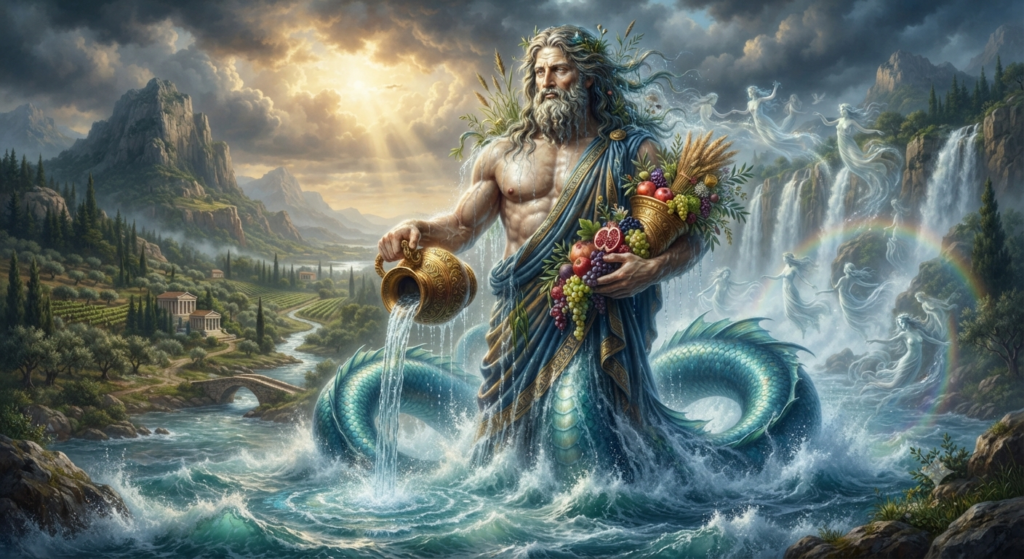
- The Cornucopia (Horn of Plenty): This symbol represents the agricultural bounty that rivers provide . The Potamoi were gods of fertility and abundance, and their waters were essential for the growth of crops.
- The Water-Jug or Amphora: This symbol represents the source of water that flows from the river. It is often depicted as an amphora from which water pours, representing the river’s constant flow .
- The Oar: This symbol represents the river’s role in transportation and navigation . Rivers were important trade routes, and the oar was a symbol of that function.
- The Bull: In some depictions, the Potamoi are shown with the head of a bull, representing the raw, powerful, and sometimes bellowing nature of a flooding river . The bull symbolized the untamed power of the river.
- The Serpentine Form: In other depictions, they are shown with the body of a snake or fish from the waist down, representing the fluid and serpentine nature of a river’s course .
Powers and Characteristics
The “powers” of the Potamoi are not the directed abilities of gods like Zeus or Athena. Their power is inherent in their very nature. As the personifications of rivers, their power was the power of the water itself.
- Personification of Water: Their primary power was to be the literal river they represented. They could provide life-giving water or unleash devastating floods. They were the force of nature that shaped the landscape and determined the fate of communities.
- Control Over Water: As the gods of rivers, they had the power to control the flow of their waters. They could flood their banks, create whirlpools, and alter their courses.
- Divine Form and Shape-shifting: The Potamoi could manifest in various forms. They were often depicted as bearded men, sometimes with bull’s heads or serpent-like lower bodies . This shape-shifting ability reflects the fluid and ever-changing nature of the water they represented.
- Procreation: The Potamoi were the fathers of the Naiads, allowing their divine lineage to continue and populate the world with minor deities .
- Physical Strength: The Potamoi were often depicted as being of immense size and strength. Achelous, for example, was a powerful wrestler who matched his strength against Heracles .
Worship and Religious Importance
The Potamoi were worshipped throughout Greece and its colonies . Their worship was a recognition of the essential role that fresh water played in the daily lives of the Greeks. They were not only feared for their destructive potential but also revered for their life-giving properties.
Local rivers were worshipped as protectors of the young and gods of agricultural bounty . Every creek and stream was believed to have its own god or nymph, and the Potamoi were the overarching deities of the rivers. It was common practice for travelers and soldiers to make offerings to the river gods before crossing a river or engaging in a battle, seeking their blessing or safe passage.
The Potamoi were also invoked in oaths and treaties, as their waters were seen as witnesses to important agreements. In some regions, they were worshipped in conjunction with other deities, such as Demeter and Dionysus, who were also associated with agriculture and fertility. The cult of the Potamoi was a practical and personal religion, reflecting the deep connection between the people and the land.
Ancient Sources
The Potamoi are mentioned in a wide range of ancient sources, from epic poetry to historical accounts.
- Hesiod’s Theogony (c. 8th-7th century BCE): The foundational text for their genealogy, establishing them as the sons of Oceanus and Tethys .
- Homer’s Iliad (c. 8th century BCE): Features the river god Scamander fighting in the Trojan War and engaging in battle with Achilles .
- Pseudo-Apollodorus’ Bibliotheca (c. 1st-2nd century CE): A later compendium of myths that provides genealogical information on the Potamoi.
- Hyginus’ Fabulae (c. 1st century CE): A Roman author who preserves the Greek traditions, listing many of the Potamoi in his preface .
- Diodorus Siculus’ Library of History (c. 1st century BCE): A Greek historian who mentions the Potamoi, including Peneus and Asopus .
- Philostratus’ Imagines (c. 3rd century CE): A Greek rhetorician who describes the river gods in art .
Artistic Representations
The Potamoi are a common subject in ancient Greek and Roman art, identifiable by their specific attributes.
- Sculpture and Reliefs: They are often depicted as reclining, bearded men with muscular, bared chests, symbolizing their strength . They are typically shown with a cornucopia (horn of plenty), a water-jug, and an oar .
- Vase Painting: In Greek vase painting, the Potamoi are sometimes shown in scenes from mythology, such as the fight between Achelous and Heracles.
- Mosaics: Roman mosaics often feature the Potamoi as personifications of the rivers of the empire, such as the Nile or the Tiber. They are usually shown as reclining figures, representing the river’s journey to the sea.
Cultural Influence and Historical Legacy
The cultural influence of the Potamoi is deeply embedded in the ancient Greek worldview and continues to resonate in modern times. Their legacy is as much in the physical landscape as it is in mythology.
- Geography and Toponymy: The names of many rivers in Greece and the Mediterranean world are derived from the names of the Potamoi. The Achelous, Alpheus, Peneus, and many other rivers still bear the names of their ancient gods.
- Literature and Poetry: The Potamoi have inspired countless poets and writers, from Homer to modern authors. Their stories are a staple of Greek mythology and continue to be retold.
- Art: Artists from the Renaissance to the present day have been inspired by the images of the river gods, capturing their strength and their connection to the natural world.
Frequently Asked Questions About Who are the Potamoi, the river gods of Greek mythology?
Who were the parents of the Potamoi?
All Potamoi were the sons of the Titans Oceanus, the great world-encircling river, and his wife Tethys, making them brothers to the Oceanids .
How many Potamoi were there?
According to Hesiod, there were 3,000 Potamoi, the same number as their sisters, the Oceanids . It would be difficult for a mortal man to tell the names of all of them, but each is known by those who live by him .
What are the symbols of the Potamoi?
Their standard attributes include the cornucopia (horn of plenty), which symbolizes agricultural bounty, a water-jug or amphora, which represents the river’s flow, and an oar, which symbolizes navigation .
How were the Potamoi depicted in art?
They were usually depicted as reclining, bearded men with bared chests . They could also appear as man-headed bulls, representing the raw power of a flooding river, or with the body of a serpent-like fish from the waist down, representing the fluid nature of a river’s course .
Who were the daughters of the Potamoi?
The Potamoi were the fathers of the Naiads, the nymphs of springs and fountains. The Potamides were a type of Naiad specifically associated with rivers and streams .
Are the Potamoi mentioned in any famous ancient texts?
Yes, they are mentioned in Hesiod’s Theogony, Homer’s Iliad, and the works of many later authors, including Apollodorus, Hyginus, and Diodorus Siculus .
What is the most important role of the Potamoi?
Their most important role was to personify the rivers and streams of the earth. They were living deities whose actions and characteristics were directly linked to the behavior of the rivers they represented .
Did the Potamoi have any special powers?
Their power was the power of the water itself. They could provide life-giving water or unleash devastating floods. They could also manifest in various forms, including human, bull, and serpentine, and were known for their divine strength .
Conclusion
The Potamoi of Greek mythology are a testament to the profound connection between the ancient Greeks and the natural world. They were not simply gods who ruled over the rivers; they were the rivers themselves, the living embodiment of the life-giving and destructive forces that shaped their lives. The answer to the question of who are the Potamoi, the river gods of Greek mythology? is a story of divine genealogy, cultural importance, and enduring legacy. As the sons of Oceanus and Tethys, they were among the most ancient of the divine beings, and their worship was a practical and personal expression of the recognition of the vital importance of fresh water. Their iconography, from the cornucopia to the serpentine form, conveys their role as providers of agricultural bounty and their untamed nature. The Potamoi remain a powerful symbol of the ancient world’s understanding of the cosmos, a world where every river was a god, and every god was a river.

Orin Vale has spent the better part of two decades tracing the threads that connect the world’s oldest stories — from the halls of Asgard to the banks of the Nile, from Olympus to the jungles of the Maya. What began as a childhood fascination with flood myths and trickster gods grew into years of independent study across comparative mythology and ancient religion, always chasing the same question: what did these stories mean to the people who first told them? Orin writes for readers who want more than trivia — the ones looking for the beliefs, fears, and truths that myths were built to carry.