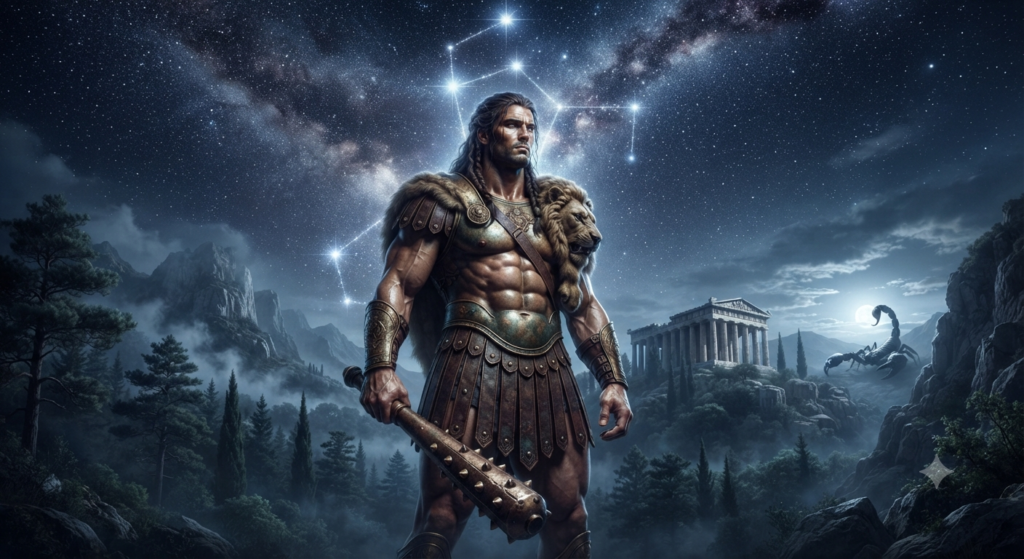
The question of who is Orion in Greek mythology? leads us to one of the most recognizable and compelling figures of the ancient world—a giant hunter whose legend is etched not only in ancient texts but also in the stars themselves. Orion stands as a colossal figure in Greek myth, a giant huntsman of extraordinary beauty, prowess, and arrogance, whose story is a tapestry woven from conflicting tales of divine parentage, blinding passion, and a dramatic death that ultimately secured his place among the constellations . He is a figure of immense contradictions: a beloved companion of the goddess Artemis, yet a victim of her arrows; a being with the power to walk on water, yet ultimately defeated by a tiny scorpion. This article will serve as a definitive guide to Orion, exploring his complex origins, his various adventures and transgressions, the multiple accounts of his demise, and his enduring legacy as the most famous constellation in the night sky.
Origins and Historical Background of Orion
Orion is a figure of immense antiquity, with his name appearing in the earliest works of Greek literature, including Homer’s Iliad and Odyssey, and Hesiod’s Works and Days, which date to the 7th or 8th century BCE . However, the origins of his myth are even older, rooted in an oral tradition that stretches back several centuries earlier. Unlike many heroes of Greek myth, there is no single, standardized version of Orion’s life; instead, his legend survives in fragments, incidental allusions, and summaries by later mythographers, creating a rich but often contradictory tapestry of stories .
Orion’s name itself provides some clues to his nature. In Greek, it may be derived from oros, meaning “mountain,” signifying his giant stature, or from ourion, meaning “urine,” which is a direct reference to one of his more unusual birth legends . These competing etymologies reflect the diverse nature of the myths that surround him.
The Mythological Role of Orion
Orion’s primary mythological role is that of the archetypal hunter—a being of immense skill, strength, and virility, whose prowess is both his greatest asset and his ultimate downfall. In Homer’s Odyssey, he is depicted in the underworld as a “great slayer of animals,” relentlessly pursuing his quarry with an indestructible bronze club . This image of the eternal hunter captures his essence: a force of nature whose existence is defined by the chase.
However, Orion is not merely a hunter. He is also a symbol of the dangers of hubris. His boast that he could kill every animal on Earth directly challenges the natural order and the authority of the gods, leading to his destruction . His story serves as a cautionary tale about the limits of mortal power and the consequences of transgressing against the divine. Furthermore, as the personification of the constellation, Orion serves a practical astronomical and agricultural function. The rising and setting of his constellation were used by the ancient Greeks as a guide for navigation and for determining the seasons for planting and harvesting .
The Complex Origins of Orion
The legends surrounding Orion’s birth are as varied as the stories of his life. Two major versions predominate, each connecting him to a different divine lineage.
The Divine Son of Poseidon
One of the most persistent traditions, found in a lost work attributed to Hesiod, makes Orion the son of the sea god Poseidon and Euryale, one of the daughters of Minos, King of Crete . This parentage grants Orion a unique and magical ability: he can walk on the waves of the sea as if it were solid land . This ability is crucial to his story, as it allows him to travel easily from island to island in the Aegean. His mother, Euryale, is sometimes described as a Gorgon, adding a monstrous element to his divine heritage .
The Earth-Born Hunter
A second, more unusual birth legend is preserved in the margins of ancient texts and in the works of later compilers. In this version, the gods Zeus, Hermes, and Poseidon are guests of Hyrieus, a poor but pious king of Tanagra in Boeotia . Hyrieus, who is childless, roasts a whole bull for his divine guests. In gratitude, the gods offer him a boon, and he asks for a son. The gods take the bull’s hide, urinate into it, and then bury it in the earth, instructing Hyrieus to dig it up ten months later . When he does, he finds Orion, who is therefore “earthborn.” This story not only explains his name (via its connection to urine) but also cements his connection to the earth and the agricultural cycle, as his constellation is linked to seasonal rains . This version emphasizes a more chthonic, or earth-based, origin for the giant.
Family and Relationships
Orion’s relationships with women and goddesses are central to his myth, often leading to his downfall.
Orion and Merope
While hunting on the island of Chios, Orion fell in love with Merope, the beautiful daughter of King Oenopion . The king promised Orion his daughter if he could clear the island of its wild beasts. Orion accomplished this task, but Oenopion, unwilling to part with his daughter, delayed the marriage. In a rage, and perhaps driven by wine, Orion broke into Merope’s chamber and assaulted her . In revenge, Oenopion called upon his father, the wine god Dionysus, who made Orion drunk and had him blinded by satyrs . This act of blinding sets off a crucial part of Orion’s journey.
Orion and Artemis
After regaining his sight, Orion traveled to the island of Crete, where he became a hunting companion to the virgin goddess Artemis and her mother, Leto . This relationship is a source of intense drama and is the cause of his death in many versions of the myth. Some accounts suggest that Orion fell in love with Artemis and attempted to violate her or one of her handmaidens . Others portray their relationship as a deep friendship, which made Apollo jealous, leading him to orchestrate Orion’s death .
Orion and Eos
In some versions, the goddess of the Dawn, Eos, fell in love with Orion’s beauty and abducted him . This angered the gods, and Artemis was sent to kill him on the island of Ortygia . This story further highlights Orion’s overwhelming attractiveness and the danger it posed, even to goddesses.
Symbols and Meaning
Orion’s primary symbol is the constellation that bears his name, which in the night sky depicts a giant hunter with a raised club, a lion’s skin, and a prominent belt . The three bright stars of his belt are one of the most recognizable asterisms in the night sky . The constellation was seen as an eternal monument to his life and death.
Other symbols associated with him include his weapons: the bronze club and the lion’s skin, which connect him to the archetype of the mighty hunter. The giant scorpion, Scorpius, which was sent to kill him, is his eternal antagonist in the sky; the two constellations are placed on opposite sides of the heavens so that they are never visible at the same time .
Powers and Characteristics
Orion’s defining characteristic is his supernatural prowess as a hunter, which is his primary “power.” He is described as a “great slayer of animals,” capable of hunting any creature on Earth . His divine heritage grants him other abilities. As the son of Poseidon, he possessed the power to walk on water, a feat that allowed him to travel freely across the sea .
Orion is also characterized by his immense size and physical beauty. He is often called a giant and is considered one of the most handsome of all men . His “power” is also a fatal flaw: his hubris. His boast that he could kill every animal on the planet was an act of defiance against the gods, directly leading to his death .
Worship and Religious Importance
Orion was not a widely worshipped deity in the sense of the Olympian gods, but he was venerated as a hero in the region of Boeotia, particularly at Tanagra, where his tomb was believed to be located . This hero cult was a form of religious importance that honored the memory of a legendary figure rather than seeking his intervention.
Orion’s primary religious and cultural importance was astronomical. The constellation of Orion was used throughout the ancient world as a vital tool for navigation and as a celestial calendar. Hesiod, in his Works and Days, instructs farmers to use the rising and setting of Orion to determine the proper times for various agricultural tasks .
Ancient Sources
Orion appears in numerous ancient sources, though often in fragmentary or contradictory forms. The most important early references are in Homer’s Iliad and Odyssey, where he is mentioned as a constellation and as a shade in the underworld . Hesiod’s Works and Days also mentions the constellation .
The most complete accounts of his life are found in later summaries, particularly the lost work Astronomia attributed to Hesiod, which is known through the writings of Eratosthenes and Hyginus . The Bibliotheca of Pseudo-Apollodorus also provides a detailed summary of his myth . Other important sources include the Roman poets Ovid and Virgil, who offer their own versions of his story .
Artistic Representations
Orion is a common figure in ancient art, particularly in vase painting and mosaics, where he is often depicted as a giant hunter carrying a club. He is a central figure on the constellations in astronomical texts, and his image was used in Roman mosaics to represent the hunter in the sky. In Renaissance and Neoclassical art, he has been a popular subject, often depicted in scenes of his death or his elevation to the stars.
Cultural Influence and Historical Legacy
The cultural influence of Orion is immense, extending far beyond the ancient Greek world. The constellation that bears his name is recognized and named in countless cultures around the world, each with its own set of myths and associations . He remains one of the most famous and recognizable figures in Greek mythology, appearing in literature, art, and modern popular culture. His story, a tragic cycle of pride, love, betrayal, and death, continues to resonate, reminding us of the power of myth to explain the world and the human condition.
Frequently Asked Questions About Who is Orion in Greek mythology?
Who were the parents of Orion?
There are two major versions. In one, he is the son of the sea god Poseidon and the mortal princess Euryale. In another, he was earth-born, created when the gods Zeus, Hermes, and Poseidon urinated into a bull’s hide and buried it in the ground for King Hyrieus .
What is Orion famous for in Greek mythology?
Orion is famous for being a giant and incredibly skilled hunter. He boasted that he could kill every animal on Earth, which led to his death. He was also known for his great beauty and his complex relationships with goddesses like Artemis and Eos .
Who killed Orion in Greek mythology?
The myths offer several different accounts of his death. Some say he was killed by the goddess Artemis, either because she was tricked by her brother Apollo or because Orion tried to assault her. The most common version is that he was stung to death by a giant scorpion, sent by Gaia (Earth) as punishment for his boast .
Why is Orion in the stars?
After his death, Orion was placed among the stars as a constellation by Zeus or Artemis as a memorial to the great hunter. His eternal antagonist, the Scorpion (Scorpius), was placed on the opposite side of the sky so that they would never meet again .
What is Orion’s relationship to the Pleiades?
Orion was in love with the Pleiades, the seven daughters of the Titan Atlas, and he relentlessly pursued them. To protect them, Zeus transformed the sisters into a constellation. In the sky, Orion is still depicted as chasing them .
Conclusion
The figure of Orion in Greek mythology is a testament to the enduring power of myth. He is a hero, a transgressor, and a god all at once, his story a complex and often contradictory collection of legends that have captivated audiences for millennia. The answer to the question of who is Orion in Greek mythology? is not a simple one, but a journey through a world of giants, goddesses, and cosmic justice. He is the ultimate hunter, whose pride and passion led to his doom, yet whose memory was immortalized in the stars. His legacy is the constellation that still shines brightly in the night sky, a constant reminder of the human struggle between ambition and mortality, and a testament to the ancient Greek impulse to understand the universe through stories.

Orin Vale has spent the better part of two decades tracing the threads that connect the world’s oldest stories — from the halls of Asgard to the banks of the Nile, from Olympus to the jungles of the Maya. What began as a childhood fascination with flood myths and trickster gods grew into years of independent study across comparative mythology and ancient religion, always chasing the same question: what did these stories mean to the people who first told them? Orin writes for readers who want more than trivia — the ones looking for the beliefs, fears, and truths that myths were built to carry.