The question of who are the Asclepiades in Greek mythology? opens a window into the ancient world’s profound connection between divine healing, religious practice, and the art of medicine. The Asclepiades (Greek: Ἀσκληπιάδες, Asklêpiades) were the descendants of Asclepius, the god of medicine and healing, and they represented two interconnected concepts in the ancient Greek world: the divine personifications of healing and health, and the historical priest-physicians who claimed descent from the god and perpetuated his medical knowledge . As a collective term, the Asclepiades encompassed both the mythological children of Asclepius—goddesses who personified aspects of health, cure, and treatment—and the mortal families of physicians who established a hereditary tradition of medical practice that persisted for centuries . This dual nature makes the Asclepiades one of the most fascinating and historically significant groups in Greek mythology, bridging the gap between divine intervention and rational medicine. This article will serve as a definitive guide to the Asclepiades, exploring their divine origins, their individual roles, their historical importance as a medical guild, and their enduring legacy in the history of medicine.
Origins and Historical Background of the Asclepiades
The origins of the Asclepiades are rooted in the complex mythology surrounding their divine progenitor, Asclepius. Asclepius was a figure of immense importance, a demigod hero who was the son of Apollo and the mortal princess Coronis, who later became the god of medicine . His story is one of tragedy and transformation. According to the most prevalent version, Asclepius was born in Epidaurus, where his mother Coronis gave birth to him during a journey . In some accounts, he was abandoned as an infant but was found and raised by a shepherd or, in other versions, by the wise centaur Chiron, who taught him the secrets of healing using plants and herbs . Asclepius’s healing abilities were so powerful that he could even bring the dead back to life. This act of defiance against the natural order angered Hades, the god of the underworld, who persuaded Zeus to kill Asclepius with a thunderbolt . After his death, Asclepius was elevated to divine status, becoming a god worshipped throughout the Greek world .
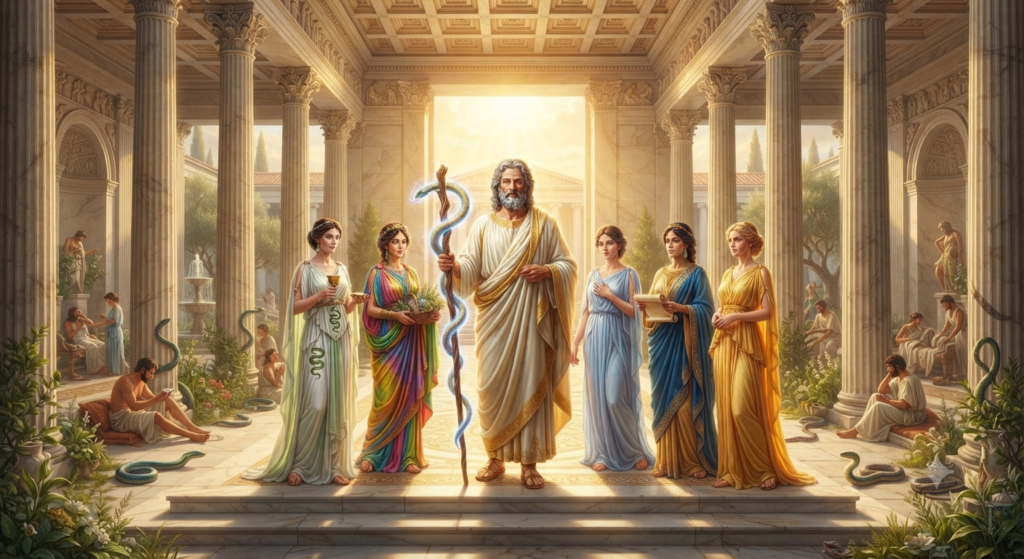
The Asclepiades, as his divine children, were the natural extension of his legacy. They were the personifications of the various aspects of health and healing, each embodying a specific facet of the medical arts. Their names—Hygeia, Panacea, Iaso, Aceso, and Aegle—were direct reflections of their functions, making them a practical and accessible part of Greek religious life. The historical Asclepiades, the priest-physicians, claimed descent from Asclepius and his sons, Machaon and Podalirius, and they formed a powerful and influential guild of doctors who practiced medicine in the temples of Asclepius, known as Asclepieia .
The Mythological Role of the Asclepiades
The primary mythological role of the Asclepiades was to serve as the divine embodiments of health, healing, and the various aspects of medical practice. They were the daughters of Asclepius and Epione, the goddess of soothing pain . In some traditions, Hygeia was considered the wife of Asclepius rather than his daughter, but the most common lineage establishes them as his children . These goddesses were not merely abstract concepts; they were active participants in the healing process, invoked by the sick and the suffering who sought relief in the temples of their father.
The Asclepiades were worshipped alongside Asclepius in his sanctuaries, and they were the recipients of hymns and prayers from supplicants seeking cures . Their specific domains covered the entire spectrum of medical care, from preventative public health to acute treatment and the restoration of health. This division of labor within the divine family reflects the ancient Greek understanding that healing was a multifaceted process, requiring different approaches for different ailments and stages of illness. They represented the ideal of a holistic approach to health, one that encompassed physical, mental, and spiritual well-being.
The Divine Children of Asclepius: The Asclepiades
The Asclepiades were typically considered to be five daughters of Asclepius, though some sources list four or six, including the male godling Telesphoros . Each of these goddesses had a specific and crucial role in the healing process.
Hygeia (Good Health)
Hygeia (Ὑγεία) was the goddess of health, hygiene, and the prevention of disease . She is perhaps the most famous of the Asclepiades, and her name is the root of the modern English words “health” and “hygiene” . In Roman mythology, she was known as Salus . Hygeia represented the maintenance of good health and the importance of clean living and preventative care. She was a key figure in the promotion of public health, and her role was to ensure that people remained well, rather than simply curing them when they became ill. In modern medicine, her influence is seen in the fields of hygiene, health programs, and nursing .
Panacea (Cure-All)
Panacea (Πανάκεια) was the goddess of universal remedy or the “cure-all” . Her name has become a byword for a solution that solves all problems. In the context of Greek myth, she personified the power of medicine to heal any ailment, representing the ultimate goal of the physician: a complete and total cure. She was the embodiment of therapy and the belief that there was a remedy for every disease. Her name is still used today to refer to a universal cure .
Iaso (Healing)
Iaso (Ἰασώ) was the goddess of healing, cures, and modes of recovery . Her name is derived from the Greek word iasthai, meaning “to heal.” She represented the process of recovery and the return to health after an illness or injury. She was the deity who oversaw the actual act of healing, the transition from sickness to health. In the practice of medicine, she was associated with the work of clinicians, who are the primary agents of healing .
Aceso (Curing)
Aceso (Ἀκεσώ) was the goddess of curing and the healing process . Her name comes from the Greek word akeisthai, meaning “to cure.” She represented the process of curing, the active treatment of a disease or injury. She was the goddess who presided over the application of remedies and the mending of the body. In the division of the medical arts, she was considered a protector of surgical domains .
Aegle (Radiance)
Aegle (Αἴγλη) was the goddess of radiance and good health . Her name means “splendor” or “radiance,” and she personified the glow of health that comes after a successful cure. She was also the goddess who granted physicians social prestige and the right to charge fees for their services . Aegle is sometimes listed as the second wife of Asclepius, but in most traditions, she is counted as one of his daughters .
The Sixth Asclepiad: Telesphoros
In some lists, the male god Telesphoros (Τελεσφόρος) is included among the Asclepiades . Telesphoros was the godling who assisted in the cure of the sick, bringing them to completion and recovery. He is often depicted as a small child wearing a hooded cloak, representing the hope of recovery and the final stages of healing .
The Historical Asclepiades: The Medical Guild
The term Asclepiades was also applied to a historical group of physicians who claimed descent from Asclepius and formed a hereditary guild of doctors . These were not just any physicians; they were the practitioners who served in the Asclepieia, the temples dedicated to the god of healing. The Asclepieion of Epidaurus was the most famous of these temples, and it was the center of the Asclepiad tradition .
The historical Asclepiades were an ancient and powerful guild of doctors who believed they had inherited the secret knowledge of healing from their divine ancestor . They were a closed group, passing their medical expertise from father to son, and they practiced a form of medicine that combined rational therapy with religious ritual. The Asclepiades were involved in all aspects of the treatment process, from performing sacrifices to interpreting the dreams of patients who slept in the temple’s dormitory, known as the abaton . The network of Asclepieia throughout Greece was vast, and the Asclepiades were the principal practitioners in these healing sanctuaries .
The Relationship Between Divine and Human Asclepiades
The two meanings of the term “Asclepiades” are interconnected. The divine Asclepiades—Hygeia, Panacea, Iaso, Aceso, and Aegle—were the patrons of the historical Asclepiades. The physicians who served in the temples would have prayed to these goddesses and sought their favor in their work. The mythological framework provided a divine sanction for the practice of medicine, and the historical guild drew its authority and legitimacy from its claimed descent from the god Asclepius. The temples of Asclepius, the Asclepieia, were the centers of this fusion of religion and medicine, where the gods and the physicians worked together to heal the sick .
Symbols and Meaning
The symbols associated with the Asclepiades reflect their roles in the healing arts and their connection to their father, Asclepius.
- The Rod of Asclepius: This is the most important and enduring symbol of the Asclepiades. It depicts a staff with a single snake coiled around it. This was the symbol of Asclepius, and by extension, of all his descendants . The snake was a symbol of rejuvenation and healing, as it sheds its skin and is reborn. This symbol is still used today as a sign of the medical profession.
- The Cup or Bowl: The Asclepiades, particularly Hygeia, are often depicted holding a cup or bowl from which a snake is drinking. This symbolizes the use of medicine and the act of healing.
- The Sacred Snake: As mentioned, the snake was a sacred animal to Asclepius and his children. Non-poisonous snakes were kept in the temples and were believed to have healing powers. They would crawl over the sleeping patients in the abaton, contributing to the healing process .
Worship and Religious Importance
The Asclepiades were worshipped primarily within the context of the Asclepieia, the temples of Asclepius . They did not typically have temples of their own, but they were venerated alongside their father. Supplicants would invoke their names and seek their specific form of assistance. For example, a person suffering from a long-term illness would pray to Iaso and Aceso, while someone seeking to maintain their health would pray to Hygeia. The hymns known as peanes were sung in their honor, and offerings were made to them . The cult of the Asclepiades was a practical and personal religion, reflecting the daily concerns of health and sickness that affected everyone.
Ancient Sources
The Asclepiades are mentioned in several key ancient sources.
- Hesiod: The earliest mentions of the Asclepiades are found in fragments of Hesiod’s works, as preserved by later authors.
- The Hippocratic Oath: The famous Hippocratic Oath, which dates from the Classical period, begins with the invocation “I swear by Apollo the Healer, by Asclepius, by Hygeia, by Panacea, and by all the gods and goddesses of healing…” . This is a direct testimony to the religious importance of the Asclepiades in the medical profession.
- Aristophanes’ Plutus: The playwright mentions the Asclepiades in his comedy, listing some of their names .
- The Suda: The Byzantine encyclopedia preserves traditions about the Asclepiades, including their parentage and names .
Artistic Representations
The Asclepiades are a common subject in ancient Greek and Roman art. They are often depicted in reliefs and mosaics found in the Asclepieia. Hygeia is the most frequently represented, often shown as a beautiful young woman feeding a snake from a cup or bowl. The other goddesses are also depicted in scenes of healing, often alongside their father, Asclepius. These images served as a focus for prayer and a reminder of the divine power that was present in the healing sanctuaries.
Cultural Influence and Historical Legacy
The influence of the Asclepiades is immense. Their names have entered the vocabulary of modern medicine, and their symbolism is still used by medical organizations around the world. The Rod of Asclepius is the most recognized symbol of medicine. The concepts of hygiene, panacea, and therapy are all rooted in the names of these ancient goddesses. The historical Asclepiades established a tradition of hereditary medical practice that influenced the development of medicine in antiquity and beyond. Their legacy is the integration of religious faith and rational science in the pursuit of healing, a tradition that continues to inform the practice of medicine today.
Frequently Asked Questions About Who are the Asclepiades in Greek mythology?
Who were the Asclepiades in Greek mythology?
The Asclepiades were the descendants of the god Asclepius. They referred to both his divine children, who were goddesses of healing, and to the historical families of physicians who claimed descent from the god .
How many Asclepiades were there?
There were typically five divine daughters: Hygeia, Panacea, Iaso, Aceso, and Aegle. Some sources also include the godling Telesphoros as a sixth Asclepiad .
Who were the parents of the Asclepiades?
The Asclepiades were the children of the god Asclepius and his mortal wife Epione. In some traditions, Hygeia is considered his wife, but the most common tradition has her as his daughter .
What was the role of each Asclepiad?
Hygeia was the goddess of health and hygiene; Panacea was the goddess of the universal cure; Iaso was the goddess of healing; Aceso was the goddess of curing; and Aegle was the goddess of radiance and good health . Telesphoros was the godling who helped bring the sick to completion and recovery .
What is the connection between the Asclepiades and the medical profession?
The historical Asclepiades were a guild of priest-physicians who served in the temples of Asclepius. They claimed descent from the god and his sons, Machaon and Podalirius, and practiced a form of medicine that combined religious ritual with rational treatment .
What is the Rod of Asclepius?
The Rod of Asclepius is a staff with a single snake coiled around it. It was the symbol of Asclepius and, by extension, of all the Asclepiades. It remains a universal symbol of the medical profession today .
Conclusion
The Asclepiades of Greek mythology represent a unique and enduring synthesis of religion and medicine. The question of who are the Asclepiades in Greek mythology? leads to a dual answer: they are the divine goddesses who personify health and healing, and they are the historical guild of physicians who claimed descent from the god of medicine and perpetuated his healing art. From the majestic Hygeia, whose name is the root of “health,” to the hopeful Telesphoros, who brought cures to completion, the Asclepiades embodied every facet of the medical arts. Their influence is still felt today in the symbols of medicine, the vocabulary of health, and the enduring tradition of physicians who seek to heal the sick. The Asclepiades are a powerful reminder of the ancient Greek understanding that true healing is a holistic endeavor, one that honors both the rational and the divine.

Orin Vale has spent the better part of two decades tracing the threads that connect the world’s oldest stories — from the halls of Asgard to the banks of the Nile, from Olympus to the jungles of the Maya. What began as a childhood fascination with flood myths and trickster gods grew into years of independent study across comparative mythology and ancient religion, always chasing the same question: what did these stories mean to the people who first told them? Orin writes for readers who want more than trivia — the ones looking for the beliefs, fears, and truths that myths were built to carry.