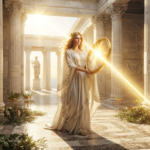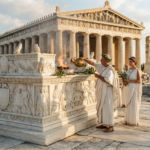
The question of who is the nymph Ismenis in Greek mythology? leads us to the shadowy banks of the River Ismenus near the ancient city of Thebes, where a naiad of singular beauty and tragic maternal love once dwelt. Ismenis (Ancient Greek: Ἰσμηνίς) was a naiad nymph, one of the daughters of the Boeotian river god Ismenus . Her name is a patronymic rather than a given name, identifying her as “she of the River Ismenus” , and she is most famous for her love affair with the god Pan, which produced a son, Crenaeus, and for the heart-rending grief she suffered when that son fell in battle . This article will serve as a definitive guide to Ismenis, exploring her origins, her family, her role in the epic war of the Seven Against Thebes, and her place in the rich tapestry of Greek mythology.
Origins and Genealogy
Ismenis is a figure whose origins are inextricably linked to the geography of Boeotia, the region of central Greece that was home to the powerful city of Thebes. As a naiad, she was a freshwater nymph, a spirit of springs, streams, and rivers. Her parentage is clearly established in the ancient sources: she was the daughter of the river god Ismenus .
The identity of this River Ismenus, however, is itself a subject of multiple traditions. The river that flowed past Thebes was personified by a god who was either the son of the Titan Oceanus and his wife Tethys, or the son of the god Apollo and the Oceanid nymph Melia, or a son of the river god Asopus and the nymph Metope . Regardless of the precise genealogy of her father, Ismenis, as his daughter, was a member of the vast and ancient family of the Potamoi, the river gods who were the sons of Oceanus and Tethys.
Given her parentage, Ismenis was probably the sister to other nymphs associated with the springs and streams of Thebes, including Dirce, Strophia, and Crocale . In some traditions, the younger Linus, the music teacher of Heracles, was possibly a brother of hers . Her family, therefore, is a complex web of divine beings who personified the life-giving but also potentially dangerous waters of the Boeotian landscape.
The Myth of Ismenis and Pan
The most significant relationship in Ismenis’s life was her love affair with the god Pan. Pan was a rustic god of the wild, shepherds, and flocks, a figure associated with untamed nature and sudden, irrational panic. According to the primary source for this myth—the Thebaid, an epic poem by the Roman author Statius—Pan fell in love with the nymph Ismenis, and she bore him a son named Crenaeus .
The name Crenaeus (Κρηναῖος) is significant in itself. It means “of the spring” or “of the fountain,” a name that directly reflects his mother’s identity as a water nymph . The union of the forest god Pan and the river nymph Ismenis produced a child who was a fusion of their two worlds. Crenaeus was a being of both the woods and the waters, a warrior who could move with ease along the banks of his grandfather’s river . He represents the intersection of the wild, untamed power of Pan with the fluid, life-giving nature of a river nymph.
The Tragedy of Crenaeus and the Grief of Ismenis
The story of Ismenis is not a tale of love and happiness but one of devastating loss. Her son, Crenaeus, was a warrior who participated in the epic conflict known as the Seven Against Thebes, a war in which seven Argive champions led an army against the city of Thebes to restore the deposed prince Polynices to the throne .
During the battle, the action reached the banks of the River Ismenus. Crenaeus, confident in his ability to fight on the home ground of his grandfather, challenged the Argive champion Hippomedon to single combat. He boasted of his divine lineage and his invincibility in the sacred waters of the Ismenus. However, Hippomedon drove his spear home, piercing Crenaeus’s life . The river shuddered at the horrid deed, and the woods on either shore lamented.
The Lament of a Mother
The death of Crenaeus triggered an outpouring of grief from his mother, Ismenis. Statius paints a vivid picture of her frantic search for her son’s body. She rose from the river, frenzied, with loosened hair, and in wild grief rent her face and bosom. She cried out her son’s name, frantically searching the flood for any sign of him . The only trace she found was his shield, floating on the water. She sank back into the depths, searching in vain for her dead son by many a track .
The grief of Ismenis was so profound that the other nymphs and even the Nereids of the sea were moved to pity. They eventually found Crenaeus’s body and wafted it back to his mother’s breast . Ismenis, embracing him as though he lived, brought him home and laid him on the sloping bank, drying his wet face with her soft tresses. Her lament is a heart-wrenching account of a mother’s love, the loss of a child who was “the price and glory of wave and woodland,” and her feeling that his death made her less of a goddess .
Ismenis and the River Ismenus
Ismenis was not only the daughter of the river god Ismenus but was also loosely identified with the nymph Melia, the nymph of the Ismenian spring, who was sometimes considered to be her grandmother . The myth of Ismenis and her son is deeply intertwined with the river itself. In the Thebaid, the River Ismenus becomes a character in the story, reacting with anger to the death of his grandson. The river god attempts to raise his waters against Hippomedon in revenge for the death of Crenaeus, although he is forced to withdraw his attack at the request of Zeus .
The story of Ismenis is therefore an etiology, a story that explains the significance of the River Ismenus and the events that took place on its banks. The river was not just a body of water but a divine being, the father of a nymph and the grandfather of a warrior, a participant in the epic struggles of the heroes of Thebes.
Frequently Asked Questions About Who is the nymph Ismenis in Greek mythology?
Who were the parents of the nymph Ismenis?
Ismenis was the daughter of Ismenus, the river god of the Ismenus River near Thebes in Boeotia .
Which god was the lover of Ismenis?
The god Pan was the lover of Ismenis. He fell in love with the nymph, and she bore him a son named Crenaeus .
Who was the son of Ismenis?
Ismenis’s son was Crenaeus, whose name means “of the spring.” He was a warrior who fought in the war of the Seven Against Thebes and was killed in battle by Hippomedon .
Where did Ismenis live?
Ismenis was a naiad nymph who lived in the River Ismenus near the city of Thebes in Boeotia, central Greece .
What role did Ismenis play in the war of the Seven Against Thebes?
During the war, her son Crenaeus was killed. After his death, Ismenis searched frantically for his body and was overcome with grief. Her father, the river god Ismenus, attempted to avenge Crenaeus’s death .
Is Ismenis mentioned in any other ancient sources?
Ismenis is primarily known from the Thebaid of the Roman poet Statius. She is also mentioned in the Greek tradition as a daughter of the river god Ismenus, and in some sources, she is loosely identified with the nymph Melia .
Conclusion
Ismenis, the naiad nymph of the River Ismenus, is a figure of profound beauty and tragic loss. As the daughter of the river god Ismenus , the lover of Pan, and the mother of Crenaeus, she was woven into the fabric of Theban myth . Her story, immortalized in Statius’s Thebaid, is not one of grand adventures but of intimate grief . The question of who is the nymph Ismenis in Greek mythology? reveals a mother whose love for her son transcended the boundaries of the divine and the mortal, a being whose sorrow echoed through the very waters of the Ismenus itself. Her legacy is a testament to the power of maternal love and the enduring human experience of loss, a story that continues to resonate across the centuries.

Orin Vale has spent the better part of two decades tracing the threads that connect the world’s oldest stories — from the halls of Asgard to the banks of the Nile, from Olympus to the jungles of the Maya. What began as a childhood fascination with flood myths and trickster gods grew into years of independent study across comparative mythology and ancient religion, always chasing the same question: what did these stories mean to the people who first told them? Orin writes for readers who want more than trivia — the ones looking for the beliefs, fears, and truths that myths were built to carry.