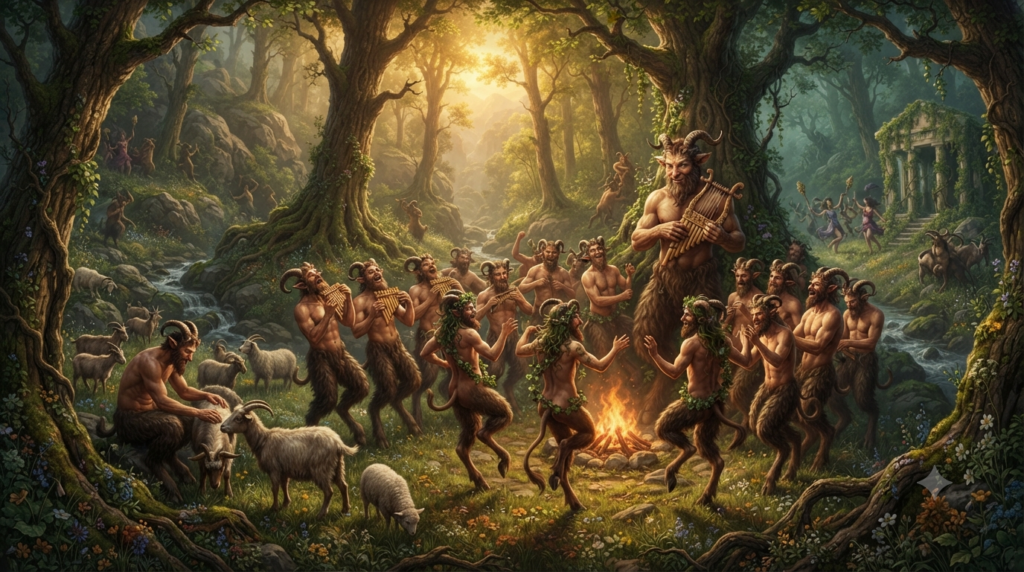
The question of who are the Panes (followers of Pan) in Greek mythology? leads us into the wild, untamed heart of the ancient Greek countryside, where the boundaries between god, spirit, and beast blur into a chorus of rustic revelry. The Panes were a multitude of rustic spirits (daimones) who personified the wild, untamed forces of nature, serving as the companions and followers of the great god Pan . They were not merely a single entity but a multiplication of Pan himself, a tribe of goat-footed, horned beings who presided over the mountains, highland pastures, and the flocks that grazed there . This article will serve as a definitive guide to the Panes, exploring their origins, their appearance, their roles as fertility spirits, and their place in the broader company of the Greek gods.
Origins and Nature of the Panes
The Panes were envisioned as a multiplication of the Arcadian god Pan, a rustic deity who was himself a figure of profound antiquity, perhaps even predating the Olympian pantheon . While the single god Pan was the chief, he could be multiplied into a whole tribe of Panes, each embodying different aspects of his wild nature . In this sense, they were not separate deities but aspects of the primal Pan, a fractal expansion of his power across the landscape . Some scholars suggest that the numerous Panes may have preceded the concept of a single Pan, with humanity first imagining a multitude of nature spirits before conceiving of a composite god to lead them .
Their parentage was as varied as their forms. Some of the Panes were said to be sons of Hermes, the messenger god who was often associated with rustic and pastoral life; others were sons of Zeus, the king of the gods; and some were simply children of the primeval Pan himself . This diverse genealogy reflects the fluid and often contradictory nature of Greek myth, where local traditions and different poets could assign different origins to the same figures.
Appearance and Characteristics
The Panes were depicted as goat-footed men, sharing the unmistakable features of their chief, Pan. They possessed the horns, tail, beard, snub nose, and ears of a goat, and sometimes even had actual goat-heads instead of merely goatish features . As lascivious fertility spirits, they were often depicted with erect members, symbolizing their connection to the procreative forces of nature . They were the embodiment of raw, untamed virility and the wild, sexual energy of the natural world. In ancient accounts, they are described as “capripedes” (goat-footed) and were often taken as a symbol of impudence and unchastity .
It is important to distinguish the Panes from the Satyroi (Satyrs). While both were rustic spirits, the Satyrs were characterized by asinine tails and ears, whereas the Panes were distinguished by their goatish features . This distinction, though subtle, was important in the ancient Greek imagination, separating the horselike or donkey-like followers of Dionysus from the goat-like followers of Pan.
The Panes of the Hunt and Pasture
Among the Panes, certain individuals were given specific names and functions, representing the different facets of the god Pan’s domain. The trio of Agreus, Nomios, and Phorbas were particularly prominent :
- Agreus (Ἀγρεύς), whose name means “Hunter,” presided over hunting .
- Nomios (Νόμιος), whose name means “Of the Pastures,” presided over shepherds and the grazing lands .
- Phorbas (Φόρβας), whose name means “Of the Grazing” or “Frightener,” was associated with the act of grazing .
These three were essentially aspects of the god Pan personified as individual spirits. They were often found in the company of the mountain nymphs, participating in their wild dances and rustic pursuits . Other named Panes included Aigipan (Αἰγίπαν), a Pan who helped Zeus in his battle against the monster Typhoeus and was placed amongst the stars as the constellation Capricorn , and Pan Sybarios, an Italian Pan born of a shepherd who had coupled with a goat .
The Panes and the Dionysian Thiasus
The Panes were also closely associated with the retinue of Dionysus, the god of wine, ecstasy, and frenzy. In depictions of wild landscapes and Dionysian revels, there appeared not only the great Pan but also the little Panes (Paniskoi), playing the same part as the Satyrs . They were part of the thiasus, the ecstatic procession of Dionysus, which included satyrs, maenads, and other wild spirits. In this context, the Panes represented the untamed, orgiastic forces of nature that were unleashed in the worship of the wine god. The 1911 Encyclopædia Britannica notes that Pan was a favourite of Dionysus and accompanied him on his Indian expedition, suggesting that the Panes, as his followers, would have been part of that divine entourage .
The Panes and Roman Religion
The Panes were not merely a Greek phenomenon. The Romans identified them with their own rustic spirits, the Fauni. The Roman god Faunus, who was equated with Pan, was himself multiplied into a race of Fauni, who were essentially the Roman equivalent of the Panes . The Latin poet Ausonius refers to the “Capripedes… Panes” (goat-footed Panes), clearly demonstrating the cultural continuity . This syncretism reflects the broader Roman practice of identifying their own gods with those of the Greeks, blending the two traditions into a unified Greco-Roman mythology.
Frequently Asked Questions About Who are the Panes (followers of Pan) in Greek mythology?
Who are the Panes in Greek mythology?
The Panes were rustic spirits (daimones) who were the followers and companions of the god Pan. They were a multiplication of Pan himself, goat-footed beings who presided over the mountains, pastures, and flocks .
What did the Panes look like?
The Panes were depicted as goat-footed men with the horns, tail, beard, snub nose, and ears of a goat. Sometimes they had actual goat-heads. As fertility spirits, they were often depicted with erect members .
How were the Panes related to the god Pan?
The Panes were a multiplication of the god Pan, embodying his various aspects and powers. Some were his children, while others were aspects of him personified as individual spirits .
Who were the named Panes?
Some of the named Panes include Agreus (Hunter), Nomios (Of the Pastures), Phorbas (Of the Grazing), Aigipan (who helped Zeus defeat Typhoeus), and Pan Sybarios (an Italian Pan) .
What is the difference between a Pan and a Satyr?
The primary difference was their physical form. Satyrs had asinine (donkey-like) tails and ears, while the Panes were distinguished by their goatish features .
What was the role of the Panes?
The Panes were spirits of the wild, protecting goat herds and sheep flocks. They were also fertility spirits and participated in the wild revels of Dionysus .
Conclusion
The Panes were the wild, untamed spirits who populated the mountains and pastures of the ancient Greek imagination. As the followers and companions of the god Pan, they were the embodiment of the raw, procreative forces of nature. The answer to the question of who are the Panes (followers of Pan) in Greek mythology? reveals a multitude of goat-footed beings, each an aspect of the great Pan, who presided over hunting, herding, and the untamed wilderness. Whether they were the sons of Hermes, Zeus, or Pan himself, their role was to safeguard the flocks and embody the lascivious, fertile energy of the natural world. Their legacy lives on in the art and literature of the ancient world, a testament to the Greek fascination with the wild, the rustic, and the untamed.

Orin Vale has spent the better part of two decades tracing the threads that connect the world’s oldest stories — from the halls of Asgard to the banks of the Nile, from Olympus to the jungles of the Maya. What began as a childhood fascination with flood myths and trickster gods grew into years of independent study across comparative mythology and ancient religion, always chasing the same question: what did these stories mean to the people who first told them? Orin writes for readers who want more than trivia — the ones looking for the beliefs, fears, and truths that myths were built to carry.