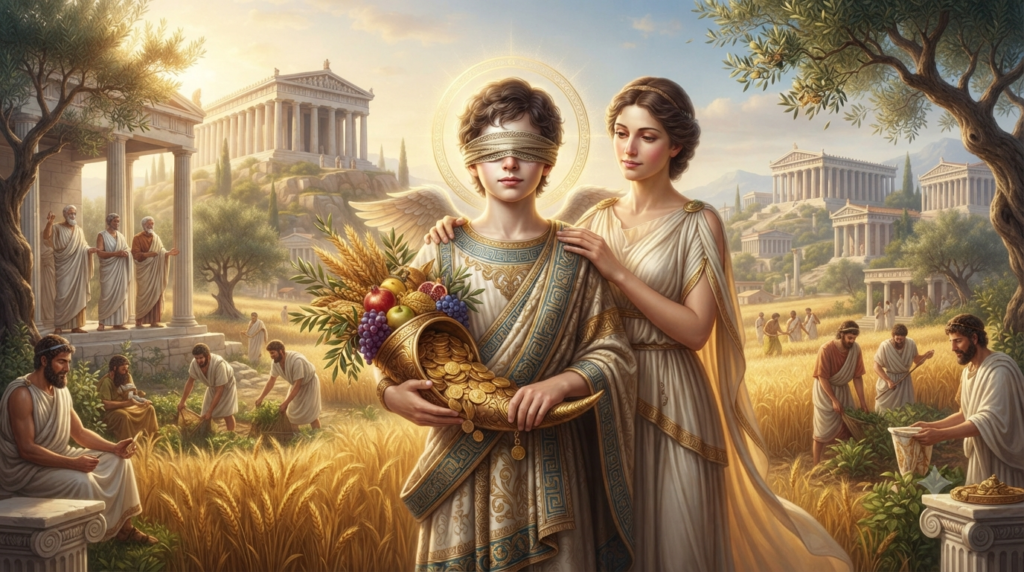
In the vast and intricate pantheon of Greek mythology, amidst the thunderous gods of Olympus and the chthonic deities of the underworld, there exists a figure who personifies one of humanity’s most enduring and complex desires. The question of who is Plutus (Ploutos), the Greek god of wealth? leads us to a deity whose very name is the ancient Greek word for “wealth” and “riches” . Plutus was not merely a god who dispensed money; he was the living embodiment of abundance, agricultural bounty, and later, the indiscriminate distribution of fortune that could elevate the wicked and bypass the virtuous . His story, woven from agricultural myth and philosophical satire, offers a profound commentary on the nature of prosperity, justice, and the often arbitrary forces that govern human fortune. This article will serve as a definitive guide to Plutus, exploring his origins, his family, his unique afflictions, his relationship with other gods, and his enduring legacy in literature and language.
Origins and Historical Background
The origins of Plutus are deeply rooted in the ancient Greek agricultural cycle and its mythology. He was first and foremost a god of agricultural bounty, a natural extension of his mother, the harvest goddess Demeter . The most authoritative account of his birth comes from Hesiod’s Theogony, the foundational text of Greek theology. According to Hesiod, Plutus was born in Crete when the goddess Demeter lay with the hero Iasion in a thrice-ploughed field . This union, taking place on fertile, cultivated ground, explicitly links the god’s creation to the fertility of the earth and the promise of a good harvest .
This agricultural origin is crucial for understanding his initial role. For the early Greeks, “wealth” (ploutos) was not abstract currency but the tangible produce of the land: grain, olives, and the bounty that ensured a community’s survival. This connection is why Plutus was worshipped alongside his mother at Eleusis, the site of the famous mystery cult that celebrated the cycle of life, death, and the rebirth of crops . In this context, Plutus was a benevolent god, the natural reward for piety and hard work.
The Mythological Role of Plutus
While his origins lie in agriculture, Plutus’s mythological role evolved into a more complex and morally ambiguous figure. He became the personification of wealth in a broader sense—money, property, and all forms of material prosperity . This shift in understanding led to a key myth that defines his nature in Greek thought: his blinding by Zeus .
The Blinding of Plutus
According to the myth, Zeus, the king of the gods, became concerned that if Plutus could see, he would dispense his gifts only to the good and the just . This would have disrupted the natural order and made the world a place where virtue was always rewarded, a concept that was clearly not the reality the Greeks observed. To ensure that wealth was distributed indiscriminately and without any regard to merit, Zeus blinded the god . This act was a cynical but realistic recognition that good fortune does not always favor the righteous. As a result, the god became a figure of chaos, often enriching the wicked and corrupt while leaving the virtuous in poverty.
His Infirmities: Blindness, Lameness, and Wings
Beyond his blindness, the god was often described with other symbolic traits that added layers to his meaning. In the plays of Aristophanes, Plutus is not only blind but also lame and winged . His lameness symbolized that wealth is slow to arrive; it takes its time coming to a person . Conversely, his wings signified that wealth departs quickly, flying away far faster than it arrived . These characteristics combined to create a universally relatable image of fortune: hard to acquire and easy to lose.
Family and Relationships
Plutus’s relationships within the divine family tree offer further insight into his nature and function.
Parents
The primary and most widely accepted genealogy makes him the son of the harvest goddess Demeter and the mortal hero Iasion . This lineage solidifies his connection to the earth and its bounty.
Alternative Parentage
In some traditions, Plutus is considered the son of the goddess Tyche (Fortune) . This alternative parentage is significant; it aligns the concept of wealth directly with the whims of chance, further emphasizing that riches are not a matter of personal merit but of luck and random distribution . This association with Tyche makes Plutus an even more capricious figure, a gift of fortune rather than a reward for virtue.
Association with Hades/Pluto
There is a crucial distinction that must be made: Plutus is often confused with Pluto, the alternative name for Hades, the god of the underworld . This confusion arises from their similar-sounding names and shared associations. The name “Pluto” was a euphemistic title for Hades, meaning “the wealthy one,” referring to the vast mineral wealth and precious metals hidden beneath the earth . However, they are distinct figures. Plutus is the personification of wealth itself, while Pluto is the king of the dead, whose riches are of a different, more subterranean nature . As Lucian of Samosata wryly observed in his dialogue Timon, the connection is that Hades and his wealth are often transferred to mortals through wills and inheritance .
Symbols and Iconography
Plutus is depicted with a consistent and recognizable set of symbols in ancient art, each representing his divine function.
The Cornucopia
The most important symbol of Plutus is the cornucopia, or the “horn of plenty” . This overflowing horn of fruit and grain is a universal symbol of abundance, prosperity, and the wealth that comes from a bountiful earth. His depiction with this horn emphasizes his role as the provider of material goods and agricultural success.
An Infant Figure
Plutus is usually represented as a young boy, often an infant . This depiction is highly symbolic. As a child, he represents the potential for growth and the new, fresh abundance that comes with each harvest. It also serves a practical artistic function, allowing him to be held in the arms of more powerful goddesses. In a famous sculpture from the 4th century BCE by Cephisodotus, the goddess Eirene (Peace) is depicted holding the infant Plutus in her arms . This iconography powerfully visualizes the idea that peace and prosperity go hand in hand.
Worship and Religious Importance
Plutus’s religious importance was primarily tied to the agricultural cycle and the mystery cults of his mother, Demeter. He did not have independent, large-scale temples across Greece but was venerated as part of the Eleusinian Mysteries, where he symbolized the wealth of the harvest that the goddess provided . His presence in these rites celebrated the fundamental prosperity that came from the earth and the cycle of rebirth.
Plutus in Literature
The most vivid and comprehensive portrait of Plutus comes from Greek and Roman literature, where his character is explored, satirized, and philosophically examined.
Aristophanes’ Plutus (388 BC)
The god is the central character in Aristophanes’s final surviving comedy, simply titled Plutus . In this play, the god is discovered as a blind beggar wandering the streets of Athens. The protagonist, a poor but honest citizen, is instructed by an oracle to follow the first man he meets, who turns out to be the blind god of wealth. He brings Plutus home, intending to restore his sight. This act sparks a chaotic revolution: once Plutus can see, he distributes wealth only to the deserving, turning the social order upside down. The rich are made poor, and the poor are suddenly elevated. The traditional gods are starved of offerings, as mortals no longer need to pray for wealth, leading to a cosmic crisis . This comedy is a sharp satire on Athenian society and a philosophical exploration of the morality of wealth.
Roman Literature
In Phaedrus’s fables, a story is told of Hercules’s arrival in Olympus. Hercules greets all the gods but refuses to acknowledge Plutus, whom he hates for favoring the wicked and the corrupt . This story reinforces the image of Plutus as a morally ambiguous figure and a source of societal corruption. Similarly, in Dante’s Inferno, Plutus appears as a demon guarding the fourth circle of Hell, a fitting punishment for the sins of avarice and prodigality .
Frequently Asked Questions About Who is Plutus (Ploutos), the Greek god of wealth?
Who were the parents of Plutus?
Plutus was most commonly the son of Demeter, the goddess of agriculture, and the mortal hero Iasion . He is also sometimes described as the son of Tyche (Fortune) .
What is the difference between Plutus and Pluto?
Plutus is the god of wealth and abundance. Pluto is the Romanized name for the god Hades, the king of the underworld . The two were often confused due to their similar names, but they are distinct figures. Pluto earned his name from the mineral wealth hidden in the earth , while Plutus is the direct personification of riches themselves.
Why was Plutus blinded?
Plutus was blinded by Zeus so that he would distribute wealth without discrimination and not favor only the good . This myth explains why the virtuous are often poor while the wicked become rich.
What are the symbols of Plutus?
His primary symbol is the cornucopia, or horn of plenty, which represents abundance and prosperity . He is usually depicted as a young boy, often an infant , and in art, he is often shown in the arms of goddesses like Eirene (Peace) or Tyche (Fortune) .
Is Plutus a good or bad god?
Plutus is neither entirely good nor evil. He represents the morally neutral concept of wealth. While he was originally a benevolent god of agricultural bounty, his blinding made him a symbol of the arbitrary nature of fortune, rewarding both the good and the wicked . In literature, he is often portrayed as a corrupting influence.
What is Aristophanes’s Plutus about?
Plutus is a comedy in which the blind god of wealth has his sight restored. This leads to a chaotic redistribution of wealth, where only the deserving become rich, turning the social and economic order of Athens upside down . It is a satirical exploration of wealth, poverty, and the nature of justice.
Conclusion
Plutus, the Greek god of wealth, is a figure of profound contradiction and enduring relevance. He embodies the very concept of material prosperity, a force that can be a blessed reward for toil or a corrupting curse bestowed by blind fortune. The question of who is Plutus (Ploutos), the Greek god of wealth? is not just a matter of genealogy but a deep inquiry into the ancient Greek understanding of merit, chance, and prosperity. Born from the union of the harvest goddess and a mortal, he was first a symbol of agricultural bounty, a gift from the earth . But the myth of his blinding by Zeus transformed him into a cynical personification of fortune’s randomness, explaining why wealth so often favors the undeserving . His depiction as a blind, lame, and winged figure in the plays of Aristophanes creates a poignant metaphor for the elusive and capricious nature of riches . His legacy continues in the very words we use—plutocracy, plutocrat—and in the art and literature that still explore the timeless question of the moral weight of wealth. Plutus reminds us that the pursuit of riches is a story as old as humanity, a tale of hope, injustice, and the eternal hope for a better fortune.

Orin Vale has spent the better part of two decades tracing the threads that connect the world’s oldest stories — from the halls of Asgard to the banks of the Nile, from Olympus to the jungles of the Maya. What began as a childhood fascination with flood myths and trickster gods grew into years of independent study across comparative mythology and ancient religion, always chasing the same question: what did these stories mean to the people who first told them? Orin writes for readers who want more than trivia — the ones looking for the beliefs, fears, and truths that myths were built to carry.