The question of who is Mnemosyne, and how does she relate to ‘moneta’? connects two seemingly unrelated pillars of classical antiquity: the Greek goddess of memory and the Latin root for money. While the primary answer concerns the Greek Titan goddess Mnemosyne, the connection to ‘moneta’ involves a fascinating detour into Roman religion and etymology that links the abstract concept of remembrance to the very concrete idea of coinage. This article will serve as a definitive guide to Mnemosyne, exploring her origins, her mythological role as the mother of the Muses, and her relationship with the Roman goddess Moneta, revealing the unexpected ways in which memory and money are linguistically and culturally intertwined.
Who is Mnemosyne?
In Greek mythology, Mnemosyne (pronounced nee-MOS-uh-nee) is the goddess of memory and remembrance. She is the personification of the power to remember, a fundamental force that shapes identity, history, and culture. Her name is directly derived from the Greek word for memory itself, a detail that underscores her role as the embodiment of this essential human faculty. Unlike the Olympian gods who often represent abstract concepts, Mnemosyne is the concept she represents, making her a crucial figure in the ancient Greek understanding of the world. Her Roman counterpart is the goddess Moneta.
Origins and Genealogy of Mnemosyne
Mnemosyne is one of the Titans, a primordial race of deities who predate the Olympians. Her lineage places her at the very beginning of the cosmos, linking her to the fundamental forces of creation. According to Hesiod’s Theogony, the definitive source for Greek cosmogony, she is the daughter of Uranus (Heaven) and Gaia (Earth). This makes her a second-generation Titan, a sister to powerful figures like Cronus, Rhea, and Themis, and an aunt to Zeus and the other Olympian gods. This parentage gives her a status of immense antiquity, placing her among the elemental powers of the universe, rather than a later invention of myth.
Her genealogy also places her in a position of considerable respect and influence among the immortals. Her union with her nephew Zeus, the king of the gods, produced the nine Muses, which established her as a mother of the arts and culture. As the goddess of memory, she was the divine force that allowed for the preservation of knowledge, the foundation upon which all other intellectual and artistic pursuits were built.
Mnemosyne and the Muses
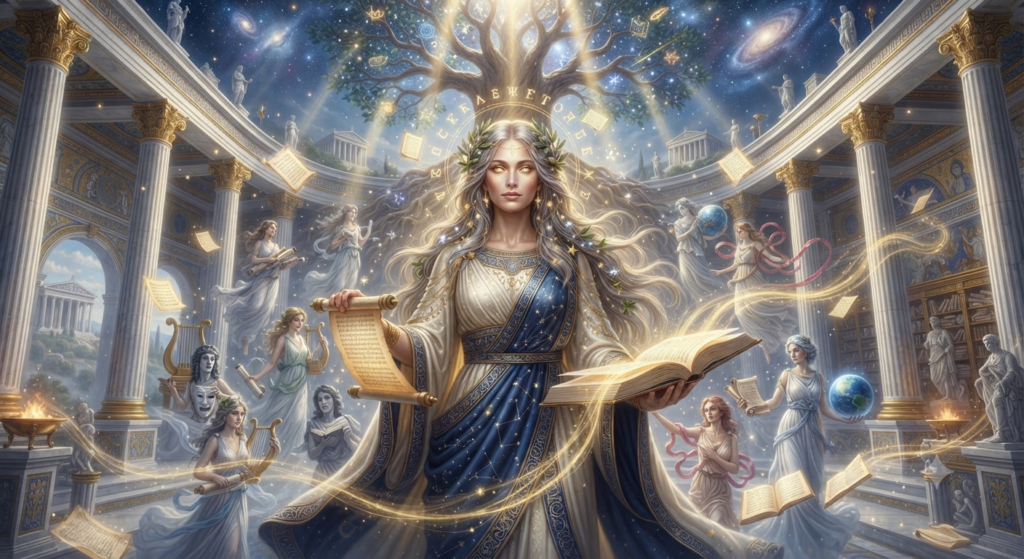
Mnemosyne’s primary mythological role is as the mother of the nine Muses. According to myth, Zeus, the king of the gods, courted her for nine consecutive nights, and from this union, nine daughters were born. These daughters became the Muses, the goddesses who preside over the arts and sciences, inspiring poets, musicians, and thinkers.
Each Muse presides over a specific domain of human creativity:
- Calliope: Epic Poetry
- Clio: History
- Erato: Love Poetry
- Euterpe: Music and Lyric Poetry
- Melpomene: Tragedy
- Polyhymnia: Sacred Hymns
- Terpsichore: Dance
- Thalia: Comedy and Pastoral Poetry
- Urania: Astronomy
This genealogy has profound implications for the ancient Greek worldview. It directly links the capacity for artistic and intellectual creation to the power of memory. Without Mnemosyne, there could be no Muses; without memory, there could be no poetry, no history, no music, no dance. The relationship establishes memory as the foundation of all culture and knowledge. Before one can create, one must remember.
The Significance of Mnemosyne: Language and Oral Tradition
Mnemosyne’s importance extends beyond her role as the mother of the Muses. She is also considered the inventress of language and words, a goddess of time, and a central figure in the oral tradition of ancient Greece. In a world where literacy was not universal, memory was the primary means of preserving knowledge, history, and law. The oral poets, or “bards,” who recited epic poems like the Iliad and the Odyssey of Homer, relied on their memories to recall thousands of lines of verse. They could do so because the Muses, Mnemosyne’s daughters, were believed to inspire them with the gift of remembrance and poetic skill.
In this context, Mnemosyne was a practical and vital goddess. She was the guardian of all that was known, the force that prevented the world from slipping into the chaos of oblivion. A hymn to her would have been a prayer for the ability to remember, to recall, and to preserve the stories that gave meaning to life. She was the divine force behind the very concept of history, making her a crucial figure for the ancient Greeks’ understanding of their own past.
Relating Mnemosyne to ‘Moneta’
The connection between Mnemosyne and the Latin word ‘moneta’ is a classic example of interpretatio romana, the Roman practice of identifying their own gods with those of Greece, and a fascinating linguistic evolution that links memory to money.
The Roman Goddess Moneta
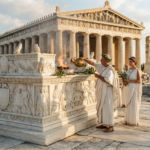
As the Romans encountered Greek culture, they identified Mnemosyne with their own goddess of memory, Moneta. The name Moneta itself has a dual meaning, referring both to a temple and a goddess. Most famously, the Temple of Juno Moneta was located on the Capitoline Hill in Rome. The temple was significant for two reasons:
- It housed the mint, the place where Roman coins were made.
- Moneta was seen as the goddess who gave warnings, the “Advisor,” a role that aligned her with the preservation of memory.
It is this location that cemented the word’s legacy.
From Moneta to Money
The connection between Moneta and coinage is direct. Because the Roman mint was located in the Temple of Juno Moneta, the Latin word moneta came to mean “money” or “coin” itself. The Spanish word for coin, moneda, is a direct descendant of this Latin root. While the temple’s name may have originated from a different Indo-European root related to “warning” or “advising,” the association with the mint was so strong that it permanently linked the concept of money with the goddess of memory.
Mnemosyne and the Temple of Moneta
The identification of Mnemosyne with Moneta created a fascinating, if indirect, relationship. Mnemosyne, the goddess of memory, was seen as the Greek equivalent of the Roman goddess associated with the Temple of Moneta. When the Romans spoke of Moneta, they were often thinking of the Greek Mnemosyne, but they were also invoking the goddess whose temple housed the very source of their wealth. This syncretism meant that the abstract concept of memory became, through a cultural and linguistic chain, inextricably linked to the physical concept of coinage.
Frequently Asked Questions About Who is Mnemosyne, and how does she relate to ‘moneta’?
What is the meaning of the name Mnemosyne?
The name Mnemosyne is derived from the Greek word mnēmē, meaning “memory” or “remembrance”. Her name is a direct reflection of her divine function as the personification of memory.
Who were the parents of Mnemosyne?
According to Hesiod’s Theogony, Mnemosyne was the daughter of the primordial deities Uranus (Heaven) and Gaia (Earth). She is one of the Titans, a second-generation deity of immense antiquity.
What is the story of Mnemosyne and Zeus?
Zeus, the king of the gods, lay with Mnemosyne for nine consecutive nights. From this union, she gave birth to the nine Muses, the goddesses of the arts and sciences. Each Muse presides over a specific domain of human culture.
What is the Roman equivalent of Mnemosyne?
The Roman equivalent of Mnemosyne is Moneta, the goddess of memory. In Rome, her name was also associated with the Temple of Juno Moneta on the Capitoline Hill.
Why is the word ‘moneta’ related to money?
The Temple of Juno Moneta in Rome housed the Roman mint, where coins were produced. The Latin word moneta therefore came to mean “money” or “coin,” leading to modern words like the Spanish moneda (“coin”). This linguistic chain creates a powerful, if indirect, link between the goddess of memory and the concept of money.
Conclusion
Mnemosyne, the Greek goddess of memory, is a figure of profound importance in ancient Greek religion and culture. The question of who is Mnemosyne, and how does she relate to ‘moneta’? reveals a complex web of mythological, etymological, and cultural connections. She stands as the mother of the Muses and the guardian of all knowledge, a reminder that culture and identity are built on the foundation of remembrance. Her association with the Roman goddess Moneta and the temple where money was coined is a remarkable example of how linguistic evolution and cultural syncretism can create unexpected links between the abstract and the tangible. In the end, Mnemosyne’s legacy is a testament to the ancient belief that memory is the most precious of treasures.

Orin Vale has spent the better part of two decades tracing the threads that connect the world’s oldest stories — from the halls of Asgard to the banks of the Nile, from Olympus to the jungles of the Maya. What began as a childhood fascination with flood myths and trickster gods grew into years of independent study across comparative mythology and ancient religion, always chasing the same question: what did these stories mean to the people who first told them? Orin writes for readers who want more than trivia — the ones looking for the beliefs, fears, and truths that myths were built to carry.