The question of who is the Greek personification of generosity? leads us into the rich and complex world of ancient Greek moral philosophy, where the virtues that underpinned society were often given divine or semi-divine form. Unlike the major Olympian gods, the personifications of abstract concepts—known as daimones—represented the ethical ideals that the Greeks sought to embody in their daily lives. While there was no single goddess specifically named “Generosity” in the way that Eleos personified mercy or Euthenia personified abundance, the concept of generosity was a deeply valued virtue, enshrined in both philosophical thought and mythological tradition. The closest figure to a direct personification is Liberalité (Eleutheriotes), a concept discussed by Aristotle and depicted in later medieval art as a moral virtue . This article will serve as a definitive guide to the personifications and concepts related to generosity, exploring the philosophical and mythological frameworks that defined this essential virtue in ancient Greece.
The Philosophical Foundation: Eleutheriotes
In the ancient Greek ethical system, the virtue of generosity was most clearly defined by the philosopher Aristotle, who wrote extensively on the nature of virtue in his Nicomachean Ethics. Aristotle identified the virtue concerning the giving and spending of money as Eleutheriotes (Ἐλευθεριότης), often translated as “generosity” or “liberality” . This term, derived from eleutheros meaning “free,” is best translated into English as “Generosity” and was considered a mean between the vices of profligacy (excessive spending) and illiberality or avarice (insufficient giving) .
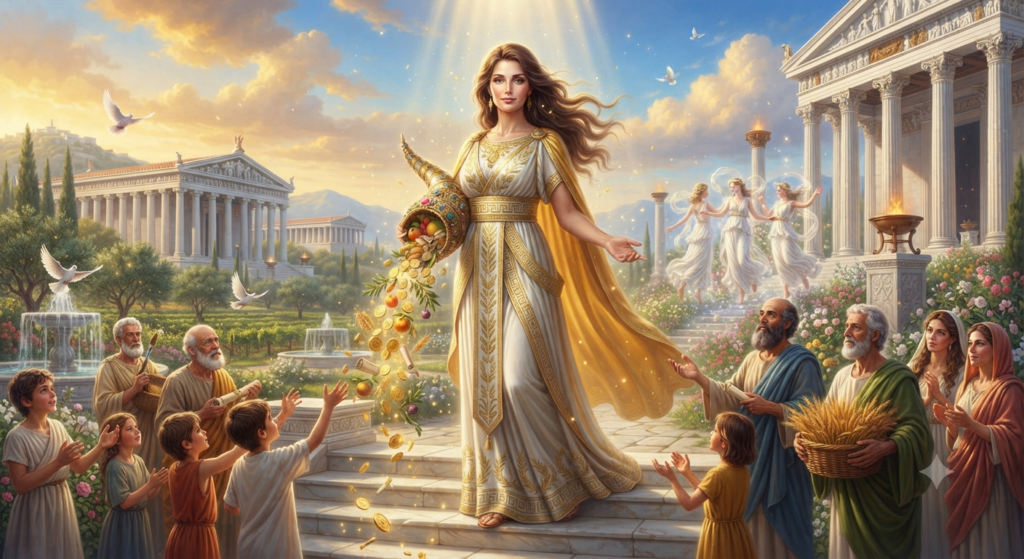
For Aristotle, generosity was not simply about giving money; it was about giving “in the right amounts, and at the right time, with all other qualifications that accompany right giving” . This was a virtue of great concern to rulers and the powerful, as their expenditure had significant political and social implications. The personification of Liberalité appears in medieval art as a female figure dispensing coins from a treasure trove, guarding her riches but giving to those in need—a visual representation of the mean between miserliness and wasteful extravagance .
The Reciprocity of Kindness: The Charites
Another important concept related to generosity in Greek thought is the reciprocal nature of giving. The Charites, or Graces, were the goddesses of charm, beauty, and goodwill, but their name, Charis, has a broader meaning that encompasses the concept of gratitude and the reciprocal exchange of kindnesses. The word charis can be translated as “kindness,” “grace,” “favor,” or “gratitude,” and it represented the mutual goodwill that bound society together . The temple of the Graces symbolized the mutual services of men to each other, on which society depends . This reciprocal kindness was central to the ancient Greek understanding of generosity: giving was not just an act of charity but a vital part of a social and economic system based on mutual obligation and gratitude.
The Personification of Abundance: Euthenia
While not a direct personification of generosity itself, Euthenia was the goddess of prosperity, abundance, and the grain-supply that made generosity possible . Her name is the ancient Greek word for “prosperity, plenty, abundance” . She was primarily worshipped in Greco-Roman Egypt, where she was associated with the flooding of the Nile and the abundant harvests it provided . Euthenia was often depicted on coins wearing a crown of wheat and holding ears of wheat or a cornucopia (horn of plenty), attributes borrowed from other deities like Demeter and Abundantia . She was sometimes syncretized with the Egyptian goddess Isis . In the mythological framework, Euthenia personified the material prosperity that allowed individuals and cities to practice generosity and provide for those in need. Her opposite number was Penia, the personification of poverty .
Other Related Personifications
Other personified concepts were associated with the ethical and social dimensions of giving and receiving.
Eleos (Mercy and Compassion)
While not directly about generosity, Eleos, the personification of mercy and compassion, was closely related to the spirit of giving . The Athenians uniquely worshipped Eleos, who had an altar in the agora where suppliants could seek protection and aid . Those who implored the assistance of the Athenians, such as Adrastus and the Heracleidae, approached as suppliants the altar of Eleos . This cult demonstrated that the capacity for mercy and pity was a form of generosity, a willingness to give aid and sanctuary to those in need without expectation of return. Her opposite number was Anaideia, the spirit of ruthlessness .
Dikaiosyne (Righteousness and Justice)
Dikaiosyne, the goddess of righteousness and justice, was closely related to the idea of giving others their due . While her primary domain was justice, the concept of dikaiosynē in ancient Greek thought was broader than mere legal justice; it encompassed the idea of giving each person their proper place and portion, which included the giving of honor, respect, and material goods when appropriate . She was the personification of the moral order that made fair and just giving possible . Dikaiosyne was the daughter of Zeus and Themis, and her Roman equivalent was Justitia .
The Nephelai and Naiades
It is important to note that the name “Euthemia” is also associated with an obscure nymph of Kos, who is mentioned in the Astronomica of Hyginus . This figure, however, has no connection to generosity or abundance but is instead a minor figure in a myth about her insulting the goddess Artemis . This highlights the importance of distinguishing between different figures with similar names in Greek mythology.
Frequently Asked Questions About Who is the Greek personification of generosity?
Is there a Greek goddess of generosity?
There is no single, universally recognized Greek goddess named “Generosity.” The concept was most clearly defined by Aristotle as the virtue of Eleutheriotes (liberality) . The goddess Euthenia personified the prosperity and abundance that made giving possible , and the Charites represented the reciprocal kindness and gratitude that were the social basis of gift-giving .
What is the Greek word for generosity?
The Greek word for generosity is eleutheriotes (Ἐλευθεριότης), which is more accurately translated as “liberality” or “the virtue concerning the giving and spending of money” .
What is the difference between Euthenia and Eleutheriotes?
Euthenia was the goddess of prosperity and abundance, the material wealth that could be given . Eleutheriotes was the virtue of generosity itself, the ethical mean between greed and wastefulness . Euthenia was an external condition of plenty; Eleutheriotes was an internal moral quality of the giver.
How did the Greeks view generosity?
The Greeks saw generosity as a crucial social and ethical virtue. It was tied to the concept of charis (grace, favor, and gratitude), which formed the basis of social bonds through reciprocal giving . Generosity was particularly expected of the wealthy and powerful, such as kings, as part of their role as leaders and protectors of their communities.
Conclusion
The Greek personification of generosity is a complex concept that was deeply embedded in the ethical and social fabric of ancient Greek life. Rather than a single deity, generosity was understood through a network of related concepts: the virtue of Eleutheriotes as defined by Aristotle, the material abundance personified by Euthenia, and the reciprocal kindness embodied by the Charites. The question of who is the Greek personification of generosity? reveals that generosity was not just a godly trait but a fundamental human virtue, a mean between extremes, a pillar of society, and a moral quality essential for rulers. From the temple of the Graces to the altar of Eleos, the ancient world recognized that the capacity for giving was what made civilization possible.

Orin Vale has spent the better part of two decades tracing the threads that connect the world’s oldest stories — from the halls of Asgard to the banks of the Nile, from Olympus to the jungles of the Maya. What began as a childhood fascination with flood myths and trickster gods grew into years of independent study across comparative mythology and ancient religion, always chasing the same question: what did these stories mean to the people who first told them? Orin writes for readers who want more than trivia — the ones looking for the beliefs, fears, and truths that myths were built to carry.