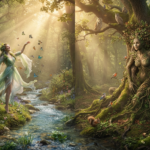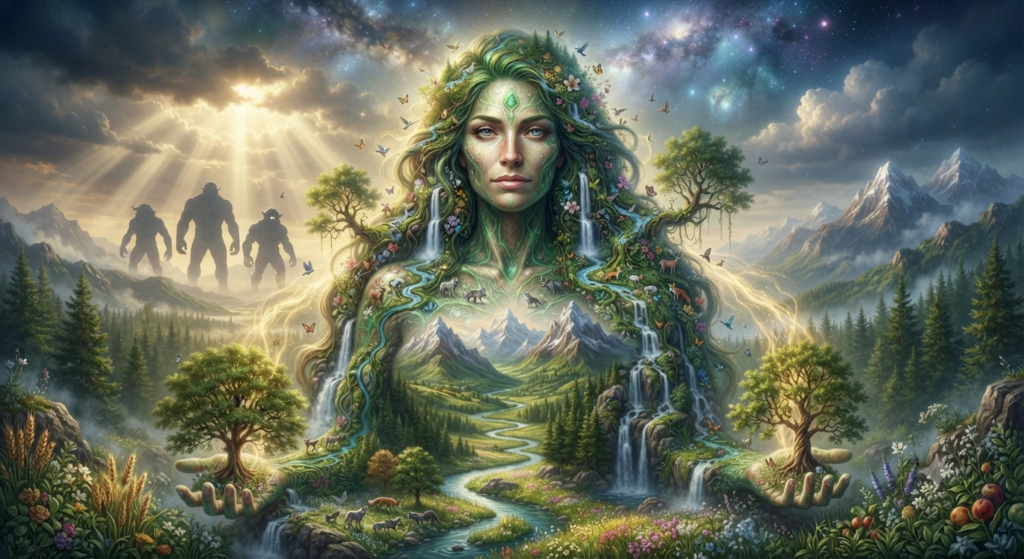
The question of who is Gaia in Greek mythology? leads us to the very foundation of existence in the ancient Greek worldview, to the primordial mother from whom all life sprang. Gaia (Γαῖα), also known as Gaea or Ge, was the primal goddess and personification of the Earth, a figure of immense antiquity and profound significance . She was not merely a deity who ruled over the earth; she was the earth itself, the solid, fertile, and everlasting foundation upon which the cosmos was built . As the “great mother of all,” she gave birth to the sky, the mountains, and the sea, and from her union with these elemental forces emerged the Titans, the gods, and all of humanity . This article will serve as a definitive guide to Gaia, exploring her origins, her central role in the creation of the universe, her complex relationships with her divine offspring, her cult worship, and her enduring legacy as the archetypal Mother Earth.
Origins and Genealogy
Gaia was one of the Protogenoi, the first generation of primordial deities who emerged at the dawn of creation . According to Hesiod’s Theogony, which is the most authoritative source for Greek cosmogony, Gaia was the second being to emerge after Chaos, the great void . She was “broad-breasted,” a “firm and everlasting abode” that would serve as the foundation for all the gods . She was not born from any other deity but came into existence spontaneously, fully formed as a fundamental principle of the universe.
Her Roman equivalent was Terra Mater or Tellus Mater, the goddess of the earth in Roman religion . While the Greeks worshipped Gaia as a primordial and powerful mother goddess, the Romans often blended the concepts of an Earth Titan (Tellus) with a grain goddess (Ceres), a distinction not always consistently made . The name “Gaia” is itself a collateral form of the Greek word “γῆ” (ge), meaning “earth,” a word of unknown origin .
The Mythological Role of Gaia
Gaia’s primary mythological role was as the mother of all creation. She was the source from which all life emerged, both divine and mortal. Her role was not passive; she was an active, powerful, and often vengeful force who shaped the cosmos through her unions, her rebellions, and her interventions in the affairs of her children.
The Birth of the Universe
Hesiod’s Theogony tells how, from Chaos, arose broad-breasted Gaia, the everlasting foundation of the gods of Olympus . She brought forth, through parthenogenesis (without a male partner), her equal, the starry sky god Uranus, the mountains (Ourea), and the fruitless deep of the sea, Pontus .
The Revolt Against Uranus
Uranus, her son and consort, hated the children they had together—the mighty Titans, the one-eyed Cyclopes, and the terrifying Hecatoncheires (hundred-handed giants). He hid them away in a secret place of Gaia, causing her great pain . In her anger, Gaia fashioned a great sickle of flint and convinced her son Cronus, the youngest of the Titans, to castrate his father . The blood that fell from Uranus’s severed genitals onto the earth impregnated Gaia, giving birth to the Erinyes (the Furies), the Gigantes (Giants), and the Meliae (tree nymphs) . This act marked the beginning of the cycle of divine succession, where each generation of gods overthrew the previous.
The Alliance with Zeus and the War with the Titans
After Cronus took the throne, he too proved to be a tyrannical father, swallowing his children to prevent a prophecy that he would be overthrown. Gaia, once again angered, aided her grandson Zeus. She helped Rhea, Zeus’s mother, conceal the infant god in a cave on Crete . Later, during the Titanomachy, Gaia counselled Zeus to free the Cyclopes and Hecatoncheires from Tartarus, which proved crucial to the Olympian victory over the Titans .
The Final Revolt: The Giants and Typhon
Despite her aid in Zeus’s ascension, Gaia was angered by the imprisonment of her Titan sons in Tartarus. She then bore a tribe of Giants to overthrow the Olympians, but they were defeated with the help of Heracles . As a final attempt, Gaia lay with Tartarus (the underworld pit) and gave birth to the monstrous Typhon, a storm giant of immense power who challenged Zeus but was ultimately defeated and buried under Mount Etna .
Family and Relationships
Gaia’s relationships are defined by her role as the progenitor of the cosmos. Her family tree is the foundation of Greek mythology.
Consorts
- Uranus (Sky): Her son and consort, with whom she produced the Titans, Cyclopes, and Hecatoncheires.
- Pontus (Sea): Her son and consort, with whom she produced the sea gods and goddesses.
- Tartarus (Underworld Pit): With him, she produced the monster Typhon .
Offspring
Gaia’s offspring are numerous and include almost all the major figures of Greek myth:
- The Primordials (without a mate): Uranus (Sky), Ourea (Mountains), Pontus (Sea) .
- The Titans and Titanides: Oceanus, Coeus, Crius, Hyperion, Iapetus, Theia, Rhea, Themis, Mnemosyne, Phoebe, Tethys, and Cronus .
- The Cyclopes: Brontes, Steropes, and Arges .
- The Hecatoncheires: Cottus, Briareos, and Gyges .
- The Erinyes (Furies), the Giants, and the Meliae (ash tree nymphs), born from the blood of Uranus .
- Typhon, with Tartarus .
- Nereus, Thaumas, Phorcys, Ceto, and Eurybia, with Pontus .
- Antaeus, a giant son of Poseidon .
- Erichthonius, an early king of Athens born from Hephaestus’s seed that fell on Gaia .
- Python, the serpent guardian of the oracle at Delphi .
- All of humanity, as mortal creatures were born directly from her earthy flesh .
The Oracle at Delphi and Cult Worship
Gaia was the original overseer of the Oracle at Delphi, the most prestigious oracle in the ancient Greek world . She later handed over the rights to her daughters Themis and Phoebe, who then passed it to the god Apollo . This myth of the “Previous Owners” placed Gaia at the heart of one of the most significant religious institutions .
Gaia’s cult was widespread, with temples and altars at Delphi, Athens, Sparta, Olympia, and many other cities . Oaths sworn in the name of Gaia were considered the most binding of all . She was worshipped under various epithets:
- Gē Kourotrophos, the “nurturer of young,” associated with the care of children .
- Gē Themis, linked to divine law and order .
Her worship was often associated with fertility, marriage, and prophecy. At Aegeira in Achaea, her priestess would drink bull’s blood, a practice poisonous to others, to achieve a state of divine communion and prophecy .
Depictions in Art
In Athenian vase painting, Gaia was often depicted as a matronly figure rising only halfway from the earth, symbolizing her inseparability from her element . A famous example shows her handing the infant Erichthonius to Athena. In later mosaic representations, she appears as a full-figured woman reclining on the earth, often surrounded by the Carpi (infant gods of the fruits of the earth) and the Seasons .
Cultural Influence and Historical Legacy
The concept of Gaia has had a profound and lasting impact on Western culture and thought. In antiquity, her role as the first mother shaped the very structure of the Greek pantheon. In the modern world, her name has been adopted by the scientific community to describe the Gaia Hypothesis, which proposes that the Earth functions as a complex, self-regulating organism . She also features prominently in modern literature, such as in Rick Riordan’s Percy Jackson series, where she is the primary antagonist, an ancient and powerful force seeking to destroy the gods . From the foundation of Greek theology to modern science and storytelling, Gaia remains a powerful symbol of the earth as a living, nurturing, and at times terrifying mother.
Frequently Asked Questions About Who is Gaia in Greek mythology?
Is Gaia the first god?
Technically, the first being to emerge was Chaos. Gaia is considered the first goddess and the mother of all life, as she was the first immortal to emerge from Chaos, and all gods and humans are descended from her .
Who were the children of Gaia?
Gaia had many children. She gave birth to Uranus (the Sky), the Ourea (Mountains), and Pontus (the Sea) by herself. With Uranus, she had the Titans, the Cyclopes, and the Hecatoncheires. With Pontus, she had the sea gods, and with Tartarus, she had the monster Typhon .
What is the story of Gaia and Cronus?
Gaia was angry with Uranus for hiding their children. She created a sickle and convinced her son Cronus to castrate his father. Cronus did so, and from the blood that fell on the earth, Gaia gave birth to the Erinyes, the Giants, and the Meliae .
Is Gaia a Titan?
No. Gaia is a primordial goddess (a Protogenos), who predates the Titans. The Titans are her children, born from her union with Uranus .
What is the oracle at Delphi’s connection to Gaia?
The Oracle at Delphi originally belonged to Gaia. She passed it on to her daughters, Themis and Phoebe, before it eventually came into the possession of Apollo .
What does Gaia mean spiritually?
Spiritually, Gaia represents the source and meaning of all life. She is a mother goddess, the nourisher of all things, and the giver of dreams. In ancient Greece, she was seen as the all-nourishing and all-producing mother .
Conclusion
Gaia is the foundation upon which the entire edifice of Greek mythology was built. The question of who is Gaia in Greek mythology? reveals a being of immense power and complexity. She is the primordial Earth, the mother of gods and mortals, the source of creation, and a force of vengeance. From her body emerged the sky, the mountains, and the sea. From her unions came the Titans, the gods who would shape the cosmos, and the monsters who would challenge them. She was the original oracle, the keeper of secrets, and the guardian of oaths. Her story is not one of passive motherhood but of active and often violent intervention in the divine succession. Gaia’s legacy is one of profound and lasting influence, a testament to the ancient Greek understanding of the earth as a living, breathing, and all-powerful entity.

Orin Vale has spent the better part of two decades tracing the threads that connect the world’s oldest stories — from the halls of Asgard to the banks of the Nile, from Olympus to the jungles of the Maya. What began as a childhood fascination with flood myths and trickster gods grew into years of independent study across comparative mythology and ancient religion, always chasing the same question: what did these stories mean to the people who first told them? Orin writes for readers who want more than trivia — the ones looking for the beliefs, fears, and truths that myths were built to carry.