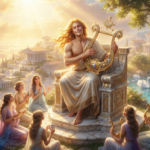
The question of who is the nymph Sinoe in Greek mythology? leads us to the rugged mountains of Arcadia, the heartland of ancient Greek pastoral life, where a minor but significant figure played a crucial role in the upbringing of one of the most distinctive gods of the Greek pantheon. Sinoe (Σινόη) was an Arcadian nymph, specifically an Oreiad (mountain nymph) and an Epimelid (nymph of highland pastures and flocks) . Her name, meaning “mischievous” in Greek, hints at a spirited character that perfectly aligns with the rustic, unpredictable world she inhabited . However, her primary mythological importance lies in her role as a nurse who reared the infant god Pan, and from whom the god derived his epithet, “Sinoeis” . This article will serve as a definitive guide to the nymph Sinoe, exploring her origins, her role in the life of Pan, her worship, and her place in the rich tapestry of Arcadian myth.
The Mountain Nymph of Arcadia
Sinoe was an Arcadian nymph, a native of the mountainous region of Arcadia in the central Peloponnese, a land that was the very heart of Greek pastoral mythology . Arcadia was the wild, untamed home of the god Pan, and it was filled with nymphs who personified its rivers, mountains, and forests .
As an Oreiad, Sinoe was a spirit of the mountains, and as an Epimelid, she was specifically associated with highland pastures and flocks, reflecting her role as a guardian and nurse of the pastoral god . Her name is derived from Mount Sinoe in Arcadia, and she was so closely associated with this mountain that the two were forever linked in myth . The nymph appears to have been a localized figure, one of the many minor deities who were not worshipped across Greece but were deeply significant to the communities of a particular region. Her parentage is not preserved in any surviving texts, but her very existence was tied to the landscape she inhabited.
The name “Sinoe” itself is a key to understanding her character. In Attic Greek, it is pronounced Sinóe and is derived from the word sínos (σίνος), meaning “harm,” “hurt,” or “mischief” . This suggests that Sinoe was not simply a passive, nurturing figure but a playful, perhaps even capricious, nature spirit, embodying the unpredictable and mischievous energy of the wild. This mischievous quality was an essential part of the Arcadian landscape, a world that was beautiful and nurturing but also wild and untamed.
Sinoe and the Infant God Pan
Sinoe’s most important mythological role was her service as a nurse to the infant god Pan . Pan, the god of shepherds, flocks, and rustic music, was a figure of immense importance in Arcadia, and his upbringing was a subject of great mythological interest. According to the 2nd-century CE travel writer Pausanias, who is the primary source for the myth of Sinoe, Pan was nursed by a group of nymphs, but Sinoe is singled out as the one who nursed him “on her own account” . This phrasing suggests a particularly close bond between the nymph and the divine infant, making her a key figure in his origin story.
Her act of nurturing the god had a lasting consequence: Pan was given the surname “Sinoeis” (Σινόεις) in her honour . This epithet, meaning “of Sinoe,” was used to distinguish the god and was a permanent mark of gratitude and respect for the nymph who had raised him. In Pausanias’s description, an image of Pan made of stone in the temple of Zeus at Megalopolis was specifically identified as “Pan Sinoeis,” an enduring physical reminder of the relationship between the god and his foster mother . This statue, located in one of Arcadia’s most important cities, demonstrates the lasting significance of this local myth, intertwining the worship of Zeus with the story of the nymph and her divine foster child.
The Cults and Images of Sinoe
Sinoe did not have a temple or formal cult of her own. However, her legacy was preserved through the worship of her foster son. The cult of Pan Sinoeis in Megalopolis is the most significant testament to her importance. This cult, which specifically invoked Pan by his epithet derived from Sinoe, was a way of honoring the nymph’s role in the god’s early life. The statue of Pan Sinoeis in the temple of Zeus is the primary piece of physical evidence for the nymph’s worship .
In this context, Sinoe is remembered as the goddess who received credit for Pan’s upbringing, a figure whose nurturing and connection to the land was celebrated as part of the broader religious life of Arcadia. The story of Sinoe and Pan is an example of how minor mythological figures, through their connections to major gods, could achieve a lasting, if localized, significance in the religious and cultural life of the ancient world.
Frequently Asked Questions About Who is the nymph Sinoe in Greek mythology?
What is the meaning of the name Sinoe?
The name Sinoe comes from the Attic Greek Sinóe, which is derived from sínos, meaning “harm,” “hurt,” or “mischief.” It suggests that the nymph was a spirited and perhaps capricious nature spirit .
Where did Sinoe live?
Sinoe lived in Arcadia, a region in the central Peloponnese of Greece . She was specifically associated with Mount Sinoe, from which she derived her name .
Who was the foster son of Sinoe?
Sinoe was the nurse of the god Pan, who she raised as an infant. In recognition of her care, Pan was given the surname “Sinoeis,” meaning “of Sinoe” .
How is Sinoe related to Pan?
Sinoe was a nurse to Pan. Her nurturing of the god in his infancy was so significant that he took on a name that honoured her .
What is the source for the myth of Sinoe?
The primary and most important source for the myth of Sinoe is Pausanias’s Description of Greece, a 2nd-century CE travelogue that describes the statue of Pan Sinoeis in the temple of Zeus at Megalopolis .
Conclusion
Sinoe, the Arcadian nymph of Mount Sinoe, is a figure of gentle power and profound significance. As a nurse to the infant god Pan, she was a key figure in his origin story, an integral part of the wild landscape of Arcadia that he personified. The question of who is the nymph Sinoe in Greek mythology? reveals a being whose legacy is recorded in the epithet of a god, a subtle but enduring mark of her influence. From her mischievous name to her role as a mother figure to a rustic god, Sinoe embodies the nurturing and untamed spirit of the Arcadian wilderness. Although she lacked a major cult of her own, the worship of Pan Sinoeis in Megalopolis, a city of great importance, ensured that her memory lived on for centuries. In the end, Sinoe stands as a testament to the power of minor deities to shape the personalities and identities of the gods, reminding us that the pantheon was a complex web of relationships, where even a nymph from a mountain could leave an indelible mark.

Orin Vale has spent the better part of two decades tracing the threads that connect the world’s oldest stories — from the halls of Asgard to the banks of the Nile, from Olympus to the jungles of the Maya. What began as a childhood fascination with flood myths and trickster gods grew into years of independent study across comparative mythology and ancient religion, always chasing the same question: what did these stories mean to the people who first told them? Orin writes for readers who want more than trivia — the ones looking for the beliefs, fears, and truths that myths were built to carry.