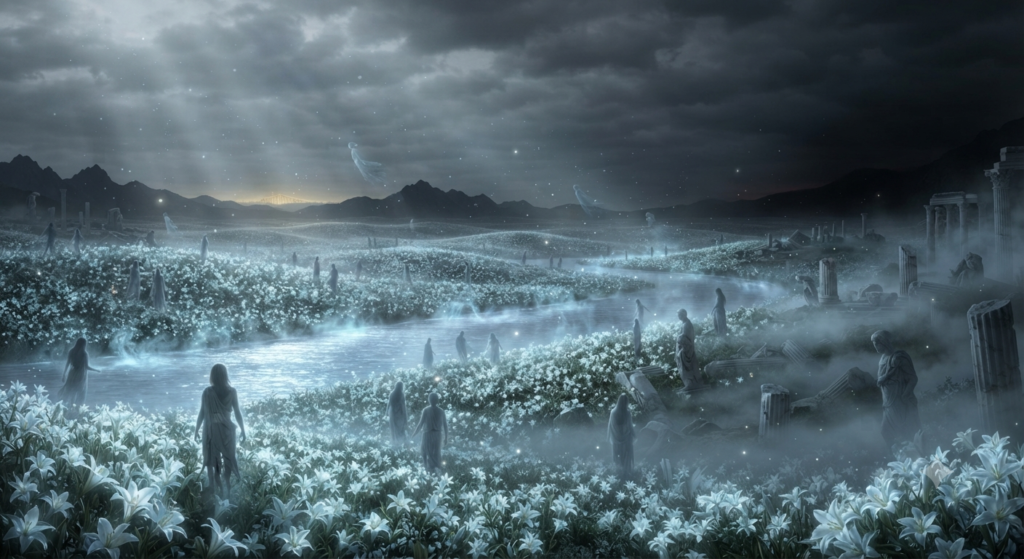
In the ancient Greek conception of the afterlife, the underworld was not a single, uniform realm of darkness but a complex landscape divided into distinct regions, each reserved for different types of souls. What are the Asphodel Meadows in the Greek underworld? They represent the vast and neutral territory where the majority of ordinary souls were sent to dwell after death, a place of neither punishment nor reward, but of shadowy, listless existence . First described in Homer’s Odyssey as the dwelling place of the spirits of the dead, the Asphodel Meadows occupy a central position in the Greek cosmology of the afterlife . Unlike the blissful Elysian Fields for heroes and the fiery torments of Tartarus for the wicked, the Asphodel Meadows were the destination for those who lived lives of neither great virtue nor exceptional vice. This article will explore the origins, geography, and evolving perception of this enigmatic realm, revealing how the Greeks understood the fate that awaited the vast majority of humanity.
Origins and Historical Background
The concept of the Asphodel Meadows is deeply rooted in the earliest Greek literature, with its most significant and foundational description appearing in Homer’s Odyssey, composed around the 8th century BCE . In Book 11, Odysseus travels to the underworld to consult the prophet Tiresias, and in Book 24, the spirits of the slain suitors are described as flitting “like bats” through the meadow . These passages provide the earliest extended descriptions of the afterlife and the first references to an “asphodel meadow” .
However, the Homeric depiction is far from the pleasant “paradise” that later poets and commentators would imagine . In the Odyssey, Hades is a “dark, gloomy, and mirthless place” . The spirits there are disembodied and senseless, weeping and wailing pathetically, flitting about “purposelessly like shadows or dreams” . The meadow itself is part of this sunless realm of “gloomy darkness” . This early view stands in stark contrast to the Elysian Plain, where life is easy and a refreshing west wind always blows, or the Isles of the Blessed, reserved for the most distinguished heroes . The historical shift in perception, where the Asphodel Meadows came to be seen as more desirable, reflects the complex and sometimes contradictory views the Greeks held about the afterlife, a characteristic shared by many cultures .
The Name and Its Meaning
The very name “Asphodel Meadows” is a subject of fascinating scholarly debate. The Greek term is asphodelòs leimṓn . The most straightforward interpretation connects it to the asphodel flower (Asphodelus), a plant with pale, ghostly flowers that was associated with the dead . Many ancient Greek poets and commentators understood the adjective asphodelòs to mean “flowery,” “fragrant,” “fertile,” or “lush,” painting a picture of a vibrant and pleasant meadow . The asphodel was even described as “good-smelling” and the meadow as “holy” .
However, a compelling alternative theory suggests a much different origin. Some scholars propose that the name originally meant “field of ashes” . This theory links the word to an alternative form, spodelos, which is related to the Greek word spodós, meaning “ashes,” “embers,” or the ashes of the dead used in funerary rites . Given that the Homeric descriptions of Hades are anything but pleasant, a meaning of “field of ashes” would fit the context much better than “flowery meadow” . This linguistic debate reflects the evolution of the concept itself: over time, the grim “field of ashes” was reinterpreted as a “meadow of asphodel,” and the flower’s pale, ghostly color was deemed appropriate for the shadowy underworld .
Geography and Location
Within the broader topography of the Greek underworld, the Asphodel Meadows held a specific and significant place. The underworld was a vast realm controlled by Hades, surrounded by five rivers: the Acheron (sorrow), Cocytus (lamentation), Phlegethon (fire), Lethe (forgetfulness), and Styx (the boundary river) . Upon death, souls would be ferried across the rivers by Charon, provided they had the coin for passage .
Once in the underworld, the souls were judged by three kings: Minos, Rhadamanthus, and Aeacus . These judges would then determine the soul’s final destination . The Asphodel Meadows was one of the three main divisions of the underworld, along with Elysium (for the righteous and heroic) and Tartarus (for the wicked) . Homer, in his Odyssey, places the Fields of Asphodel close to the Land of Dreams, referring to them as the dwelling place of the spirits of men who have abandoned their earthly labors . This location reinforces the sense of listlessness and unreality associated with the realm. The Asphodel Meadows was, therefore, the default destination, the vast middle ground for the vast majority of souls who had not distinguished themselves in either virtue or vice .
Mythological Role
The mythological role of the Asphodel Meadows was to serve as the primary abode for the ordinary dead in the Greek underworld . It was a place of neutrality, reserved for those who lived lives of near equal good and evil . The souls there were not punished, but neither were they rewarded. They existed in a state of shadowy, mechanical existence . This view of the afterlife for the “average” person was a powerful motivator in Greek culture: if one wanted to achieve the everlasting joy of the Elysian Fields, one had to strive for heroism and excellence . Conversely, to be condemned to the torments of Tartarus required a life of exceptional wickedness. The Asphodel Meadows, therefore, acted as a default, somewhat neutral territory that underscored the Greek ideal of arete (excellence) . It represented the fate of those who made little impact on the world.
Powers and Characteristics
Unlike the punishing fires of Tartarus or the blissful breezes of Elysium, the Asphodel Meadows is characterized by its lack of extreme sensations. It is a realm of utter neutrality . There is no pleasure, but there is also no pain.
A key characteristic of this realm is the loss of identity. Some accounts state that all residents are required to drink from the river Lethe, the river of forgetfulness, before entering the fields . By doing so, they lose their memories, their personalities, and their individual identities, becoming something akin to mere shades or ghosts . This concept of oblivion is central to the nature of the Asphodel Meadows; it is not a place of active existence but of passive, forgetful twilight. As the spirits are described in Homer, they flit about like shadows, purposeless and without sensation . Only a libation of blood offered to them in the world of the living could reawaken in them, for a time, the sensations of humanity .
Ancient Sources
The most important and foundational ancient source for the Asphodel Meadows is the Odyssey of Homer . The descriptions in Books 11 and 24 establish the realm as a “dark, gloomy” place of “ash-filled meadow” . The Odyssey provides the earliest extended descriptions of Hades and is the primary source for the concept.
Hesiod, in his Works and Days, provides a different perspective, focusing on the more exclusive afterlife, like the Isles of the Blessed, but his works also help to contextualize the Greek underworld . Later, the mythographer Apollodorus and travel writer Pausanias also contributed to the understanding of the underworld’s geography, but it is Homer who remains the definitive source for the Asphodel Meadows . The concept of the Asphodel Meadows also appears in later poetic sources, which described the meadow as “untouched, lovely, soft and holy,” a significant departure from the original Homeric vision .
Artistic Representations
Artistic representations of the Asphodel Meadows are not as common as depictions of more dramatic underworld scenes, such as the punishments of Tartarus. However, the concept has persisted in various forms of art and literature. The plant itself, the asphodel, has been a symbol of death and the afterlife since antiquity. Its ghostly gray color and its association with the dead made it a common motif on ancient Greek grave stelae and in funerary art .
The Asphodel Meadows have also inspired modern artistic depictions. In the 2020 video game Hades, the Asphodel Meadows, referred to simply as “Asphodel,” serves as the second of four levels the protagonist must traverse . In a creative twist that reconciles the two competing images of the meadow, the game depicts it as once having been a verdant and peaceful place, but it has since been overflown by the river Phlegethon, transforming it into a charred, barren land surrounded by giant pits of magma . This modern interpretation demonstrates the continued cultural relevance of the ancient myth and its ability to be reinterpreted for contemporary audiences.
Cultural Influence and Legacy
The cultural influence of the Asphodel Meadows extends far beyond the ancient world. It has shaped Western concepts of the afterlife, providing a model for a “neutral” or “ordinary” fate. The term “asphodel” itself has become a poetic byword for death and the underworld.
The concept of a neutral, forgettable afterlife for the mediocre has had a profound influence on later religious and philosophical thought, providing a contrast to the Christian concepts of Heaven and Hell. It also served a social function in ancient Greece, acting as an incentive for heroic action . If the alternative to a heroic life was an eternity of shadowy, listless existence in the Asphodel Meadows, then the drive to achieve glory and remembrance was a powerful one. The legacy of the Asphodel Meadows is thus tied to the fundamental Greek values of kleos (glory) and arete (excellence). It is a stark reminder of the ancient Greek belief that a life without impact leads to an eternity without identity.
Frequently Asked Questions About What are the Asphodel Meadows in the Greek underworld?
What exactly were the Asphodel Meadows in Greek mythology?
The Asphodel Meadows were the section of the Greek underworld where the majority of ordinary souls were sent to live after death . It was a neutral realm of neither punishment nor reward, reserved for those who lived lives of near equal good and evil .
Who went to the Asphodel Meadows?
Souls who lived mediocre or ordinary lives were sent to the Asphodel Meadows . It was the destination for people who were neither exceptionally virtuous heroes nor exceptionally wicked villains .
How is the Asphodel Meadows different from Elysium and Tartarus?
The Asphodel Meadows was the middle ground of the underworld. Elysium was the reward for heroes and the righteous, a place of everlasting joy and bliss . Tartarus was the prison for the wicked, a place of horrible punishment and torment . The Asphodel Meadows was for everyone else .
What did the Asphodel Meadows look like?
The original Homeric descriptions depict it as a dark, gloomy, and mirthless place . Later poets, however, described it as a lovely, fragrant, and flowery meadow . The reality was likely a shadowy, ghostly landscape of pale, pallid flowers .
Did people in the Asphodel Meadows have identities?
According to some accounts, residents of the Asphodel Meadows were required to drink from the river Lethe, the river of forgetfulness, before entering . This act erased their memories and identities, reducing them to shadowy, passive shades .
Why is it called the Asphodel Meadows?
The name comes from the asphodel flower, a plant associated with death in ancient Greece . However, some scholars believe the original name meant “field of ashes,” referring to the ash of the dead, and that the association with the flower came later .
Where in the underworld were the Asphodel Meadows located?
The Asphodel Meadows was one of the three main divisions of the underworld, along with Elysium and Tartarus . Homer places it close to the Land of Dreams . The underworld itself was a realm surrounded by the rivers Styx, Acheron, Cocytus, Phlegethon, and Lethe .
What is the modern legacy of the Asphodel Meadows?
The Asphodel Meadows has become a powerful symbol of a neutral or forgettable afterlife, influencing literature, art, and popular culture. It serves as a contrast to the concepts of Heaven and Hell and continues to be reinterpreted in modern media .
Conclusion
In conclusion, the Asphodel Meadows represent one of the most enduring and thought-provoking concepts in Greek mythology. The answer to the question, what are the Asphodel Meadows in the Greek underworld, reveals a profound insight into the ancient Greek psyche. They are the realm of the ordinary, the destination for the vast majority of souls who lived lives unmarked by great heroism or profound wickedness. From the bleak “field of ashes” in Homer’s Odyssey to the “flowery meadow” of later poets, the Asphodel Meadows evolved as a concept, reflecting the complex and sometimes contradictory views the Greeks held about the afterlife.
The cultural legacy of this realm is immense. It served as a powerful motivator for the heroic ideal, reminding mortals that a life without impact led to an eternity without identity. The image of the shadowy, forgetful spirits in the Asphodel Meadows is a haunting reminder of the Greek pursuit of kleos, or glory. In the end, the Asphodel Meadows are not just a place in a myth; they are a mirror reflecting humanity’s ancient and ongoing anxieties about mortality, identity, and the meaning of an ordinary life.

Orin Vale has spent the better part of two decades tracing the threads that connect the world’s oldest stories — from the halls of Asgard to the banks of the Nile, from Olympus to the jungles of the Maya. What began as a childhood fascination with flood myths and trickster gods grew into years of independent study across comparative mythology and ancient religion, always chasing the same question: what did these stories mean to the people who first told them? Orin writes for readers who want more than trivia — the ones looking for the beliefs, fears, and truths that myths were built to carry.