The ancient Greeks personified the natural world through a vast pantheon of deities, and among the most elemental of these were the Anemoi, the gods of the winds. What is Notos, the Greek god of the south wind? Known in Greek as Notos and in Latin as Auster, he is the deity who embodies the wet, storm-bringing winds of late summer and early autumn . As one of the four principal directional wind gods, Notos was a figure of immense practical and symbolic importance to the ancient Greeks. His arrival heralded the end of the harvest season, bringing with it the desiccating heat, torrential rains, and destructive storms that could make or break a farming community . Yet, unlike his more famous brothers Boreas, the god of the north wind, and Zephyrus, the gentle west wind, Notos remains an enigmatic figure, with little unique mythology of his own . This article will explore the origins, family, attributes, and lasting legacy of Notos, revealing what his story tells us about the ancient Greek worldview and their relationship with the powerful forces of nature.
Origins and Historical Background
The origins of Notos are rooted in the ancient Greek understanding of the cosmos, where natural phenomena were governed by divine beings. The Anemoi were not simply forces of nature but were individual gods with distinct personalities and functions . Notos, along with his brothers Boreas (North), Eurus (East), and Zephyrus (West), represented the four cardinal directions, and each wind was associated with a specific season and set of weather conditions . This system of belief provided a framework for the ancient Greeks to interpret and predict the changing seasons, essential for agricultural and maritime societies.
The concept of wind gods predates classical Greece, appearing in the works of the earliest Greek poets. Hesiod, in his Theogony, lists the Anemoi among the offspring of the dawn goddess Eos and the star-god Astraeus, cementing their place in the divine genealogy . The cult of the winds was not as prominent as that of the Olympians, but their importance was recognized through local rituals and the construction of monuments like the Tower of the Winds in Athens, which featured eight wind deities, including Notos . This historical context demonstrates that the winds were not merely meteorological phenomena but integral components of religious and civic life. The name Notos itself, from the Greek νότος, refers to both the south cardinal direction and the wind that blows from it, highlighting the intrinsic link between geography and meteorology in the Greek mind .
Mythological Role and Attributes
Notos’s primary mythological role was as the god of the south wind. However, the Greeks distinguished between different types of south winds. The one Notos mostly represented was the notos proper, which blew from various directions in winter and was seen as the rain-bringer that obscured visibility . There were also sub-categories, such as the leukonotos (“white notus”), which was milder and cleared up the sky, and the hot, dust-bearing wind that is identified with the sirocco .
This subtle classification reflects the detailed observation of natural phenomena by the ancient Greeks. Notos was a god of duality: he could be a bringer of life-giving rain, but he was also feared as a destroyer of crops . His winds brought the storms of late summer and early autumn, a time when the harvest was vulnerable to destruction . This dual nature made him a complex and ambivalent figure, unlike the more straightforwardly beneficial Zephyrus or the harsh, wintry Boreas. Notos is also noted as having little to no unique mythology, with no consorts or offspring recorded . His identity is almost entirely defined by his seasonal function, which may explain why he is less prominent in mythic narratives than his brothers.
Family and Relationships
Notos’s genealogy places him firmly within the divine hierarchy of the Greek pantheon as a second-generation Titan. His parents were Eos, the rosy-fingered goddess of the dawn, and Astraeus, the god of the stars and planets . This parentage is highly symbolic: as the offspring of Dawn and the Stars, the winds are born from the celestial realm and are intermediaries between the sky and the earth.
Notos’s siblings include his brothers Boreas, Eurus, and Zephyrus . This kinship forms the core of the Anemoi, the four principal wind gods. Other siblings are named in various sources, including the star-gods and the justice goddess Astraea . Through his mother, Eos, he is also a half-brother to the mortal heroes Memnon and Emathion . Unlike his brothers, particularly Zephyrus, who had well-known mythological lovers and progeny, Notos has no recorded consorts or offspring . This lack of a mythological family outside his immediate parents and siblings reinforces his role as a functional deity, defined by his purpose and season rather than personal narratives.
Symbols and Meaning
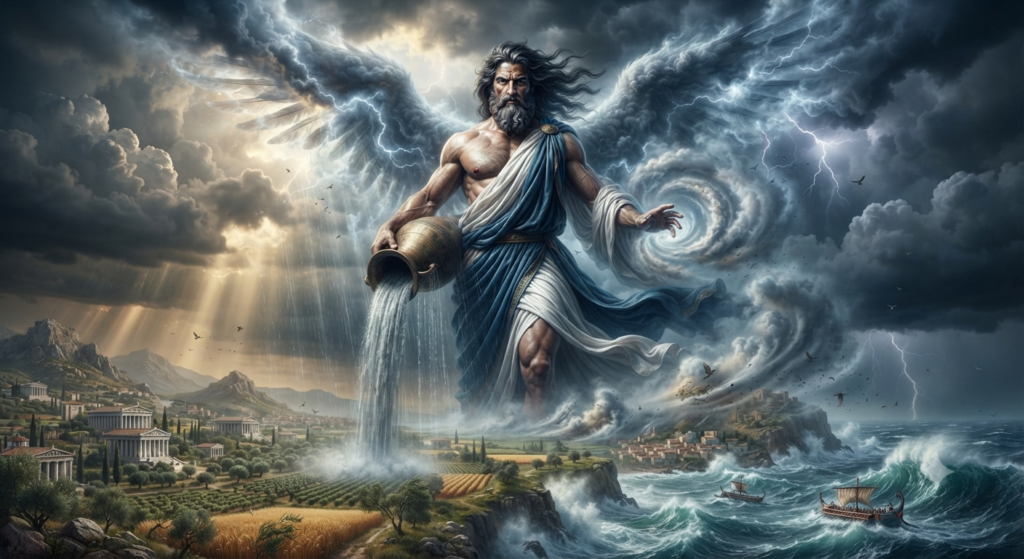
Notos is characterized by specific visual symbols that represent his divine function. The most prominent symbol is the vase or pitcher from which he pours water . This imagery directly connects him to his role as the bringer of late-summer and autumn rains, symbolizing the storms he ushers in. Depictions of Notos on the Tower of the Winds show him as a bearded man pouring water from a vase, a powerful visual metaphor for his meteorological influence .
In some representations, he is depicted as a youth blowing a trumpet or holding a vessel . The water-pouring motif is the most enduring and significant symbol of Notos, representing the life-giving and potentially destructive power of the rains he brings. This iconography highlights the agricultural importance of his winds, which could either nourish the crops or devastate them with violent storms. The Roman equivalent of Notos is Auster, a name that has become associated with the southern wind in Western culture . This linguistic legacy demonstrates the enduring influence of these ancient gods, even as their mythological prominence waned.
Worship and Religious Importance
Although Notos did not have a large, pan-Hellenic cult following like major Olympians, his worship was integral to the lives of the ancient Greeks. Sailors and farmers would have prayed to the wind gods for favorable conditions. The presence of Notos on the Tower of the Winds, a large, octagonal clocktower in the Roman agora of Athens, underscores his civic and religious importance . This structure not only functioned as a timepiece and weather vane but also served as a public monument acknowledging the power of the winds.
The Anemoi were sometimes offered sacrifices to appease their wrath or seek their favor. In the Iliad, we see Agamemnon sacrificing to the winds before setting sail for Troy . Similarly, the myth of the Boreads, the winged sons of Boreas, suggests that the wind gods were seen as powerful beings who could be called upon for assistance. While Notos himself is not the subject of many surviving myths, his inclusion in such monuments and his presence in literary works like Hesiod’s Theogony demonstrate that he was a recognized and significant deity. His importance was practical; he was a god whose domain directly impacted daily life, from agriculture to seafaring, which was the lifeblood of the Greek world.
Ancient Sources
Notos appears in several key ancient sources, primarily as a member of the Anemoi. The most foundational text is Hesiod’s Theogony (c. 8th-7th century BCE), which mentions him as a son of Eos and Astraeus . The Homeric epics, while not giving him a prominent role, refer to the winds collectively in passages like the Odyssey (Book 5), where the winds are described as a unified force .
Later accounts, such as the Library of Apollodorus, also include Notos in the genealogies of the winds . Lucian’s Dialogues of the Sea-Gods mention him, and Ovid’s Heroides include references to his character . The most complete ancient description of his iconography comes from the Tower of the Winds, which dates to the 1st century BCE and features a sculptural frieze depicting all eight wind deities . In this representation, Notos is shown as a bearded man pouring water from a vase. These sources collectively establish Notos as a consistent, if minor, figure in the Greek mythological landscape, valued for his functional role rather than his narrative significance.
Artistic Representations
Artistic depictions of Notos are less common than those of his brothers, but they follow a consistent iconographic tradition. He is most famously depicted on the Tower of the Winds in Athens, where he appears as a bearded man pouring water from a vase . This image is the most authoritative representation of him in the ancient world.
In Byzantine art, the tradition of personifying the winds continued. A plaster fresco from approximately 1200 CE depicts Notos as a youth blowing a trumpet and holding a vase filled with water . This fusion of the older iconography (the vase) with a new element (the trumpet) shows how the figure of Notos persisted through time, adapting to different artistic and cultural contexts. Modern representations often draw from these ancient sources. The band The Oh Hellos released an album titled Notos in 2017 as part of a series named after the four principal wind gods, demonstrating how these ancient figures continue to inspire contemporary art . The use of Notos as an album title, along with the suite for concert band named Anemoi Suite, showcases his enduring appeal as a symbol of elemental power . These artistic representations, both ancient and modern, highlight his continued relevance as a cultural symbol.
Cultural Influence and Legacy
The cultural influence of Notos extends beyond his mythological narrative. His name, as the god of the south wind, has become synonymous with the direction itself and the type of wind it represents. His Roman equivalent, Auster, has given rise to the modern term “austral,” meaning “southern,” which is used in words like “Australia” . This linguistic legacy is a direct and lasting testament to his importance.
The system of the Anemoi has also had a profound influence on Western thought, shaping how we conceptualize the cardinal directions and associate them with seasons and weather patterns. The Tower of the Winds in Athens, where Notos is prominently featured, has served as a model for astronomical and meteorological instruments throughout history . In popular culture, the Anemoi continue to be a source of inspiration. In addition to the musical works mentioned, the video game Hades features the wind gods, and various fantasy novels and games incorporate them. Notos, despite his status as a “minor” deity, has secured a unique place in the cultural memory as a symbol of the powerful, rain-bringing, and sometimes destructive winds of the late summer and autumn, a time of transition and change.
Frequently Asked Questions About What is Notos, the Greek god of the south wind?
Who were the Anemoi?
The Anemoi were the Greek gods of the winds. The four principal Anemoi were Boreas (the north wind), Eurus (the east wind), Notos (the south wind), and Zephyrus (the west wind). Each wind was associated with a specific season and weather condition . They were the children of Eos, the goddess of dawn, and Astraeus, the god of stars .
What did Notos look like?
Notos was typically depicted as a bearded man pouring water from a vase or pitcher, symbolizing the rains he brought . On the Tower of the Winds in Athens, he is shown in this manner . In some Byzantine representations, he is shown as a youth blowing a trumpet and holding a water vase .
What is the Roman name for Notos?
The Roman equivalent of Notos is Auster . The word “auster” is the root of the modern English word “austral,” meaning “southern.”
What powers did Notos have?
Notos was the personification of the south wind. His powers were tied to the natural phenomena he represented, including bringing the storms, rains, and fog of late summer and early autumn . He could bring life-giving water, but his storms could also be destructive to crops .
Was Notos a good or evil god?
Notos was neither strictly good nor evil. He was a natural force that could be both beneficial and destructive. He brought the rain needed for the harvest, but he was also feared as a destroyer of crops . Like many Greek gods, his nature was ambivalent, reflecting the duality of the natural world .
What is the significance of the name Notos?
The name Notos comes from the Greek word νότος, meaning “south.” This is consistent with the naming of the other wind gods, who were named after the direction from which they blew . This etymology highlights the practical and geographical nature of these deities.
Is Notos mentioned in the Bible?
The Greek word for the south wind, notos, is used a few times in the New Testament . For example, in the Gospel of Luke, Jesus mentions the south wind bringing heat . This usage shows how the term was used in the wider Greek-speaking world as a common noun for the wind itself.
What is the legacy of Notos in modern culture?
Notos’s legacy survives primarily through his name, which is synonymous with the south wind. He is also a figure in modern art and popular culture, appearing in music, video games, and literature. The Tower of the Winds in Athens remains a testament to his ancient significance. His name continues to be used by artists seeking to evoke themes of nature and change, such as the band The Oh Hellos, who named an album after him .
Conclusion
In conclusion, Notos, the Greek god of the south wind, is an essential figure for understanding the ancient Greek worldview. Although he lacks the rich narrative tapestry of his brothers, his role as the bringer of late-summer and autumn storms defined his importance. The answer to the question, what is Notos, the Greek god of the south wind, lies in his function as an elemental force, a deity who controlled the weather that sustained or destroyed crops and dictated the success of maritime ventures. As a son of Eos and Astraeus, he was part of a cosmic order, a being whose domain was the sky and whose power was felt on the earth.
The cultural legacy of Notos, from his depiction on the Tower of the Winds to his naming in modern music and his linguistic descendant “austral,” demonstrates the enduring power of these ancient concepts. He is a testament to how the Greeks personified the natural world, creating a rich and complex system of belief to explain the forces that governed their lives. Though he may be a minor figure in the grand tapestry of Greek mythology, Notos stands as a powerful symbol of the wild and often unpredictable forces of nature, a reminder of humanity’s ancient and ongoing relationship with the wind.

Orin Vale has spent the better part of two decades tracing the threads that connect the world’s oldest stories — from the halls of Asgard to the banks of the Nile, from Olympus to the jungles of the Maya. What began as a childhood fascination with flood myths and trickster gods grew into years of independent study across comparative mythology and ancient religion, always chasing the same question: what did these stories mean to the people who first told them? Orin writes for readers who want more than trivia — the ones looking for the beliefs, fears, and truths that myths were built to carry.