In the vast and intricate tapestry of Greek mythology, few figures embody the intersection of divine justice, human resilience, and cultural origins quite like Deucalion. Who is Deucalion in Greek mythology? He is the Greek equivalent of Noah, the righteous survivor of a great flood sent by Zeus to destroy a corrupt humanity, and the patriarch who repopulated the world through a divine act of creation from stones . His story, preserved in the works of ancient poets and mythographers, serves as a foundational myth for the Hellenic people, establishing not only their origin but also their relationship with the gods. Deucalion is the son of Prometheus, the titan who created mankind, and the husband of Pyrrha, the daughter of Pandora . Together, they represent piety, intelligence, and the capacity for renewal. This article will explore the origins, mythological role, family, symbols, and lasting legacy of Deucalion, revealing why this ancient flood hero remains a figure of enduring cultural and historical importance.
Origins and Historical Background
The myth of Deucalion is deeply rooted in the Bronze Age of Greek mythology, a period characterized by the third race of mankind, a generation that had become irredeemably wicked and impious . According to the ancient sources, it was this moral decay that ultimately provoked the wrath of Zeus, the king of the gods. The specific catalyst for the flood was the impiety of Lycaon, a king of Arcadia who attempted to serve Zeus the flesh of his own son as a meal, testing the god’s omniscience . Enraged by such barbarity and the widespread corruption of humanity, Zeus resolved to purge the earth of its inhabitants through a great deluge.
The story of Deucalion is part of a broader mythological tradition found in many ancient cultures: the flood myth. In the Greek context, it serves both as a punishment for human sin and a narrative of renewal. The historicity of the event was taken seriously by later Greek writers, who sought to anchor it in real geography. The flood was said to have occurred during the reign of Cecrops at Athens, a date that early Christian writers like St. Augustine attempted to synchronize with biblical chronology . This blending of myth and quasi-history highlights how the ancient Greeks used such narratives to explain catastrophic events and to establish a sense of shared cultural identity. The story of Deucalion provided an aetiology, or origin story, for the Greek people, tracing their lineage back to a single, pious ancestor.
The Great Flood and Survival
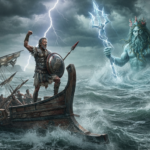
The core of Deucalion’s narrative is his survival of the great flood. Warned by his father, the prophetic Titan Prometheus, of the impending catastrophe, Deucalion was instructed to build a chest or a ship . Following his father’s advice, he constructed this vessel, laid in provisions, and with his wife Pyrrha, boarded it as the floods came. The destruction was total: Zeus sent torrential rains, the seas rose, and all of Hellas was submerged, destroying all other inhabitants .
For nine days and nights, Deucalion and Pyrrha floated in their chest, the sole survivors of humanity . The ship eventually came to rest, and according to the most common tradition, landed on Mount Parnassus in central Greece . Other local traditions claimed different landing sites, such as Mount Othrys in Thessaly, Mount Athos, or even Mount Etna in Sicily, suggesting that many regions wished to claim a connection to the flood hero . This localization of the myth reflects the importance of place in Greek identity; communities often adapted pan-Hellenic stories to fit their own landscapes, a practice seen in other regional flood-survival tales where figures like Megarus escaped by following cranes to Mount Gerania, or the Delphians were led by wolves to Parnassus .
Repopulating the Earth: The Stones of Themis
Once the waters subsided and Deucalion and Pyrrha were safe on the dry land of Parnassus, they were faced with the desolate reality of an empty world. Alone and grieving for their lost community, they sought guidance from the gods . In some early Greek versions, Hermes was sent by Zeus to promise Deucalion any wish he desired, to which Deucalion simply prayed for the restoration of mankind . However, the more famous and elaborate account, found in the Roman poet Ovid’s Metamorphoses, describes their consultation of the oracle of Themis, the goddess of divine law and prophecy .
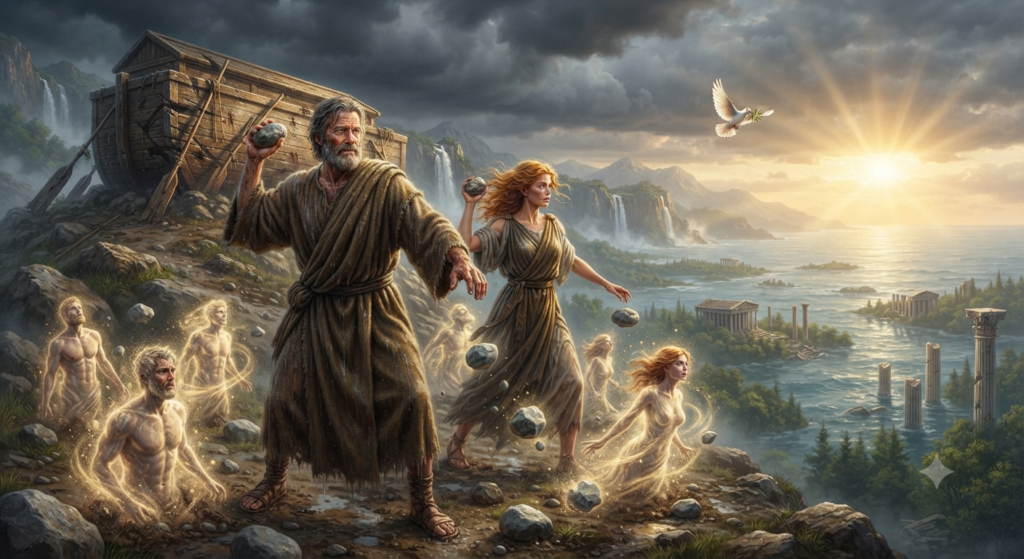
At the sanctuary of Themis, the oracle delivered a cryptic command: they were to “cast behind them the bones of their mother” . Pyrrha was horrified, deeming it impious to disturb the remains of her parents, but Deucalion, using the intelligence of his father Prometheus, reasoned that the command was not literal . He understood “mother” to mean Gaia, the Earth, and her “bones” to be the stones of the hillside . The couple followed this interpretation, covering their heads and throwing stones behind their backs as they walked. The miracle that followed was the foundation of the new human race: the stones thrown by Deucalion became men, while those thrown by Pyrrha became women . This new race, born from the stones of the earth, was considered hardy and resilient, a people suited to the harsh realities of the post-diluvian world .
Family and Relationships
Deucalion’s family connections are central to his role in Greek mythology, as they establish him as the ancestor of the entire Hellenic race. His lineage connects the age of gods and monsters directly to the historical Greeks.
Parentage: Son of Prometheus
Deucalion was the son of the Titan Prometheus, the benefactor of mankind who stole fire from the gods . His mother is named in different sources as Clymene or Pronoea, but the consistent association is with Prometheus, who is also credited as the creator or benefactor of the first humans . This paternity is significant: Deucalion inherits the intelligence and foresight of his father, qualities that enable him to interpret the oracle of Themis correctly and to survive the flood. He is literally the son of the one who gave humanity its spark, and through him, that legacy continues.
Wife: Pyrrha
Pyrrha, the daughter of Epimetheus and Pandora, was Deucalion’s devoted wife . Her name, derived from the Greek word pyrrhos meaning “flame-colored” or “fiery,” complements her husband’s name, which some interpret as “the one who sails on the sea” . Together, they represent a complete and pious couple. Their bond is crucial to the myth; they act as a unit in their survival, their prayer, and their repopulation of the earth. The fact that they are both survivors and co-creators of the new human race establishes an essential duality in the origin of the Hellenes.
Offspring: The Ancestors of Greece
Deucalion and Pyrrha had several children, the most famous of whom was Hellen . Hellen became the eponymous ancestor of the Hellenes, the Greeks themselves, and his name was given to the nation of Hellas . Other notable children included Amphictyon, who was said to have founded the Amphictyonic League, a religious association of Greek tribes; and Protogeneia and Thyia, who were loved by Zeus and who gave birth to further ancestors of important Greek families . Through these children, Deucalion became the patriarch of the Greek people. His descendants, including figures like Sisyphus, Athamas, Ion, and Endymion, would go on to rule most of the kingdoms of Greece in the mythical age . Thus, Deucalion’s mythological role is not simply that of a survivor but of the progenitor of a whole civilization.
Symbols and Meaning
The myth of Deucalion is rich in symbolism, with key objects and actions taking on profound meaning that explains human nature and the relationship between gods and mortals.
The Ark or Chest
The vessel built by Deucalion is a potent symbol of safety, salvation, and divine favor. It represents the means by which the righteous are preserved during divine punishment. By following his father’s advice, Deucalion demonstrates piety and intelligence, choosing to prepare for a disaster that only he knew was coming. The chest also connects the Greek myth to other flood narratives, such as the story of Noah’s Ark in the Bible, a similarity that was not lost on later commentators . The presence of animals in some versions of the Greek myth, who followed Deucalion into the chest, further cements this cross-cultural connection .
The Stones
The stones cast by Deucalion and Pyrrha are the most powerful symbols of the myth. They represent the enduring “bones” of Mother Earth, the raw material from which life is created anew . The transformation of these inanimate objects into living human beings is a metaphor for the resilience and grounded nature of the new human race . As Ovid suggests, the new people born from stones were harder, tougher, and more suited to the struggles of life in a post-apocalyptic world . The act of throwing the stones over their shoulders also signifies the need to leave the past behind and embrace the future.
The Dove
In some accounts, like those recorded by the Roman historian Plutarch, Deucalion is said to have sent a dove out from the chest to check if the floodwaters had receded . The dove that returned signaled that the earth was still submerged, while the dove that did not return indicated that land had once again appeared. This detail, also present in the story of Noah, is a powerful symbol of hope and the search for new life. Its presence in the Greek myth underscores the shared heritage of flood stories across the ancient Near East and Mediterranean, suggesting a common cultural memory of catastrophic inundations .
Powers and Characteristics
As a mortal hero, Deucalion did not possess the supernatural powers of the gods. Instead, his defining characteristics were his piety, intelligence, and righteousness, qualities that set him apart from the rest of humanity.
Piety and Justice
Deucalion is consistently described as a “just and religious man” . It was his piety that earned him the favor of Zeus and allowed him to survive the flood. He is also said to have been the first to build a temple to the gods, an act that further underscores his devotion . When the flood destroyed the world, Deucalion and Pyrrha were the only ones who were “free from sin,” marking them as the sole individuals worthy of preservation . This righteous character made him the natural choice to be the father of a new, better breed of humanity.
Intelligence and Foresight
Inheriting the cunning of his father Prometheus, Deucalion is also characterized by his intelligence . This is most clearly demonstrated in his interpretation of the oracle of Themis. While Pyrrha was initially horrified at the thought of throwing their mother’s bones, Deucalion understood the riddle as a metaphor for the stones of the earth . This ability to think beyond the literal and grasp the symbolic meaning is what makes the repopulation of the earth possible. His foresight was also crucial in constructing the ark before the flood, showing that he was not merely pious but also prudent and prepared.
Worship and Religious Importance
Deucalion was a hero, not a god, and therefore he did not receive widespread cult worship in the same manner as the Olympians. However, his importance in Greek religion was profound, and he was venerated through local traditions and as a figure of ancestral reverence.
Veneration of Zeus Phyxius
After the flood, Deucalion is said to have offered sacrifices to Zeus Phyxius, the “helper of fugitives” . This epithet acknowledges Zeus’s role in saving Deucalion and Pyrrha from the deluge. This act of sacrifice established a precedent for worshipping Zeus as a protector in times of trouble, recognizing his role as both the punisher of the wicked and the savior of the just. The god’s favor was not simply given; it was honored and reciprocated through ritual.
Local Cults and Associations
While there was no pan-Hellenic cult of Deucalion, many places claimed connections to him. His tomb was shown in Athens, near the sanctuary of Olympian Zeus, suggesting that the Athenians considered him part of their own local history . Additionally, there were traditions that Deucalion lived in Athens and that the sanctuary of Olympian Zeus was his work . Furthermore, the oracle of Themis, which he consulted to repopulate the earth, became an important site of pilgrimage . These local traditions demonstrate that while Deucalion’s story was part of the broader Greek heritage, individual cities adapted it to fit their own identities and sacred landscapes.
Ancient Sources
The myth of Deucalion is preserved in several key ancient sources, which together provide a comprehensive picture of his story and its variations.
Ovid’s Metamorphoses
The most complete and famous version of the Deucalion myth comes from the Roman poet Ovid’s Metamorphoses (Book I) . Ovid’s account is detailed and poetic, describing the flood, the survival of Deucalion and Pyrrha, their consultation of Themis, and the miracle of the stones. Ovid’s version has been particularly influential in shaping the modern understanding of the myth, emphasizing the themes of piety, transformation, and the resilience of humanity.
The Library of Apollodorus
The mythographer Apollodorus provides a succinct but important summary of the Deucalion myth in his Library . Apollodorus’s account is valuable because it is drawn from a wide range of earlier sources and often includes variations, such as the different accounts of where the ark landed and the tradition that Hermes, rather than Themis, was the one who instructed Deucalion .
Pausanias and Other Writers
The travel writer Pausanias, in his Description of Greece, offers a geographical perspective on the myth. He mentions various local traditions, such as the survival of Megarus and the Delphians, and notes the places where Deucalion’s tomb was shown . Other significant sources include the Fabulae of Hyginus and the Argonautica of Apollonius of Rhodes, which mention Deucalion as a significant ancestor figure . The 17th-century scholar Alexander Ross also provides an allegorical Christian interpretation of Deucalion, further demonstrating the myth’s endurance in Western thought .
Cultural Influence and Legacy
The figure of Deucalion has had a significant and enduring cultural impact, serving as a foundational myth for the Greeks and a source of inspiration for artists and writers.
The Greek Flood Hero
As the “Greek Noah,” Deucalion is a pivotal figure in Greek cultural identity . He represents the endurance of the Hellenic race through divine trial and its rebirth from a single, pious couple. His descendants, particularly Hellen, established the genealogical framework for understanding the Greek people as a single, related group. This narrative was essential for shaping Greek identity, providing a shared origin story that transcended the political divisions of the city-states. The myth of Deucalion is a national epic in miniature, explaining not just where the Greeks came from but also why they were a uniquely favored people.
Literary and Artistic Depictions
Deucalion’s story has been a frequent subject in literature and art, from Ovid’s epic poetry to modern works. The dramatic themes of the flood, the devastating loss of humanity, and the miraculous creation of a new race have inspired painters and sculptors for centuries. Depictions of Deucalion and Pyrrha often emphasize their piety and the desolate landscape they inhabit. The myth’s use of symbolism, such as the ark and the stones, has made it a rich source for allegory and philosophical commentary.
A Touchstone for Comparative Mythology
Because of its strong parallels to the biblical story of Noah’s Ark, the Deucalion myth has been a key text in the study of comparative mythology and the analysis of flood stories across cultures . Scholars have long debated the origins and connections between these myths, exploring whether they derive from a common source, such as a shared memory of a real ancient flood event, or from independent cultural developments. This makes Deucalion a valuable figure for understanding how different civilizations have made sense of catastrophe, divine justice, and human resilience.
Frequently Asked Questions About Who is Deucalion in Greek mythology?
Who was Deucalion in Greek mythology?
Deucalion was the son of the Titan Prometheus and the husband of Pyrrha. He is the central figure in the Greek flood myth, the only righteous man saved from a devastating deluge sent by Zeus to destroy a corrupt humanity. He and his wife survived by building an ark and later repopulated the world by throwing stones that transformed into people .
What is the story of Deucalion and Pyrrha?
The story of Deucalion and Pyrrha recounts how they survived a great flood sent by Zeus. Warned by Prometheus, Deucalion built a chest, and he and Pyrrha floated on it for nine days before landing on Mount Parnassus. They were the only humans left. Upon consulting the oracle of Themis, they were told to cast the “bones of their mother” behind them, which they interpreted as stones. These stones then transformed into a new race of humans .
Was Deucalion the Greek version of Noah?
Yes, Deucalion is often referred to as the Greek equivalent of Noah. Both are righteous men who survive a world-destroying flood by building an ark. Both repopulate the earth and are considered patriarchs of their respective peoples. Later commentators noted the strong similarities between the two stories, though they are part of different cultural and religious traditions .
How did Deucalion repopulate the earth?
Deucalion repopulated the earth by following the instructions of the oracle of Themis. He and his wife threw stones over their shoulders. The stones cast by Deucalion turned into men, while those thrown by Pyrrha turned into women. This act gave rise to a new, hardy race of humans to inhabit the world after the flood .
What does the name Deucalion mean?
The name Deucalion (Δευκαλίων) is of uncertain etymology but is often understood as a combination of the Greek words deukos (a variant of glykys, meaning “sweet”) and hals (“sea”), suggesting “sweet sailor” or “sweet sea” . Another possible interpretation links deus (“god”) and halos (“sea”), making it “god of the sea.” The name was also connected by some later writers to deuo, meaning “to water,” and kaleo, “to call” .
Who were the parents of Deucalion?
Deucalion was the son of Prometheus, the Titan who stole fire from the gods for humanity. His mother is generally given as Clymene, but some sources also name her as Pronoea or Pandora, which creates a circular relationship since Pyrrha is famously Pandora’s daughter . His parentage is significant because it gives him the intelligence and foresight necessary to survive the flood .
What is the meaning of the stones in the Deucalion myth?
In the Deucalion myth, the stones represent the “bones” of Mother Earth (Gaia). When Deucalion and Pyrrha cast them behind them, they are following the oracle’s cryptic command to throw the “bones of their mother.” This act symbolizes the rebirth of humanity from the earth itself. The new humans born from these stones were considered a harder, more resilient race, reflecting the nature of the material from which they were created .
Where did Deucalion’s ark land?
According to the most common tradition, Deucalion’s ark landed on Mount Parnassus in central Greece . However, because the myth was localized in different regions, other sources claim it landed on Mount Othrys in Thessaly, Mount Athos, or even Mount Etna in Sicily . These variations reflect the Greek practice of connecting important myths to their own local landmarks.
Conclusion
The story of Deucalion is more than just an ancient myth; it is a profound meditation on justice, survival, and the origins of the Greek people. Who is Deucalion in Greek mythology? He is the righteous survivor of a divine apocalypse, the son of a Titan, and the patriarch of a new humanity. His myth encapsulates the Greek understanding of the relationship between gods and mortals, where piety is rewarded and impiety punished. Yet, it also offers a message of renewal and hope, demonstrating that even after a total annihilation, life can begin anew. Through his intelligence, inherited from his father Prometheus, Deucalion deciphers the will of the gods, transforming lifeless stones into the ancestors of the Hellenes.
The cultural legacy of Deucalion is immense. As the “Greek Noah,” he provides a foundational story that helped unify the often-fragmented Greek world through a shared ancestry. His myth has been a subject of fascination for millennia, inspiring poets, artists, and scholars. The parallels with other flood narratives, such as the biblical account of Noah, have made his story a central piece in the study of comparative mythology and cultural exchange. Ultimately, Deucalion endures as a symbol of human resilience and divine mercy. He reminds us that in the face of catastrophe, the qualities of intelligence, piety, and righteousness can lead to a new beginning. His story is a testament to the enduring human need to understand our origins and our place in the universe, a need that connects us directly to the ancient Greeks who first told his tale.

Orin Vale has spent the better part of two decades tracing the threads that connect the world’s oldest stories — from the halls of Asgard to the banks of the Nile, from Olympus to the jungles of the Maya. What began as a childhood fascination with flood myths and trickster gods grew into years of independent study across comparative mythology and ancient religion, always chasing the same question: what did these stories mean to the people who first told them? Orin writes for readers who want more than trivia — the ones looking for the beliefs, fears, and truths that myths were built to carry.