In the rich and complex tapestry of Greek mythology, the practice of magic and sorcery was not merely a human endeavor but a divine art, intimately connected with a select group of powerful deities. To understand which Greek deities are associated with witchcraft is to enter a world where the boundaries between the mortal and the divine, nature and the supernatural, were fluid and often perilous. These deities were not mere patrons of magic; they were its very embodiments, wielding powers that could transform, heal, destroy, and communicate with the dead. From the dark, primordial forces of the night to the skilled herbalists of myth, these figures provided the ancient Greeks with a framework for understanding the mysterious and often terrifying forces of the unseen world. This comprehensive guide explores the primary goddesses and figures who governed the realm of witchcraft, necromancy, and enchantment, revealing their origins, powers, and enduring influence on the Western magical tradition.
Hecate: The Supreme Goddess of Witchcraft
Any inquiry into which Greek deities are associated with witchcraft must begin with Hecate. She is unequivocally the preeminent goddess of magic, witchcraft, necromancy, ghosts, and the crossroads in Greek mythology . Her association with the darker aspects of human experience solidified in the 5th century BCE, from which point she became intrinsically linked to death, magic, the night, and creatures that roam in darkness .
Origins and Family
Hecate’s origins are somewhat mysterious. While she was accepted into Greek religion early, she may have been derived from the Carians in southwest Asia Minor . In Hesiod’s Theogony, she is the daughter of the Titan Perses and the nymph Asteria, making her a granddaughter of the Titans Phoebe and Coeus . This lineage connects her to the older, more primeval powers of the cosmos. However, other authors provide different parentage, including Zeus and Demeter, or even Night itself, highlighting her complex and multifaceted nature . Her name itself, sometimes translated as “Worker from Afar” or “She Who Works Her Will,” speaks to her immense and far-reaching power .
Powers and Role
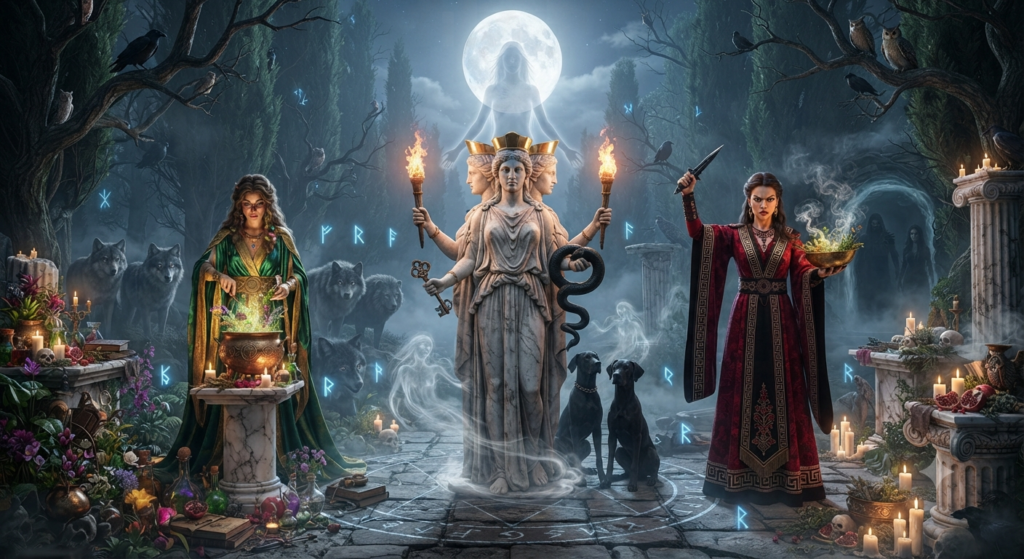
Hecate’s powers are vast and encompass a wide range of supernatural domains. She is the chief goddess presiding over magic and spells, and she was especially appealed to by sorceresses for aid in their magical workings . Her authority extended over the night, the moon (often in its darker, more mysterious phases), and the spirits of the dead. She was a torch-bearing deity, using her light to guide souls and to illuminate the darkness of the underworld, famously assisting Demeter in her search for the abducted Persephone with her torch in hand . Her companions were the Furies (Erinyes) and her children were the Empusae, female demons known for seducing travelers . This entourage solidifies her role as a leader of the spectral and demonic forces of the night.
Worship and Iconography
Worship of Hecate was distinct and often took place at the fringes of society. She was worshipped at crossroads, doorways, and other boundaries, where her images could ward off evil spirits . Her most common cult practice was the “supper of Hecate,” where offerings of food such as eggs, cheese, bread, and dog meat (or a dish of red mullet) were left at crossroads, often on the night of the new moon . Small household shrines dedicated to her were also common for protection against malevolent magic .
Iconographically, Hecate is most famous for her triple-bodied form, known as a Hekataion, with three figures standing back-to-back, allowing her to look in all directions from the crossroads . She is typically depicted as a young woman carrying a torch or a key, both symbols of her functions as a night deity and a guardian of the gates of Hades . This powerful image became the canonical representation of the goddess of magic.
Circe: The Enchantress of Aeaea
Circe is another central figure in understanding which Greek deities are associated with witchcraft. She is a powerful sorceress and goddess renowned for her vast knowledge of potions, herbs, and magical drugs . Unlike Hecate, who personifies the more chthonic and primal forces of magic, Circe is often portrayed as a beautiful, regal enchantress who uses her powers for personal gain, revenge, or entertainment, embodying a dangerous and alluring form of female sexuality and autonomy .
Family and Attributes
Circe was the daughter of the sun god Helios and the Oceanid Perse . This divine parentage positioned her within a powerful magical family: her sister was Pasiphae, the witch-queen of Crete, and her niece was Medea, another famed sorceress . In some later traditions, her mother is given as Hecate herself, further solidifying the family’s connection to magic . Circe’s primary attribute is her knowledge of pharmaka (drugs and potions), and she is often depicted with a cup or wand, the tools of her craft . Her Homeric epithet, polypharmakos, meaning “knowing many drugs or charms,” perfectly encapsulates her defining characteristic .
The Odyssey and Other Myths
Circe’s most famous appearance is in Homer’s Odyssey. She lives on the island of Aeaea, surrounded by a menagerie of wild animals—lions and wolves—who were once men she had transformed . When Odysseus and his crew land on her island, she uses her enchanted wine to turn most of them into swine. Only Odysseus, with the help of the god Hermes and the magical herb moly, is able to resist her spell. He compels her to restore his men to human form, and they end up living together for a year . Circe then becomes a crucial guide for Odysseus, advising him on how to navigate the perils of the underworld and the Sirens, demonstrating her expertise in magical knowledge and the geography of the spirit world .
Other myths highlight her more vengeful and jealous nature. When the sea god Glaucus spurned her love in favor of the nymph Scylla, Circe poisoned the water where Scylla bathed, transforming her into a horrific sea monster . In a similar story, she turned the king Picus into a woodpecker for rejecting her advances . These tales establish her as a formidable and dangerous figure who could not be crossed without severe consequences.
Medea: The Archetypal Sorceress
Medea is perhaps the most complex and terrifying figure among which Greek deities are associated with witchcraft. A princess of Colchis and granddaughter of Helios, she is an archetypal sorceress whose story blends love, betrayal, and ruthless magical power . Unlike Hecate or Circe, Medea is a mortal with divine heritage, but her skill in magic makes her a figure of awe and fear, capable of acts that rival the gods themselves.
Family and Rise to Power
Medea is the daughter of King Aeëtes of Colchis, the keeper of the Golden Fleece, and is often considered a priestess of Hecate . Her knowledge of herbs and pharmaka is legendary, and she is described as polypharmakon (“skilled in many herbs”) by Apollonius of Rhodes . Her magic is rooted in the potent plants of the earth, including one that grew from the blood of the tortured Titan Prometheus .
Medea’s story is intrinsically linked to the hero Jason and the quest for the Golden Fleece. She fell in love with Jason—some say under a spell from Aphrodite—and used her magical abilities to help him complete impossible tasks, such as yoking fire-breathing bulls and putting a dragon to sleep . In her love-fueled devotion, she betrayed her family, killed her own brother to distract her father, and fled with Jason .
The Dark Side of Magic
Medea’s later life, however, reveals the full, devastating potential of her magic. When Jason abandoned her to marry Glauce, the daughter of the king of Corinth, Medea took horrific revenge. In Euripides’s famous play Medea, she uses her knowledge of poisons to create a cursed robe and crown that burn Glauce to death . Her most shocking act, however, is the premeditated murder of her own children—not with poison, but with a sword—to inflict the maximum pain on Jason .
Later authors, like Ovid, would further elaborate on her magical prowess, having her use incantations and bizarre ingredients (like the wings of an owl and entrails of a werewolf) to rejuvenate Jason’s father, Aeson . Over time, her image evolved from that of a powerful, if tragic, herbalist into a truly wicked witch, associated with the underworld and selfish, manipulative magic .
Other Associated Deities and Figures
While Hecate, Circe, and Medea are the primary figures, they are not alone in their association with magic. Several other deities and mythical figures form part of the broader context of which Greek deities are associated with witchcraft.
Selene
The goddess of the moon, Selene, is intrinsically linked to magic due to the common association of lunar cycles with the practice of spells and enchantments. Hecate was often conflated with Selene, as both were goddesses of the night and the moon. In magical papyri, Selene is frequently invoked as a powerful deity for spellcasting .
Persephone and Hades
The queen and king of the underworld are naturally associated with the magical arts, particularly necromancy (the practice of communicating with the dead). Hecate’s association with the underworld ties her to them, and later magic eras viewed the original powers of the underworld, like Pluto and Proserpine (the Roman equivalents of Hades and Persephone), as protectors of magical arts .
Minor Sorceresses
Other figures like Pasiphae, Circe’s sister and the mother of the Minotaur, and her daughter Ariadne, who helped Theseus navigate the Labyrinth, also possess magical knowledge . While their roles are more peripheral to the central narrative of witchcraft, they reinforce the idea that magical ability was a trait that ran in divine families, particularly those descended from Helios .
Frequently Asked Questions About Which Greek deities are associated with witchcraft?
Who is the primary Greek goddess of witchcraft and magic?
Hecate is the primary Greek goddess of witchcraft, magic, necromancy, ghosts, and the crossroads. She is the chief divine figure presiding over spells and sorcery in Greek mythology .
Is Circe a goddess or a witch?
Circe is considered both a powerful sorceress and a goddess. She is often described as a goddess in Homer’s Odyssey and is the daughter of the sun god Helios, placing her firmly in the divine realm, yet she is primarily known for her mastery of magic and potions .
What is the relationship between Circe and Medea?
Circe is Medea’s aunt. Circe is the sister of Medea’s father, Aeëtes, king of Colchis. In some later traditions, both are said to be daughters of the goddess Hecate .
What type of magic is Medea known for?
Medea is known for her mastery of herbs, potions, and pharmaka (medicinal and poisonous plants). She was also capable of using her magic to perform feats such as rejuvenation, putting dragons to sleep, and in later literature, making her magic more potent through incantations and supernatural ingredients .
Why is Hecate associated with dogs and crossroads?
Hecate is associated with crossroads because she is the guardian of boundaries and the goddess of the “three ways” (Trivia), allowing her to look in all directions. She is associated with dogs because they are often linked to the underworld, death, and the moon; they were also used in her sacrifices .
Did the ancient Greeks worship these deities as witches?
The ancient Greeks worshipped figures like Hecate in the context of her divine power. The practice of magic was often associated with her cult, with offerings left at crossroads to appease her. She was a goddess to be respected and feared, and her worship included rituals meant to ward off evil spirits .
How do Circe and Hecate differ in their magical powers?
Hecate is the patron of all witchcraft, ruling over the night, ghosts, and the underworld. She is the source of magical power itself. Circe is a practitioner of magic, specifically skilled in potions and herbs, which she uses to transform men into beasts, cast illusions, and reveal secret knowledge to heroes .
What is the significance of the name Polypharmakos?
Polypharmakos is a Homeric epithet for Circe, meaning “knowing many drugs or charms.” It highlights her vast knowledge of herbs and potions, which was the foundation of her magical power . Medea is also described similarly with the term polypharmakon .
Conclusion
To ask which Greek deities are associated with witchcraft is to be introduced to a formidable and terrifying triad of divine power, each representing a different facet of the ancient magical arts. Hecate stands as the supreme patron, the very embodiment of witchcraft, whose power governs the night, ghosts, and the crossing of boundaries. Circe represents the allure and danger of the enchantress, a skilled herbalist whose knowledge of drugs and potions allowed her to control and transform both men and gods. Medea exemplifies the devastating potential of magic when it is fueled by love, betrayal, and vengeance, a mortal woman whose mastery of the arcane arts allowed her to perform horrific acts. Together, these figures, alongside associated deities like Selene and Hades, form the core of the Greek magical tradition, creating a legacy that has continued to influence the Western concept of witchcraft, sorcery, and the occult for millennia. Their stories remain powerful testaments to the ancient Greek belief in a world where the boundaries between the mortal and the supernatural were thin, and where magic was a divine and potent force to be both respected and feared.

Orin Vale has spent the better part of two decades tracing the threads that connect the world’s oldest stories — from the halls of Asgard to the banks of the Nile, from Olympus to the jungles of the Maya. What began as a childhood fascination with flood myths and trickster gods grew into years of independent study across comparative mythology and ancient religion, always chasing the same question: what did these stories mean to the people who first told them? Orin writes for readers who want more than trivia — the ones looking for the beliefs, fears, and truths that myths were built to carry.