The night sky has always been a canvas for human imagination, and for the ancient Greeks, the constellations were not mere patterns of stars but eternal monuments to their gods, heroes, and the powerful emotions that defined their lives. Among the most compelling of these celestial narratives are those that speak of love—its triumphs, its tragedies, and its transformative power. To understand which constellations are linked to love in Greek mythology is to explore a collection of stories where passion defies death, devotion conquers fate, and the gods themselves are moved to immortalize their affections in the stars. From the heroic rescue of a princess to the tragic demise of a great hunter, these constellations offer a romantic map of the heavens, each bearing witness to a love so profound that it was inscribed among the constellations for all eternity. This comprehensive guide explores the primary constellations associated with love, revealing the myths that gave them their names and the enduring legacy of these celestial romances.
The Eagle and the Cup-Bearer: Aquila and Aquarius
The Abduction of Ganymede
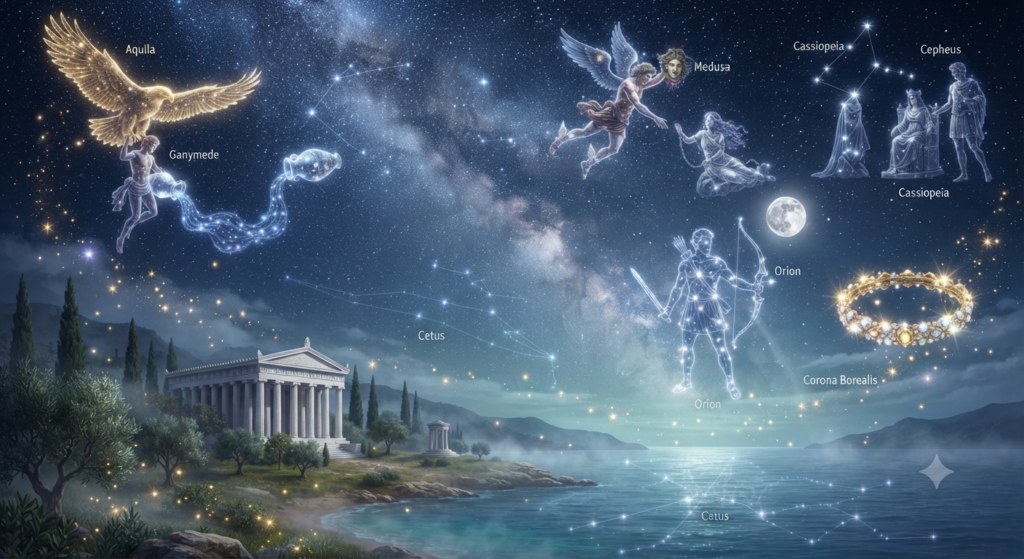
One of the most famous love stories in the night sky involves the constellations Aquila (the Eagle) and Aquarius (the Water-Bearer), linked by the myth of Zeus and the beautiful Trojan prince Ganymede . According to the myth, Ganymede was the most handsome of all mortals, the son of King Tros, the founder of Troy . His beauty was so extraordinary that it caught the attention of Zeus, the king of the gods, who desired the youth .
Zeus, in the form of a magnificent eagle (Aquila), swooped down from Mount Olympus and snatched Ganymede from the slopes of Mount Ida, carrying him up to the heavens . Once on Olympus, Ganymede was appointed as the cup-bearer to the gods, replacing the goddess Hebe, and became Zeus’s beloved companion . In some accounts, Ganymede was also associated with the constellation Aquarius, the water-bearer, as he was said to have poured out the waters of the gods for humanity, and his mixing cup was sometimes identified with the constellation Crater . This myth, which first appears in Homer’s Iliad without explicit romantic overtones, later became a powerful symbol of homoerotic love, with Ganymede and Zeus representing the archetypal lover-beloved relationship . The presence of these two constellations side-by-side in the sky serves as a celestial testament to this legendary love, firmly establishing them among which constellations are linked to love in Greek mythology.
The Rescued Princess: Andromeda and Perseus
A Love That Defied a Monster
The constellations Andromeda and Perseus are inextricably linked by a story of heroic rescue and enduring love . Andromeda was the daughter of King Cepheus and Queen Cassiopeia of Ethiopia. The queen’s vanity proved to be the family’s undoing when she boasted that her daughter was more beautiful than the Nereids, the sea nymphs . The insulted nymphs appealed to Poseidon, who sent a sea monster (Cetus) to ravage the kingdom .
An oracle decreed that the only way to appease the god and save the land was to sacrifice Andromeda to the monster. She was chained to a seaside cliff to await her fate . It was at this moment of peril that the hero Perseus, returning from his triumph over Medusa, saw Andromeda and instantly fell in love with her . He offered to rescue her in exchange for her hand in marriage. After killing the monster, Perseus freed Andromeda, and the couple was married .
As a reward for their union, the goddess Athena placed images of both Andromeda and Perseus among the stars . The constellation Andromeda is often depicted as a chained maiden with her arms outstretched, a permanent reminder of her sacrifice and salvation . This myth of love overcoming monstrous adversity makes Andromeda and Perseus a central part of understanding which constellations are linked to love in Greek mythology.
The Eternal Hunters: Orion and Artemis
A Tale of Forbidden Love and Tragic Loss
The constellation Orion, the great hunter, is the subject of one of the most dramatic and tragic love stories in the night sky . The myths surrounding Orion are numerous and contradictory, but many versions emphasize his romantic entanglements, particularly with the goddess Artemis, the goddess of the hunt and the moon .
In one popular account, Orion was a solitary and handsome hunter who lived on a remote island. His nightly activities caught the attention of Artemis, who fell in love with him from her vantage point in the sky . Despite the divine decree that gods should not mingle with mortals, Artemis could not resist and descended to Earth to be with Orion. They spent many nights hunting and playing together .
This forbidden love affair was discovered by Apollo, Artemis’s twin brother, who was enraged . Seeing a threat to his sister’s divine duties, Apollo devised a plan to kill Orion. He tricked Artemis into shooting a distant target at sea, which was actually Orion swimming with only his head visible above the water. Artemis’s aim was perfect, and her arrow struck and killed her lover . Grief-stricken, Artemis placed his body among the stars as the constellation Orion . In some versions, a giant scorpion sent to kill Orion is also placed in the sky as the constellation Scorpius, positioned opposite Orion so that the hunter eternally flees his killer . The intensity of Artemis’s love and her subsequent loss makes Orion’s story a key answer to which constellations are linked to love in Greek mythology.
The Royal Couple: Cepheus and Cassiopeia
A Devotion Beyond the Grave
The constellations Cepheus and Cassiopeia are unusual among the love-linked constellations, as they represent an enduring marital love rather than a romantic courtship . Cepheus was the king of Ethiopia and Cassiopeia his beautiful but exceptionally vain queen. Cassiopeia’s boast that she was more beautiful than the Nereids ultimately led to a series of catastrophes, including the sacrifice of their daughter, Andromeda .
However, the story of their celestial placement focuses on their devotion to one another. In some accounts, Cassiopeia’s final boast—that she was even more beautiful than Hera, the queen of the gods—led to her divine punishment. The enraged Hera chained Cassiopeia to her throne and flung her into the sky, where she remains forever bound, often depicted upside down as a punishment for her vanity . When Cepheus learned of his wife’s fate, he was heartbroken. Remembering his vow never to be separated from her, he begged Zeus to allow him to join her in the stars. Moved by his devotion, Zeus granted his wish, placing Cepheus in the sky as a constellation, where he remains forever in a celestial embrace with his beloved queen . This powerful tale of a king’s unwavering love makes Cepheus and Cassiopeia an important part of any discussion of which constellations are linked to love in Greek mythology.
The Crown of Ariadne: Corona Borealis
A Gift of Love and Eternal Memory
The constellation Corona Borealis, the Northern Crown, is associated with one of the most poignant love stories of Greek mythology, that of the princess Ariadne and the god Dionysus . Ariadne, daughter of King Minos of Crete, had fallen in love with the Athenian hero Theseus and helped him navigate the Labyrinth to defeat the Minotaur. Theseus, however, later abandoned her on the island of Naxos.
There, the god Dionysus discovered Ariadne and fell in love with her. They were married, and as a wedding gift, the goddess Aphrodite (in some accounts, the god Hephaestus) presented Ariadne with a magnificent crown made of gold and precious gems . After Ariadne’s eventual death, Dionysus placed the crown in the sky as a constellation to immortalize his love for her . The constellation Corona Borealis is depicted as a semicircle of stars, forever shining as a symbol of divine love and eternal remembrance, making it a key part of the question which constellations are linked to love in Greek mythology.
Other Celestial Romances
While the above constellations are the primary examples of love stories written in the stars, other constellations are linked to love through their associations with the goddess Aphrodite and the god Eros. While not a constellation itself, the arrow of Eros (represented by the constellation Sagitta, the Arrow) is said to have played a role in the story of Zeus and Ganymede, with the eagle (Aquila) guarding the arrow that made Zeus lovestruck . Moreover, the goddess Aphrodite’s favor was often bestowed upon lovers in myth, and her influence is felt in many romantic stories, including that of Hippomenes and Atalanta, where she provided the golden apples that allowed the suitor to win his beloved .
Frequently Asked Questions About Which constellations are linked to love in Greek mythology?
What is the most famous love story among the constellations?
The story of Orion and Artemis is among the most famous and tragic love stories in the constellations. Artemis, the goddess of the hunt, fell in love with the hunter Orion. However, she was tricked by her brother Apollo into killing him. Grief-stricken, she placed Orion among the stars as the constellation we see today .
Which constellations are associated with the love of Zeus?
The constellations Aquila (the Eagle) and Aquarius (the Water-Bearer) are associated with Zeus’s love for the Trojan prince Ganymede. Zeus transformed into an eagle to abduct Ganymede, who then became the cup-bearer of the gods and was later associated with the constellation Aquarius .
Which constellations represent a married couple?
Cepheus and Cassiopeia represent a royal married couple. Despite Cassiopeia’s vanity and punishment, Cepheus’s devotion to her was so great that he begged Zeus to let him join her in the stars, and the two remain forever in a celestial embrace .
What constellation is a wedding gift from a god?
Corona Borealis, the Northern Crown, is a constellation said to be the wedding crown of Princess Ariadne. The god Dionysus, who fell in love with Ariadne, placed her crown in the sky after her death as a symbol of his eternal love .
Which constellations are linked to the rescue of a princess by a hero?
Andromeda and Perseus are linked by the hero’s rescue of the princess from a sea monster. Perseus fell in love with Andromeda as she was chained to a cliff, killed the monster, and married her. Athena placed both of them among the stars .
What is the story behind Scorpius and Orion in the sky?
In one myth, the giant scorpion (Scorpius) was sent to kill Orion. After his death, both were placed in the sky on opposite sides of the heavens. As a result, when Scorpius rises, Orion sets, and the hunter forever flees from the creature that killed him .
Is the goddess Aphrodite connected to any love constellations?
While not directly a constellation, the goddess of love, Aphrodite, is associated with the myth of Ariadne and Dionysus, as she provided Ariadne’s wedding crown that became the constellation Corona Borealis . Her influence is felt throughout many love myths linked to the stars.
Why are these constellations important in Greek mythology?
These constellations are important because they demonstrate that the gods and heroes of Greek mythology were not merely figures of power but also beings of deep emotion. The constellations serve as eternal reminders that love, in all its forms, was a force powerful enough to move the gods themselves and to be immortalized in the heavens.
Conclusion
To ask which constellations are linked to love in Greek mythology is to uncover a celestial tapestry woven with tales of passion, devotion, and tragedy. From the heroic rescue of Andromeda by Perseus to the forbidden love of Orion and Artemis, and from the divine abduction of Ganymede to the enduring marital loyalty of Cepheus and Cassiopeia, the night sky tells a series of powerful love stories. These constellations were not just random patterns of stars for the ancient Greeks; they were the eternalized forms of their most cherished myths, serving as a constant reminder that love, in all its power, was a force that could transcend even death and find a home among the gods. The legacy of these celestial romances continues to inspire, reminding us that the human experience of love is written not only in our hearts but also in the stars.

Orin Vale has spent the better part of two decades tracing the threads that connect the world’s oldest stories — from the halls of Asgard to the banks of the Nile, from Olympus to the jungles of the Maya. What began as a childhood fascination with flood myths and trickster gods grew into years of independent study across comparative mythology and ancient religion, always chasing the same question: what did these stories mean to the people who first told them? Orin writes for readers who want more than trivia — the ones looking for the beliefs, fears, and truths that myths were built to carry.