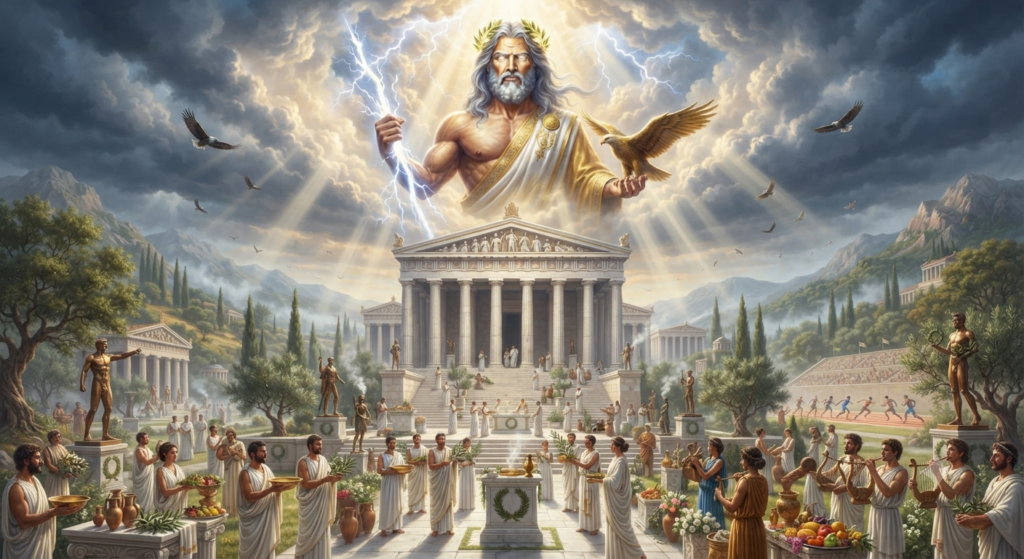
The cult of Zeus in ancient Greece was far more than a simple religious observance; it was a complex and multifaceted institution that lay at the heart of Greek identity, politics, and daily life. As the king of the gods and the ruler of the sky, weather, fate, law, and moral conduct , Zeus was the supreme deity of the Hellenic world, and his worship reflected his paramount importance. To understand what was the cult of Zeus in ancient Greece is to explore a network of sacred sites, rituals, festivals, and beliefs that spanned the entire Mediterranean, from the mountain peaks of Arcadia to the bustling marketplaces of Athens. This comprehensive guide delves into the origins, manifestations, practices, and profound cultural significance of the worship of Zeus, revealing how the ancient Greeks honored the god who governed their world and shaped their destiny.
Origins and Historical Development of the Cult
The Most Ancient Sanctuaries
The origins of Zeus’s worship are rooted in the deepest layers of pre-Hellenic religion. The most ancient sanctuaries of the god were often located on mountain tops, reflecting his identity as a sky and weather god. Recent archaeological discoveries have pushed the timeline of Zeus worship back far earlier than previously thought. Excavations at the ash altar on Mount Lykaion in Arcadia, one of the most important Zeus sanctuaries, have revealed pottery sherds dating from as early as 3000 BCE . This remarkable find suggests that the altar was in use for at least a millennium before the Greeks began to worship Zeus specifically, indicating a continuity of devotion to some divinity or natural force on that spot from the Early Bronze Age .
The sanctuary on Mount Lykaion was one of the oldest and most significant cult sites of Zeus. In the 2nd century CE, the traveler Pausanias described the altar as a mound of earth on the highest peak, offering a panoramic view of the Peloponnese . This mountaintop location was no accident; the god of rain, thunder, and lightning was appropriately venerated in a place where storms were frequent and nature’s power was manifest . The site’s significance is further attested by the discovery of a Late Minoan rock crystal seal from the 15th-14th centuries BCE, suggesting connections between the Arcadian sanctuary and Minoan Crete, another claimed birthplace of Zeus .
The Evolution of Cult Practice
Early worship of Zeus, as with many Greek divinities, was aniconic, meaning it was conducted without images of the god . In Homer’s epics, there is no explicit reference to a statue of Zeus, in contrast to references to idols of Athena and Apollo. This reluctance to depict Zeus may have stemmed from a religious reserve, a sense that the supreme god was too powerful and transcendent to be reduced to a human-like image . On Mount Lycaeum and elsewhere, the cult remained without an image for longer than most other divine cults .
The aniconic stage was followed by the worship of certain objects consecrated to him. The strangest of these was a stone near Gythium in Laconia, upon which Orestes had sat and been healed of madness, and which was called “Zeus the stayer” . The sanctuary at Dodona also began as an outdoor cult centered around a sacred oak tree, with ceremonies performed around the tree itself . The transition to iconic representation marked a significant shift in Greek religion, culminating in the creation of some of the most magnificent statues of the ancient world, such as Pheidias’s colossal chryselephantine (gold and ivory) statue of Zeus at Olympia in the 5th century BCE .
The Role of Myth and Legend
Mythology played a crucial role in defining the cult of Zeus. The claim that Zeus was born on Mount Lykaion was one of the reasons for the sanctuary’s importance . Similarly, the myth of the establishment of the oracle at Dodona, where two black pigeons (peleiades) from Thebes in Egypt indicated the site of the oracle , was recounted by the priests to Herodotus. These myths provided the sacred narratives that justified and explained the existence of the sanctuaries and their rituals. The story of the sacred marriage of Zeus and Hera, celebrated at the Daedala festival on Mount Cithaeron in Boeotia, was another myth that was ritually reenacted, connecting the divine couple to the fertility of the land and the cycle of the seasons .
The Major Sanctuaries of Zeus
Olympia: The Panhellenic Sanctuary
The sanctuary of Zeus at Olympia was arguably the most famous and prestigious in the Greek world . Located in the western Peloponnese, it was a Panhellenic sanctuary, drawing pilgrims, athletes, and dignitaries from all over the Greek-speaking world. The sanctuary was renowned for its colossal temple of Zeus, built in the 5th century BCE, which housed Pheidias’s magnificent gold and ivory statue of the god, one of the Seven Wonders of the Ancient World . The site was also famous for the Olympic Games, held every four years in honor of Zeus, which were among the most important athletic and religious festivals in Greece . The games and the sanctuary were intimately linked to warfare, with military dedications, spoils of war, and athletic victory statues serving as thank-offerings to Zeus for military success . The athletic contests were seen as a form of preparation for warfare, and the dedication of weapons and trophies alongside victor statues underscored this connection . Olympia was the supreme expression of Zeus’s power, combining athleticism, military victory, and religious devotion in a single magnificent site.
Dodona: The Oracle of the Oak
The sanctuary at Dodona in Epirus was another vital center for the cult of Zeus, renowned as the oldest oracle in Greece . Unlike the monumental architecture of Olympia, Dodona’s early cult was centered around a sacred oak tree, through whose rustling leaves the god’s will was communicated . The priests, who originally were men from the Selloi tribe, interpreted the sounds of the wind in the branches, the flight of birds, and the murmur of a sacred spring . By the 5th century BCE, priestesses, called Peleiades, also served the oracle . The sanctuary also featured a unique system of bronze cauldrons on tripods that vibrated and produced sounds, another method of divination . Dodona was not a site of monumental building until the 3rd century BCE under King Pyrrhus, but its spiritual authority was immense, with the oracle consulted by individuals and city-states seeking divine guidance on matters of war, politics, and personal destiny. The sacred oak, considered the dwelling place of Zeus and his local consort Dione, was central to the cult’s identity; its eventual felling in the Christian era symbolized the end of the ancient religion .
Mount Lykaion: The Arkadian Sanctuary
The sanctuary on Mount Lykaion was a major Pan-Arcadian and Pan-Hellenic site, rivaling Olympia in its fame and importance for the people of the Peloponnese . The ash altar of Zeus, a massive mound of earth located on the southern peak, was the focal point of the cult . Pausanias describes a secret sacrifice performed here, which other ancient authors, including Plato and Theophrastus, identify as a human sacrifice . Pausanias himself refused to pry into these details, stating, “let it be as it is and was from the beginning” . Below the altar was a temenos (sacred precinct) containing two pillars with gilded eagles, and further down, a meadow with a hippodrome, stadium, and other buildings used for athletic games held in Zeus’s honor every four years . The sanctuary’s remote location at 1382 meters above sea level made it a fitting home for the god of weather, and it was the site of a renowned rain charm performed by the priest of Zeus, who would dip an oak branch into a sacred spring . The discovery of extraordinarily early pottery at the altar has made Mount Lykaion a key site for understanding the deep antiquity of Zeus worship .
The Civic Sanctuaries
Beyond the great Panhellenic sanctuaries, Zeus was worshipped in every Greek city. His civic epithets reflected his role as the protector of the community, the defender of justice, and the guarantor of the social order . In Thebes, there was a sanctuary of Zeus Agoraios (of the Market), highlighting his presence in the civic and commercial heart of the city . In Plataea, there was a bronze altar and a white marble image of Zeus Eleutherios (God of Freedom), commemorating the Greek victory over the Persians at the Battle of Plataea in 479 BCE, a definitive example of his role as a political deity . In Athens, he was worshipped as Zeus Polieus (of the City) and Zeus Olympios (Olympian). These civic cults were often closely tied to the political structures of the polis, with the god providing a divine sanction for the laws, oaths, and governance of the city. The use of Zeus’s image on coinage, with eagles and thunderbolts, was another way in which cities claimed his authority and identity . This practice shows that the political appropriation of Zeus’s cult was a key factor in its proliferation .
Epithets and Manifestations of Zeus
Weather and Natural Forces
As the god of the sky and weather, Zeus was worshipped under numerous epithets that reflected his control over natural phenomena. He was Zeus Hypsistos (Most High), a name emphasizing his supreme position and often associated with mountaintop sanctuaries . He was Zeus Hypatos (Supreme) and Zeus Kithaironios (of Mount Cithaeron) in Boeotia . As the god of rain, he was Zeus Hyetios (Rain-god), and prayers for rain were a common feature of his cult . He was also the god of thunder and lightning, worshipped as Zeus Kataibates (the Descender), the god who came down in the flash from heaven, and altars were set up in places struck by lightning . At Athens, there was a sacrificial hearth of Zeus Astrapaios (Lightning Zeus) on the city wall, where priests watched for lightning at certain times of the year . The oak tree was the most sacred tree to Zeus, and the worship of the oak god was shared by all branches of the Aryan stock in Europe . The god’s connection to the oak, the thunder, and the rain was a central theme in his worship .
Justice, Law, and Politics
Zeus was not only a god of nature but also of law, justice, and moral conduct . He was the guarantor of oaths and the protector of the social order. This is reflected in epithets such as Zeus Basileus (King), Zeus Soter (Savior), and Zeus Eleutherios (Freedom). At Thebes, he was Zeus Agoraios (of the Market), watching over the civic assembly and commerce . The myth of the Drakon (serpent) at Thespiae, where Zeus earned the epithet Soter for saving the city from a monster, demonstrates how he was seen as a divine protector . The political significance of Zeus was immense; he was not shared by other Hellenic deities to the same degree . His worship was appropriated and consolidated by Greek city-states to legitimize political groups and regimes and to construct networks of Greek identity . The proliferation of civic sanctuaries and coin types featuring Zeus and his attributes in the 5th and 4th centuries BCE reflects this consolidation .
Other Manifestations
Other epithets reflected more specific functions or local traditions. Zeus Kenaios (of Cape Canaeus) was worshipped in Euboea . Zeus Laphystios (of Mount Laphystius) in Boeotia was associated with the story of Phrixus and Helle . Zeus Trophonios was the god of the oracle at Lebadeia, where an underground chasm was used for divination . The epithet Zeus Naios at Dodona, along with his consort Dione, shows his integration into a local pantheon . In Crete, he was worshipped as Idaean Zeus, and his initiates were associated with the Curetes, a group of divine beings who protected the infant god . This diversity demonstrates that Zeus’s worship was not monolithic but adapted to the needs and traditions of each local community.
Rituals, Sacrifices, and Festivals
Sacrifices and Offerings
Animal sacrifice was the central act of worship in the cult of Zeus. The ash altar on Mount Lykaion, consisting of a thick layer of bone ash from animal sacrifices, demonstrates the scale and frequency of these offerings . At Olympia, military thank-offerings were particularly prevalent, with weapons and trophies dedicated to Zeus in his guise as “Zeus Olympios” . Bronze tripods, statuettes, jewelry, and weapons were common offerings at sanctuaries like Dodona, with some dating to as early as the 8th century BCE . The sacrifices were often accompanied by prayers, hymns, and libations. The priests at Dodona, known for walking barefoot and sleeping on the ground, were believed to be in direct contact with the earth and thus closer to the divine .
The Eleutheria and Other Festivals
Festivals were a vital part of Zeus’s cult, providing a communal expression of devotion and celebrating the god’s power. The Eleutheria, held every four years at Plataea, were games “Of Freedom” established to commemorate the Greek victory over the Persians . Competitors ran in armor before the altar of Zeus Eleutherios, combining athletic competition with patriotic and religious significance . The Daedala, held by the Plataeans every six (or fewer) years, was a festival commemorating the reconciliation of Zeus and Hera . The Olympic Games, held every four years at Olympia, were the most important Panhellenic festival in honor of Zeus, attracting competitors and spectators from all over the Greek world . The Naian Games at Dodona, also held in honor of Zeus, were another major festival . These festivals often included athletic, musical, and dramatic contests, which were both a form of worship and a display of Greek cultural identity.
The Sacred Marriage and Mysteries
The festival of the Daedala provides a glimpse into the sacred marriage (hieros gamos) of Zeus and Hera, a ritual that enacted their divine union and was believed to ensure the fertility of the land . The myth of the Daedala involved Zeus pretending to marry a wooden image, tricking Hera into reconciliation . The wooden images (daidala) were then carried in a procession and burned on a pyre, a ritual of sacrifice and renewal .
In Crete, the worship of Zeus was characterized by mystery cults, such as that of “Idaean Zeus” and the rites of “night-ranging Zagreus” . The initiates of these cults wore white clothing, shunned the birthing of men and the places of the dead, and observed dietary restrictions . The performances likely included ecstatic nocturnal rites, sometimes involving the dismemberment and ingestion of animals, either literally or symbolically . These mysteries offered their initiates a deeper, more esoteric connection to the god.
Frequently Asked Questions About What was the cult of Zeus in ancient Greece?
What was the most important sanctuary of Zeus in ancient Greece?
The sanctuary of Zeus at Olympia in the Peloponnese was the most important and famous Panhellenic sanctuary dedicated to Zeus. It was renowned for its colossal temple, the gold and ivory statue of Zeus by Pheidias, and the Olympic Games held in his honor .
What was the oldest oracle of Zeus?
The oracle at Dodona in Epirus was considered the oldest oracle in Greece. Priests and priestesses interpreted the will of Zeus by observing the rustling of the leaves of a sacred oak tree, the flight of birds, and the murmuring of a sacred spring .
Were there human sacrifices in the cult of Zeus?
Ancient authors, including Plato and Theophrastus, suggest that human sacrifice was practiced at the sanctuary of Zeus on Mount Lykaion in Arcadia . Pausanias also alluded to mysterious sacrificial practices there. However, no archaeological evidence of human sacrifice has been found at the site to date .
How was Zeus worshipped in Greek cities?
Zeus was worshipped in every Greek city under various civic epithets. He was honored as Zeus Agoraios (of the Market) in Thebes, Zeus Eleutherios (God of Freedom) in Plataea, and Zeus Polieus (of the City) in Athens. His cult was closely tied to politics, law, oaths, and civic identity .
What role did Zeus play in Greek athletics?
Zeus was the patron god of athletes, and athletic games were a major part of his worship, most famously the Olympic Games at Olympia . Victors dedicated their crowns and statues to Zeus, and military thank-offerings were also common, linking athletics and warfare as acts of devotion to the god .
What did the cult of Zeus involve at Dodona?
At Dodona, the cult centered on a sacred oak tree. Originally, priests interpreted the god’s will through the rustling of its leaves, the flight of birds, and the sounds of bronze gongs and cauldrons. By the 5th century BCE, priestesses also served the oracle. The sanctuary was initially outdoors, with ceremonies performed around the tree .
What animals were sacrificed to Zeus?
Animals, particularly cattle, sheep, and goats, were sacrificed to Zeus. The ash altar on Mount Lykaion is made up of layers of bone ash from animal sacrifices spanning millennia. The “supper of Hecate” also involved offerings of food, but animal sacrifice was the primary form of worship for Zeus .
What epithets were used for Zeus in his cult?
Zeus had a vast number of epithets reflecting his many functions. Key epithets included Zeus Hypsistos (Most High), Zeus Basileus (King), Zeus Soter (Savior), Zeus Eleutherios (Freedom), Zeus Agoraios (of the Market), and Zeus Kataibates (the Descender, associated with lightning) .
Conclusion
The cult of Zeus in ancient Greece was a vast and complex system of belief and practice that was central to Greek civilization. To ask what was the cult of Zeus in ancient Greece is to explore a religious phenomenon that evolved over millennia, from aniconic mountaintop worship to the creation of magnificent statues and temples. It was a cult that expressed itself through grandiose Panhellenic sanctuaries like Olympia and Dodona, as well as through intimate civic rituals in every Greek city. Zeus was the god of the sky, the weather, justice, and the political order, and his worship was both a personal act of piety and a powerful expression of civic and Greek identity. The myth of Zeus provided the narrative justification for his cult, while the rituals—sacrifices, festivals, and oracular consultations—provided the means for mortals to communicate with the divine and to ensure the favor of the king of the gods. The enduring legacy of Zeus’s cult is evident in the Olympic Games, the concept of divine justice, and the very idea of a supreme deity who watches over the world, a legacy that continues to influence Western culture to this day.

Orin Vale has spent the better part of two decades tracing the threads that connect the world’s oldest stories — from the halls of Asgard to the banks of the Nile, from Olympus to the jungles of the Maya. What began as a childhood fascination with flood myths and trickster gods grew into years of independent study across comparative mythology and ancient religion, always chasing the same question: what did these stories mean to the people who first told them? Orin writes for readers who want more than trivia — the ones looking for the beliefs, fears, and truths that myths were built to carry.