In the ancient Greek cosmos, the night sky was a dynamic tapestry of divine beings, with most stars fixed in their eternal patterns. Yet, a select few celestial bodies moved independently, tracing their own paths against the backdrop of the constellations. To understand what are the Astra Planeta, the Greek gods of the planets, one must step into a world where these “wandering stars” were not simply astronomical phenomena but were personified as divine youths, the children of the dawn itself. These five gods were the original deities of the classical planets, each a distinct entity with a name that reflected their unique qualities. This comprehensive guide delves into the origins, identities, and mythological significance of the Astra Planeta, exploring their roles as the divine personifications of Mercury, Venus, Mars, Jupiter, and Saturn, and their enduring legacy in the transition from ancient star-gazing to modern planetary names.
Origins and Parentage of the Wandering Stars
The Children of Eos and Astraeus
The Astra Planeta were not primordial forces but a generation of gods born from the union of the Titan Astraeus and the goddess of the dawn, Eos . Astraeus, whose name means “starry,” was the Titan god of the stars and the art of astronomy, making him a fitting father for celestial deities . Eos, the rosy-fingered goddess who heralded the sun each morning, gave birth to the Astra Planeta along with her other celestial and meteorological children . This parentage linked the planets intrinsically to the cyclical rhythm of the sky, with their appearances and disappearances mirrored in the daily journey of their mother, the dawn.
This divine family extended beyond the planets. The Astra Planeta were the brothers of the Anemoi, the four wind gods (Boreas, Notus, Eurus, and Zephyrus), and also the siblings of Astraea, the goddess of justice, who was also a star . This familial connection positioned the planets within a broader pantheon of sky deities who governed the natural forces of weather, season, and cosmic order. In ancient Greek vase painting, this relationship was depicted beautifully: the Astra Planeta were portrayed as youths diving into the earth-encircling river Okeanos (Oceanus) before the rising chariot of the sun-god Helios . This imagery symbolizes their daily “drowning” beneath the horizon, only to be reborn again each dawn.
The Meaning of “Astra Planeta”
The term “Astra Planeta” comes from the Ancient Greek words Astra (stars) and Planeta (wanderers). Thus, their name translates directly to “Wandering Stars” . This name perfectly encapsulates the ancient Greek understanding of the planets. Unlike the fixed stars, which maintained their relative positions in constellations, these five celestial bodies moved independently across the sky, their paths “wandering” against the static backdrop of the heavens . The Latin translation of this concept was stellae errantes, which also means “wandering stars” .
To the ancient Greeks, these were not planets in the modern sense of the word, as they were unaware that these “stars” were distinct worlds. Rather, they were divine entities whose movement was a form of cosmic travel, a journey between the realm of the gods and the world of mortals. This understanding was so profound that the planets were considered to have homes within the river Okeanos, the great river that encircled the earth, from which they rose each day and to which they returned .
The Five Astra Planeta and Their Divine Associations
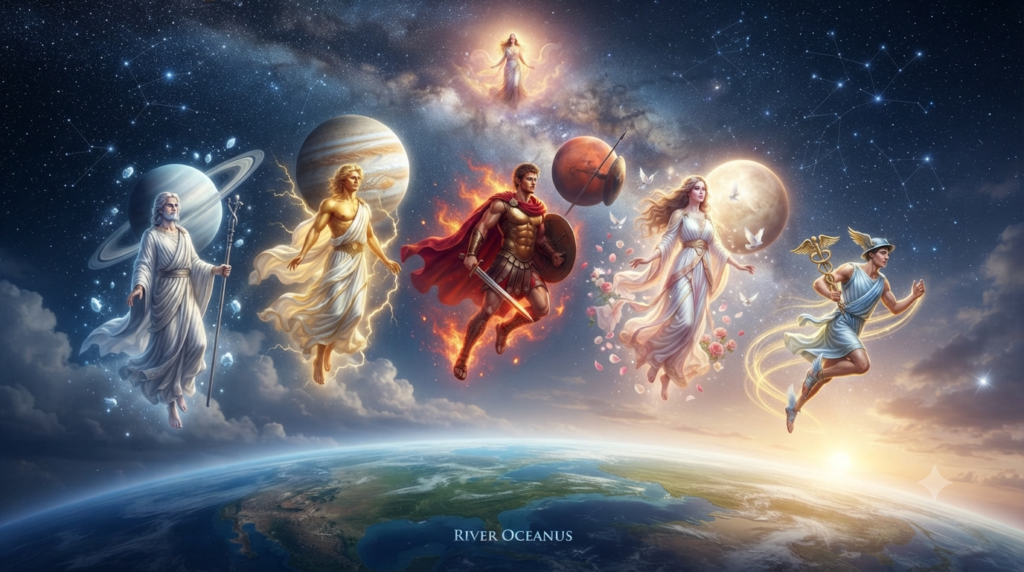
The five Astra Planeta correspond to the five planets visible to the naked eye, each with a unique name, epithet, and a specific Olympian or Titan deity with whom they were associated .
Phainon: The Shining One (Saturn)
Phainon (Φαίνων), meaning “the shining one” or “the shiner,” was the god of the planet Saturn . Its name derives from the Greek verb phainô meaning “to shine” or “to appear” . In antiquity, Phainon was recognized as the furthest of the five known planets from the Earth . Its slow, dim progress through the sky was noted, and the Greeks believed its orbit took thirty years, a close approximation to its actual period of 29.45 years .
Phainon was associated with the Titan Cronus, the father of Zeus and the king of the Titans, whom the Romans later named Saturn . As a result, Phainon was also known as Aster Kronion (the star of Cronus) . The Greeks observed its relative dimness and believed it was cold and icy due to its great distance from the sun’s heat . This led to the belief that Phainon exerted a malign influence on the world, a notion that persisted in the astrological traditions of the ancient world .
Phaethon: The Blazing One (Jupiter)
Phaethon (Φαέθων), meaning “the blazing” or “the radiant one,” was the god of the planet Jupiter . His name shares a root with the Greek verb phaethô, meaning “to shine” or “to blaze” . The Greeks knew Jupiter as the second furthest planet from Earth, and they calculated its orbit to take twelve years, very close to the actual period of 11.86 years .
Phaethon was associated with the supreme god Zeus, whom the Romans called Jupiter. He was therefore titled Aster Dios or Aster Diôn (the star of Zeus) . Unlike the distant and cold Phainon, Phaethon was observed to shine brightly, leading the Greeks to believe it existed in a temperate balance between the extremes of Saturn and Mars . Consequently, astrologers considered Phaethon’s influence to be beneficent and moderating . It is important to distinguish Phaethon, the Astra Planeta, from the more famous Phaethon, the son of the sun-god Helios, who famously lost control of the solar chariot . In some myths, the celestial Phaethon is considered the mortal son of Helios deified and placed among the stars .
Pyroeis: The Fiery One (Mars)
Pyroeis (Πυρόεις), meaning “the fiery one,” was the god of the planet Mars . His name is derived from the Greek word for fire, pyra . The Greeks were immediately struck by the planet’s distinct reddish tint, which they interpreted as a sign of heat and flame . In the Argonautica, the poet Apollonius Rhodius describes Pyroeis as emitting beautiful red beams .
Pyroeis was associated with Ares, the Olympian god of war, who was known to the Romans as Mars. He was therefore titled Astêr Areios, the star of Ares . In some traditions, Pyroeis was also said to belong to the hero Heracles (Hercules) . Given his fiery color and connection to the god of war, Pyroeis was also called Mesonyx (Μεσονυξ), meaning “midnight,” a reference to his perceived brightness in the dark night sky . Like Saturn, astrologers generally regarded Mars as a source of misfortune and a malefic influence .
Eosphoros, Phosphoros, and Hesperos: The Bringers of Light (Venus)
The planet Venus was represented not by one, but by three closely linked deities: Eosphoros, Phosphoros, and Hesperos . This is because ancient astronomers did not initially realize that the bright “morning star” and the bright “evening star” were the same celestial body . They were considered two distinct entities.
- Eosphoros (Ἑωσφόρος) means “Dawn-Bringer” . As the god of the morning star, he appeared in the sky just before the sunrise, heralding the arrival of his mother, Eos . In Homer’s Iliad, Eosphoros is described as a harbinger of light, appearing alongside Eos herself . He was also known as Phosphoros (Φωσφόρος), which means “Light-Bringer” .
- Hesperos (Ἕσπερος) means “Evening” . He was the god of the evening star, the planet Venus that appeared in the western sky after sunset . Homer describes Hesperos as the fairest star in the sky .
When the Greeks later realized that Eosphoros and Hesperos were one and the same, they were combined into a single figure. Eosphoros-Hesperos was the brightest and most beautiful of all the Astra Planeta . The planet was associated with Aphrodite, the goddess of love, whom the Romans called Venus. This made the Venus-star Aster Aphrodites . Due to its brilliance and association with the goddess of love, the planet was also linked to Juno and other mother goddesses, and was seen as a star of good fortune in astrology .
Stilbon: The Gleaming One (Mercury)
Stilbon (Στίλβων), meaning “the gleaming” or “the glittering one,” was the god of the planet Mercury . His name derives from the Greek verb stilbô, which means “to gleam” or “to glitter” . In the ancient Greek geocentric model, astronomers could not agree on the order of the planets, but Stilbon was observed to move across the sky more quickly than the other “wandering stars,” a trait that defined his character .
Stilbon was associated with the god Hermes, the messenger of the gods, who was known to the Romans as Mercury. Stilbon was thus titled Aster Hermaon, the star of Hermes . The god Hermes was known for his speed and cunning, qualities reflected in the swift movement of the planet. Interestingly, while astrologers viewed the influence of Mercury as variable, Stilbon’s swift movements were noted for their ability to herald both good and bad fortune .
The Legacy of the Astra Planeta
The Roman Adaptation and Naming of Planets
The legacy of the Astra Planeta lies in the fundamental influence they had on the naming practices of the planets in the Western world. When the Romans studied Greek astronomy, they were deeply impressed by the Greek tradition of associating these wandering stars with their pantheon of gods . However, they substituted the names of their own deities for the Greek ones, a common syncretic practice.
Thus, the Greek associations were translated into the Latin names we know today:
- Phainon (the star of Cronus) became the planet of Saturnus (Saturn).
- Phaethon (the star of Zeus) became the planet of Juppiter (Jupiter).
- Pyroeis (the star of Ares) became the planet of Mars (Mars).
- Eosphoros-Hesperos (the star of Aphrodite) became the planet of Venus (Venus).
- Stilbon (the star of Hermes) became the planet of Mercurius (Mercury) .
This Roman practice has endured to the present day, meaning that the names of the planets in most Western languages are direct descendants of the Roman deities who were associated with the Astra Planeta .
The Unknown Planets
It is also important to note what the Astra Planeta are not. The ancient Greeks, relying only on the naked eye, did not know of the planets Uranus, Neptune, and Pluto . These outer planets are invisible without a telescope and were only discovered in the modern era (Uranus in 1781, Neptune in 1846, and Pluto in 1930). The Roman convention of naming them after their own deities (Uranus, Neptune, and Pluto) follows the same tradition established by the Astra Planeta .
Frequently Asked Questions About What are the Astra Planeta, the Greek gods of the planets?
Who are the Astra Planeta in Greek mythology?
The Astra Planeta were the five gods of the “wandering stars,” or the classical planets visible to the naked eye. They were the children of the Titan Astraeus and the goddess of dawn, Eos. Their names were Phainon (Saturn), Phaethon (Jupiter), Pyroeis (Mars), Eosphoros/Hesperos (Venus), and Stilbon (Mercury) .
What does “Astra Planeta” mean?
The name “Astra Planeta” is Ancient Greek for “Wandering Stars” . This term was used because the planets appeared to move or “wander” across the night sky differently from the fixed stars, which maintained a constant pattern .
Who were the parents of the Astra Planeta?
The parents of the Astra Planeta were the Titan god of the stars, Astraeus, and the goddess of the dawn, Eos . They were the brothers of the wind gods (the Anemoi) and the goddess Astraea .
Which Olympian gods were the planets associated with?
Each planet was sacred to a specific Greek god or Titan:
- Phainon (Saturn) was associated with Cronus .
- Phaethon (Jupiter) was associated with Zeus .
- Pyroeis (Mars) was associated with Ares .
- Eosphoros/Hesperos (Venus) was associated with Aphrodite .
- Stilbon (Mercury) was associated with Hermes .
How were the Astra Planeta depicted in ancient art?
In ancient Greek vase painting, the Astra Planeta were depicted as nude youths diving into the earth-encircling river Okeanos . This represented their daily disappearance below the horizon, often shown just before the rising of the sun-god Helios .
Why are there three names for the planet Venus?
The planet Venus was originally thought to be two separate stars: the morning star (Eosphoros or Phosphoros, the “Dawn-Bringer” or “Light-Bringer”) and the evening star (Hesperos, meaning “Evening”). When the Greeks realized they were the same celestial body, the two figures were combined .
What is the connection between the Astra Planeta and the modern names of the planets?
The Romans adopted the Greek practice of associating the planets with gods. They substituted the names of their own deities for the Greek ones, leading directly to the planetary names we use today: Mercury, Venus, Mars, Jupiter, and Saturn .
Why are Uranus, Neptune, and Pluto not included among the Astra Planeta?
The Astra Planeta included only the planets visible to the naked eye. Uranus, Neptune, and Pluto are invisible without a telescope and were only discovered in the modern era. The ancients were unaware of their existence .
Conclusion
To ask what are the Astra Planeta, the Greek gods of the planets is to uncover a crucial chapter in the history of astronomy and mythology. These five divine youths—Phainon, Phaethon, Pyroeis, Eosphoros-Hesperos, and Stilbon—were the ancient Greek personifications of the wandering stars, the children of the dawn and the starry heavens. Their individual names, derived from their appearances (the shining one, the blazing one, the fiery one, the light-bringer, and the gleaming one), reflect the careful astronomical observation of the ancient world. Their association with the Olympian gods and Titans established a divine framework for understanding the cosmos, a framework that would be inherited, adapted, and immortalized by the Romans. The legacy of the Astra Planeta is written across our solar system, as their Greek divine associations live on in the Latin names of the planets we still study today, a testament to the ancient impulse to find gods in the stars and to see the movements of the heavens as a divine and narrative-driven journey.

Orin Vale has spent the better part of two decades tracing the threads that connect the world’s oldest stories — from the halls of Asgard to the banks of the Nile, from Olympus to the jungles of the Maya. What began as a childhood fascination with flood myths and trickster gods grew into years of independent study across comparative mythology and ancient religion, always chasing the same question: what did these stories mean to the people who first told them? Orin writes for readers who want more than trivia — the ones looking for the beliefs, fears, and truths that myths were built to carry.