The verdant hillsides of ancient Greece were not just the domain of mortal shepherds and farmers; they were also the sacred haunts of a vast and diverse pantheon of rustic deities. When one asks which rustic goddess does this refer to in Greek mythology, the answer is rarely a single name, for the Greek countryside was teeming with divine spirits, nymphs, and goddesses who governed every aspect of the natural world. The term “rustic goddess” encompasses a rich hierarchy of beings, from the grand Olympian goddesses of the hunt and agriculture to the legions of nature spirits who inhabited trees, springs, and pastures. This comprehensive guide will explore the identities, roles, and significance of these deities, providing a definitive answer to the question of which divine feminine figures presided over the wild and untamed landscapes of ancient Greece.
The Olympian Rustic Goddesses
While the nymphs and minor spirits formed the bulk of the rustic divine population, the Greek pantheon also included several major Olympian goddesses who were intrinsically associated with the countryside.
Artemis: The Queen of the Wild
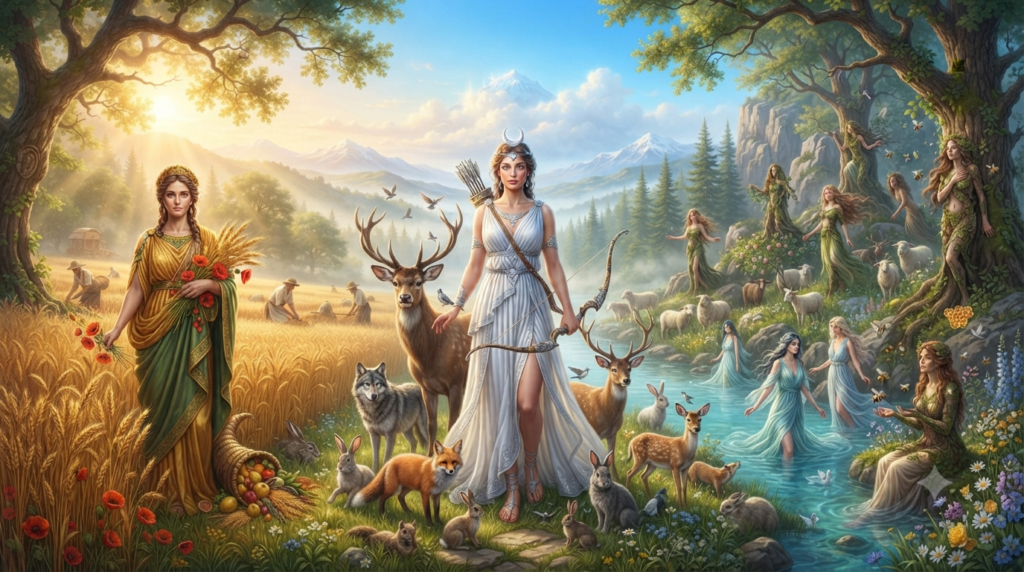
Artemis stands as the paramount Olympian goddess of the wilderness, hunting, and wild animals. Often depicted with her bow and accompanied by a retinue of nymphs, she roamed the mountains and forests, embodying the untamed spirit of nature itself . She is frequently referred to as Potnia Theron—the Mistress of Animals—a title that connects her to ancient, pre-Hellenic goddesses of the wild .
Artemis’s role in the countryside is multifaceted. She protected the young of both animals and humans, serving as a guardian of childbirth . Despite her association with hunting, she was also a protector of wildlife, maintaining a balance between the hunter and the hunted . Her connection to vegetation is also well-documented, as she was worshipped as a goddess of lush growth and the natural cycle of life . In the Peloponnese, she was especially revered near bodies of water—springs, rivers, and marshes—under epithets like Limnaea and Limnatis (Lady of the Lake) . This connection to water and vegetation placed her alongside other agricultural fertility cults, with her worship sometimes involving dances by maidens representing tree nymphs .
Demeter: Goddess of the Tilled Earth
While Artemis ruled the wild, untamed forests and mountains, Demeter presided over the cultivated countryside. As the goddess of agriculture, grain, and the fertility of the earth, she was fundamental to rural life and the cycle of the seasons . Demeter was one of the oldest gods of the Greek pantheon, inheriting her close connection to the earth from her mother, Rhea .
Demeter’s mythological identity is inseparable from the story of her daughter Persephone. The grief that caused her to withdraw from the world and create a great drought, and her subsequent joy upon the return of her daughter, explained the changing of the seasons—the death of vegetation in winter and its rebirth in spring . Her most important cult site was at Eleusis, home of the famed Eleusinian Mysteries, which promised initiates a blessed afterlife and were central to her worship . Demeter was often depicted with symbols of agriculture, such as ears of grain, poppies, a torch (signifying her search for Persephone), or a sceptre . She was paired closely with Persephone, and the duo was often simply referred to as “the Two Goddesses” . The Thesmophoria, an all-female autumn festival, was dedicated to Demeter to promote general fertility, involving rituals where pigs were thrown into pits and their remains mixed with seeds . As a goddess of the agrarian cycle, Demeter is fundamental to the concept of a rustic deity .
Other Major Rustic Deities
While Artemis and Demeter were the primary Olympian goddesses with clear rustic domains, their function was often supported by a network of other gods and minor spirits. As summarized in various sources, the “Theoi Nomioi” (Rustic Gods) fell under the dominion of three primary gods: Hermes (lord of the herds), Dionysus (god of wild vegetation), and Artemis (queen of the beasts) .
The Rustic Nymphs: Spirits of the Natural World
Beyond the major goddesses, the Greek countryside was filled with a multitude of nature spirits known as nymphs. The question of which rustic goddess does this refer to might often be answered by pointing to one of these diverse groups, as they were intimately tied to specific features of the landscape .
Dryads and Hamadryads: Tree Nymphs
Dryads and Hamadryads were the nymphs of trees and forests. The Dryads were generally tree nymphs, often specifically associated with oak trees, and were good friends with Artemis . The Hamadryads were a specific kind of dryad whose very life force was bound to a particular tree—if the tree died, the Hamadryad died as well . These spirits were the guardians and personifications of the forest, embodying the life force of the flora they inhabited.
Oreads: Mountain Nymphs
The Oreads were nymphs of mountains, valleys, and ravines. They were specifically associated with mountain-growing pine trees, and like the Hamadryads, their life was often bound to a tree . One of the most famous Oreads was Echo, the nymph who was cursed by Hera to only repeat the words of others . Another was Adrasteia, a nursemaid of the infant Zeus . These nymphs were the spirits of the high places, the rocky peaks, and the forested slopes.
Epimelides: Guardians of Pastures
The Epimelides were the nymphs of meadows and pastures. These white-haired maidens were specifically tasked with the protection of sheep flocks and fruit-trees . They are perhaps the most direct answer to the concept of a “rustic goddess,” as their role was entirely centered on the pastoral and agricultural concerns of the countryside.
Naiads: Spirits of Fresh Water
The Naiads were nymphs of fresh water—lakes, rivers, springs, marshes, and fountains . As freshwater nymphs, they were often associated with the health and fertility of the natural world, as water is the lifeblood of any landscape. They were attended to by their brothers, the Potami (river gods), and were guardians of the natural resources vital to life .
The Meliae and Hecaterides
The Meliae were rustic nymphs of the mountain ash-tree, associated with bees and honey . The Hecaterides were nymphs of the high-stepping country dance, known as the mothers of the Satyrs, Curetes, and Oread nymphs . These groups further illustrate the diversity of the nymphs, each tied to a specific aspect of the natural and cultural life of the countryside.
Other Rustic Goddesses and Spirits
The Horae and Auxesia
The Horae (Hours) were originally personifications of the seasons, making them deities of the natural cycle of growth and decay . Related to agricultural fertility, Auxesia was the Hora (Season) or Kharis (Grace) of spring growth, and was sometimes considered a title for Persephone, the goddess of spring vegetation .
Britomartis and Aura
Britomartis was a Cretan goddess of hunting, fishing, and fowling. A virgin goddess like Artemis, she was associated with the nets used in these activities . Aura was the Titan goddess of the cooling breeze and was also a virgin huntress, though she was later violated by Dionysus . These figures represent the more specialized, regional versions of the rustic goddess, often connected to specific activities or landscapes.
Gaea, Cybele, and Rhea
At a more primordial level, the earth itself was personified by Gaea, the primeval goddess of the earth . While she represented the entire planet, her domain was shared by Demeter (the fertile plains) and Rhea (the mountain wilds) . Cybele, the Phrygian mountain goddess, was identified by the Greeks with Rhea. She was a powerful Mother Goddess, worshipped with orgiastic rites and often depicted driving a chariot pulled by lions . These figures represent the earth as a divine entity, the source of all rustic life.
Frequently Asked Questions About Which rustic goddess does this refer to in Greek mythology?
Who is the main Greek goddess of the wilderness?
Artemis is the main Greek goddess of the wilderness, the hunt, and wild animals. She is frequently described as roving through mountains and forests with her bow and a retinue of nymphs, embodying the untamed aspects of nature .
What is the difference between Demeter and Artemis?
The primary difference lies in their domain. Artemis is the goddess of the wild, untamed countryside—forests, mountains, and wild animals. Demeter is the goddess of the cultivated countryside—agriculture, grain, and the fertility of the tilled earth .
What are Dryads and Hamadryads?
Dryads and Hamadryads are tree nymphs. Dryads are generally the spirits of trees and forests, while Hamadryads are a specific type whose very life force is directly bound to a single tree; if the tree dies, the Hamadryad also dies .
Who are the Epimelides?
The Epimelides are nymphs of meadows and pastures. They were specifically tasked with protecting sheep flocks, goat herds, and fruit trees, making them the most pastoral of the rustic nymphs .
What is the Eleusinian Mysteries’ connection to rustic deities?
The Eleusinian Mysteries were a secretive and important cult dedicated to Demeter and her daughter Persephone. The myth surrounding the cult explained the cycle of the seasons, making it a key religious institution for understanding agricultural fertility and the promise of a blessed afterlife .
Are there any rustic goddesses associated with bees?
Yes, the Meliae were rustic nymphs of the mountain ash-tree, associated with bees and honey. Additionally, Aristaeus, a male god of bee-keeping, was a rustic deity, and Melisseus was the old rustic god or Curete of honey and bee-keeping .
Which goddess is associated with mountain peaks and caves?
Artemis and Rhea were closely associated with mountains. Artemis roamed them freely, while Rhea was a mother goddess of the mountain wilds. The Oreads were specifically the nymphs of mountains and ravines .
What is the role of the Horae in the rustic pantheon?
The Horae were originally goddesses of the seasons, making them central to the natural cycles of growth, harvest, and decay that defined rustic life. They represented the natural order and time itself .
Conclusion
In conclusion, the question which rustic goddess does this refer to in Greek mythology unveils a rich and layered world of divine feminine power deeply connected to the land. The answer is not a single deity but a vibrant pantheon that includes the majestic Olympian Artemis, the untamed huntress and queen of the wilds, and Demeter, the nurturing mother of the cultivated earth. The countryside was also populated by a vast chorus of nymphs—the tree-dwelling Dryads, mountain-haunting Oreads, and pastoral Epimelides—each a goddess of a specific aspect of the natural world. The concept of a rustic goddess is therefore a collective one, encompassing the grand, the pastoral, and the elemental forces that the ancient Greeks believed animated their world. Their enduring presence in myth, cult, and literature continues to resonate, reminding us of a time when the divine and the natural were inextricably intertwined.

Orin Vale has spent the better part of two decades tracing the threads that connect the world’s oldest stories — from the halls of Asgard to the banks of the Nile, from Olympus to the jungles of the Maya. What began as a childhood fascination with flood myths and trickster gods grew into years of independent study across comparative mythology and ancient religion, always chasing the same question: what did these stories mean to the people who first told them? Orin writes for readers who want more than trivia — the ones looking for the beliefs, fears, and truths that myths were built to carry.