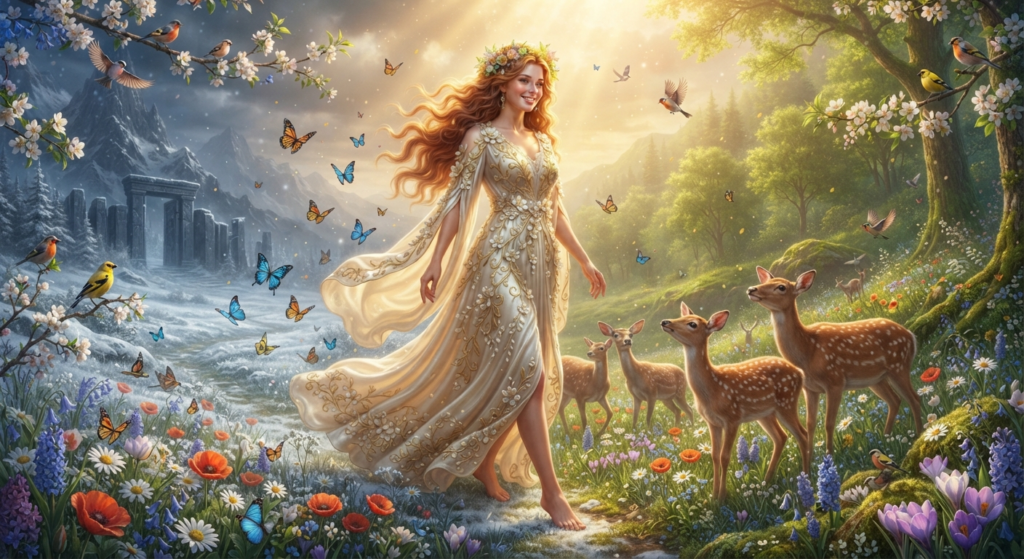
When people ask which Greek goddess is linked to spring, the name most often given is Persephone. In Greek myth, she stands at the turning point between winter’s barrenness and the return of growth, her yearly movement between the world above and the underworld shaping one of antiquity’s most enduring seasonal stories. The goddess is not a simple emblem of blooming fields alone; she is tied to renewal, fertility, loss, and return, which is why her myth has remained so influential in both literature and religious history.
Persephone and the Return of Spring
Persephone is the Greek goddess most closely associated with spring, especially in the tradition that explains the changing seasons through her cyclical descent and return. In the familiar myth, she spends part of the year in the underworld with Hades and part of the year above ground with her mother, Demeter. Her reemergence is linked to the thawing of the earth, the sprouting of grain, and the first visible signs of renewal after winter.
This connection appears most clearly in the Hymn to Demeter, where the return of Persephone brings relief to Demeter and, by extension, fertility back to the world. The myth does not describe spring in a modern botanical sense alone; it frames the season as a sacred restoration of order. Persephone becomes a figure of return, a goddess whose presence marks the land’s awakening.
Which Greek Goddess Brings Spring?
The answer is usually Persephone, though her mother Demeter is equally important in the mythic logic of the seasons. Persephone represents the living return of growth, while Demeter governs grain, harvest, and the earth’s productivity. Together they explain why spring follows winter and why the land flourishes when divine favor is restored.
Classical sources do not present a single, uniform seasonal theology. Some traditions emphasize Persephone’s annual return, while others focus more strongly on Demeter’s grief and joy as the cause of the earth’s changing fertility. Even so, when modern readers ask which Greek goddess brings spring, Persephone is the most direct answer because her ascent from the underworld is the mythic moment that signals renewal.
Persephone in Greek Myth and the Seasons
Persephone, also called Kore in her maiden aspect, appears in Greek religion as both a daughter and a queen. In older layers of the tradition, she is not merely a passive figure moved by others; she is a powerful goddess in her own right, associated with vegetation, the dead, and the hidden life of the earth. Her two names reflect two faces of the same divinity: the maiden of growing things and the sovereign of the underworld.
The seasonal interpretation of her myth became especially influential through the Homeric Hymn to Demeter, but the goddess herself was known in broader cultic settings as well. Her story gave shape to a central agricultural truth familiar to ancient Greeks: life in the fields does not vanish, but retreats below the surface before returning. Persephone embodies that hidden continuity.
Demeter, Grain, and the First Blossoms
Demeter is the goddess of grain, cultivation, and the nourishment that comes from the earth. Without her, spring would lose much of its meaning in Greek myth, because she is the power that makes the fields fruitful once Persephone returns. Her sorrow over her daughter’s absence causes famine in the Hymn to Demeter, showing how closely divine emotion and seasonal fertility are joined.
The first blossoms and fresh shoots of spring belong to Persephone’s return, but they depend on Demeter’s restored joy and willingness to let the earth bear fruit again. Ancient Greek religion often treated mother and daughter together, not as separate symbols but as complementary powers. Spring is therefore not just Persephone’s season; it is the visible result of Demeter’s recovered blessing.
The Eleusinian Mysteries and Fertility
Persephone and Demeter were central to the Eleusinian Mysteries, the most famous religious rites of ancient Greece. These rites were linked to fertility, agricultural abundance, and hopes for a blessed afterlife, though their details remained secret to initiates. What is clear from classical evidence is that the mother-daughter pair stood at the heart of a cult that connected the renewal of crops with deeper forms of sacred transformation.
Because the Mysteries were tied to the agricultural cycle, spring symbolism naturally surrounded them. Persephone’s return was not only a mythic event but also a ritual and emotional truth for worshippers who depended on the earth’s cycles. The rites at Eleusis gave religious form to the same idea found in the seasonal myth: from darkness comes return, and from concealment comes growth.
Hades, the Underworld, and Seasonal Change
Hades is the god most closely associated with Persephone’s absence, though the relationship between them is portrayed differently across sources. In the Homeric Hymn to Demeter, Persephone is taken to the underworld with Zeus’s consent, an account that emphasizes separation and loss rather than romance. Later authors, including Ovid, present the episode with their own literary emphases, but the underworld remains the realm that interrupts spring’s arrival.
The seasonal change in the myth arises from the tension between two worlds: the fertile surface and the hidden depths below. When Persephone is below, the earth lies dormant; when she returns, life rises again. Hades is therefore not a spring figure, but his domain makes spring meaningful by defining the period of absence against which renewal is measured.
Springtime Symbols in Ancient Greek Religion
Ancient Greek religion did not use a single official symbol for spring, but several images recur in connection with Persephone and Demeter. Grain stalks, flowers, torches, pomegranates, and youthful maidens appear in mythic and cultic contexts. These symbols suggest both growth and transition, especially the movement from hidden life to visible bloom.
The flower most famously linked to Persephone is the narcissus, which appears in the Hymn to Demeter as the blossom that lures her before her abduction into the underworld. That scene is not a spring festival in itself, yet it ties floral beauty to a moment of profound transformation. In Greek imagination, spring is rarely innocent; it is often a threshold season, beautiful because it marks change.
Homeric Hymns and the Myth of Renewal
The Homeric Hymn to Demeter is the most important ancient source for Persephone’s seasonal role. It tells how her seizure plunges Demeter into grief, how the world withers under divine withdrawal, and how a compromise allows Persephone to spend part of the year with her mother. This is the foundation of the myth of renewal that later readers associate with spring.
The Hymn presents renewal as negotiated rather than effortless. Persephone does not simply vanish and return in a cycle of nature; her story is bound to divine agreements, ritual memory, and cosmic balance. That complexity helps explain why she became so enduring a figure for spring, because the season itself is not constant or simple, but arrives after darkness and delay.
Persephone’s Descent and Earthly Reawakening
Persephone’s descent into the underworld is one of the most powerful myths in Greek tradition because it links death and fertility in a single image. Ancient audiences understood that the seed must be buried before it can grow, and Persephone’s subterranean sojourn gave that agricultural truth a divine story. Her return is therefore not merely seasonal; it is regenerative.
When she rises again, the world above responds with greening fields, opening flowers, and lengthening life. In some tellings, her time below is tied to the pomegranate seeds she eats; in others, the emphasis falls on Zeus’s arrangement or the necessities of fate. However the details are handled, the central pattern remains the same: descent precedes reawakening, and spring is the visible proof.
Why Persephone Became a Spring Goddess
Persephone became the Greek goddess linked to spring because her myth best expresses the logic of seasonal return. She is the maiden who comes back from the underworld, the sign that the earth’s silence is ending. Unlike a purely personified season, she unites flower, seed, loss, and rebirth in one divine figure, which gave the Greeks a powerful explanation for nature’s recurring rhythm.
Her lasting appeal lies in that duality. Persephone is both underground queen and spring maiden, both absent and present, both lamented and welcomed. In Greek myth and religious life, she does not simply represent spring as a pleasant season; she embodies the deeper idea that life can reappear after concealment, and that renewal often comes through passage into darkness first.
Persephone is the Greek goddess most closely linked to spring, though Demeter remains inseparable from the season in the larger mythic cycle. Together, mother and daughter explain the Greek understanding of fertility, seasonal change, and the return of life after winter’s stillness. Their story endured because it spoke not only to agriculture, but to a wider human experience: the expectation that what is lost beneath the earth may rise again.

Orin Vale has spent the better part of two decades tracing the threads that connect the world’s oldest stories — from the halls of Asgard to the banks of the Nile, from Olympus to the jungles of the Maya. What began as a childhood fascination with flood myths and trickster gods grew into years of independent study across comparative mythology and ancient religion, always chasing the same question: what did these stories mean to the people who first told them? Orin writes for readers who want more than trivia — the ones looking for the beliefs, fears, and truths that myths were built to carry.