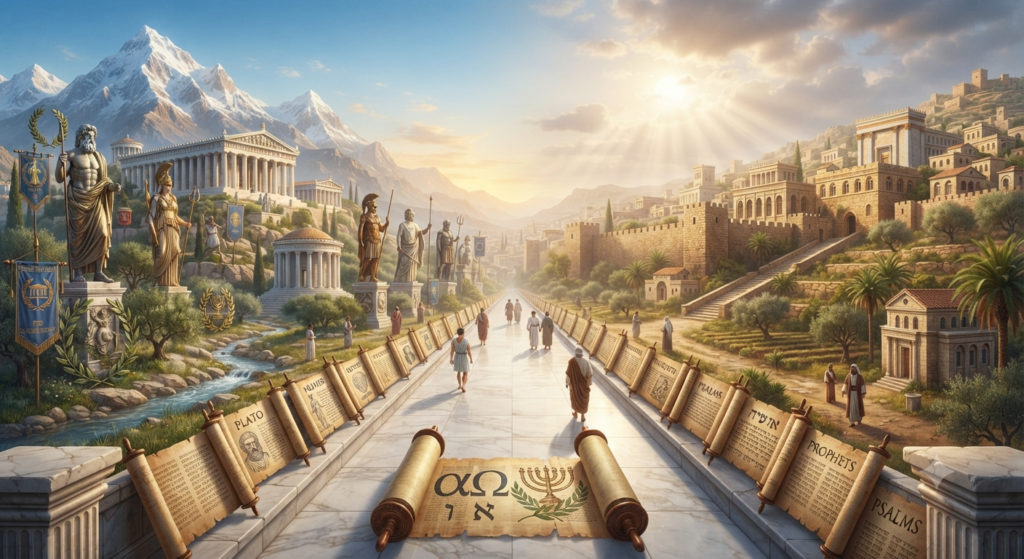
Greek mythology and the Bible belong to different religious worlds, yet they emerged from overlapping ancient landscapes where stories traveled, changed, and answered similar human questions. The Bible grew within the traditions of ancient Israel and later Judaism and Christianity, while Greek myth developed in the broader Mediterranean imagination preserved by poets such as Homer, Hesiod, and later writers like Apollodorus and Ovid. When people ask how Greek mythology relates to the Bible, the answer is not that one is simply copied from the other, but that both reflect a shared ancient culture of sacred storytelling, divine justice, creation, flood, exile, prophecy, and the struggle to understand the human place in the cosmos.
Greek Mythology and the Bible in Context
Greek mythology and the Bible are often compared because both contain narratives about gods, origins, judgment, heroes, sacrifice, and the order of the world. Yet they are not the same kind of literature. The Bible is a collection of sacred texts rooted in the religious life of ancient Israel and, later, early Christianity, whereas Greek myth belongs to a polytheistic tradition preserved through epic, hymn, drama, history, and local cult. In the Greek case, stories about Zeus, Athena, Apollo, and others do not form a single canonical scripture in the way the Bible does; they are a web of inherited traditions that sometimes agree and sometimes sharply differ.
Still, the two traditions meet in the ancient Mediterranean world, where languages, empires, and ideas moved across borders. Hellenistic Jews read Hebrew scriptures in Greek, most famously in the Septuagint, and later Christian writers used Greek philosophical and literary vocabulary to explain biblical faith. This does not erase the differences between the traditions, but it helps explain why comparisons are so common. Greek myth and biblical narrative both speak in the language of antiquity: mountains as meeting places of heaven and earth, sacred kingship, divine messengers, and a cosmos shaped by will rather than accident.
Shared Ancient Near Eastern Story Motifs
Many motifs found in both Greek mythology and the Bible are older than either tradition in its preserved form. The ancient Near East was full of stories about a divided sea, a structured cosmos, divine assemblies, sacred gardens, and catastrophic floods. The Bible shares this wider background with Mesopotamian texts such as the Epic of Gilgamesh and the Enuma Elish, while Greek myth preserves its own versions through Hesiod and later authors. Similarities, then, often point not to direct borrowing from Greek sources alone, but to a broader world of ancient storytelling.
For example, the idea of a chaotic beginning followed by order appears in both traditions. In Hesiod’s Theogony, the world begins with Chaos, and from it emerge primordial powers. In Genesis, the earth is “formless and void,” and order comes through divine speech. The pattern of a deity or deities bringing shape to an unformed world is widely shared across ancient literature. What differs is the theological frame: Greek myth imagines a divine family in conflict and succession, while Genesis presents a single sovereign God creating by command.
Creation Accounts in Genesis and Hesiod
Genesis and Hesiod offer two of the most famous creation narratives from the ancient world, but they work in strikingly different ways. Hesiod’s Theogony is not a creation of matter from nothing; it is a genealogy of divine powers. From Chaos come Gaia, Tartarus, Eros, and the generations of gods that follow, ending in Zeus’s rule over the cosmos. The world is born through descent, conflict, and succession. The gods themselves are part of the story’s fabric, and order is established after struggle among divine generations.
Genesis, by contrast, opens with a single God who creates through speech, separating light from darkness, waters from land, and filling the world with living beings. There is no divine family struggling for power in the biblical account. Even when the text uses imagery shared with neighboring cultures, it keeps creation firmly under one sovereign will. Scholars often note that both texts reflect ancient concerns about order, authority, and cosmic legitimacy, yet they answer those concerns differently. Hesiod explains the rise of Zeus’s rule; Genesis explains the goodness and purpose of creation under one God.
Flood Traditions from Noah to Deucalion
Flood stories appear across the ancient world, and the biblical account of Noah has a close Greek parallel in the myth of Deucalion and Pyrrha. In Genesis, God judges a corrupt world with a great flood, sparing Noah, his family, and the animals in the ark. After the waters recede, Noah offers sacrifice, and a covenant follows, marked by the rainbow. The story combines judgment, preservation, renewal, and divine promise.
In Greek mythology, the most familiar flood tradition is associated with Deucalion, son of Prometheus, and his wife Pyrrha. In versions preserved by Apollodorus, Ovid, and others, Zeus sends a flood to destroy a degenerate human race. Deucalion and Pyrrha survive in a chest or vessel, then repopulate the earth through a mysterious oracle that tells them to cast the “bones of their mother” behind them, which become stones and then people. The similarities to Noah are obvious, but the differences are just as important: Genesis frames the flood as moral judgment within covenant theology, while Greek versions tend to emphasize divine displeasure, survival, and the remaking of humanity through cryptic sacred speech.
Divine Councils, Angels, and Olympian Gods
One of the strongest points of comparison between the Bible and Greek mythology is the presence of a heavenly court. In the Hebrew Bible, God is often pictured presiding over a divine council, with heavenly beings such as angels or “sons of God” attending. This does not mean the Bible embraces polytheism in the Greek sense; rather, it preserves older imagery of a celestial assembly while maintaining the uniqueness of Israel’s God. Texts such as Job and Psalms reflect this world of heavenly attendants, judgment, and delegated power.
Greek mythology also centers on divine gatherings, especially the Olympian court of Zeus. The gods deliberate, send messengers, intervene in human affairs, and distribute honors and punishments. Hermes functions as a divine messenger much as angels do in biblical literature, though the theological meaning is different. In Greek myth, the gods form a family of powerful beings with competing interests; in the Bible, angels serve a transcendent creator. The resemblance lies in the imaginative structure of heaven as a realm of ordered authority, not in a shared doctrine.
Prophets, Oracles, and Sacred Revelation
Greek and biblical traditions both place great weight on revelation, but they understand its source in different ways. The Bible presents prophets as chosen spokespeople who deliver the word of God to kings, nations, and communities. Their authority comes from divine calling, and their message often includes warning, judgment, consolation, and covenant recall. From Isaiah to Jeremiah, prophecy is morally charged and historically situated, speaking to specific crises in Israel’s life.
Greek mythology and religion rely more heavily on oracles, especially those associated with Apollo, such as Delphi. Oracle speech is often cryptic, ambiguous, and open to tragic misreading. Kings and heroes seek divine guidance, but the answer may arrive in riddles or double meanings. This difference matters: biblical prophecy tends to insist on ethical clarity and covenantal accountability, while Greek oracle tradition dramatizes the instability of human interpretation. Both, however, show a world where the divine can still speak into history.
Heroes, Covenants, and the Moral Order
Biblical figures such as Noah, Abraham, Moses, and David are not heroes in the Greek sense, but they do share some narrative space with mythic champions. Greek heroes like Heracles, Perseus, and Theseus are marked by extraordinary birth, divine favor, suffering, and achievement. Yet they are often morally mixed figures, capable of bravery and violence, wisdom and recklessness. Their stories explore glory, labor, and mortality rather than covenant fidelity.
The Bible’s major figures are linked less by fame than by relationship with God. Abraham’s story centers on promise and covenant; Moses becomes mediator of law; David embodies kingship under divine judgment. The moral order in the Bible is not simply heroic success but obedience, failure, repentance, and mercy. Greek myth sometimes rewards boldness and endurance, but it rarely offers the same covenantal framework. The comparison shows two different ways of imagining the human place in a divinely ordered world: one through sacred promise, the other through struggle for honor and survival.
Hades, Sheol, and Views of the Afterlife
The afterlife in Greek mythology and the Bible is another area of partial overlap with major differences. In Greek tradition, Hades is the underworld ruled by the god of the same name, where the dead go after death. Homer’s Odyssey presents it as a shadowy realm, while later traditions distinguish regions such as the Elysian Fields or Tartarus. The afterlife can be bleak, heroic, punitive, or blessed depending on the source. It is not a single unified doctrine.
In the Hebrew Bible, Sheol is the abode of the dead, often described as a place of silence, shadow, and diminished life rather than reward or punishment in a later, fully developed sense. The biblical picture changes over time, especially in later Jewish thought, where resurrection and final judgment become more prominent. Greek and biblical traditions therefore begin with similar imagery of descent to the dead but move in different theological directions. Both testify to the ancient struggle to speak of death without modern certainty.
Law, Ritual, and Worship in Two Traditions
Greek religion and biblical religion both include ritual, sacrifice, sacred spaces, and patterns of purity, but their purposes differ. In Greek myth and cult, sacrifice maintains proper relations between humans and gods, secures favor, and confirms communal identity. Ritual is practical, reciprocal, and local. Temples, festivals, and offerings sustain the bond between a city and its divine patrons. Myth explains why the rites matter, while cult gives them lived form.
The Bible, especially in the Torah, gives ritual a more explicitly covenantal character. Law, sacrifice, purity, and holiness are tied to the identity of a people called by one God. Worship is not merely transactional; it is an expression of obedience, remembrance, and communal sanctification. Greek and biblical traditions both understand that sacred order must be enacted, not only believed. Yet the Bible’s ritual system is tied to monotheistic covenant, while Greek worship reflects a plural divine landscape of powers and local protections.
Greek Mythology’s Influence on Biblical Reading
Greek mythology did not reshape the Bible’s earliest texts, but it strongly influenced how the Bible was later read, translated, and interpreted. Once Jewish and Christian scriptures entered the Greek-speaking world, readers naturally compared biblical stories with Homeric and mythic traditions. Early Christian apologists, for instance, sometimes contrasted biblical truth with Greek myths, while others used Greek philosophical concepts to articulate biblical ideas. The result was a long conversation rather than a simple opposition.
Modern readers often notice parallels between biblical and Greek stories because both traditions address enduring human concerns: origins, suffering, authority, fate, and hope. Those parallels can illuminate each other, as long as they are handled carefully. Greek mythology helps reveal the Bible’s ancient setting and the shared narrative language of the Mediterranean world, but the Bible remains distinct in its covenant theology, prophetic voice, and monotheistic vision. Reading them together deepens understanding of both, so long as their differences are kept clear.
Greek mythology relates to the Bible through resemblance, contrast, and historical contact. Some themes are shared because both emerged from the ancient world’s common stock of sacred storytelling; others appear because later readers, especially in the Greek-speaking world, compared the two traditions and found echoes between them. Creation, flood, divine councils, prophecy, law, death, and renewal all reveal how ancient peoples gave shape to the mystery of existence.
The connection is therefore real, but not simplistic. Greek myth and biblical narrative are not interchangeable, nor do they teach the same theology. Yet side by side, they show how civilizations used story to explain the heavens, the earth, and the human condition.

Orin Vale has spent the better part of two decades tracing the threads that connect the world’s oldest stories — from the halls of Asgard to the banks of the Nile, from Olympus to the jungles of the Maya. What began as a childhood fascination with flood myths and trickster gods grew into years of independent study across comparative mythology and ancient religion, always chasing the same question: what did these stories mean to the people who first told them? Orin writes for readers who want more than trivia — the ones looking for the beliefs, fears, and truths that myths were built to carry.