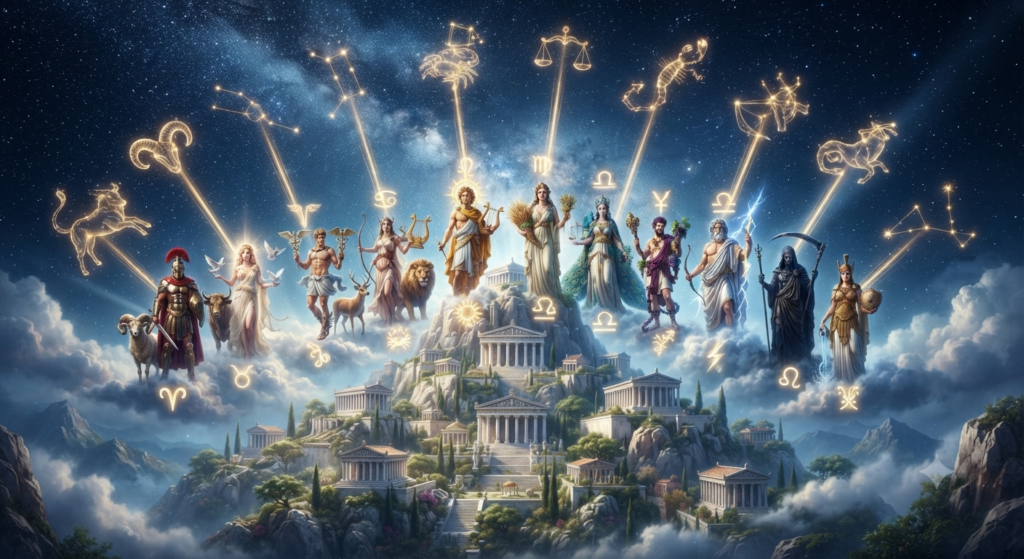
In Greek myth, the zodiac is not a single, fixed canon handed down from antiquity, but a later interpretive tradition that joined the constellations with gods, heroes, and sacred animals. Classical writers such as Hesiod, Homer, Apollodorus, and later mythographers preserve the stories from which these links were drawn, while astrologers and Hellenistic commentators shaped the symbolic pairings that became familiar in Western lore. The result is a richly layered pattern: some signs are tied to deities by shared qualities, others by explicit mythic episodes, and some by constellation lore that developed after the classical age.
Aries and Ares in Greek zodiac tradition
Aries, the ram, is often associated in modern retellings with Ares, the Greek god of war, because both evoke force, momentum, and martial energy. Strictly speaking, however, the best-attested myth behind Aries is the golden ram of Phrixus and Helle, the creature sent by divine intervention and later placed among the stars. Ares is not the ancient source of Aries in the way that Zeus is for Jupiter in Roman astrological analogy; rather, the connection is symbolic, built on the sign’s aggressive, initiating nature and the god’s own domain of battle.
Even so, the link remains culturally persistent because Ares embodies the qualities astrologers later read into Aries: impulse, courage, and confrontation. Greek myth itself rarely joins Ares directly to the ram constellation, but the broader tradition of zodiac interpretation often aligns the sign with his fiery temperament. In this sense, Aries belongs to the space where astronomical myth and divine symbolism meet, even when the classical sources keep the ram and the war god distinct.
Taurus, Aphrodite, and the bull myth
Taurus is among the clearest examples of a zodiac sign bound to a Greek mythic image, though the sign is not attached to a single god in a simple one-to-one way. The bull appears in several major stories, most famously in the tale of Zeus taking the form of a white bull to abduct Europa, a myth recorded by later authors and alluded to in ancient tradition. Taurus therefore carries the weight of divine transformation, fertility, and royal potency, all of which made the bull a powerful emblem in the Mediterranean world.
Aphrodite is sometimes linked to Taurus through modern astrological association, since the sign is often read as sensuous, artistic, and pleasure-loving. Classical myth, however, is more cautious: Aphrodite is not the origin of Taurus, though she is deeply connected to desire, beauty, and the generative force that the bull can represent. In Greek religious thought, the bull could belong to Zeus, Poseidon, Dionysus, or a local cult context; the zodiac sign absorbs these overlapping meanings rather than reducing them to a single divine owner.
Gemini and the Dioscuri in the heavens
Gemini has one of the most direct and widely recognized links in Greek mythology: the Dioscuri, Castor and Polydeuces, the twin sons associated with Sparta and later honored as stars. Ancient sources preserve varying parentage for the brothers, with Polydeuces commonly said to be the son of Zeus and Castor the son of Tyndareus, which explains their mixed mortal and divine status. Their celestial placement reflects that duality, and the constellation of the Twins became a natural fit for the zodiac sign Gemini.
The Dioscuri were revered as protectors of sailors, companions in war, and models of brotherhood bound beyond death. In some traditions, when Castor died, Polydeuces refused to enjoy immortality alone, and Zeus allowed the brothers to share existence between Olympus and Hades or to dwell together among the stars. This story gives Gemini a distinctly Greek character: not merely a sign of duality, but of loyalty, exchange, and the boundary between mortality and divine privilege.
Cancer, Hera, and the sacred crab
Cancer, the crab, is tied to the labor of Heracles rather than to a major god or goddess as the sign’s primary mythic agent. During the struggle with the Hydra, Hera sent a crab to harass Heracles, and the hero crushed it. In reward for its service, Hera placed the crab among the stars. The constellation’s Greek myth therefore comes from Hera’s hostility toward Heracles, one of the most persistent patterns in the Heracles cycle.
Hera’s role is crucial here, even though she is not “the crab goddess” in any formal sense. She acts as the divine force that animates the episode and transforms the defeated creature into a celestial sign. Cancer thus combines Hera’s intervention, Heracles’ labor, and the small but memorable dignity of an animal elevated to the heavens. In zodiac tradition, the sign’s association with protection and tenacity can be read back into this mythic scene, where even a crab becomes worthy of remembrance.
Leo and Heracles in stellar myth
Leo is linked most firmly to the Nemean Lion and to Heracles, who killed the beast in his first labor. Ancient mythographers describe the lion as an invulnerable monster that terrorized Nemea until Heracles strangled it and thereafter wore its skin as armor. The constellation and the zodiac sign preserve that triumph, turning a brutal contest into a permanent celestial emblem of strength, endurance, and kingship.
Heracles is not the lion itself, of course, but he is essential to Leo’s mythic meaning. The sign often carries the hero’s image because his labor against the lion made the creature famous across the Greek world. At the same time, the lion also retains its own royal and solar symbolism, which later astrologers emphasized when they read Leo as a sign of sovereignty and confident force. Greek tradition allows both readings: the defeated beast and the hero who mastered it.
Virgo, Demeter, and maiden symbolism
Virgo is more complicated than many sign-to-deity pairings because ancient sources connect the maiden figure with several goddesses and goddess-like figures, not only one. In Greek and Hellenistic tradition, Virgo is often associated with Demeter, Persephone, or Astraea, depending on the interpretive framework. Demeter’s role is especially strong when Virgo is understood through themes of grain, harvest, and the female presence that governs the earth’s fertility.
Demeter’s link to Virgo rests less on one specific myth than on symbolic resemblance. The maiden of the zodiac can suggest the ordered abundance of cultivated land, the careful labor of sowing and reaping, and the dignified reserve that ancient readers associated with fertility properly directed. Some traditions prefer Persephone, the daughter of Demeter, because she bridges the world above and below; others use Astraea, the virgin of justice, for a more moral and cosmic reading. Virgo is therefore a constellation of meanings rather than a single fixed goddess.
Libra and Themis in Greek astrology
Libra, the scales, is often connected with Themis, the Titaness of divine law, order, and custom. Though Libra as a zodiac sign is a later astrological development in relation to the Greek constellation tradition, Themis became the natural emblem for balance and just proportion. Her role in myth as an upholder of lawful order made her a fitting personification for scales, even if the sign’s astronomical history also intersects with the claws of Scorpio in older star lore.
Themis embodies a principle rather than a dramatic narrative, and that is exactly why she suits Libra. Greek thought often treated justice as measured arrangement: proper place, proper time, proper limit. In that sense, Libra expresses a Hellenic ideal of symmetry and settled order, with Themis as its divine face. The association is less about a single episode and more about the ancient imagination linking celestial balance with ethical balance.
Scorpio, Artemis, and the hunt motif
Scorpio is associated in myth with the great scorpion sent to kill Orion, though the exact divine sender varies by source. Some traditions name Artemis, others Apollo, and still others leave the agent implicit. In the version where Artemis is involved, she stands within the hunt motif that defines Orion’s mythic world: the hunter, the wild beast, and the divine power that restrains human overreach. The scorpion’s rise to the heavens becomes a starry answer to Orion’s arrogance or violence, depending on the telling.
Artemis fits Scorpio not because she is the scorpion itself, but because she presides over the untamed spaces in which such creatures belong. As goddess of the hunt, wilderness, and the moon, she governs the boundary between civilization and the wild. The sign’s intensity and hidden force later became part of its astrological meaning, but in Greek myth the emphasis lies on danger, pursuit, and the stern logic of divine correction. Scorpio therefore carries the shadow of a hunt story in which even the stars preserve an ancient conflict.
Sagittarius and Chiron among the centaurs
Sagittarius is usually linked to a centaur, and in Greek tradition the most significant centaur associated with wisdom and medicine is Chiron. Unlike the violent or drunken centaurs of many myths, Chiron is civil, educated, and capable of training heroes such as Achilles, Jason, and Asclepius. That said, the figure of Sagittarius in ancient star lore is not always identical with Chiron; some traditions imagine a more general bow-wielding centaur, while later readers often merged the constellation with the noble teacher.
Chiron’s importance lies in the way he transforms the centaur image from brute nature into disciplined knowledge. He is wounded, immortal, and tragic, and his eventual placement among the stars reflects both his suffering and his usefulness to gods and heroes alike. Sagittarius, under this reading, becomes a sign of aim, instruction, and pursuit, shot through with the paradox of a creature half-wild and half-wise. The constellation’s arrow and horse-body preserve that tension beautifully.
Capricorn, Pan, and sea-goat imagery
Capricorn is traditionally associated with the sea-goat, a composite figure whose Greek mythic background often includes Pan. In one well-known version, Pan flees the monster Typhon and leaps into the water, transforming only partly before escaping; this account, preserved by later sources, helped explain the goat-fish shape that zodiac tradition adopted. The image is not simply decorative. It expresses survival, metamorphosis, and the crossing of boundaries between land and sea, body and spirit.
Pan is a fitting figure for Capricorn because he belongs to the wild margins of the world: mountains, pastures, and untamed places. Yet Capricorn’s sea-goat form also reaches beyond Pan’s rustic domain into the realm of cosmic symbolism. Greek mythology often leaves room for such layered creatures, where a god’s escape or transformation becomes the basis for a celestial sign. Capricorn therefore stands as one of the zodiac’s most hybrid images, joining terror, adaptability, and the ancient power of metamorphosis.
The Greek zodiac is best understood as a conversation between myth and later celestial interpretation. Some signs, like Gemini and Leo, preserve stories that are strongly anchored in classical sources; others, like Libra and Capricorn, reflect the way Greeks and later astrologers read divine qualities into the sky. The gods and goddesses linked to the zodiac are not always the literal inventors of the constellations, but they give those signs their symbolic depth.
Taken together, these associations reveal how deeply Greek myth imagined the heavens as a living archive. Warriors, maidens, hunters, judges, and shapeshifters all found a place among the stars, whether as constellations, divine emblems, or stories explained after the fact. That is why the zodiac remains so compelling in Greek tradition: it is not only a system of signs, but a mythic map of power, beauty, struggle, and transformation.

Orin Vale has spent the better part of two decades tracing the threads that connect the world’s oldest stories — from the halls of Asgard to the banks of the Nile, from Olympus to the jungles of the Maya. What began as a childhood fascination with flood myths and trickster gods grew into years of independent study across comparative mythology and ancient religion, always chasing the same question: what did these stories mean to the people who first told them? Orin writes for readers who want more than trivia — the ones looking for the beliefs, fears, and truths that myths were built to carry.