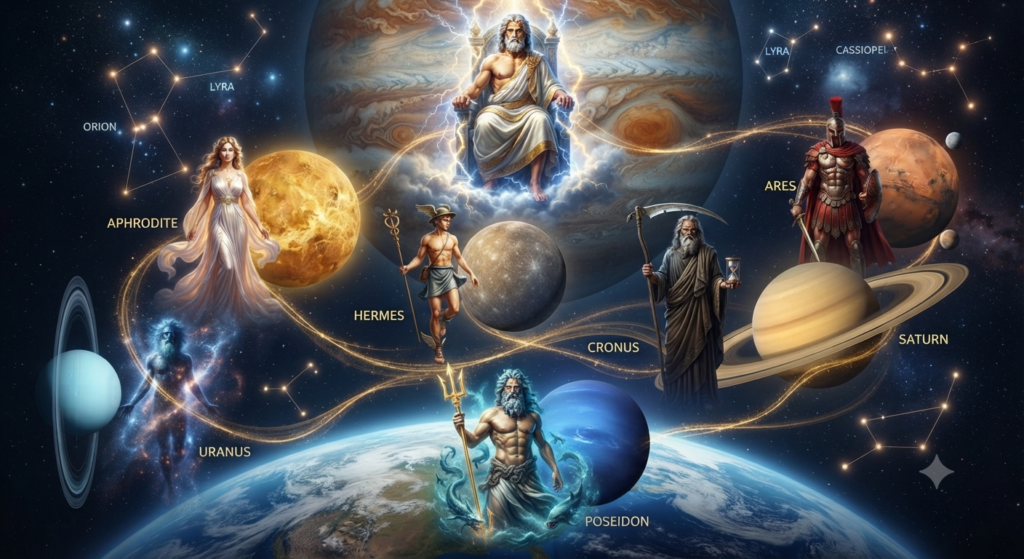
The Greek gods most often associated with the planets are the Olympian figures whose names later entered Roman planetary tradition: Helios with the Sun, Selene with the Moon, Hermes with Mercury, Aphrodite with Venus, Ares with Mars, Zeus with Jupiter, and Kronos with Saturn. Strictly speaking, the familiar planetary names used in modern astronomy are Roman, not Greek, yet the Greeks had already linked these wandering lights to divine powers long before the Latin names became standard. In Greek religion and literature, the sky was never a blank map. The planets moved with intention in the imagination of poets, philosophers, and astronomers, each one carrying traces of a god’s character, function, or cosmic rank.
Planetary Gods in Greek Myth and Astronomy
In early Greek thought, the “planets” were the wandering stars, visible lights that moved against the fixed constellations. Greek astronomers and poets did not always assign them the same divine names at the same time, but they did place them within a religious cosmos shaped by divine order. The strongest and most durable associations were established in the Hellenistic era, when Greek astronomy, Babylonian influence, and later Roman naming traditions converged. The result was a symbolic system in which each visible body reflected a divine presence.
This alignment was not simply decorative. It fit a broader ancient habit of reading the heavens as a moral and mythic order. The brightest and most easily tracked celestial bodies were matched with gods whose powers seemed to echo their behavior: the Sun with radiance and life, the Moon with nightly change, Mercury with speed, Venus with beauty, Mars with conflict, Jupiter with kingship, and Saturn with age and time. The names survived because they made the heavens legible through myth.
Helios, Sun Power, and the Solar Tradition
Helios is the Greek solar god most directly associated with the Sun. In Homer and Hesiod, he is the radiant divine driver who traverses the sky each day in his chariot, seeing and illuminating all things. Hesiod’s Theogony places Helios among the Titan-descended powers, while later poetry and hymn tradition deepen his role as the eye of the world. In myth, he is not merely a symbol of sunlight but a god with witnessing power, capable of seeing hidden deeds and swearing oaths by his own brilliance.
Greek tradition also distinguished Helios from Apollo, even though later periods often blurred them. Apollo became strongly solar in later literature and art, but in the earlier sources Helios remains the proper personification of the Sun itself. This distinction matters for planetary symbolism, because the solar body was not originally tied to Apollo in the same direct way as it later was in popular imagination. When Greek and Roman cosmology matured, Helios continued to stand behind the Sun as its true divine counterpart.
Selene and the Moon’s Nightly Dominion
Selene is the Greek goddess associated with the Moon. In the Homeric Hymn to Selene, she is described as the shining power who rides across the night sky, her light soft but commanding. Like Helios, she belongs to the older divine order of cosmic lights, and her visible change through the month made her an especially vivid presence in ritual and poetic time. The Moon was not only a marker of nights, but of months, festivals, fertility cycles, and the measured rhythm of ancient calendars.
Selene’s mythic identity also overlaps with later lunar figures such as Artemis and Hecate in some traditions, though these are not identical gods. Artemis could be imagined with lunar qualities, especially in later Greek and Roman art, but Selene is the primary personification of the Moon in the classical mythic register. Her nightly course made her the clear divine match for the lunar body, one of the most constant and emotionally resonant heavenly lights in ancient life.
Hermes and the Swift Planet of Mercury
Hermes is the Greek god associated with Mercury, the swiftest visible planet. The association rests on shared qualities: speed, mobility, intelligence, and a capacity to move between different realms. Hermes is the divine messenger in Homer, the guide of travelers, the protector of roads and crossings, and the patron of eloquence, cunning, and exchange. His movement is liminal and rapid, which made him a natural fit for the quick, erratic motion of Mercury against the stars.
The planetary identification became especially clear in Hellenistic and Roman astral lore, where the planet Mercury was understood through Hermes’ and later Roman Mercurius’ character. Ancient observers noticed that Mercury stays close to the Sun and appears only briefly, a fitting celestial pattern for a god who arrives, conveys, and departs. The planet’s elusive visibility matched Hermes’ mythic profile better than any other Greek deity’s.
Aphrodite, Love, and Venus in the Sky
Aphrodite is the Greek goddess associated with Venus, the most brilliant planet in the night sky after the Sun and Moon. Her connection to the planet is deeply rooted in beauty, desire, allure, and the power of attraction. In Hesiod’s Theogony, Aphrodite emerges from the sea, a dramatic origin that already sets her apart as a force of dazzling appearance and irresistible presence. Her heavenly counterpart was naturally seen as the star-like body that shines with unmatched brightness before dawn and after sunset.
In Greek astronomical and philosophical tradition, Venus was often treated as Aphrodite’s planet, while her Roman counterpart Venus eventually became the standard planetary name in Latin culture. The association is one of the most stable in the ancient world because the planet’s visual character aligns so well with the goddess’s domain. Aphrodite presides over union, longing, and the enchanting force that draws beings together, and Venus in the sky seemed to embody that same luminous persuasion.
Ares and Mars: War Across Cultures
Ares is the Greek god associated with Mars, the red planet whose color and motion invited warlike interpretation. Ares is the personification of battle in its raw, violent form, unlike Athena, who represents strategic warfare and disciplined intelligence. In Homer’s Iliad, Ares appears as turbulent, blood-driven, and often disastrous even when he is divine. He is not a noble war god in the modern sense of honor alone; he is war’s destructive pulse, its fear and frenzy.
The planet Mars, with its reddish hue, was naturally linked to war across several ancient cultures, and the Greeks recognized that symbolism through Ares. Although the Roman name Mars became dominant in later astronomy, the Greek identification remained clear in interpretive tradition. The planet’s reddish appearance suggested blood, fire, and conflict, and Ares was the deity whose presence best matched that visual impression. In that sense, the link is both astronomical and psychological: the sky offered a color, and myth supplied a character.
Zeus and Jupiter in Mythic Kingship
Zeus is the Greek god associated with Jupiter, the largest planet and the one most closely linked with sovereignty. Zeus is the king of the gods in Homer, Hesiod, and later Greek tradition, ruling from Olympus with authority over weather, oath, justice, and divine hierarchy. His importance in myth makes him the natural counterpart to the greatest and most commanding of the visible planets, the one that ancient observers would have recognized as unusually bright and stately.
Jupiter’s planetary identity was formalized in Greco-Roman cosmology, where Zeus and Jupiter became nearly interchangeable in celestial symbolism. The association is not based on speed or color, but on rank and scale. As ruler of heaven and dispenser of order, Zeus corresponds to the planet that ancient thinkers regarded as majestic among the wandering stars. The link reflects a cosmology in which size, brightness, and political power were read together.
Kronos, Saturn, and Ancient Timekeeping
Kronos is the Greek god associated with Saturn, the slow-moving outer planet named for the Roman Saturn. In Greek myth, Kronos is a Titan, father of Zeus and one of the central figures in the succession myths preserved by Hesiod. He is not the same as Chronos, the personification of time, though later traditions sometimes blurred the two. That confusion helped Saturn acquire a strong connection with age, duration, and the measured passing of time.
The planet Saturn’s slow motion made it an obvious emblem of patience, lateness, and antiquity. In Roman culture Saturn also carried agricultural and temporal associations, and Greek interpretation absorbed those qualities around Kronos. Because the planet moves more slowly than the others visible to the naked eye, it seemed like the most ancient and distant of the familiar wandering lights. Kronos, a deposed ruler from an older divine age, fit that celestial role with remarkable force.
Why Greek Gods Guided Planetary Names
Greek gods guided planetary naming because myth gave structure to observation. The wandering lights were not random points of brightness; they were part of an ordered cosmos that invited interpretation. When Greek scholarship met Babylonian astronomy and later Roman naming practice, divine names became a way to classify the heavens according to recognizable powers. The planets were mapped onto gods whose qualities corresponded to their appearance, motion, and symbolic force.
This was also a cultural inheritance. Greek religion did not create the later Roman planetary names in their final form, but it provided the mythic vocabulary that made such naming meaningful. The planet of speed became Hermes, the planet of beauty became Aphrodite, the planet of war became Ares, and so on. These links endured because they joined astronomy to story, turning abstract motion into divine personality.
Classical Sources Behind the Planetary Links
The classical sources do not always present a neat, single table of planetary gods, but they supply the building blocks of the tradition. Hesiod, Homer, and the Homeric Hymns establish the major divine figures: Helios, Selene, Hermes, Aphrodite, Ares, Zeus, and Kronos. Later authors and commentators, especially in Hellenistic and Roman-era contexts, connect these gods to the visible planets more explicitly. Scholars reconstruct the associations from this layered evidence rather than from one single canonical source.
That is why the Greek planetary system should be understood as a tradition of convergence rather than a list handed down unchanged from the earliest myths. The gods were older than the planets’ names, yet the names became powerful because they matched deep mythic patterns already present in Greek thought. Classical astronomy and mythology together created a sky that was not merely observed, but interpreted.

Orin Vale has spent the better part of two decades tracing the threads that connect the world’s oldest stories — from the halls of Asgard to the banks of the Nile, from Olympus to the jungles of the Maya. What began as a childhood fascination with flood myths and trickster gods grew into years of independent study across comparative mythology and ancient religion, always chasing the same question: what did these stories mean to the people who first told them? Orin writes for readers who want more than trivia — the ones looking for the beliefs, fears, and truths that myths were built to carry.