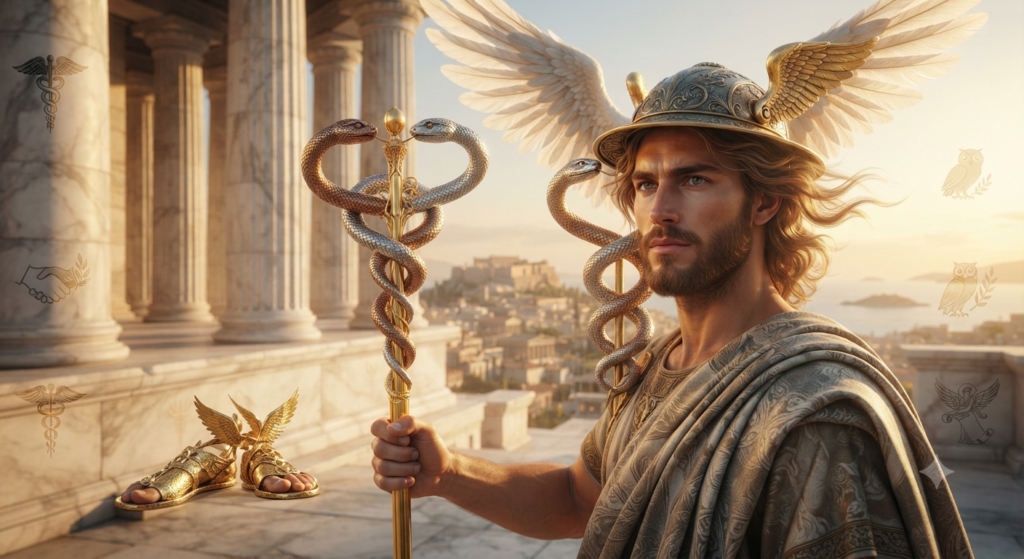
The Kerykeion is the herald’s staff associated above all with Hermes, the Greek god of messengers, boundaries, travel, commerce, and cunning intelligence. In later Greek and Roman art it is often called the caduceus, and it appears as a slender staff or wand marked by two serpents and sometimes topped with wings. Though it is widely recognized today, its ancient meaning is more specific than modern popular use suggests: it signaled the authority, safety, and diplomatic status of the divine herald who carried it.
Kerykeion Explained: Hermes’ Sacred Herald’s Staff
The Greek word kerykeion comes from keryx, meaning “herald,” and the object is therefore best understood as the staff of a herald rather than a generic magical wand. In the Homeric Hymns and later literature, Hermes is repeatedly presented as a divine messenger who moves between worlds, carrying messages, guiding souls, and crossing limits that ordinary mortals cannot. The staff belongs to that office: it is a token of sanctioned movement and recognized authority.
In myth, the kerykeion is not merely decorative. It marks Hermes as one who can enter contested spaces without immediate violence, because the staff itself signifies safe conduct. This is one reason it became associated with negotiation and reconciliation in both mythic and civic imagination. Its power is symbolic, but ancient symbolism carried real weight in ritual, diplomacy, and public ceremony.
Caduceus Symbolism in Greek Myth and Ritual
In Greek thought, symbols were rarely empty emblems. The caduceus embodied several linked ideas at once: peace, mediation, lawful communication, and the crossing of boundaries. Hermes, as psychopompos and messenger, stood between gods and humans, life and death, city and wilderness, trade and theft. The staff reflects that liminal role, making visible a deity whose authority lies in movement rather than permanence.
Ritual and myth often reinforce one another in the Greek world, and the kerykeion belongs to that pattern. A herald bearing it could speak in the name of a ruler or city, and the staff thus came to stand for protected speech and temporary immunity. Ancient audiences would have recognized in it not only Hermes’ divine prerogative but also the social order that made communication across enmity possible.
Hermes, Messenger of the Gods, and His Emblem
Hermes is among the most versatile gods in the Greek pantheon. In Homer, he is a swift divine helper who carries commands, escorts souls, and intervenes with tact or trickery depending on the need. His emblem fits this character precisely: the staff identifies him as a bearer of messages, but also as a figure who can open pathways and close them.
The kerykeion is one of several signs by which Hermes is recognized, alongside the petasos hat, winged sandals, and traveling cloak in later art. Yet the staff is especially important because it concentrates his office into a single object. Where other attributes suggest speed or movement, the kerykeion suggests authority to speak, to negotiate, and to pass unharmed through thresholds that might otherwise resist entry.
The Serpents and Wings of the Kerykeion
The two serpents are the most striking feature of the caduceus as commonly imagined today. Ancient explanations vary, and not every early source describes the staff in the same way, but serpent imagery is deeply rooted in Greek symbolism. Snakes could indicate renewal, alertness, chthonic power, or the dangerous knowledge that attends boundary-crossing. Wrapped around Hermes’ staff, they evoke the controlled union of opposing forces.
Wings appear in many later artistic depictions, though they are more closely associated with Hermes himself than with the earliest literary descriptions of the staff. Their presence reinforces speed and the passage between realms. Together, serpents and wings make the kerykeion a visual shorthand for motion, mediation, and supernatural authority, which is why the emblem remained so enduring in Greek and Roman imagination.
Origins of the Herald’s Staff in Ancient Sources
The earliest literary evidence for Hermes’ staff is not always as elaborately described as later art might suggest. In Homeric and Homeric Hymnic material, Hermes is already marked by the prerogatives of a divine messenger, and his staff belongs to that role even when the imagery is spare. Later authors, including Apollodorus and Ovid, preserve the staff as a standard attribute, showing that it had become firmly established in classical tradition.
Ancient sources also distinguish the kerykeion from purely decorative mythic objects by linking it to public function. A herald’s staff existed in real Greek civic life, not only in divine story, and that practical background matters. The mythic staff of Hermes likely draws strength from this social reality, elevating a recognizable instrument of authority into a divine emblem of passage and speech.
Kerykeion in Trade, Peace, and Safe Passage
Hermes was not only a messenger but also a god of trade, exchange, and the movements that connect distant places. The kerykeion therefore became a symbol of commercial trust as much as of speech. In a world of travel by sea, road, and caravan route, safe passage was precious, and Hermes’ emblem suggested protection for those who moved goods, carried news, or negotiated between communities.
The staff also belongs to the language of peace in a broader sense. Not peace as absence of conflict alone, but peace as the temporary suspension of hostility that allows exchange to happen. When Greek and Roman audiences saw the caduceus, they could read in it the promise that a messenger might cross a battlefield, or that two parties might meet under a recognized sign of truce.
Distinguishing Hermes’ Staff from Asclepius’ Rod
One of the most persistent confusions in later tradition is the mixing of Hermes’ kerykeion with the rod of Asclepius, the healing god. These are not the same symbol. Asclepius’ staff is a single serpent-entwined rod and is associated with medicine and healing, while Hermes’ caduceus generally has two serpents and sometimes wings. The distinction is important in both mythological and historical terms.
The confusion grew in modern periods when the caduceus was adopted in some medical contexts, especially in commercial or institutional emblems, despite its older association with Hermes rather than healing. Classical sources do not support treating the two staffs as interchangeable. Their meanings differ: Asclepius represents cure and restoration, while Hermes’ staff signifies heraldic authority, mediation, and passage across thresholds.
The Caduceus in Roman, Hellenistic, and Later Art
In Hellenistic and Roman art, Hermes was increasingly standardized in visual form, and the caduceus became one of his most recognizable attributes. Artists used it to make the god immediately legible: a youthful figure, often in motion, with the staff announcing his role before any inscription was needed. The emblem also spread beyond mythological scenes into decorative and civic contexts.
Later art and symbolism inherited this visual language, though often with shifts in meaning. Roman Mercury, the counterpart of Hermes, retained the staff as a central attribute, and Renaissance and neoclassical artists continued the tradition. Over time, the caduceus became detached from its original mythic setting and began to function more broadly as a sign of commerce, communication, and, in some cases, mistaken medical symbolism.
Mythic Gifts, Authority, and Divine Protection
In Greek myth, divine gifts often mark the transfer of function or power, and the kerykeion is no exception. Hermes’ staff is less a weapon than a credential, indicating that the bearer has legitimate access to spaces and conversations others cannot enter. Its value lies in authority granted by the gods, not in brute force.
That authority also implies protection. A herald carrying the staff is not merely speaking; he is safeguarded by the office he represents. For Hermes, this becomes part of his mythic identity as a god who protects travelers, guides the dead, and mediates between realms. The staff thus condenses a whole theology of movement under divine sanction.
Why the Kerykeion Endures as a Greek Symbol
The kerykeion has lasted because it is both simple and layered. At first glance it is just a staff with serpents; in Greek myth, it becomes a visual expression of everything Hermes governs: speech, exchange, travel, negotiation, and transition. Few symbols capture the Greek fascination with liminal power so clearly.
Its endurance also comes from its adaptability. Across centuries, the caduceus has remained recognizable even as cultures changed the contexts in which they used it. Yet its deepest meaning still belongs to Hermes: the swift messenger whose authority rests not on domination, but on the right to move between worlds and make passage possible. The Kerykeion survives as more than an image of ancient ornament. It is a compact symbol of the Greek imagination, where a staff could signify protection, speech, and lawful crossing all at once. Linked to Hermes and his Roman counterpart Mercury, it remains one of the most enduring emblems of divine mediation in the classical world.

Orin Vale has spent the better part of two decades tracing the threads that connect the world’s oldest stories — from the halls of Asgard to the banks of the Nile, from Olympus to the jungles of the Maya. What began as a childhood fascination with flood myths and trickster gods grew into years of independent study across comparative mythology and ancient religion, always chasing the same question: what did these stories mean to the people who first told them? Orin writes for readers who want more than trivia — the ones looking for the beliefs, fears, and truths that myths were built to carry.