In Greek mythology, horses stand close to divine power, royal prestige, and untamed motion. Some gods are direct patrons of horses and horsemen, while others are linked to them through myth, epithet, sacred animals, or the symbolic force of speed and mastery. The clearest associations belong to Poseidon, who was worshipped as horse-maker and horse-controller under the epithet Hippios, but the equine thread also reaches Demeter, Zeus, Apollo, Ares, Artemis, Hermes, the Dioscuri, and local cult traditions that preserved older horse worship.
The Greek pantheon does not treat horses as a single divine attribute in the modern sense. Instead, horse imagery appears in chariot myths, cult titles, battlefield scenes, hunting lore, and regional rites. Some deities command stallions and mares, some ride in chariots drawn by them, and some are invoked as protectors of horsemen. Together, these figures reveal how deeply horses belonged to the sacred imagination of the ancient Mediterranean world.
Horse-Riding Gods in Greek Myth and Cult
Horses were never merely practical animals in Greek culture; they were symbols of nobility, force, and the boundary between civilization and wilderness. That is why several gods are linked to them in different ways, from direct ownership of sacred horses to the use of horse-drawn chariots and the protection of riders. Among the Olympians, Poseidon stands out most strongly, but he is not alone. The myths preserve a wider divine network in which horses appear as markers of power, speed, fertility, and martial authority.
This association also reflects the regional nature of Greek religion. A deity could be especially horse-connected in one sanctuary or city while playing a different role elsewhere. Epithets such as Hippios, cult images of mounted gods, and local legends about divine steeds all show that horses belonged to the lived religion of the Greek world, not only to epic poetry. When asking which Greek gods are associated with horses, the answer is therefore both specific and varied: some are primary horse gods, while others are horse-linked through function, symbol, or cult.
Poseidon Hippios and the Sea Stallions
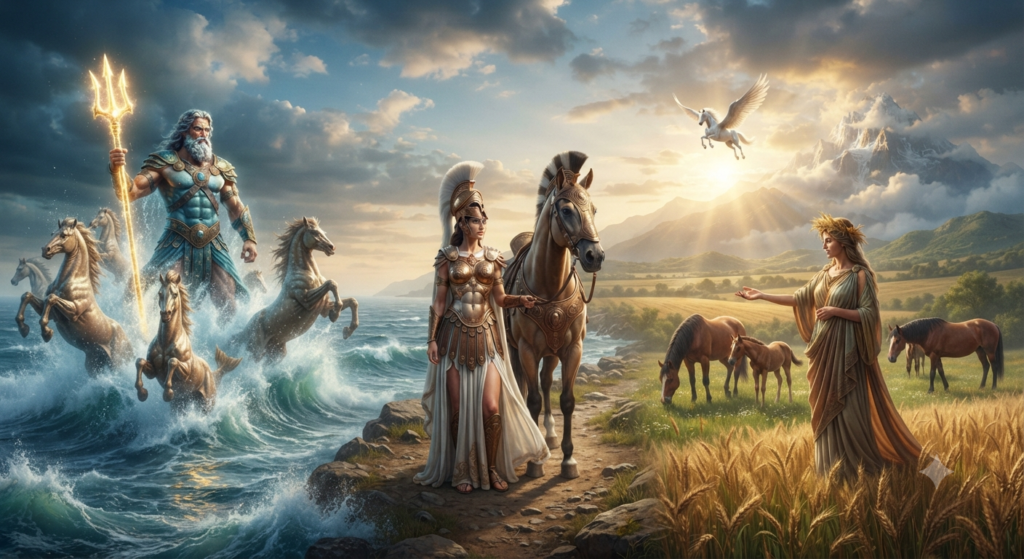
Poseidon is the strongest Greek god of horses. In addition to ruling the sea and earthquakes, he was worshipped as Poseidon Hippios, “Poseidon of Horses.” Ancient tradition often explains this connection by making him the creator of the horse itself. One well-known genealogy says that Poseidon produced the first horse, and in several myths he fathers famous divine or heroic horses, including the extraordinary steeds Arion and Pegasus in different traditions. Homer and later writers repeatedly connect him with equine power.
The association is not accidental. Poseidon’s domain includes force that cannot be easily contained, and the horse embodied precisely that kind of energy for the Greeks. He was also linked to chariot racing and to the taming of wild land through mounted mastery. In some cult settings, especially in coastal and horse-breeding regions, Poseidon’s power over horses could be as important as his rule over the sea. His epithet Hippios captures this older, broader identity: not just a sea god, but a divine lord of stallions.
Demeter Erinys and the Divine Mare Form
Demeter is not usually the first goddess people associate with horses, yet ancient myth gives her a striking equine aspect. In Arcadian tradition, she is called Demeter Erinys, and one version of the story tells how she took the form of a mare while fleeing Poseidon. To escape pursuit, she concealed herself among the horses of King Onkios, but Poseidon discovered her and united with her in horse form. From this union came the divine horse Arion and, in some accounts, a daughter whose name is given as Despoina or another local figure depending on the source.
This myth shows Demeter in a severe and archaic light, far removed from the more familiar harvest goddess. Her horse-form is tied to ancient fertility and transformation, where divine power can appear as animal life. In Arcadian cult, these motifs were preserved with unusual intensity, and local rites likely reflected a much older religious layer than the pan-Hellenic Olympian picture. Demeter’s connection to horses is therefore real, but specialized: she is a mare-goddess in a mythic and cultic sense, not a general patron of horsemanship.
Zeus, Thunder, and the White Sacred Horse
Zeus is not a horse god in the same direct way as Poseidon, yet he is occasionally linked with horses through sacrifice, cult symbolism, and the royal imagery of his chariot in later tradition. As supreme sky god, Zeus stands above the animal world, but horses often appear in his sphere because they are among the most prestigious sacrificial and ceremonial animals. White horses, in particular, could belong to a realm of brightness, sovereignty, and elevated divine display.
The connection is less systematic than in Poseidon’s case, and classical sources do not present Zeus as the maker of horses. Still, horse imagery can gather around him in hymnic and cultic language where divine kingship is emphasized. In some local practices, magnificent horses may be offered or associated with the god of authority and order. Zeus is therefore best understood as a deity to whom horses can be symbolically attached, especially when they represent magnificence, sacrifice, or the visual splendor of power.
Apollo’s Chariot and Solar Equine Power
Apollo is commonly associated with a chariot, and that image naturally brings horses into his orbit. In later poetic and artistic tradition, the god of light and order travels across the sky in a radiant vehicle drawn by horses, especially in solarized imagery. This is not always the oldest layer of Apollo’s myth, but it became one of the most enduring visual conventions attached to him. His equine connection is therefore strong in art and later reception, even when the earliest sources emphasize his arrows, lyre, and prophecy more than horse-breeding.
There is also a practical and cultic dimension. Apollo was invoked in relation to purification, roads, colonies, and movement, all of which can align with horse transport and swift passage. His chariot does not make him a horse deity in the same sense as Poseidon, but it places him among the gods whose power is expressed through controlled speed. The horses of Apollo are not wild stallions; they are ordered, luminous, and disciplined, fitting his role as a bringer of measure and harmony.
Ares, War Horses, and the Battlefield
Ares is inseparable from the violence of the battlefield, and in Greek imagination the battlefield often included war chariots and the horses that pulled them. Homer repeatedly places Ares amid the din of combat, where horses and men fall together under the pressure of divine fury. Although Ares is not primarily a horse god, his presence is frequently accompanied by equine imagery because mounted warfare was one of the most visible forms of martial force in the ancient world.
His association with horses is therefore functional rather than mythic in the strictest sense. Ares embodies battle, and horses are one of battle’s essential instruments. In later artistic traditions, he may appear in chariots or with martial steeds, emphasizing speed and destructive momentum. The link is less about breeding or sacred horse cult and more about the warhorse as an extension of violent power. For that reason, Ares belongs among the Greek gods associated with horses, though not among the strongest of them.
Artemis and the Wild Mares of the Hunt
Artemis is frequently shown with deer, hounds, and the wild landscapes of the hunt, yet horses also enter her sphere through speed, wilderness, and untamed female animality. In some local traditions and artistic scenes, she is connected with swift movement and with the keeping of wild creatures beyond human control. While she is not a horse goddess in the direct cultic sense, her domain overlaps with the mare as a symbol of independence and natural force.
Greek myth also preserves stories where Artemis’s followers, especially in more local or archaic cult settings, appear in contexts of riding, travel, or horse-related ritual. The goddess of the hunt governs the border between civilization and wilderness, and horses occupy that border too: domesticated, yet still marked by speed and danger. Her equine association is therefore subtle, but it fits her broader identity as a mistress of untamed life rather than a protector of settled agriculture alone.
Hermes, Travelers, and Horse-Borne Speed
Hermes is the god of roads, messengers, movement, and swift transition, so his association with horses arises naturally from his role. He is not the great horse-maker, but he embodies velocity and passage, qualities the horse makes visible in the human world. In iconography, Hermes is usually known for the winged sandals rather than a mount, yet the logic of his divine function places him close to horse-borne travel and the movement of riders.
In myth, Hermes is also connected with cattle theft, boundary crossing, and clever mobility, all of which relate to transport and control over animals. His speed is emblematic: he moves between worlds, just as a horse can carry a traveler rapidly across distances. In later cultural imagination, Hermes can seem almost like the patron of every messenger on horseback. That connection is interpretive rather than central, but it is firmly grounded in his nature as the god of swift exchange.
Dioscuri as Twin Protectors of Horsemen
The Dioscuri, Castor and Polydeuces, are among the most clearly horse-linked figures in Greek myth. Castor in particular is often associated with horsemanship and taming horses, while the twins as a pair became protectors of sailors, travelers, and especially horsemen. Their cult spread widely, and in many places they were revered as rescuers in battle or guardians of athletic and martial excellence. In Roman and Greek art alike, they are frequently shown with horses or mounted.
Their horse connection is not only symbolic but practical. The Dioscuri were invoked by riders and by those who valued disciplined nobility in combat and sport. Castor’s equestrian identity, contrasted with Polydeuces’ boxing and immortal status, gives the twins a balanced heroic profile. As divine patrons of mounted skill and protective aid, they belong among the most important horse-related figures in Greek religion.
Epona, Local Cults, and Greek Horse Worship
Epona is not Greek in origin, but she matters to the Greek story of horse worship because her cult spread into regions of the Roman world that had strong Greek populations. She was especially revered as a protector of horses, mules, and stables in Celtic and later Gallo-Roman contexts, and her popularity shows how horse devotion could become a focused religious practice beyond the classical pantheon. Greeks encountering such cults would have recognized familiar themes of protection, fertility, and transport.
In the broader Greek world, local cults often preserved horse-centered rites that did not always fit neatly under the names of the Olympians. Regionally important deities, heroic horsemen, and sacred stallions could dominate worship in one sanctuary while remaining obscure elsewhere. Epona therefore serves as a useful comparison, even if she is not one of the Greek gods themselves. Her presence highlights a wider Mediterranean truth: horses inspired devotion wherever people depended on their strength, speed, and beauty.
The Greek gods associated with horses form a wide and layered group rather than a single fixed category. Poseidon remains the great horse deity, Demeter preserves an archaic mare-goddess tradition, and the Dioscuri stand as patrons of riders. Zeus, Apollo, Ares, Artemis, and Hermes each touch the equine world through sovereignty, chariot imagery, battle, wilderness, or speed.
These associations reveal how Greek religion worked in practice. Horses were not only useful animals but sacred signs of motion, rank, fertility, and power. Whether in epic, local cult, or art, they linked gods to the human desire to master distance and danger. In Greek myth, the horse is never far from the divine.

Orin Vale has spent the better part of two decades tracing the threads that connect the world’s oldest stories — from the halls of Asgard to the banks of the Nile, from Olympus to the jungles of the Maya. What began as a childhood fascination with flood myths and trickster gods grew into years of independent study across comparative mythology and ancient religion, always chasing the same question: what did these stories mean to the people who first told them? Orin writes for readers who want more than trivia — the ones looking for the beliefs, fears, and truths that myths were built to carry.