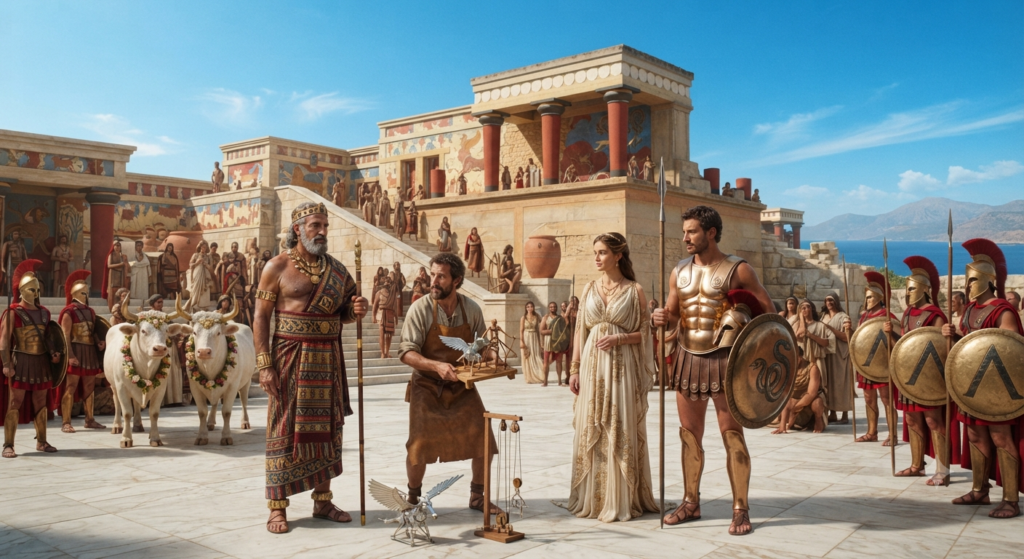
Crete and Sparta stand among the most resonant places in Greek mythic geography, not merely as islands or cities, but as power centers where divine births, royal bloodlines, and heroic legacies converge. When asking which mythological figures came from Crete and Sparta, the answer reaches beyond simple local origin: it includes gods and heroes associated with those lands by birth, kingship, cult, or destiny. Classical authors do not always agree on every detail, but the broad tradition is clear enough to show how deeply each place shaped the mythic imagination of Greece.
Crete and Sparta in Greek mythic geography
Crete appears in myth as a fertile and distant realm of ancient kingship, divine concealment, and monstrous marvels. It is the island where Zeus was raised in secrecy, where Minos ruled, where the Labyrinth stood, and where figures such as Ariadne and Pasiphae became part of a powerful royal cycle preserved in sources like Hesiod, Apollodorus, and later poets. In Greek storytelling, Crete often marks a space where civilization and strangeness meet: law, kingship, and ritual coexist with the Minotaur, the bull cult, and the hidden childhood of a god.
Sparta, by contrast, is remembered as a royal and martial landscape in the Peloponnese, closely tied to the House of Atreus and to the Dioscuri, the twin horsemen Castor and Polydeuces. In Homer and later tradition, Sparta is the home of Helen and Menelaus, and by extension part of the wider mythic network that includes Agamemnon, Clytemnestra, and the events leading to the Trojan War. Where Crete often represents antiquity and mystery, Sparta embodies lineage, discipline, and heroic continuity.
Zeus, Europa, and the Cretan royal line
The best-known divine figure linked to Crete is Zeus himself. In the Cretan tradition, he was not born there, but was hidden there as an infant to escape Cronus. Rhea gave birth to him in a cave on the island, and the Curetes clashed their weapons to drown out the child’s cries, a story found in varying forms across ancient sources. This Cretan infancy gave the island a privileged place in Greek sacred memory, since the king of the gods was said to have been nurtured there.
Europa also belongs to Crete in a foundational way, though her story begins elsewhere. Zeus carried her from Phoenicia to Crete in the famous tale of abduction and transformation, and there she became the mother of Minos, Rhadamanthys, and sometimes Sarpedon depending on the source. Europa’s arrival on Crete created one of the island’s great royal lines, and her sons became central to later Cretan myth and to Greek ideas about justice and kingship.
Minos, Rhadamanthys, and the Cretan kings
Minos is the most famous of the Cretan kings, and the sources present him both as a historical-type ruler and as a semi-divine figure. In Homer, he appears as a powerful judge of the dead in Hades, while in later tradition he becomes the husband of Pasiphae and the ruler who receives from Poseidon the bull that should have been sacrificed. His name is inseparable from Crete, the sea power, and the architectural wonder of the Labyrinth, whether that design is understood as literal, symbolic, or poetic.
Rhadamanthys, another son of Zeus and Europa, is also tied to Crete, though tradition sometimes moves him eastward to rule in the islands or to serve as a judge in the underworld alongside Minos. Ancient writers often praise him as just and wise, making him the moral counterweight to Minos’ more politically charged kingship. Together, Minos and Rhadamanthys make Crete into a land of both authority and judgment, where divine descent shapes human rule.
Pasiphae, Ariadne, and the house of Crete
Pasiphae, daughter of Helios and wife of Minos, stands at the center of the Cretan royal house. Her myth is best known through the story of her union with the Cretan bull and the birth of the Minotaur, a narrative preserved in Apollodorus and elaborated by later authors. However strange the tale, it places Pasiphae among the most memorable figures of Crete, because through her the island’s royal line becomes entwined with monstrosity, desire, and divine punishment.
Ariadne, daughter of Minos and Pasiphae, is one of the most important Cretan heroines in Greek myth. She helped Theseus navigate the Labyrinth, then was abandoned by him on Naxos in the canonical version known from many later sources. Yet her story does not end in abandonment: in some traditions she is taken up by Dionysus and becomes his divine consort. Ariadne thus bridges Crete and the wider Greek world, transforming a Cretan princess into a figure of transition, survival, and apotheosis.
Theseus, Daedalus, and Cretan mythic crossings
Theseus is not a Cretan figure by birth, but his defining myth is inseparable from Crete. He travels there from Athens to confront the Minotaur, entering the Labyrinth with Ariadne’s aid and returning as the survivor of one of Greek myth’s great trials. His journey turns Crete into an arena where Athenian heroism is tested against older, darker powers. The myth is preserved in various forms, but the essential pattern remains stable: Theseus crosses into Cretan danger and comes back with fame.
Daedalus is even more closely tied to Crete, though he is often described as Athenian by origin. Exiled after the death of his nephew, he enters the service of Minos and becomes the island’s master craftsman, creating the Labyrinth and later devising escape for himself and his son Icarus. In Cretan myth, Daedalus embodies human ingenuity under royal authority, and his presence explains why Crete is not only a kingdom of kings but also a place of artifice, concealment, and mechanical wonder.
Helen of Sparta and her divine parentage
Helen is the most famous woman associated with Sparta, though her origin is more complex than simple local identity. In the dominant version, she is the daughter of Zeus and Leda, born from the famous episode in which Zeus approached Leda in the form of a swan. Whether she was raised in Sparta from childhood or came to it as part of her dynastic position, the tradition firmly places her within the Spartan royal household and makes her the face of its mythic prestige.
Her beauty and abduction by Paris set the Trojan War in motion, according to the epic tradition of Homer and later authors. Yet Helen is more than the cause of war: she is a daughter of the divine order and a figure of astonishing ambiguity, both revered and contested. Sparta claims her as its own, and in that claim the city acquires a role in the mythic history of all Greece.
Castor and Polydeuces in Spartan tradition
Castor and Polydeuces, the Dioscuri, are among the most enduring Spartan figures. They are usually called sons of Leda, but their paternity differs by source: Polydeuces is generally the son of Zeus, while Castor is often mortal, the son of Tyndareus. This mixed parentage is part of what makes them so compelling, since one twin shares mortal fate and the other divine immortality. Their bond becomes a model of brotherhood and sacrifice in Greek mythology.
In Spartan tradition they are horse tamers, protectors, and heroic patrons of young men and travelers. Their cult was widespread in the Greek world, yet Sparta remained their deepest home. Their myth includes death, rescue, and shared destiny, especially in the version where one brother yields part of his immortality to the other so they may alternate between Olympus and Hades. That image of divided but enduring kinship helped make the Dioscuri a lasting symbol of Spartan identity.
Menelaus, Agamemnon, and the Spartan royal house
Menelaus is the Spartan king most directly tied to Homeric epic. Husband of Helen and brother of Agamemnon, he belongs to the House of Atreus, a lineage burdened by violence, exile, and inherited power. In the Iliad he appears as both a warrior and a wronged husband, while the Odyssey and later traditions continue his story after Troy. Sparta claims Menelaus not as a founder in the strictest sense, but as one of its greatest royal names.
Agamemnon is not king of Sparta in the narrow geographical sense, yet he is inseparable from the Spartan royal house because he is Menelaus’ brother and the ruling Atreid who leads the Greek expedition against Troy. The broader house of Atreus ties Mycenae, Sparta, and the tragic cycle of vengeance together. Through Agamemnon and Menelaus, Sparta becomes part of one of Greek myth’s largest dynastic dramas, where kingship is inseparable from catastrophe.
Dioscuri cults linking Sparta to heroic memory
The cult of the Dioscuri gave Sparta a living connection to heroic memory. Castor and Polydeuces were honored not only as mythic twins but as present protectors, especially in contexts of youth, battle, and civic identity. Pausanias and other ancient witnesses describe sanctuaries and local customs that show how deeply the twins were woven into Spartan religious life. Myth here was not distant story; it was a structure of worship and remembrance.
That cult also helped Sparta project itself into the wider Greek world. The Dioscuri were invoked by sailors, soldiers, and households across the Mediterranean, but their Spartan associations remained strong. Through them, Sparta appeared as a place where heroic brotherhood survived beyond death, and where mythic ancestry was preserved not just in poetry but in ritual.
Myths shared between Cretan and Spartan lore
Crete and Sparta are distinct in Greek myth, yet their traditions overlap through marriage, royal descent, and broader heroic cycles. Both places are tied to Zeus in decisive ways: Crete through his hidden childhood, Sparta through his unions with Leda and the birth of Helen and the Dioscuri. Both are also linked to powerful houses that shape pan-Hellenic myth, whether the Cretan line of Minos and Europa or the Spartan line of the Atreidae and their descendants.
These shared myths reveal a Greek imagination that moved fluidly between islands, poleis, and heroic dynasties. Figures such as Helen, Castor, Polydeuces, Minos, Ariadne, and Zeus do not belong to a single place alone; they anchor regions of memory that later audiences learned to read together. Crete and Sparta thus remain not merely locations on a map, but mythic centers from which some of Greece’s most enduring figures emerged.
The mythological figures most closely associated with Crete include Zeus in his Cretan infancy, Europa, Minos, Rhadamanthys, Pasiphae, Ariadne, and the wider royal cycle around Daedalus and the Minotaur. Sparta, by contrast, is home to Helen, Castor, Polydeuces, Menelaus, and the Spartan branch of the heroic royal house tied to the Trojan War. Together, these traditions show how Greek myth attached identity to place, making both Crete and Sparta into lasting names of power, ancestry, and sacred memory.

Orin Vale has spent the better part of two decades tracing the threads that connect the world’s oldest stories — from the halls of Asgard to the banks of the Nile, from Olympus to the jungles of the Maya. What began as a childhood fascination with flood myths and trickster gods grew into years of independent study across comparative mythology and ancient religion, always chasing the same question: what did these stories mean to the people who first told them? Orin writes for readers who want more than trivia — the ones looking for the beliefs, fears, and truths that myths were built to carry.