In Greek myth, goddesses are not always luminous and remote; some appear as shades at the edge of the living world, as underworld queens, night-roaming powers, pale maiden-spirits, or prophetic women whose voices seem to come from beyond ordinary sight. The question of which Greek goddesses are depicted as spectral or ghostly figures does not have a single answer, because classical sources use different kinds of darkness: the shadow of the underworld, the terror of nocturnal visitation, the fading of a divine presence, or the eerie condition of an oracle speaking as though half removed from life. Across Homer, Hesiod, the Homeric Hymns, tragedy, Pausanias, and later poets, several goddesses emerge in precisely this uncanny register.
Ghostly Greek Goddesses in Myth and Cult
Greek religion did not divide the divine into simple categories of “living” and “dead.” Gods could cross boundaries, and some goddesses were especially associated with thresholds, graveyards, dreams, darkness, and hidden presence. In myth, this often gives them a spectral quality rather than a literal ghostly form. Persephone rules below the earth, Hecate moves by night, the Erinyes emerge from the underworld as avengers, and certain local oracles and cult images evoke figures who seem to hover between body and shade.
The ancient sources also preserve a strong visual language of pallor, veiling, torchlight, and silence around such figures. That does not mean these goddesses were “ghosts” in the modern sense. Rather, they are presented as chthonic divinities whose power is felt through absence, fear, and uncanny appearance. In Greek thought, that liminal force could be more unsettling than a fully visible god.
Persephone as Queen of the Underworld
Persephone, the daughter of Demeter and queen of Hades, is one of the clearest Greek goddesses linked to a spectral mode of being. In the Homeric Hymn to Demeter, she is carried from the bright upper world into the underworld and becomes a divided figure, returning only for part of the year. This seasonal movement gives her a profoundly liminal character: she is neither wholly absent nor fully present, but alternates between life and death, light and shadow.
Later literature often emphasizes this eerie dual identity. Persephone can be imagined as Kore, the maiden, and as the underworld queen who receives the dead. In the mysteries of Eleusis, this transformation had sacred meaning rather than horror, yet her descent still made her a figure of haunting power. She is not a ghost in the strict sense, but she is a goddess whose mythic presence is defined by the world below and by the fragile return from it.
Hecate and Her Night-Wandering Specters
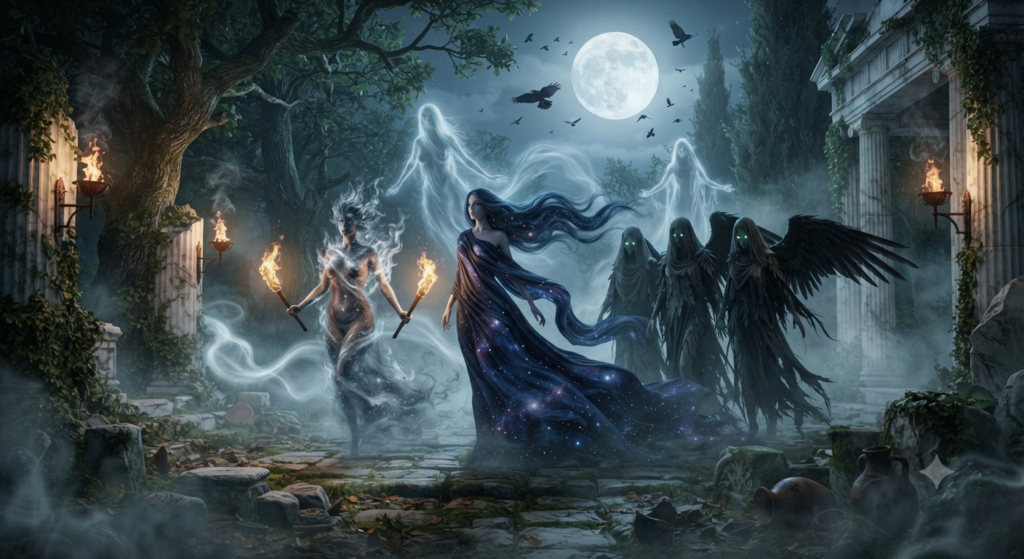
Hecate is among the most overtly nocturnal goddesses in Greek religion, and ancient texts repeatedly place her near crossroads, tombs, liminal spaces, and the edge of human habitation. In the Homeric Hymn to Demeter, she is a witness to Persephone’s disappearance and later a companion in the search. By the classical period, she is often associated with torches, dogs, ghosts, and the wandering dead, especially in popular and magical tradition.
What makes Hecate ghostly is not that she is dead, but that she belongs to the places where the dead are near. Later literary and ritual traditions, including curse tablets and magical papyri, present her as a power invoked at night, sometimes with chthonic and uncanny imagery. In this way, Hecate becomes one of the most spectral goddesses in Greek imagination: a divine presence felt in darkness, at thresholds, and in the thin distance between the living and the unseen.
The Erinyes as Fearsome Chthonic Figures
The Erinyes, or Furies, are usually treated as goddesses rather than mere spirits, and they are among the most frightening figures in Greek myth. In the Oresteia of Aeschylus, they appear as ancient chthonic avengers pursuing blood guilt, and their language and visual imagery often make them seem more like terrors from the underworld than ordinary divine beings. They are sometimes described with dark, hair-bound, serpentine, or blood-soaked features that border on the monstrous.
Because they emerge to punish crimes and then vanish back into the underworld’s order, the Erinyes often feel spectral in dramatic performance and literary description. They are not ghosts of the dead, but divine embodiments of haunting memory, inherited pollution, and vengeance that cannot be escaped. Their presence is one of the clearest examples in Greek myth of goddesses who operate as shadowy figures, half personified and half supernatural force.
Demeter’s Search in Shadowed Lore
Demeter is not usually a ghostly goddess in the same direct way as Hecate or the Erinyes, yet the Homeric Hymn to Demeter gives her a sorrow-stricken, almost shadowed quality during her search for Persephone. Disguised as an old woman and wandering among mortals, she withholds fertility from the earth, and the world itself becomes bleak, thin, and near-dead. Her grief casts a kind of spectral darkness over the landscape.
In mystery cult and later interpretation, this aspect of Demeter can appear uncanny because she stands between nourishment and deprivation, life and barrenness. Her descent into mourning is not a death, but it resembles the withdrawal of vitality, making the goddess seem absent while still exerting immense power. The myth’s emotional atmosphere gives her a ghostlike resonance: a divine mother moving through the world in concealment, veiled by sorrow.
Melinoe and the Pale Visions of Night
Melinoe is one of the most explicitly ghostly figures in Greek religion, though the evidence for her is limited and later than that for the major Olympians. In the Orphic Hymns, she is a chthonic goddess associated with madness, nightmares, and the frightening apparitions that visit sleepers at night. The hymn’s language presents her as pale, dark, and difficult to contain within the categories of ordinary deity.
Because of this, Melinoe is often discussed as a true specter-like goddess, linked to the forms that disturb dreamers and the dead who return in uncanny guise. The sources are not extensive, and scholars note that her cultic profile is obscure, but the surviving text is unmistakably eerie. She belongs to the borderland where dreams, terror, and the dead overlap.
The Cumaean Sibyl as a Fading Oracle
The Cumaean Sibyl is not a goddess in the strict sense, but she is often included in discussions of spectral female figures because classical literature presents her as a woman whose body has become strangely diminished by time. In Ovid’s Metamorphoses, she survives for centuries after asking Apollo for long life without asking for youth, so that she withers into an almost unrecognizable existence. Her voice, however, remains powerful and prophetic.
Her image is ghostly because she seems to have outlived ordinary human form while retaining sacred speech. In Roman and Greek-influenced tradition, the Sibyl’s cave, utterance, and aged body create an atmosphere of fading embodiment, as though the oracle were already half removed from the world. She is not a Greek goddess, but she belongs to the same symbolic field of spectral femininity, prophecy, and the presence that survives in weakened form.
Deities of Death, Dreams, and Haunting
Greek myth places several female figures close to death and dreaming without always turning them into literal ghosts. Nyx, the Night, is primordial and enveloping rather than spectral in the narrow sense, but her offspring include powers tied to sleep and death, such as Hypnos and Thanatos, which deepen the atmosphere around chthonic goddesses. In this wider divine family, haunting is often a matter of proximity to darkness, not postmortem identity.
The most important pattern is that Greek goddesses can become ghostly through function rather than category. They rule the underworld, walk at night, appear in dreams, or return as avengers and omens. Even when they remain fully divine, their representation borrows the language of shades, whispers, torches, and concealment, making them feel like beings who belong to the boundary between worlds.
Ritual Images of Maidens and the Afterlife
Greek ritual and art also shaped the way these goddesses were perceived. Persephone appears in vase painting and cult imagery as a crowned maiden or queen emerging from and returning to the underworld, while Hecate is often shown with torches, sometimes at crossroads or near figures from the dead. Such images do not make the goddesses “ghosts” in the modern sense, but they visually encode transition, fragility, and hidden access to other realms.
Mystery cults, especially at Eleusis, further complicated the picture by presenting death and rebirth through veiled ritual. The divine maiden, the grieving mother, and the nocturnal guide all participated in an afterlife imagination that was both sacred and unsettling. Where public myth could narrate these goddesses in grand terms, ritual often surrounded them with silence, darkness, and partial revelation, which is precisely what gives them their spectral aura.
Classical Sources for Spectral Goddesses
The strongest classical sources for these ghostly or spectral goddesses are the Homeric Hymn to Demeter for Persephone, Demeter, and Hecate; the Orphic Hymns for Melinoe and other chthonic powers; Aeschylus’ Oresteia for the Erinyes; and later authors such as Pausanias, Apollodorus, and Ovid for local traditions and mythic elaboration. Homer and Hesiod also provide the broader cosmology in which night, underworld, and divine absence make sense. Together, these texts show that spectrality in Greek myth is usually a matter of divine function and imagery, not a claim that a goddess is literally dead.
That distinction matters. Greek goddesses are rarely “ghosts” in the modern literary sense, but several are depicted in ways that make them appear ghostly: Persephone as the returning queen of the dead, Hecate as the nocturnal guide, the Erinyes as terrible avengers from below, Demeter as the grieving and darkened mother, Melinoe as a pale power of nightmares, and the Sibyl as an oracle worn thin by time. Their haunting quality comes from the ancient Greek sense that the divine often resides just beyond sight, where presence and absence meet.
The most spectral Greek goddesses are not all dead, nor are they simple apparitions. They are divinities of thresholds, underworld passage, grief, night, and prophetic distance. In that sense, Greek mythology does not treat the ghostly as a separate category from the sacred; it lets certain goddesses wear the appearance of shade, silence, and return.

Orin Vale has spent the better part of two decades tracing the threads that connect the world’s oldest stories — from the halls of Asgard to the banks of the Nile, from Olympus to the jungles of the Maya. What began as a childhood fascination with flood myths and trickster gods grew into years of independent study across comparative mythology and ancient religion, always chasing the same question: what did these stories mean to the people who first told them? Orin writes for readers who want more than trivia — the ones looking for the beliefs, fears, and truths that myths were built to carry.