Among the Greek figures tied to Capricorn, the name most often given is Pan, the rustic god of wild places, shepherds, and flocks. In some traditions, however, Capricorn is not linked to a single Olympian deity so much as to the broader myth of the sea-goat and the constellation Capricornus, whose roots run through Greek and later Roman astrology. The association is therefore both mythic and astronomical, shaped by ancient stories, artistic symbols, and the interpretation of the heavens.
Capricorn and the Greek god Pan in myth
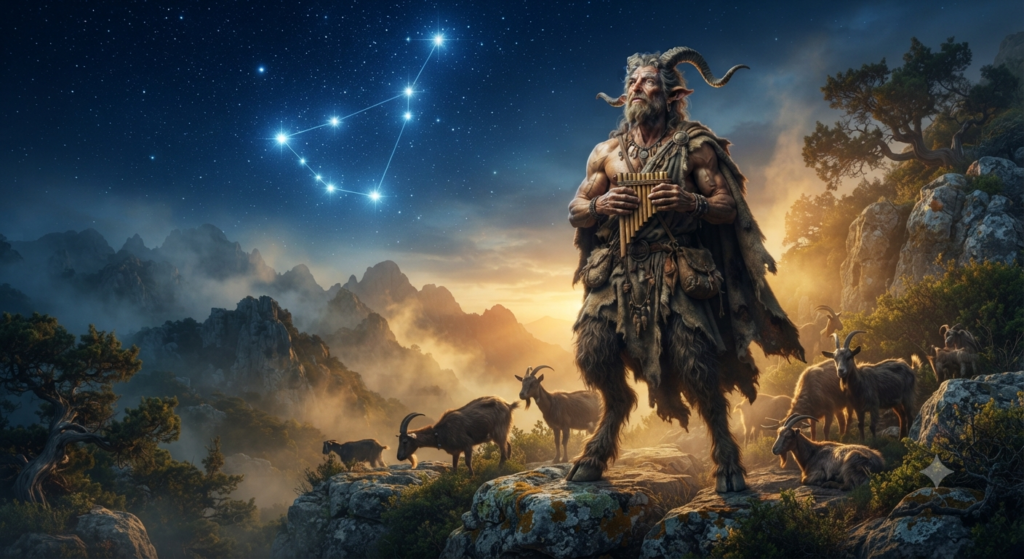
Pan is the Greek god most commonly connected with Capricorn in later astrological tradition. He is a strange and ancient figure, half man and half goat, born of the wild landscape rather than the polished order of Olympus. Because his lower body is caprine, later interpreters naturally saw in him a fitting divine image for the zodiac sign Capricorn, which is traditionally represented by a horned, goat-like being.
Classical myth does not always state outright that Pan “rules” Capricorn in the way modern astrology might assign planetary rulers. That association belongs more to interpretive tradition than to a fixed mythic doctrine. Still, Pan’s goat features, his link to mountain country, and his presence among herds made him the most obvious Greek divine counterpart for a sign whose symbols are drawn from goat imagery.
The Capricorn symbol in classical astrology
In classical astrology, Capricorn is not merely a goat but the sea-goat, a hybrid creature with the front of a goat and the tail of a fish. This image appears in Greco-Roman astrological tradition and distinguishes Capricorn from a simple pastoral goat symbol. The sign belongs to the winter sky and was tied to ideas of descent, survival, and endurance.
Ancient astrology was deeply symbolic, and Capricorn’s image gathered meanings from both land and water. The goat suggests ascent, sure-footedness, and persistence on steep terrain, while the fish tail evokes the sea and hidden depths. This combination made Capricorn one of the most visually distinctive signs in the zodiac, and it was understood less as a zoological creature than as a cosmic emblem.
Why the sea-goat belongs to this sign
The sea-goat belongs to Capricorn because ancient myth and astronomy often fused different traditions into one powerful sign. Some versions connect the image to Pan, who leapt into a river or sea in escape and acquired a fish tail in the process. Other traditions treat the creature as a symbolic mixture drawn from older Near Eastern and Greek astral lore, later absorbed into Hellenistic astrology.
What matters is that Capricorn was never meant to be a simple pastoral goat in the sky. Its hybrid form reflects a mythic logic common in antiquity: a sign could embody a god, a monster, an animal, and a cosmic force at once. The sea-goat captures Capricorn’s dual nature, balancing earthbound resilience with the mysterious pull of the waters.
Pan, rustic nature, and the Capricorn image
Pan is a god of untamed nature, often associated with mountain slopes, caves, shepherds, and the wild song of the reed pipe. His body is goat-like, and in art he is regularly shown with horns, legs, and hooves of a goat. These features made him a natural fit for later readers who looked to the zodiac and sought a Greek divine figure behind Capricorn.
His character also suits the sign’s broader symbolism. Capricorn is often linked with discipline, endurance, and the hard climb toward achievement, qualities that can be read into Pan’s survival in the rough places of the world. Yet Pan is also elusive and impulsive, reminding us that Greek myth rarely reduces a god to a single trait. The Capricorn connection arises from image, environment, and later interpretation rather than from a straightforward myth of patronage.
Amalthea, goat horns, and celestial origins
Another important Greek figure in Capricorn’s background is Amalthea, the nurturing goat who cared for the infant Zeus in Cretan myth. In some accounts, her horn became the cornucopia, the horn of plenty, after her death or transformation. Though Amalthea is not usually the “god” associated with Capricorn, her goat imagery helped shape the constellation’s symbolic world.
This matters because Capricorn’s celestial identity grew from a network of goat-related myths, not from a single source. Pan provides the best-known divine connection, while Amalthea offers a sacred goat whose image was powerful enough to enter the language of abundance and the sky. Together these figures show how ancient people layered myth onto the stars, creating meanings that were rich, flexible, and often overlapping.
Capricorn in Greek and Roman zodiac traditions
In Greek and Roman zodiac traditions, Capricorn was adopted into a broader astrological system that drew on earlier Mesopotamian sky lore and then recast it in Greco-Roman terms. The Greeks and Romans did not always agree on every symbolic detail, but they recognized Capricornus as one of the twelve signs and associated it with a specific region of the heavens. In Latin sources, the sign often appears as Capricornus, the goat with fish-like features.
Roman authors and later astrologers preserved and expanded these associations, giving Capricorn a stable place in calendrical and cosmic thought. The sign could be read as a marker of winter solstice themes, hard labor, and hidden strength. Within that framework, Pan remained the most vivid Greek mythic figure whose form and nature echoed the sign, even if he was not the only possible reference point.
How ancient sources describe the sea-goat
Ancient literary and astronomical sources describe Capricornus as a hybrid constellation, but they do not always agree on its mythic explanation. Some traditions link it to the god Pan and the story of his transformation during flight from a monster or from danger. Others, especially in later astronomical commentary, emphasize the form itself rather than a single narrative behind it.
This is typical of classical myth, where a constellation may have several explanations depending on the author. Eratosthenes, for example, and later compilers such as Hyginus preserve various etiological accounts for stars and constellations, while Ovid and other poets helped popularize the transformed, symbolic sky. The sea-goat thus stands at the meeting point of poetry, astrology, and inherited mythic memory.
The constellation Capricornus in the sky
Capricornus is one of the older and more recognizable zodiac constellations, visible in the southern sky and traditionally linked with the sun’s path through the zodiac. In ancient astronomy, constellations were not just patterns but meaningful signs that connected the heavens to fate, season, and divine order. Capricorn’s position near the winter solstice gave it special importance in many astrological systems.
The constellation’s appearance is modest compared with brighter star groups, yet its symbolic force is enduring. Ancient observers saw in Capricornus not only a shape but a story: a goat that belongs partly to the mountains and partly to the sea, a creature of transition and resilience. That visual ambiguity helped preserve the constellation’s mythic richness across Greek, Roman, and later astrological traditions.
Greek mythic traits linked to Capricorn
Capricorn is commonly associated with traits that ancient and modern readers alike have drawn from its goat symbolism: persistence, caution, endurance, and the ability to climb where others cannot. In a mythic sense, these qualities fit Pan’s wild independence and the sea-goat’s hybrid survival. The sign is less about speed than about steady ascent.
At the same time, Greek mythology reminds us that symbols are never one-dimensional. Pan is also unruly, sensual, and unpredictable, and the sea-goat is a creature of transformation rather than simple order. Capricorn therefore carries a double image: disciplined and instinctive, earthly and aquatic, enduring and elusive. That tension is part of what makes the sign so memorable in the ancient imagination.
The lasting answer to Capricorn’s patron god
If the question is asked in the simplest mythological terms, the Greek god most associated with Capricorn is Pan. He is the clearest divine figure whose goat-like form and wild nature align with the zodiac sign. Yet the full ancient picture is broader than a single patron deity, because Capricorn also draws on the sea-goat motif, the constellation Capricornus, and related goat traditions such as Amalthea.
The lasting answer, then, is both precise and layered. Pan is the principal Greek god tied to Capricorn, especially in later mythic and astrological interpretation, while the sign itself belongs to a richer constellation of symbols that ancient Greeks and Romans inherited, adapted, and preserved. In the sky, as in myth, Capricorn remains a figure of ascent, endurance, and transformation.
The association between Capricorn and Pan reflects how Greek mythology often works: one god can stand beside a constellation, a symbol can gather several stories, and a single zodiac sign can carry echoes of both rustic earth and distant sky. Capricorn endures because it is not just an image of a goat, but a mythic crossing point where Pan, the sea-goat, and the ancient heavens meet.

Orin Vale has spent the better part of two decades tracing the threads that connect the world’s oldest stories — from the halls of Asgard to the banks of the Nile, from Olympus to the jungles of the Maya. What began as a childhood fascination with flood myths and trickster gods grew into years of independent study across comparative mythology and ancient religion, always chasing the same question: what did these stories mean to the people who first told them? Orin writes for readers who want more than trivia — the ones looking for the beliefs, fears, and truths that myths were built to carry.