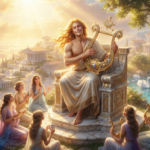
Aether is the ancient Greek personification of the bright upper air, the pure light that existed above the familiar world of earth and the dim realm of night. He is not the same as Zeus, nor simply the daylight people experience each morning. In the oldest Greek cosmologies, Aether belongs to the primordial order of the universe, a divine substance and being associated with the shining, rarefied heavens where the gods dwell and where brilliance itself seems to live.
Aether in Greek myth and cosmology
Aether appears in Greek myth as one of the earliest divine powers, linked to the luminous atmosphere above the lower world. His name can mean “brightness” or “upper air,” and in surviving sources he is usually treated less as a colorful Olympian personality than as a cosmic principle. He belongs to the language of origins, where gods are also forces that shape the structure of reality.
Greek cosmology often distinguished between the visible sky, the shadowed air around mortals, and a higher, purer zone of radiance. Aether belongs to that uppermost sphere. To the Greek imagination, this was the place where light was clearest, where divine fire could exist without burning in the ordinary sense, and where the world approached the condition of sacred brilliance.
The primal light above earth and sky
Aether is best understood as the primal light above the earth and even above the weather-filled sky. He is not sunlight alone, but the shining medium that surrounds and transcends the mortal atmosphere. In early poetic thought, this upper brightness forms part of the ordered cosmos that separates heaven from the darkness below.
This makes Aether both physical and divine. He is a way of imagining the highest reaches of the world as alive with radiance. The Greeks did not always separate cosmology from theology, so Aether could be at once the stuff of the upper air and a godly presence expressed through that brilliance.
Hesiod’s account of the shining god
Hesiod gives Aether a clear place in the genealogies of the gods. In the Theogony, he is born from Erebus and Nyx, the powers of Darkness and Night, and his sister and counterpart is Hemera, Day. This origin is striking: from darkness comes brightness, and from night emerges the luminous realm that follows it.
Hesiod’s account does not dwell on Aether as a dramatic character. Instead, it presents him as a primordial emergence, a necessary part of the world’s unfolding. That quiet role is important. In Hesiod, the universe is not merely populated by gods; it is built through divine generations, each representing a fundamental aspect of existence.
Aether, Chaos, Erebus, and Nyx
Aether stands in a sequence with some of the oldest cosmic powers in Greek myth: Chaos, Erebus, and Nyx. Chaos is the yawning opening or gap from which the first forms arise. Erebus is deep darkness, and Nyx is Night. From Nyx and Erebus come Aether and Hemera, bringing into being the realms of brightness and day.
This family structure expresses a poetic cosmology rather than a rigid scientific model. Light and darkness are not abstract opposites alone; they are divine relatives. The Greeks often understood the cosmos through relationships of generation, and in that framework Aether becomes the luminous answer to the first shadows of creation.
The realm of pure upper air
Aether is associated with the highest, purest air, the region above the clouds and beyond the ordinary breath of living beings. Ancient writers used the word in ways that could overlap with philosophy, meteorology, and myth. The same term could evoke the physical upper atmosphere or the divine brightness that filled the heavens.
In mythic terms, this realm is not a place mortals can easily enter. It is too refined, too brilliant, too removed from the world of suffering and change. Aether marks the boundary where the human world ends and a more radiant order begins, one that belongs to gods, celestial bodies, and the immortality of divine presence.
How Aether differs from Zeus’s sky
Aether is not Zeus, and he is not simply another name for the sky-god’s domain. Zeus rules the sky in the political and mythic sense: he commands clouds, thunder, storms, and divine sovereignty. Aether, by contrast, is the shining medium itself, the clear upper brightness that makes heaven seem radiant.
Later Greek writers sometimes use “aether” more broadly for the heavens, which can blur distinctions. Yet the older mythic tradition generally keeps the concepts separate. Zeus governs; Aether illuminates. Zeus acts as king of the gods, while Aether is part of the cosmic substance that surrounds and reflects divine splendor.
Divine fire, brightness, and celestial light
Aether is often linked with fire-like brightness, though not with ordinary flame. Greek thought could imagine the heavens as a place of pure, untouchable fire, especially in later philosophical traditions. This celestial fire was not destructive in the human sense; it was brilliant, ordering, and life-giving.
That association made Aether a natural symbol for stars, the upper heavens, and the luminous quality of divinity itself. He embodies a light that is not merely seen but felt as a sign of transcendence. In mythic language, Aether is the brightness that belongs to the gods before it touches the world below.
Aether in Homeric and later traditions
Homer uses the term aether frequently, though not always as a fully personified god in the Hesiodic sense. In epic language, it can refer to the bright upper atmosphere or the clear sky above mortals. This flexible usage shows that Aether lived both as a poetic word and as a divine concept.
Later authors and traditions made the personification more explicit. In some philosophical and mythological texts, Aether becomes a more developed cosmic principle, sometimes described as a male power or as the highest layer of the heavens. The tradition is not entirely uniform, but the consistent idea is of a brilliant upper realm distinct from ordinary air.
The offspring and personification of Aether
The most secure family association for Aether is his birth from Erebus and Nyx in Hesiod. Beyond that, later traditions sometimes extend his role, giving him further symbolic or genealogical significance. In some accounts, Aether is linked to the origins of celestial phenomena or treated as a parent of divine forces connected with sky and light.
Because Greek myth often changes from author to author, Aether’s offspring are not fixed in the way the children of major Olympians might be. What remains constant is the personification itself. Aether stands for a vital cosmic presence: the shining upper air from which day, brilliance, and the visibility of the world become possible.
Why Aether mattered to Greek thought
Aether mattered because he gave the Greeks a name for what lies beyond the common reach of the senses: the luminous height above the earth, the brilliance that seems to belong to heaven itself. As both god and cosmic element, he helped ancient poets and thinkers explain how the world moves from darkness into light without treating that change as merely mechanical.
He also reflects a central habit of Greek imagination: to personify the world’s deepest structures. Night, Darkness, Day, and Bright Air were not only conditions but divine realities. In Aether, Greek myth preserves the idea that light at its purest is more than illumination. It is a primordial presence, ancient as the cosmos, shining above the mortal world.
Aether is the primordial Greek god of light in the sense that he represents the highest, clearest, and most divine form of brightness known to early Greek myth. Born from Night and Darkness, he stands for the radiant upper air beyond the world of mortals, a presence that is both cosmic and sacred. His role may be quiet compared with the deeds of Zeus or Apollo, but his significance is foundational: he belongs to the architecture of the universe itself, where light first rises above the ancient dark.

Orin Vale has spent the better part of two decades tracing the threads that connect the world’s oldest stories — from the halls of Asgard to the banks of the Nile, from Olympus to the jungles of the Maya. What began as a childhood fascination with flood myths and trickster gods grew into years of independent study across comparative mythology and ancient religion, always chasing the same question: what did these stories mean to the people who first told them? Orin writes for readers who want more than trivia — the ones looking for the beliefs, fears, and truths that myths were built to carry.