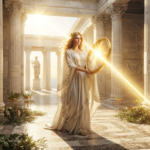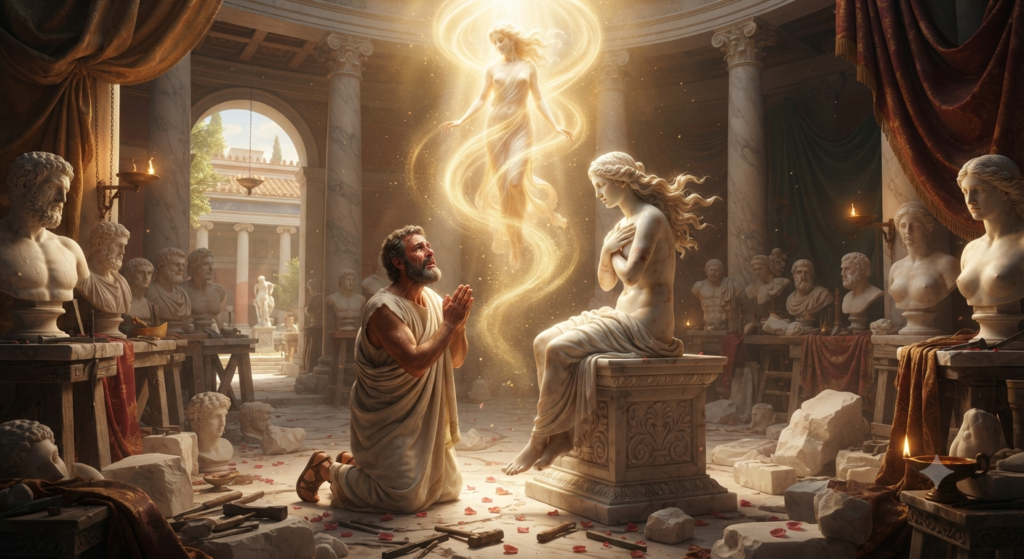
Pygmalion and Galatea is one of the most enduring stories from Greek and Roman mythology: the tale of a sculptor who falls in love with his own creation, and of a statue that is granted life. In the best-known version, preserved by the Roman poet Ovid, the figure Galatea is not a sea goddess of the same name found elsewhere in Greek tradition, but the ivory maiden fashioned by Pygmalion and brought to life through divine favor. The myth has traveled widely because it speaks to desire, craftsmanship, beauty, and the mysterious boundary between art and life.
Pygmalion and Galatea in Greek myth
The myth is usually grouped with Greek stories, though its fullest ancient form comes from Roman literature. Pygmalion is presented as a sculptor or craftsman who turns away from the women around him and shapes an ideal woman in ivory. The name “Galatea” is often attached to the statue in later retellings, but in Ovid’s Metamorphoses the woman is not named; she is simply the living image Pygmalion creates in his imagination and hands.
In the broader mythic landscape, the story belongs to a family of tales about human beings approaching the divine through art. It is not a heroic cycle like that of Heracles or Perseus, nor a tragedy of royal houses. Instead, it is intimate and inward, centered on longing, form, and transformation. That intimacy is part of why the myth remained so powerful long after the ancient world.
Ovid’s telling in the Metamorphoses
Ovid tells the story in Book 10 of the Metamorphoses, where it appears among other accounts of love and change. Pygmalion is described as a man of Cyprus who has seen the faults of real women and therefore resolves to live without marriage. Instead, he carves a statue so beautiful that it seems to surpass nature itself. He adorns it, dresses it, and treats it with the affection due to a living beloved.
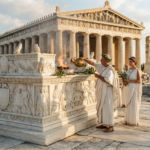
The turning point comes when Venus, the Roman counterpart of Aphrodite, honors Pygmalion’s prayer. On her festival day, he asks for a bride who resembles his ivory maiden, and the goddess understands his unspoken wish. When he touches the statue, the ivory softens, warmth returns to the body, and the figure awakens into a living woman. Ovid lingers on the gradual transition, making the miracle feel physical, almost sensual, as stone becomes flesh under divine power.
The Cyprus sculptor and his ivory maiden
Pygmalion is identified with Cyprus, an island strongly associated with Aphrodite/Venus in ancient tradition. This setting matters: Cyprus is a place where beauty, craftsmanship, and the cult of the goddess naturally converge. The sculptor’s work is not merely a craft object but an idealized body shaped from ivory, a luxurious material prized in antiquity for its gleam and smoothness.
The statue’s silent perfection is central to the myth. Pygmalion is moved not by a woman he has met, but by an artistic image he has made himself. Ancient readers would have recognized the tension in this: the artist creates beauty, yet beauty also masters the artist. His ivory maiden becomes at once a triumph of skill and an emblem of unattainable desire, a form that seems to invite life but cannot possess it on its own.
Aphrodite’s role in the statue’s life
Aphrodite, or Venus in Ovid’s Latin version, is the decisive power in the story. Pygmalion does not conjure life through talent alone; the transformation requires divine intervention. This is a common pattern in myth, where human longing reaches a limit and the gods supply what mortals cannot achieve. The goddess acts not as a distant observer but as a responder to prayer, especially since Pygmalion has honored her in ritual.
Her involvement also links the myth to the ancient understanding of love as both blessing and force beyond control. Aphrodite grants not only life to the statue but union to the sculptor. The result is framed as divine approval of marriage and fertility, though the story remains ambiguous in a way many myths do: what begins as devotion to an ideal image becomes a relationship with a living person, and the change is both wondrous and unsettling.
Desire, artistry, and divine intervention
At its heart, the myth explores the relationship between desire and making. Pygmalion shapes an ideal, then falls under the spell of what he has created. This is one reason the story has appealed so strongly to artists, writers, and later psychologists. It asks whether beauty is discovered or invented, and whether the maker is ever separate from the thing made.
The divine intervention deepens the myth rather than resolving it completely. The statue is not alive because Pygmalion wills it so, but because the goddess answers a prayer. That detail keeps the story within a religious worldview in which human skill is real but incomplete. The sculptor can imitate life; only a god can give it breath, movement, and generative power.
Galatea, the name and its later meanings
The name Galatea is not securely part of Ovid’s original version of the myth. It became attached to Pygmalion’s statue in later tradition, and much later still it was popularized in art and literature. This is worth noting because Galatea in Greek mythology also names a different figure, a Nereid or sea nymph found in other ancient sources. The two should not be confused.
Over time, “Galatea” came to symbolize the idealized female form brought to life through art or love. In modern usage, the name often evokes the statue itself rather than the sea nymph. That shift shows how myths evolve: names detach from one figure, attach to another, and acquire new meanings in the process. The result is a layered legacy in which ancient and later traditions coexist.
Ancient sources and variant versions
Ovid is the main source for the familiar version of the story, but he was not inventing from nothing. Earlier references to Pygmalion in surviving ancient literature are sparse, and the fullest narrative survives only in his poem. Because of this, scholars often treat the Ovidian account as the canonical telling, while recognizing that it may reflect earlier local traditions from Cyprus or Hellenistic sources now lost.
Other ancient authors do not give a single stable alternative. Pausanias, for example, reports myths and local cult stories in different regions, but not a competing full version of Pygmalion’s tale. Later writers and artists expanded the myth, sometimes changing details such as the statue’s name, the emotional tone, or the moral emphasis. What remains constant is the central miracle: an image made by human hands becomes a living bride through divine grace.
Pygmalion in art, literature, and opera
The story of Pygmalion and Galatea has been retold across centuries because it fits so naturally into visual and theatrical arts. Painters, sculptors, and poets were drawn to the image of art becoming life, especially during the Renaissance and the eighteenth century. The myth offered a ready-made meditation on the artist’s power and limits, and on the allure of ideal beauty.
It also entered opera and later literature in new forms. Jean-Philippe Rameau’s opera Pigmalion and George Bernard Shaw’s play Pygmalion are among the best-known later works to use the name, though Shaw’s play is not a retelling of the myth in any literal sense. Even when the plot changes, the deep structure remains recognizable: a maker shapes another being, and creation turns back upon its creator.
The myth’s themes of beauty and creation
Few myths are as direct in linking beauty with creation. Pygmalion does not merely admire beauty; he produces it, then longs for it to answer him. The story therefore raises an enduring question: is the ideal beloved something found in the world, or something fashioned by imagination and labor? The ancient tale offers no simple answer, only the image of a maker overwhelmed by his own perfection.
The myth also reflects ancient anxieties about images. A statue is a likeness, but until it lives, it remains an object of art and devotion rather than a person. The moment of animation collapses that distance. What was made to be seen becomes someone who can see back. That transformation gives the story its emotional force and its enduring unease.
Why the Pygmalion myth still endures
The myth survives because it speaks to timeless human concerns: the desire to create, the hope that beauty may become real, and the fear that idealization can never fully satisfy. It is a story about love, but also about projection, the artist’s gaze, and the fragile line between admiration and possession. Those themes have made it adaptable to many cultures and periods without losing its ancient core.
In the end, Pygmalion and Galatea remains one of mythology’s clearest images of metamorphosis. A sculptor makes a perfect form, a goddess grants life, and the boundary between artwork and beloved dissolves. That simple sequence has proved inexhaustible, because it touches something deep in the human imagination: the wish that what we shape with longing might one day answer us in return.
===OUTRO:

Orin Vale has spent the better part of two decades tracing the threads that connect the world’s oldest stories — from the halls of Asgard to the banks of the Nile, from Olympus to the jungles of the Maya. What began as a childhood fascination with flood myths and trickster gods grew into years of independent study across comparative mythology and ancient religion, always chasing the same question: what did these stories mean to the people who first told them? Orin writes for readers who want more than trivia — the ones looking for the beliefs, fears, and truths that myths were built to carry.