Apollo was among the most widely honored gods of the Greek world: a deity of music, healing, purification, archery, prophecy, and measured order. To pray to Apollo was not simply to speak a wish into the air. It was to approach a divine presence through ritual cleanliness, offerings, hymns, vows, and, at his great sanctuaries, consultation with oracles that claimed his voice.
Apollo in Greek Worship and Daily Prayer
In Greek religion, Apollo was not a distant abstraction but a god addressed in ordinary life and in moments of crisis. He could be prayed to for health, for protection from plague, for guidance before travel or battle, and for clarity of mind. Homer and later sources show him as a deity whose favor mattered to kings, households, and cities alike. Because he was linked with order and with the proper conduct of ritual, prayer to Apollo often stressed balance, reverence, and precise speech.
His worship extended across the Greek world, from Delos and Delphi to local shrines in towns and sanctuaries on mountain slopes. The god’s many epithets—Phoebus, Delian, Pythian, Paean, Lyceus—reflect different aspects of his power and different places where he was honored. When Greeks prayed to Apollo, they usually did so with awareness of which form of the god they were addressing, since each cult setting emphasized a particular role: healing, prophecy, music, purification, or civic protection.
Gods, Altars, and Sacred Offerings
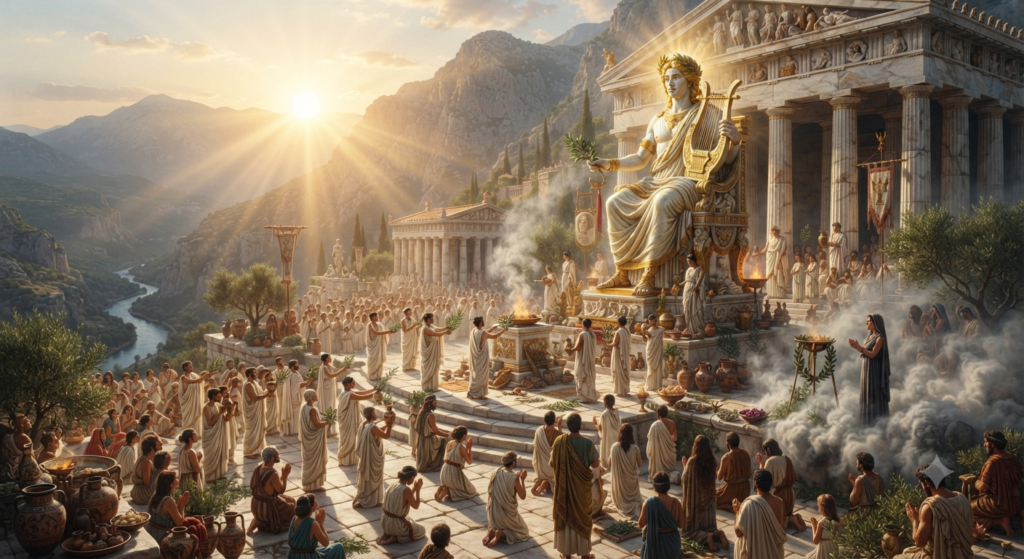
Greek prayer usually began before an altar or shrine, because worship was fundamentally relational: the worshipper approached a god in a defined sacred space. An altar to Apollo might stand in a household, a public precinct, or beside a temple. The altar itself was not merely decoration. It marked the place where fire, smoke, blood, and spoken words joined together in a recognized pattern of communication with the divine.
Offerings accompanied these prayers. The simplest might be incense, cakes, first fruits, or poured drink offerings; more elaborate rites included animal sacrifice. Apollo was commonly honored with gifts appropriate to the occasion and the worshipper’s means. Pausanias and other ancient witnesses describe sanctuaries rich with votive objects, showing that devotion to Apollo could be both public and deeply personal. A prayer was often sealed by a gift, since Greeks regarded offerings as a tangible sign of respect and reciprocity.
Purification Before Addressing the God
Purification mattered greatly before addressing Apollo, especially because he was closely associated with ritual purity and the removal of pollution. Worshippers might wash their hands, bathe, or sprinkle themselves with clean water before prayer. In sanctuaries, lustral basins and ritual washings made this practice visible and communal. The point was not moral perfection, but readiness to stand before a god whose presence demanded order and cleanliness.
This concern appears strongly in myths and cult practice alike. Apollo could punish impurity, as in stories where miasma, or pollution, offends the sacred order. At the same time, he could also heal and cleanse through ritual means. For that reason, prayer to Apollo often began with an acknowledgment of his purity and authority, as though the worshipper were stepping into a measured space where words and actions had to be properly prepared.
Libations, Hymns, and Spoken Invocations
A common form of prayer to Apollo was the libation, the pouring out of wine, water, honeyed mixtures, or oil while speaking the god’s name and titles. Libations were not silent gestures; they were accompanied by verbal invocation. The worshipper called Apollo by his epithets, named the need at hand, and asked for favor. In Greek practice, the spoken word and the poured liquid worked together, binding prayer to rite.
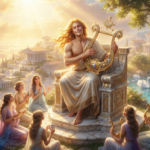
Hymns were another important mode of address. The Homeric Hymn to Apollo preserves the elevated style of praise suited to divine invocation, and paean songs were especially associated with Apollo in worship. A paean could be sung in thanks after healing, in hope during danger, or as a communal act of reverence. In such prayers, Apollo was praised not only as a helper but as the god whose presence restored harmony among people, body, and city.
Temples, Oracles, and Delphi Pilgrimage
Apollo’s great oracle at Delphi made him unique among Greek gods, because prayer there could become an act of inquiry. Pilgrims came to the sanctuary to ask Apollo questions about war, colonization, family decisions, and civic disputes. The process was ritualized: consultation involved purification, payment, sacrifice, and then the formal question, after which the Pythia, the priestess, delivered Apollo’s response in inspired speech. Ancient authors differ on details, but they agree on Delphi’s central importance.
Delphi was not the only prophetic center of Apollo, but it was the most renowned. The sanctuary on Mount Parnassus became a place where Greeks from different regions shared a common religious language. To pray there was to seek more than comfort; it was to seek direction from the god of truth and measure. The journey itself could be an act of devotion, marked by preparation, gifts, and solemn expectation before the god’s altar.
Sacrifice in Apollo’s Religious Cult
Sacrifice formed a major part of Apollo’s cult, though the exact form varied by region and occasion. Animal sacrifice could accompany prayer when communities asked for protection, success, or healing. The sacrificial animal was chosen, consecrated, and offered with careful ritual language. Fire and smoke carried the offering upward, and the distribution of meat afterward also mattered, since sacrifice in Greek religion was both sacred and communal.
Apollo was also connected with non-bloody offerings, especially in contexts that emphasized purity and music. Not every prayer required a slaughtered victim. In many settings, incense, cakes, and libations were sufficient. This flexibility reflects the breadth of Apollo’s cult: he was a god of radiant distance and precise form, but also one to whom households and cities could pray without grand expense, so long as the rite was properly observed.
Prayers for Healing, Prophecy, and Harmony
Apollo was frequently approached as a healer, especially under the name Paean. In illness or plague, people prayed to him for relief, and the prayer might include song, offerings, or vows. In myth, he could also send disease, which made his healing power all the more significant: the same god who could wound could also restore. This duality gave Greek prayer to Apollo a tone of careful respect, as though one addressed a power that could correct disorder as well as preserve health.
He was equally important as a god of prophecy and harmony. Those seeking guidance asked Apollo to reveal what was hidden, yet his answers were often indirect, requiring interpretation. Musicians, poets, and civic leaders also looked to him for balance and clarity. Prayer to Apollo, then, was not always a plea for miracles; it was often a request for right proportion, lucid speech, and a settled mind in the face of uncertainty.
Vows, Dedications, and Thank-Offerings
Greek prayer to Apollo frequently included vows, promises made in advance of divine help. A worshipper might pledge a sacrifice, a gift, or a dedication if Apollo granted healing, victory, or safe return. Such vows reveal the reciprocal logic of Greek religion: the god was honored with seriousness, and the petitioner responded with a concrete act of gratitude once the request had been fulfilled. These promises were not abstract. They were meant to be kept.
Thank-offerings could take many forms, from votive tablets and statues to weapons, vessels, locks of hair, or crafted objects. Sanctuaries of Apollo accumulated such dedications over generations. Pausanias describes shrines filled with the material memory of answered prayers. In this way, Apollo’s sanctuaries became archives of devotion, where each object testified that someone had once stood before the god, spoken a need, and returned with gratitude.
Festival Rites for the Lycian Archer God
Apollo was honored in festivals that varied by city and region, some emphasizing archery, others music, purification, or civic renewal. The epithet Lycian, often associated with Apollo as an archer, shows how his cult could merge martial symbolism with divine restraint. Festival prayer sometimes took the form of processions, sacrifices, hymns, and competitions, all of which expressed collective devotion rather than private petition alone.
At such gatherings, prayer to Apollo was public and performative. Citizens and pilgrims joined in honoring the god through shared ritual, making their petitions part of a larger civic act. The festival setting emphasized Apollo’s role as a guardian of order, not merely of individual fortunes. In this sense, the Greeks did not only ask Apollo for help; they renewed their place within the patterned life he was thought to uphold.
How Greeks Sought Apollo’s Favor
To seek Apollo’s favor, the ancient Greeks combined speech, purification, offering, and respect for ritual form. They addressed him by name and epithet, washed themselves, poured libations, sang hymns, and promised gifts in return for help. In temples, at altars, and at Delphi, prayer could become a carefully staged encounter with a god who represented clarity, healing, and divine measure. The aim was not to force Apollo’s hand, but to approach him correctly.
Because Apollo’s powers touched so many parts of life, prayer to him could be intimate or public, practical or exalted. A family might ask for health, a city for guidance, a traveler for safety, and a seeker at Delphi for prophecy. Across all these forms, the underlying principle remained the same: reverence expressed through proper rite. For the Greeks, Apollo listened most fully when words were joined to purity, offerings, and a disciplined mind.
Ancient prayer to Apollo was thus both simple and exacting. It could begin with a whispered plea at a roadside altar or unfold in the grandeur of Delphi, yet it always relied on the same sacred grammar of Greek religion: purification, invocation, offering, and reciprocity. Through that grammar, worshippers sought not only help from the god, but also alignment with the order he was believed to embody.

Orin Vale has spent the better part of two decades tracing the threads that connect the world’s oldest stories — from the halls of Asgard to the banks of the Nile, from Olympus to the jungles of the Maya. What began as a childhood fascination with flood myths and trickster gods grew into years of independent study across comparative mythology and ancient religion, always chasing the same question: what did these stories mean to the people who first told them? Orin writes for readers who want more than trivia — the ones looking for the beliefs, fears, and truths that myths were built to carry.