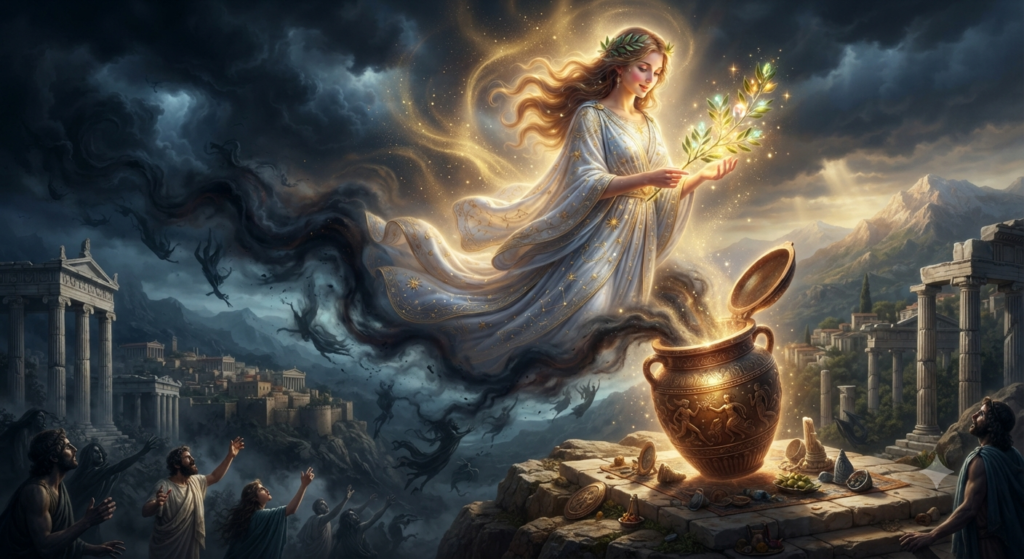
In Greek mythology, Elpis is the personification of hope, a word that carries a broader weight than the modern English term alone suggests. In ancient Greek usage, elpis could mean hope, expectation, or even fear, depending on context, so it was never a simple emotion of comfort. In myth and literature, Elpis stands at the boundary between suffering and endurance, offering the fragile sense that the future is not entirely closed.
Elpis in Greek Myth and the Vocabulary of Hope
In Greek thought, elpis did not always mean a bright and reassuring confidence. The word could refer to any expectation directed toward the future, whether good or bad, and this flexibility appears throughout early poetry. When Greeks spoke of Elpis, they were naming a human state of mind tied to uncertainty, where one looks ahead without knowing what will come.
As a mythic figure, Elpis is not among the Olympians or the great narrative deities with large cults and genealogies. She is more elusive, appearing most famously in the Pandora tradition and later in philosophical and religious reflection. That very elusiveness suits her meaning: hope is powerful precisely because it is intangible, often present most strongly when nothing else can be secured.
Pandora’s Jar and the Release of Elpis
The best-known myth involving Elpis comes from Hesiod’s account of Pandora. When Pandora opens the storage jar, the evils and hardships sealed within escape into the world, bringing toil, disease, grief, and other burdens to humankind. Only Elpis remains inside, shut away before she can emerge. This detail has generated centuries of interpretation, because Hesiod does not explain in simple terms whether her confinement is merciful or troubling.
Some readers have understood the remaining presence of Elpis as a blessing, the one force spared from release to humans. Others have argued that because she remains trapped, hope is withheld from people, leaving them to endure suffering without assurance. The ambiguity is central to the myth. Pandora’s jar does not present Elpis as a neat reward at the end of disaster, but as something suspended between rescue and deprivation.
Hope as a Power Amid Suffering and Loss
In the Greek imagination, hope was rarely detached from hardship. Human life, as the poets portray it, is shaped by labor, mortality, and instability, so hope becomes a form of strength that operates under pressure rather than outside it. Elpis does not erase pain; she exists because pain is already part of the world.
This is one reason hope can feel both noble and dangerous in ancient texts. It can sustain action, keeping a person working through uncertainty, but it can also delay acceptance of fate. Greek myth often treats the future as inaccessible to human control, and Elpis belongs to that tense space where endurance and illusion touch one another.
Hesiod’s Account of Elpis in Works and Days
Hesiod is the earliest and most important source for Elpis as a mythic presence. In Works and Days, he tells the story of Pandora and the jar, presenting her opening as the moment when suffering becomes universal. Elpis remains inside because Zeus, not mortals, determines the terms of human existence, and the poem leaves her status unresolved.
That unresolved status has invited many interpretations, but the text itself is careful and restrained. Hesiod does not explicitly call hope good or bad in this passage; instead, he places her among the consequences of divine action in a hard world. For ancient audiences, the image would have felt deeply familiar: even hope is subject to the order imposed by the gods.
Was Elpis a Blessing or a Deceptive Comfort
One of the enduring questions around Elpis is whether she is meant to console human beings or to mislead them. If hope remains trapped in the jar, then perhaps Zeus has withheld it as another burden, leaving mortals with only expectation and no fulfillment. If hope is preserved inside, then it may be the last safeguard against despair, the quiet power that lets life continue.
Both readings have merit because Greek sources often resist a single moral answer. Ancient Greek thought frequently recognizes that hope can keep people alive, yet it can also encourage them to cling to what will not come to pass. Elpis, therefore, is not simply optimism in the modern sense. She is expectation under uncertainty, and that uncertainty is what makes her divine and dangerous at once.
Hope and Fear in Ancient Greek Thought
Greek vocabulary places hope and fear close together, since both are responses to an unknown future. A person who elpizei may be hoping, but may also be anticipating something ominous. This closeness reveals a worldview in which the future is not a safe horizon but a contested realm, shaped by gods, fortune, and mortality.
Philosophers and tragedians later explored this tension in different ways. Hope can steady the soul, but it can also bind people to false expectations. In this sense, Elpis stands beside fear rather than in opposition to it, because both arise when human beings confront what cannot yet be seen.
Elpis in Homeric and Later Mythic Tradition
Homer does not give Elpis the same prominent mythic role that Hesiod does, but the broader Homeric world is already saturated with expectation, fear, and the uncertain outcome of heroic action. Heroes pray, wait, calculate, and endure, all while knowing that the gods may reverse any human plan. The emotional atmosphere of the epics makes room for hope, even when it is not personified as a goddess.
In later Greek and Roman literature, Elpis appears more clearly as an idea worth naming, and sometimes as a figure in moral or allegorical contexts. Authors after Hesiod used her to reflect on the human condition, often contrasting fragile expectation with the hard realities of fate. Her presence in mythic tradition is therefore less a matter of elaborate stories than of enduring symbolic force.
The Shrine of Elpis at Sicyon in Pausanias
Pausanias preserves an important trace of Elpis in local religion by noting a shrine or image associated with Hope at Sicyon. This is significant because it shows that Elpis was not only a literary idea but also a presence honored in civic and religious space. In Greek practice, abstract powers could become worthy of devotion when they were felt to matter in daily life.
Such evidence also reminds us that Greek religion was not limited to the major gods of Olympus. People prayed to a wide range of powers tied to survival, transition, and uncertainty. A shrine of Elpis makes sense in a world where hope was not an abstraction but a necessity, especially in times of illness, travel, war, or harvest failure.
Hope, Destiny, and Human Endurance
Elpis belongs to the same moral landscape as fate, labor, and perseverance. Greek mythology rarely promises human mastery over destiny, but it often shows how endurance itself becomes a form of dignity. Hope supports that endurance, not by guaranteeing success, but by making action possible in the face of uncertainty.
This is why Elpis remains so compelling in Greek myth. She is neither a simple comfort nor a shallow illusion. She expresses the condition of mortal life, in which people move forward without certainty, sustained by the possibility that suffering is not the final word.
Elpis in Greek Religion and Everyday Life
In everyday Greek life, hope would have been present in prayer, household ritual, and the ordinary calculations of survival. Farmers hoped for rain at the right season, sailors hoped for safe passage, families hoped for health, and city-states hoped for victory or stability. Elpis, as a concept, gathered all these fragile anticipations into one name.
Greek religion did not separate the sacred from the practical, so hope belonged naturally to both. Whether imagined as a goddess, a divine force, or a human impulse, Elpis expressed the ancient conviction that life must be lived toward what is not yet visible. In that sense, hope in Greek mythology is not merely a feeling. It is the stubborn human act of facing darkness without surrendering the future.
Elpis is one of the most revealing figures in Greek mythology because she is so difficult to define. She can be blessing, expectation, illusion, or endurance, depending on the source and the angle of interpretation. Yet through Hesiod, Pausanias, and the wider Greek tradition, she remains unmistakably tied to the human struggle to live with uncertainty. Hope, in the Greek sense, is not naïve confidence. It is the power that survives when certainty has already failed.

Orin Vale has spent the better part of two decades tracing the threads that connect the world’s oldest stories — from the halls of Asgard to the banks of the Nile, from Olympus to the jungles of the Maya. What began as a childhood fascination with flood myths and trickster gods grew into years of independent study across comparative mythology and ancient religion, always chasing the same question: what did these stories mean to the people who first told them? Orin writes for readers who want more than trivia — the ones looking for the beliefs, fears, and truths that myths were built to carry.