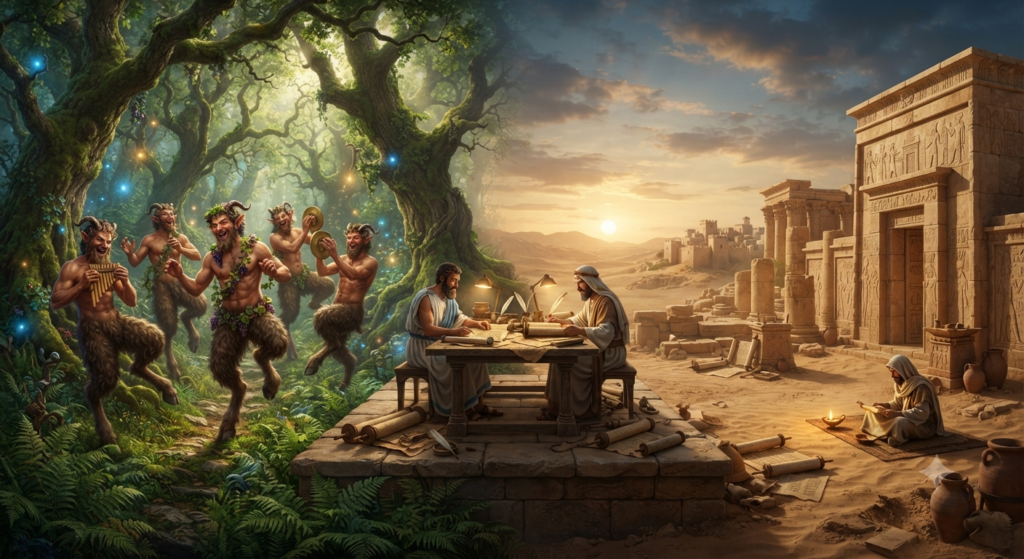
Satyrs belong to the world of Greek myth, with their wild bodies, goat ears, and untamed appetites, but the Bible uses related imagery in a different way. When readers ask whether satyrs are mentioned in the Bible, the answer depends partly on translation. Several passages in the Hebrew scriptures use terms such as se’irim, often rendered as “satyrs,” “goat-demons,” or “wild goats,” and these words open a window onto ancient beliefs about desolate places, wilderness spirits, and the language of fear surrounding ruin.
Biblical satyrs and the meaning of he-goats
In English Bibles, “satyr” can appear as a translation choice rather than a direct borrowing from Greek mythology. The underlying Hebrew word se’ir means “hairy” or “he-goat,” and its plural form se’irim can refer to goat-like beings or, in some contexts, desert spirits. Because of this, older translations sometimes used “satyr,” a term that would have suggested a goat-shaped uncanny being to early readers.
That does not mean the Bible is importing the full Greek satyr tradition of Dionysus, revelry, and woodland masks. The biblical usage is more restrained and more ominous, linked to waste places, idolatry, and the uncanny edge of civilization. The animal and the spirit are closely related in the language, but not identical in cultural meaning.
Where the Old Testament names satyrs
The clearest biblical passages associated with satyrs come from poetic and prophetic texts, especially those describing desolation. English versions have rendered the relevant term in different ways, so one translation may say “satyrs” while another says “goat-demons” or “wild goats.” The variation itself is a sign that the Hebrew is difficult and that no single English word captures it perfectly.
This means that satyrs are not a major biblical category like angels, cherubim, or demons in later Christian tradition. They appear as part of a wider symbolic vocabulary for abandoned places, where human settlement has collapsed and the land is imagined as given over to strange inhabitants. The image is atmospheric, not systematic.
Goat-demons in Hebrew scripture and translation
The phrase “goat-demons” reflects a long-standing scholarly attempt to preserve both the animal and supernatural dimensions of se’irim. Ancient readers often understood wilderness not as empty space but as inhabited by powers beyond ordinary control. A goat-shaped being fit that imaginative landscape well, especially in regions associated with ruins, night, and sacrifice.
Translation history matters here. The Septuagint, the ancient Greek translation of the Hebrew Bible, sometimes rendered these beings in ways that moved away from a literal goat creature and toward broader notions of demonic or monstrous presences. Later English Bibles inherited a range of choices, which is why “satyrs” can sound classical, while the Hebrew background is actually rooted in Semitic religious language.
Isaiah, wilderness spirits, and desolate lands
Isaiah is one of the strongest sources for this imagery, especially in oracle language describing ruined cities and judgment. When a place becomes a wasteland, the text often fills it with creatures associated with the wild. This is not mere decoration; it is a way of saying that order has withdrawn and the world has returned to uncultivated forces.
In that setting, se’irim function as markers of abandonment. The prophet’s language places them among owls, jackals, and other denizens of the night. Such lists create a vivid borderland between the human world and the untamed exterior, where the imagination of ancient Israel gave shape to fear through the language of animals and spirits.
Satyrs in Leviticus, 2 Chronicles, and Isaiah
Leviticus contains a notable reference to goat-like beings in the context of sacrificial prohibition and wilderness cultic practice. The passage warns against offering sacrifices to such entities, linking them with improper worship outside the covenantal order. Here the term is not a decorative monster but a religious marker, tied to forbidden sacrifice.
In 2 Chronicles, the same idea appears in the description of apostasy, where images and cultic objects are associated with idolatrous practice. Isaiah returns to the theme of desolate land, where these beings are imagined as haunting abandoned places. Across these books, the pattern is consistent: the se’irim belong to the margins, the forbidden, and the uninhabited.
The Hebrew term se’irim in ancient context
The Hebrew se’irim is best understood against the wider ancient Near Eastern background, where goats could symbolize fertility, wilderness, vitality, or uncivilized danger. A goat is not merely an animal in these texts; it is a creature that moves between domestication and the wild. That makes it a fitting emblem for liminal spiritual beings.
Scholars generally caution against reading se’irim too simplistically as Greek-style satyrs. The biblical authors were not writing myths of forest companions or comic rustic figures. Their concern was more austere: to describe a world in which stray worship, ruin, and the uncanny converge. The term is therefore culturally local, even when later translators reached for a classical equivalent.
Greek satyrs versus biblical desert beings
Greek satyrs are companions of Dionysus, deeply tied to wine, music, sex, and theatrical exuberance in later Greek art and literature. They are part of a mythic world of fertility and excess, often comic, sometimes threatening, but rarely detached from celebration. Their horns, tails, and goat legs belong to a very different symbolic system.
Biblical desert beings are darker and more restrained. They do not dance in vineyards or follow a god of ecstasy. Instead, they dwell in the ruins, on the edge of the cultivated world, where silence and wilderness dominate. The resemblance lies in their goat-like form, not in their mythic role.
Early Jewish and Christian interpretations of satyrs
Early Jewish interpreters were often aware that the Hebrew terms could suggest something more than ordinary animals, though not always in the same way. Some traditions emphasized demons or dangerous spirits rather than literal goat-men. The Septuagint’s rendering helped shape this reception, since Greek-speaking readers encountered language that could evoke the satyr world even when the Hebrew original was different.
Christian writers, especially in late antiquity, sometimes treated these passages as evidence of demonic beings in pagan lands or as proof that classical monsters and biblical spirits could be read together. Over time, “satyr” in biblical translation became both a literary and theological choice, one that bridged two symbolic universes without fully merging them.
Do the Bible and Greek myth describe the same
The short answer is no, not in a strict sense. The Bible’s goat-like beings and Greek satyrs share visual features, but they arise from different religious imaginations. One belongs to Hebrew scripture and its concern with holiness, idolatry, and the wilderness; the other belongs to Greek myth and its lush, ambivalent celebration of life’s unruly energies.
Still, translation can blur the line. When English Bibles say “satyr,” readers naturally think of Greek half-goats, and that association is not entirely accidental. Ancient translators knew they were choosing a word that would communicate strangeness to their audience, even if it was not a perfect cultural match. The result is a real overlap of language, but not of myth.
Why satyr imagery matters in Scripture reading
Satyr imagery matters because it reveals how scripture uses the landscape itself as a theological symbol. Desolate places are not empty in biblical imagination; they are charged with memory, judgment, and the possibility of restoration. The creatures said to inhabit them help express the loss of human order and the boundary between sacred and profane space.
For modern readers, the question “Are satyrs mentioned in the Bible?” opens a wider lesson about translation and context. The answer is yes, in some English versions and in certain interpretive traditions, but the biblical beings are not Greek satyrs in disguise. They are part of a distinct ancient vocabulary of wilderness and ruin, where the goat becomes a sign of what lies beyond settled life.
The Bible does not present satyrs as the Greeks did, yet it does preserve goat-like figures in passages shaped by wilderness, judgment, and forbidden worship. Depending on translation, those beings may appear as satyrs, goat-demons, or wild goats. The name changes, but the atmosphere remains the same: a stark landscape where ancient writers placed the marks of abandonment and the uncanny edge of the world.

Orin Vale has spent the better part of two decades tracing the threads that connect the world’s oldest stories — from the halls of Asgard to the banks of the Nile, from Olympus to the jungles of the Maya. What began as a childhood fascination with flood myths and trickster gods grew into years of independent study across comparative mythology and ancient religion, always chasing the same question: what did these stories mean to the people who first told them? Orin writes for readers who want more than trivia — the ones looking for the beliefs, fears, and truths that myths were built to carry.