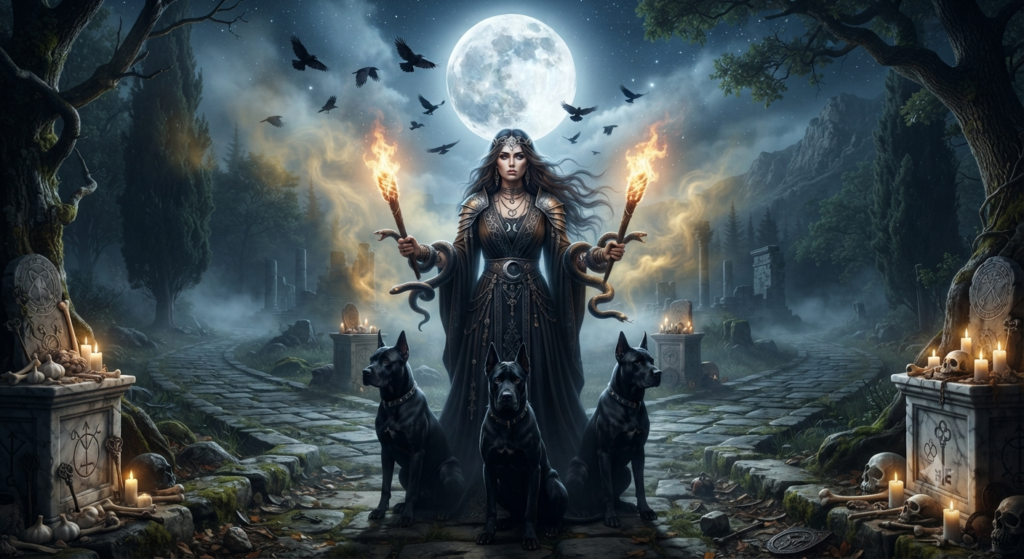
Hecate is the Greek goddess most often shown with torches, and in some traditions with snakes as well. She belongs to the older, darker edge of the Olympian world: a power of crossroads, night roads, thresholds, ghosts, and the hidden forces that move beneath ordinary life. Her emblems are not decorative additions. In Greek myth and ritual, they express what she governs, and they help explain why she remained one of the most visually distinctive deities in the ancient imagination.
Hecate and the Triple-Crossroads Tradition
Hecate’s strongest association is with the crossroads, especially the place where three roads meet. In later Greek tradition, this “triple-crossroads” became one of her most familiar settings, a liminal space where direction is uncertain and the traveler must choose a path. Because crossroads stood between settled places, they were thought to be vulnerable to uncanny forces, and Hecate’s presence there made her a guardian of boundaries as much as a figure of fear. Her emblems suit this role: the torch cuts through confusion, while the serpent suggests hidden, earth-bound power.
Her link to crossroads also helped shape her visual identity. At such places, a goddess had to be recognizable in darkness, in transition, and in uncertainty. Torches made Hecate visible as a guide, while snakes marked her as a being connected to older chthonic powers beneath the surface of the world. Ancient Greek religion often expressed divine functions through objects and animals, and in Hecate’s case both symbols reinforce the same idea: she stands where ordinary order gives way to something older and less easily mastered.
The Torchbearer in Greek Myth and Ritual
Among Hecate’s most enduring attributes, the torch is the clearest. In Greek imagination she is frequently “torch-bearing,” a title that appears in poetic language and fits her nocturnal character. A torch does more than provide light; it marks movement through darkness, reveals hidden things, and allows safe passage where the eye alone cannot guide. For a goddess tied to night travel, rites, and liminal spaces, the torch became a natural emblem.
Ritually, torches also connected Hecate with domestic and public worship. Offerings to her were made at doorways and at crossroads, often at night or at the dark of the moon, when the unseen world seemed nearest. The flame could protect, summon, or purify, depending on the context. In this way the torch is not merely mythic decoration but a symbol rooted in practice: Hecate illuminates what lies between worlds, and her fire announces her presence there.
Night, Paths, and the Guide Through Darkness
Hecate is deeply tied to night, and that association is one reason torches belong to her. In Greek myth, darkness is not simply absence of light; it is a realm of uncertainty, danger, and supernatural activity. The goddess’s torch makes her a guide through these conditions, whether the traveler is moving across a road, through a dream, or through the borderland between life and death. She does not remove darkness, but she makes passage possible within it.
This guiding role appears clearly in later literary and ritual traditions, where Hecate can accompany seekers, answer calls, or stand watch at thresholds. Her torch suggests active guidance rather than passive radiance. It is a deliberate light, one that marks a path where none is obvious. The image fits a deity who belongs to transitions: evening into night, outside into inside, living into dead, known into unknown.
Snakes as Symbols of Chthonic Power
Snakes belong to Hecate’s more ancient and earth-centered symbolism. In Greek religion, serpents are often linked with the underworld, the dead, and the hidden life of the soil. They move close to the ground, emerge from crevices, and disappear again without warning, which made them powerful signs of chthonic force. When Hecate is shown with snakes, the image points to her connection with subterranean power and with the dark vitality of the earth.
The serpent also carries a dual meaning. It can be feared as a creature of danger and mystery, but it can also represent potency, protection, and continuity with the old powers beneath human settlements. In Hecate’s case, the snake reinforces her status as a goddess who is not confined to bright Olympian order. She belongs to what lies below and beside it, where life, death, and renewal remain intertwined.
Hecate’s Links to Ghosts and the Underworld
Hecate’s association with ghosts and the underworld is one of the main reasons her imagery becomes so striking. Later Greek sources often place her among the dead, or at least at their edges, where restless spirits and infernal forces are encountered. She is not usually the sovereign of the underworld in the way Hades is, but she serves as a mediator between the human world and realms beneath it. Torches help her move through these regions; serpents signify their earth-bound, subterranean nature.
This connection also explains why Hecate appears in spells, protective rites, and magical invocations in later antiquity. A goddess who can stand near the dead, or at least command the boundaries where the dead are approached, becomes especially important in practices concerned with cleansing, warding, and transition. Her symbols belong to that function. The torch reveals, and the snake embodies the hidden presence that her power can confront or command.
The Goddess of Thresholds and House Doors
Hecate was not limited to remote or mythic spaces. She also belonged to the household threshold, where doors, entrances, and boundary stones marked the divide between private safety and the outside world. Greeks sometimes set aside offerings for her at the door, especially at crossroads or during new moon observances. This domestic role made her one of the most practical gods in Greek religion, and it clarifies why she appears with objects that signal guarding and vigilance.
Torches fit the doorway perfectly. They light the passage between inside and outside, showing both who enters and what approaches in darkness. Snakes, by contrast, can symbolize the protective force of the threshold itself, a living reminder that borders are not empty but occupied by powers that watch and defend. Hecate’s presence at the door is therefore not only ominous; it is protective, preserving the fragile line between the household and the unknown.
Torches in the Myth of Persephone’s Search
One of the best-known reasons Hecate carries torches is her role in the myth of Persephone. In the Homeric Hymn to Demeter, when Persephone disappears, Hecate hears her cry and later joins Demeter with her torches as the search continues. She does not prevent the abduction in that version of the story, but she becomes an illuminating witness and helper in the search for the missing girl. The torches naturally suit this narrative of searching, grief, and revelation.
Different later traditions develop Hecate’s role in varying ways, but the torch remains central because it belongs to the act of seeking in darkness. Persephone’s descent also deepens Hecate’s underworld associations, since the goddess moves between surface and below while Demeter searches. The torch becomes more than an implement of light; it becomes an emblem of sympathy, passage, and the difficult knowledge that follows loss.
Serpents, Renewal, and Protective Magic
The serpent attached to Hecate can be read not only as a sign of the underworld but also of renewal. Snakes shed their skins, and in the ancient world this visible transformation made them potent symbols of rebirth, renewal, and cyclical power. While Hecate is often feared for her associations with night and spirits, this more regenerative aspect belongs to her as well. She is a deity of transitions, and the snake expresses change as much as menace.
Snakes also appear in many protective and magical contexts in the Greek and later Greco-Roman worlds. Because Hecate was invoked in rites of warding, purification, and secret knowledge, the serpent became a fitting companion. It could guard, warn, or embody the force being directed in a ritual. In her imagery, then, the snake is not simply a sign of darkness. It is a sign that darkness itself contains power, discipline, and the possibility of transformation.
Ancient Cult Images of Hecate in Greece
Ancient cult images help explain why Hecate is so often shown with these attributes. In the Greek world she was represented in several forms, including the famous three-bodied or triple-formed Hecate in later art and cult statuary. Such images reflect her role at crossroads and her capacity to look in multiple directions at once. Torches often accompany these figures because the goddess oversees movement across borders where visibility matters.
Serpents appear less universally than torches, but they belong to the wider iconographic language of chthonic divinities. In sanctuary contexts, Hecate’s statues and votive images could combine markers of protection, mystery, and liminality. The persistence of these features shows that artists and worshippers were not inventing random symbols; they were translating religious function into visible form. Hecate’s torches and snakes together tell viewers that she belongs where light meets darkness and where the earth keeps its oldest powers.
Why Hecate’s Emblems Endured in Later Art
Hecate’s torches and snakes endured because they are simple, memorable signs of a complex goddess. Later Greek, Roman, and post-classical art continued to preserve her as a figure of night, magic, and thresholds, and these emblems made her instantly recognizable. The torch preserved her role as guide and revealer, while the snake preserved her connection to the earth, the dead, and hidden transformation. Together they create a visual language that remained powerful long after specific local cults faded.
Her imagery also survived because it answers a lasting human need. Crossroads, doors, darkness, grief, and the search for protection are not uniquely ancient concerns. Hecate’s symbols speak to those moments when certainty breaks down and something must be faced without full knowledge. That is why the goddess of the threshold continues to be shown with fire and serpent: she stands in the place where the visible and invisible touch.
Hecate’s torches and snakes are not arbitrary attributes but concentrated symbols of her divine office. The torch marks her as a guide through night, search, and transition; the serpent marks her link to chthonic power, renewal, and the hidden life beneath the world. In Greek myth and ritual, she is the goddess who stands at crossings, doors, and dark edges, making her one of antiquity’s most enduring figures of liminality and sacred power.

Orin Vale has spent the better part of two decades tracing the threads that connect the world’s oldest stories — from the halls of Asgard to the banks of the Nile, from Olympus to the jungles of the Maya. What began as a childhood fascination with flood myths and trickster gods grew into years of independent study across comparative mythology and ancient religion, always chasing the same question: what did these stories mean to the people who first told them? Orin writes for readers who want more than trivia — the ones looking for the beliefs, fears, and truths that myths were built to carry.