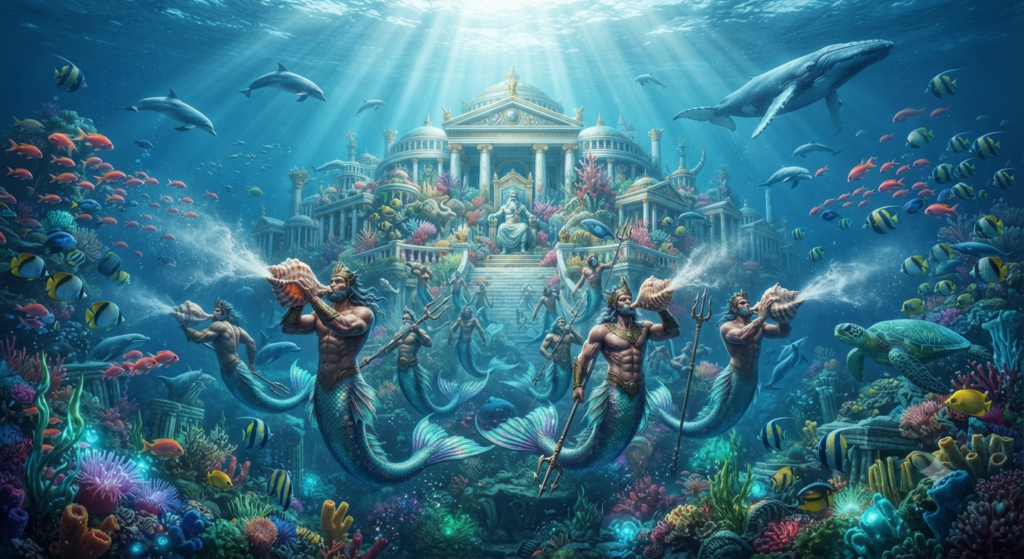
In Greek mythology, “triton” can mean more than one thing. Most often it refers to a sea deity with the body of a man and the tail of a fish, but ancient authors also use the plural Tritones for a broader class of marine attendants and monsters in the retinues of gods such as Poseidon and, in Roman literature, Neptune. The names of these figures are not always fixed, and the surviving sources preserve only a small number with certainty.
Tritons in Greek Myth: Names and Lineages
The best-known Triton is simply Triton, a divine sea being whose name is also used as the common title for his kind. In Homer and later mythographic tradition, he is associated with the depths of the sea, a heraldic role, and the sound of the conch shell. His name is not only personal but representative: when Greek and Roman writers speak of “tritons,” they often mean an entire category of sea beings rather than a long list of individually named persons.
Genealogies are uneven in the sources. The most authoritative tradition makes Triton the son of Poseidon and Amphitrite, and many later writers treat him as the paradigmatic Triton. Beyond him, named Tritons become rare in surviving literature, and the mythological record is often descriptive rather than genealogical. Where names do appear, they are usually attached to local cult, artistic labels, or late mythographic compilations rather than to a stable pan-Hellenic family tree.
Triton, Son of Poseidon and Amphitrite
The central Triton of Greek myth is the son of Poseidon and Amphitrite, the sea-god and sea-goddess who rule the waters together. In this lineage, Triton is not an ordinary monster but a divine intermediary, inhabiting the watery realm between the Olympian gods and the maritime world. He is commonly described with a human upper body and a fish tail, a form that became canonical in later art.
Ancient sources do not give him a large narrative cycle, but they do assign him an important symbolic place. Triton is the voice of the sea, a being who can calm or stir the waves and who stands close to his father’s authority. In some traditions, he is effectively the first and greatest of the Tritons, the figure from whom the category derives its name.
The Sea-God’s Herald in Homeric Tradition
In Homeric and early epic atmosphere, Triton is less a character with dialogue than a majestic presence linked to the sea’s power. Later authors build on that epic aura and make him a herald-like figure, carrying the conch shell that can summon or terrify. This image helps explain why “triton” became a broader term: the sound-bearing sea attendant became a symbol of the ocean’s command.
Homer himself does not offer a full roster of Triton names, and that silence matters. The early tradition emphasizes function and divine status over catalogues of individuals. When later mythographers speak of Tritons in the plural, they are extending the Homeric and post-Homeric image of a marine retinue, not reproducing a long list preserved in epic poetry.
Other Tritons in Greek Mythological Genealogy
Outside the principal Triton, Greek mythology preserves very few securely named Tritons. Some late sources and scholarly reconstructions suggest that the plural Tritones was used for a race or class of sea beings rather than a single family with many named children. Because of that, attempts to build a genealogy of multiple Tritons usually outrun the evidence.
Where named sea beings do appear in related contexts, they are often not Tritons in the strict sense. Greek myth includes many marine figures—Nereids, Old Man of the Sea figures such as Proteus and Nereus, and various sea daimones—but these belong to separate traditions. The rarity of attested Triton names reflects how fluid marine mythology was: the sea was populated richly in art and imagination, but not always with fixed personal names in the surviving texts.
Palaemon and the Marine Retinue of Tritons
Palaemon is not a Triton, yet he often appears in the same maritime imaginative world. Once the mortal Melicertes, he becomes a sea divinity associated with safe passage and rescue, especially in later Greek and Roman traditions. In art, Palaemon may be shown alongside Tritons, Nereids, and marine creatures as part of a festive or sacred sea procession.
This proximity can cause confusion, but the distinction is important. Tritons belong to the category of half-human, fish-tailed sea beings, while Palaemon is a transformed divine child of the sea. Their companionship in vase painting and relief reflects the broader marine court of Poseidon rather than any claim that Palaemon is himself one of the Tritons.
Names of Tritons in Vase Painting and Reliefs
Greek vase painting and relief sculpture often show Tritons without naming them. Artists relied on the visual type: a human torso, fish tail, sometimes a beard, sometimes a shell or other sea attributes. In such works, the figure is “a Triton” in the generic sense, not necessarily Triton the specific god. This makes the iconographic record rich but onomastically sparse.
Occasionally, later inscriptions or explanatory labels identify sea beings, but truly secure individual Triton names remain limited. The art history of Tritons is therefore broader than the literary one: many unnamed Tritons populate Dionysiac or marine scenes, yet the surviving labels do not yield a large list of personal names. What art gives abundantly is form; what it rarely gives is a proper name.
Classical Sources on Triton and Sea Deities
The most important literary anchor is the tradition around Triton in Hesiodic and later mythographic material, where he belongs to the divine sea family of Poseidon and Amphitrite. Apollodorus and other compilers help preserve his identity as the central Triton, even when they do not elaborate many separate Triton characters. Roman poets, especially Ovid and Virgil, expand the visual and ceremonial image of Tritons in their seascapes.
Classical sources are also careful in ways modern readers sometimes overlook. They may use “Triton” as a singular proper name, as a generic species term, or as a poetic image. Because of this flexibility, the safest reading is source-by-source. Some passages describe one named deity; others describe a whole company of sea spirits. The name itself moves between person and category.
Triton Nereids, Sea Monsters, and Companions
Tritons are often grouped with Nereids, but they are not Nereids. The Nereids are daughters of Nereus and Doris, a distinctly different divine lineage. In art and poetry, however, both groups belong to the same shimmering seascape, where Poseidon’s world is crowded with attendants, sea horses, dolphins, monsters, and wind-borne creatures.
This broader marine company explains why named Tritons are so hard to isolate. Greek myth tends to name the great gods and major local figures, while the lesser attendants remain collective. Even when a Triton appears beside Nereids or sea monsters, the source may care more about the symbolic choreography of the sea than about his personal identity. The mythic ocean is full, but its residents are not always individually catalogued.
Regional Variants in Greek and Roman Accounts
Regional tradition sometimes shapes sea beings more than genealogy does. In one city or shrine, a Triton may be a local divine helper; in another, he may simply be part of Poseidon’s entourage. Roman authors further broaden the usage, sometimes making Tritons appear as standard decorative beings in triumphal or marine scenes, regardless of strict Greek precedent.
This regional flexibility is one reason the question “What are the names of the Tritons?” has a restrained answer. The ancient Mediterranean did not preserve a universally agreed list. Instead, the image of the Triton traveled widely, while personal names remained few, local, or lost. The best-attested name is still the foundational one: Triton.
Which Triton Names Are Actually Attested?
The securely attested name in the classical tradition is Triton, the son of Poseidon and Amphitrite and the great marine herald associated with the conch. Beyond him, named Tritons are rare and not consistently preserved across the major literary sources. Many references to “Tritons” are plural and generic, describing a class of sea beings rather than several named individuals.
So the most accurate answer is simple: in Greek mythology, the Triton names that are clearly attested are limited, and the central one is Triton himself. Other sea figures may resemble Tritons in art or function, but they are usually not named as Tritons in the classical record. The mythic sea is crowded; the named Tritons are not.
The ancient sources do not support a long, secure list of Triton names. Greek mythology gives us one powerful and enduring figure, Triton, and then a wider, more fluid population of sea beings that are often called Tritons collectively rather than individually. That scarcity is itself revealing: the Greeks and Romans imagined the sea as a living court, but they did not always fix every attendant with a separate biography.

Orin Vale has spent the better part of two decades tracing the threads that connect the world’s oldest stories — from the halls of Asgard to the banks of the Nile, from Olympus to the jungles of the Maya. What began as a childhood fascination with flood myths and trickster gods grew into years of independent study across comparative mythology and ancient religion, always chasing the same question: what did these stories mean to the people who first told them? Orin writes for readers who want more than trivia — the ones looking for the beliefs, fears, and truths that myths were built to carry.