When people ask what the temple of Hermes was like in ancient Greece, the answer is both simpler and more elusive than they may expect. Hermes was not always served by a grand marble temple in the way that Zeus, Athena, or Apollo were at major pan-Hellenic centers. His worship was often woven into roads, markets, gymnasia, borders, and household or civic spaces, where altars, statues, and small sanctuaries could matter more than monumental architecture. Yet Hermes was widely honored across the Greek world, and the places dedicated to him reveal much about how the Greeks understood movement, exchange, passage, and protection.
Hermes temples in ancient Greece and their setting
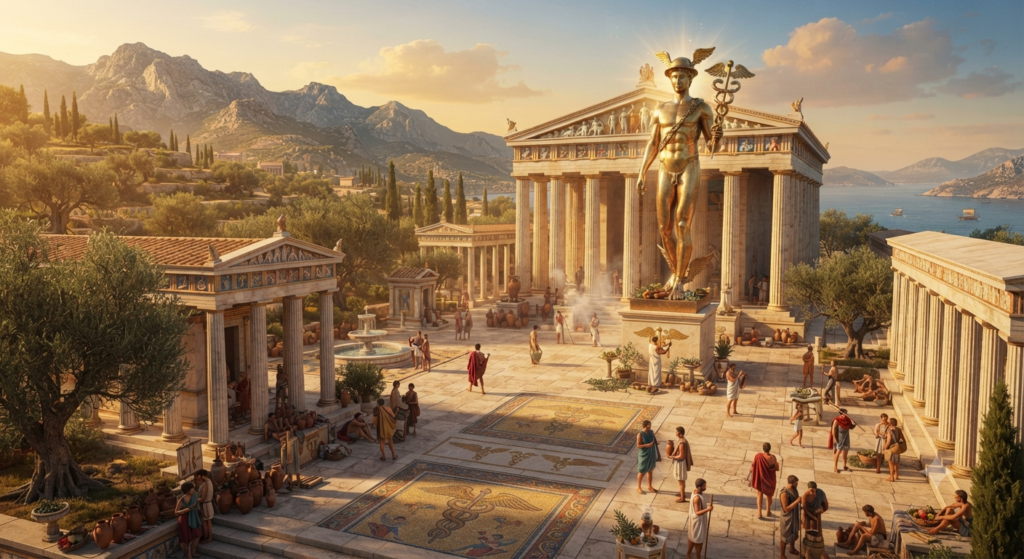
Hermes, the Olympian messenger and guide of travelers, was worshiped throughout ancient Greece, but his sanctuaries were usually tied to places of transit rather than to isolated mountain shrines or vast temple complexes. He was especially present at gates, crossroads, market areas, and city boundaries, where people were constantly moving between inside and outside, known and unknown. In this sense, a “temple of Hermes” might be a formal temple in some cities, but more often it was a carefully marked sacred place that fit the god’s role as a mediator between worlds.
The setting mattered as much as the building itself. Hermes belonged to thresholds: the edge of the road, the entrance to the agora, the boundary stone, the path into a sanctuary, or the entrance to a gymnasium. Pausanias, who recorded many Greek sanctuaries, shows that Hermes worship could appear in modest local forms as well as in more elaborate cult sites. The god’s sacred presence was therefore less about overwhelming scale and more about location, movement, and social usefulness.
The god Hermes and his cult in local worship
Hermes was not only the fleet-footed messenger of the gods. In Greek religion he also oversaw herds, trade, eloquence, athletic skill, sleep, dreams, and the safe passage of souls to the underworld. Different cities emphasized different aspects of his character, which helped shape local cult practice. A shepherd community might honor him as a guardian of flocks, while a trading center might stress his role as protector of commerce and exchange.
This flexibility made Hermes especially adaptable to local worship. Unlike a deity whose cult demanded one fixed sacred model, Hermes could be venerated in many settings without losing his identity. Greeks placed herms—stone boundary markers often bearing his head and phallus—at roads and property lines, and these were not decorative in a modern sense but deeply religious. They signaled a divine presence that guarded passage and order, reflecting a cult rooted in practical life as much as myth.
Sacred precincts, altars, and roadside shrines
A sacred precinct for Hermes could be very small, even open-air, with an altar, a statue, and perhaps a few boundary markers. The Greeks did not always separate “temple” from “sanctuary” as sharply as modern readers might imagine. Many divine spaces were defined by enclosure and ritual use rather than by a large roofed cella. For Hermes, whose power was linked to roads and thresholds, roadside shrines were especially fitting, since travelers could offer a quick prayer before continuing their journey.
Altars were central in these spaces. Offerings of incense, cakes, wine, or first fruits could be made without a large temple building at all. In some places the cult was associated with a heroon, a shrine for a hero or semi-divine figure, especially where local tradition linked Hermes to a founder, ancestor, or protective spirit. Such precincts would have felt intimate rather than imposing, a reminder that divine aid was sought in ordinary movement and daily uncertainty.
Architecture of a Hermes temple or heroon
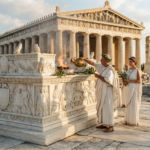
When Hermes did have a dedicated temple, it usually followed the broad patterns of Greek sacred architecture rather than a unique “Hermes style.” A small Doric temple, a treasury-like shrine, or a simple sanctuary building could house his cult image. The plan often centered on a pronaos and cella, with a cult statue inside, though many Hermes sanctuaries were too modest to require a full monumental temple. The architecture was practical, elegant, and proportioned to the local importance of the cult.
A heroon associated with Hermes could look different depending on regional custom. Some such shrines were commemorative and chthonic in character, linking Hermes to boundary-crossing and the dead; others served civic or athletic purposes and were closer to a small temple or chapel. The essential feature was not grandeur but sacred function. Greek architecture for Hermes reflected his own nature: mobile, intermediate, and suited to the spaces between fixed places.
Materials used in sanctuaries for the messenger god
The materials used in Hermes sanctuaries varied according to wealth, locality, and date. In the Archaic and Classical periods, many shrines were built from local stone, limestone, or marble where available, with wooden elements in roofs and interior fittings. Earlier structures may have used mudbrick and timber, while later reconstructions often replaced them with more durable masonry. Even a small sanctuary could be carefully finished if a city wished to honor Hermes prominently.
Inside and around the shrine, materials were chosen for visibility and ritual function. Painted plaster, bronze fittings, terracotta roof tiles, and stone bases for statues or herms could all be part of the setting. Because Hermes was tied to movement and public spaces, his sanctuaries were not always secluded and sacralized by luxury; often they were meant to be seen by passersby. The materials therefore served both endurance and recognition, giving the god a stable place in a world of motion.
Statues, reliefs, and votive offerings to Hermes
The most recognizable image of Hermes in ancient Greece was the herm, a square pillar topped by his head and often marked by an erect phallus. These statues stood at boundaries, crossings, and entrances, and they were themselves objects of devotion. In more formal sanctuaries, Hermes could also appear as a youthful bearded or beardless god, sometimes carrying the caduceus, wearing a petasos hat, or standing in a relaxed but alert pose. Greek art captured him as both divine and approachable, agile and composed.
Votive offerings to Hermes were often practical in nature, which suits a god of useful passage and exchange. Travelers, merchants, athletes, and perhaps shepherds might dedicate small figurines, inscriptions, coins, or personal objects after receiving help or success. Reliefs and painted vessels also show Hermes in mythic scenes, escorting souls, helping heroes, or standing beside other gods. These offerings formed a visual record of his cult: less about awe alone than about gratitude, success, and the hope of continued favor.
Rituals, libations, and prayers at the sanctuary
Ritual at a Hermes sanctuary was usually straightforward, though no less sacred for its simplicity. Worshipers might pour libations of wine, oil, milk, or honey before a herm or altar, while reciting prayers for safe travel, success in business, or protection at a border or crossing. Incense and small cakes are also attested broadly in Greek cult practice and would have suited Hermes well. The god’s accessibility made his rites feel immediate, directed toward the practical needs of the present moment.
Hermes was also connected with purification, transitions, and the movement between states. Prayers to him could ask for a safe departure, a favorable return, or help in communication and negotiation. In some contexts he may have been honored with sacrifices appropriate to local custom and festival calendar, though evidence varies from city to city. The essential pattern is clear: worshipers approached Hermes as a god who could carry messages, smooth passage, and stand watch at life’s thresholds.
Hermes as protector of travelers and merchants
No aspect of Hermes was more widely recognized than his role as protector of travelers. Roads in the ancient world were uncertain, and journeys could involve bad weather, theft, wrong turns, or political danger. Hermes, “Guide” and “Wayfarer” in spirit if not always in title, was asked to keep movement safe and directed. His herms stood as silent guarantees that the road belonged to divine oversight as much as human use.
Merchants also depended on Hermes, and this sharpened his link to exchange, bargaining, and profitable movement. In busy cities, a sanctuary to Hermes could be especially important near the agora or along trade routes. His worship suited a world where goods, news, and people constantly crossed regional lines. The god’s temple or shrine was therefore not merely a religious structure but a social one, marking the point where trust, passage, and profit met.
The temple’s role in athletic and civic life
Hermes had a strong place in athletic culture, since Greek athletes valued speed, coordination, and competitive intelligence. He was honored in gymnasia and among young men in training, and his images often stood where physical discipline met civic education. A Hermes sanctuary near a gymnasium would remind athletes that skill and grace were divine gifts as well as human achievements. In this setting, the god could appear as patron of the body in motion, not only the tongue and the road.
His civic role was equally important. Hermes helped define public space through boundary markers, and this made him useful to city life in a literal and symbolic sense. He stood at the edge of domestic, commercial, and political worlds, linking them without erasing their differences. A temple or shrine to Hermes could thus serve as a point of civic identity, especially in places where trade, athletics, and public movement were central to urban life.
Archaeological traces of Hermes worship today
Archaeology has revealed Hermes worship mostly through herms, inscriptions, statue bases, altars, and sanctuary remains rather than through large surviving temples alone. In some places scholars have identified temple foundations or precinct walls associated with Hermes, while in others the evidence is indirect but persuasive. Because his cult often occupied public and liminal spaces, many traces are fragmentary, damaged, or reused in later construction. Even so, the material record confirms how widespread and practical his worship was.
The remains also show why Hermes is such a revealing figure in Greek religion. His sanctuaries do not always dominate the landscape, yet they are everywhere once one learns where to look: at crossings, in gymnasia, near markets, beside roads, and at the thresholds of cities. What survives is often small, but it speaks clearly. Hermes was honored in places where movement mattered, and his temple, when it existed, embodied that same living threshold between one world and the next.
A temple of Hermes in ancient Greece was seldom a single monumental type. More often it was a sanctuary shaped by the god’s own character: modest, local, practical, and placed where people were most in need of guidance. Whether marked by a herm, an altar, a small shrine, or a formal temple building, it belonged to the roads, the market, the gymnasium, and the boundary line.
To ask what it was like is to see how the Greeks imagined sacred space itself. For Hermes, holiness did not always rise in size; sometimes it stood quietly at the edge of a path, ready to guide, protect, and connect.

Orin Vale has spent the better part of two decades tracing the threads that connect the world’s oldest stories — from the halls of Asgard to the banks of the Nile, from Olympus to the jungles of the Maya. What began as a childhood fascination with flood myths and trickster gods grew into years of independent study across comparative mythology and ancient religion, always chasing the same question: what did these stories mean to the people who first told them? Orin writes for readers who want more than trivia — the ones looking for the beliefs, fears, and truths that myths were built to carry.